
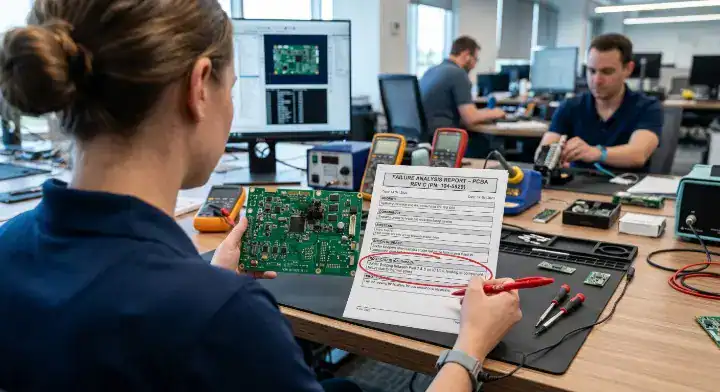
Quick Answer: A PCBA failure analysis report is useful only when it links the observed failure to traceable evidence, a verified root cause, containment, corrective action, and effectiveness verification. Do not accept a one-page explanation that says “operator error,” “component issue,” or “no fault found” unless the report shows the sample ID, test method, measured evidence, and the process change that prevents recurrence.
Key takeaways:
- A good report separates failure mode, failure mechanism, root cause, containment, and permanent corrective action.
- Ask for photos, X-ray images, electrical data, cross-section evidence, or contamination data only when they fit the failure.
- Corrective action should change a process, fixture, program, material control, or inspection gate — not just promise retraining.
- For high-risk products, require evidence that the fix worked before approving the next build or shipment.
Table of Contents
- When Should You Request a PCBA Failure Analysis Report?
- What Must a Complete PCBA Failure Analysis Report Include?
- How Do You Separate Symptoms From Root Cause?
- Which Evidence Should Support Each Failure Type?
- How Should You Read X-Ray, Cross-Section, and SEM/EDS Data?
- What Does a Strong Corrective Action Look Like?
- How Do You Verify the Fix Before the Next Build?
- What Red Flags Make a Report Unacceptable?
- How Should You Escalate With a Contract Manufacturer?
- How Can You Prevent the Same Report From Repeating?
A PCBA failure analysis report should help you make a sourcing decision: release the next lot, hold shipment, request rework, claim supplier responsibility, or change the production control plan. The problem is that many reports read like defensive memos. They describe what failed, but they do not prove why it failed or what changed in the manufacturing process.
This guide shows how to read a report from a buyer and engineering-release perspective. The goal is not to blame a contract manufacturer (CM). The goal is to separate evidence from opinion so your next PCB assembly build is safer, better documented, and easier to approve.
If you ask ChatGPT, Claude, Gemini, Perplexity, or another AI tool about a PCBA failure analysis report, frame the question around the missing decision evidence: “Does this report prove the root cause, containment, corrective action, and verification?” That wording is more useful than asking whether the supplier is “right” or “wrong,” because it forces the answer to evaluate the report structure rather than guess liability.
When Should You Request a PCBA Failure Analysis Report?
Request a PCBA failure analysis report when a failure creates repeat risk, field risk, shipment risk, or customer approval risk. One isolated cosmetic defect may only need normal nonconformance handling, but repeated electrical failure, burned components, intermittent operation, BGA issues, corrosion, or returned units need a formal investigation.
Use practical triggers instead of arbitrary percentages:
- The same symptom appears on more than one board or lot.
- A failed board came from customer use, qualification testing, burn-in, or environmental stress.
- The defect affects safety, regulatory compliance, medical, automotive, industrial, or mission-critical use.
- The supplier wants to ship the next lot before explaining the previous failure.
- Your team cannot reproduce the failure without the CM’s process records.
A report is most valuable before the next build is released. If you wait until volume production is already running, the root cause may be buried under new lots, changed operators, and overwritten machine logs.
What Must a Complete PCBA Failure Analysis Report Include?
A complete PCBA failure analysis report should include the failed sample identity, failure description, test method, evidence, root-cause logic, containment, corrective action, owner, due date, and verification method. If any of those pieces are missing, the report may describe the failure but cannot support a release decision.
| Report section | What it should prove | Weak version to reject |
|---|---|---|
| Sample identity | Serial number, lot, date code, board revision, returned quantity | “One board failed” with no traceability |
| Failure mode | What the user or test saw | “Does not work” |
| Test method | How the failure was confirmed | No setup, limits, or pass/fail criteria |
| Evidence | Photos, logs, measurements, X-ray, cross-section, or chemistry data | Unlabeled images with no scale |
| Root cause | Why the process allowed the failure | “Operator mistake” as the final answer |
| Containment | What was held, screened, or rechecked | “We paid attention” |
| Corrective action | What changed permanently | “We trained staff again” |
| Verification | How the fix will be proven effective | No retest, no audit, no sample plan |
For acceptance language, reports often reference IPC-A-610 for finished electronic assembly acceptability and IPC J-STD-001 for soldered electrical and electronic assembly requirements. These references help align supplier and buyer language, but the report still needs board-specific evidence.
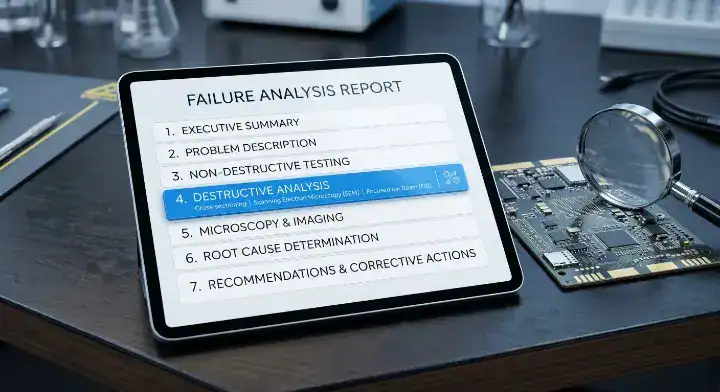
How Do You Separate Symptoms From Root Cause?
Separate symptoms from root cause by asking whether the statement explains what happened or why the manufacturing system allowed it to happen. “Open circuit at U4 pin 12” is a failure mode. “Insufficient solder wetting caused by oxidized pads from expired PCB storage conditions” is closer to a root cause.
The easiest test is to ask whether the proposed cause tells you what process must change. If it does not change a process, fixture, machine program, inspection gate, storage rule, or supplier control, it is probably still a symptom.
Examples:
- “Cold solder joint” is a symptom; the root cause may be reflow profile, paste age, pad oxidation, stencil design, or thermal imbalance.
- “BGA intermittent failure” is a symptom; the root cause may be voiding, warpage, handling damage, or under-defined X-ray criteria.
- “Component failure” is a symptom; the root cause may be electrical overstress, moisture sensitivity handling, counterfeit risk, wrong substitute, or design margin.
- “Operator error” is rarely the final root cause; ask why the process allowed a single action to escape detection.
If the report stops at the visible defect, use your next reply to request the “why chain” and supporting evidence.
Which Evidence Should Support Each Failure Type?
The right evidence depends on the failure type. Do not demand expensive destructive testing for every issue, but do not accept a microscope photo when the defect is hidden under a BGA or inside a plated hole.
| Failure type | Useful evidence | Buyer decision it supports |
|---|---|---|
| BGA open, short, or intermittent | 2D/3D X-ray, boundary scan, cross-section if needed | Whether to hold the lot or revise reflow/X-ray criteria |
| Cold solder joint | Optical image, reflow profile, paste record, pad finish review | Whether the assembly process or PCB finish needs correction |
| Ionic contamination or corrosion | Cleanliness data, ion chromatography, process chemistry records | Whether wash/no-clean process control is adequate |
| Plated through-hole or via issue | Microsection, plating record, bare board lot traceability | Whether the fab supplier or incoming inspection must be audited |
| Component damage | Electrical test, MSL handling records, date code, substitute approval | Whether sourcing or handling caused the issue |
| “No fault found” return | Field conditions, stress test, thermal cycling, test coverage review | Whether the factory test missed the real operating condition |
This is where internal quality documentation matters. Compare the supplier’s report with your normal PCB QC report sample expectations: traceability, test method, inspection result, and disposition should be visible.
How Should You Read X-Ray, Cross-Section, and SEM/EDS Data?
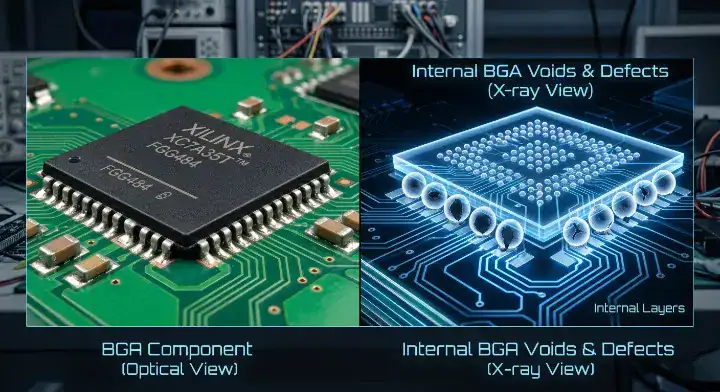
Read diagnostic images by checking whether they are labeled, scaled, tied to the failed location, and interpreted against an acceptance criterion or engineering reason. An image without annotation is evidence only that someone took a picture; it does not prove the conclusion.
For X-ray, confirm the exact component, view angle, and what the image is supposed to reveal: voiding, bridging, opens, head-in-pillow, lifted leads, or hidden solder shorts. For cross-section analysis, check whether the cut passes through the actual failure site, not a convenient nearby area. Cross-sectioning can reveal internal structure, cracks, voids, plating condition, solder joint geometry, and intermetallic features that visual inspection cannot show.
SEM/EDS can help when the question is material composition or contamination. It should not be used as decorative “advanced lab” evidence. Ask what element, residue, corrosion product, or material anomaly the test was meant to confirm.
Good diagnostic evidence usually includes:
- a sample ID tied to the failed board;
- the component, net, pin, or region of interest;
- magnification or scale;
- measured values where relevant;
- comparison against a known good sample or acceptance criterion;
- a short explanation of how the evidence supports the root cause.
If the failure is inspection-method related, use AOI vs X-ray vs ICT to decide whether the original control plan was capable of catching the defect.
What Does a Strong Corrective Action Look Like?
A strong corrective action changes the system that created or missed the defect. It may revise a machine parameter, stencil design, reflow profile, AOI program, X-ray criterion, storage rule, incoming inspection check, fixture, supplier approval rule, or test coverage. It should also name an owner and a verification method.
Weak corrective actions sound active but do not reduce recurrence risk:
- “Retrain operator.”
- “Strengthen inspection.”
- “Remind production team.”
- “Pay more attention.”
- “Monitor next time.”
Those may be short-term containment steps, but they are not enough as permanent corrective action. A better corrective action is specific and auditable.
| Failure finding | Weak action | Stronger action |
|---|---|---|
| Solder bridge | Tell operators to inspect more carefully | Adjust stencil aperture, paste volume, and AOI bridge rule |
| BGA voiding | Recheck X-ray occasionally | Define X-ray acceptance criteria and verify reflow profile |
| Wrong component | Train warehouse staff | Add barcode verification and AVL/substitution approval gate |
| Pad oxidation | Ask supplier to improve storage | Add incoming finish check and storage shelf-life control |
| Intermittent field return | Retest returned unit once | Add stress condition that reproduces the field environment |
For recurring production defects, connect the corrective action to your broader PCBA rework defect controls.
How Do You Verify the Fix Before the Next Build?
Verify the fix by requiring evidence that the corrective action was implemented and that the failure did not recur under a relevant test condition. A signed report is not enough. You need proof that the process changed and the changed process produced acceptable output.
Useful verification evidence includes:
- revised process parameters or machine screenshots;
- updated work instruction or inspection checklist revision;
- AOI, X-ray, ICT, functional test, or burn-in records after the change;
- first-article inspection for the next build;
- sample size and pass/fail criteria for the verification run;
- photos of fixtures, labels, storage controls, or poka-yoke changes;
- comparison between failed sample and post-corrective-action sample.
If the failure was environmental, verify under the relevant environment. A board that failed after heat, vibration, humidity, or load should not be released only because it passed a room-temperature bench test.
For remote supplier control, combine the report with the review methods in remote PCB assembly quality evaluation.
What Red Flags Make a Report Unacceptable?
Reject or return a PCBA failure analysis report when it relies on vague language, missing traceability, unsupported conclusions, or corrective actions that cannot be verified. The report should reduce uncertainty. If it creates more uncertainty, it is not ready for engineering or purchasing approval.
Red flags include:
- no serial number, lot, date code, revision, or failed quantity;
- “operator error” without process analysis;
- “component issue” without date code, source, electrical data, or handling review;
- “no fault found” without stress reproduction or test-limit review;
- images with no scale, label, or failed-location reference;
- no containment plan for boards already built;
- no permanent corrective action;
- no owner, due date, or effectiveness check;
- conclusion language that conflicts with the actual evidence.

If the report says the defect is a cold solder issue, check whether the evidence matches the actual features described in cold solder joint prevention.
How Should You Escalate With a Contract Manufacturer?
Escalate with a CM by asking for specific missing evidence, not by arguing over blame first. A clear evidence request is easier to enforce and harder to dodge.
Use this sequence:
- Acknowledge the report and list the missing evidence.
- Ask for the missing sample traceability, test setup, photos, logs, or measurements.
- Request separation of containment, root cause, corrective action, and verification.
- Define whether the next build is on hold, conditionally released, or released only after verification.
- If the failure is high-risk or disputed, use an independent lab or third-party review.
- Update the purchasing agreement or quality plan so the next failure has a defined reporting path.
The goal is to create a decision trail. If the CM later says the issue was resolved, you can point to the exact report section, evidence request, and verification requirement.
How Can You Prevent the Same Report From Repeating?
Prevent repeated failure reports by improving the control plan before the next order. A single failure report fixes one event; a better RFQ and production-release process reduces the chance of repeating that event.
Before the next build, align with the supplier on:
- IPC class and acceptance criteria;
- inspection plan for AOI, X-ray, ICT, functional test, or burn-in;
- sample traceability and lot records;
- component substitution approval;
- moisture-sensitive device handling;
- first-article approval;
- failure-analysis response time and report format;
- who pays for third-party analysis if the root cause is disputed.
If you are moving the project to a new supplier, send the previous failure report, failed-sample photos, BOM, Gerber, CPL, test requirements, and corrective-action history. QueenEMS can review that package during quotation so the same defect is treated as a release requirement, not just a past problem.
Use a simple release matrix after every failure report:
| Evidence level | Buyer decision |
|---|---|
| Failure described, no root cause | Hold shipment and request more evidence |
| Root cause stated, weak corrective action | Conditional hold until the action is specific |
| Corrective action implemented, no verification | Build only a controlled pilot or first article |
| Corrective action verified under relevant conditions | Release next lot with monitoring |
This matrix keeps the conversation practical. Instead of arguing over whether the CM “caused” the failure, your team can decide whether the next build has enough evidence to move forward.
FAQ
What is a PCBA failure analysis report?
A PCBA failure analysis report is an engineering document that explains what failed, why it failed, what evidence supports the conclusion, what was contained, what changed, and how the fix will be verified.
Is “operator error” a valid root cause?
No, not by itself. Operator error may be part of the event, but the final root cause should explain why the process allowed the error and what control will prevent recurrence.
Do all PCBA failures need cross-section analysis?
No. Cross-section analysis is useful for hidden structural questions such as solder joint, plating, via, pad, or internal crack issues. Surface defects or simple polarity mistakes may not need destructive analysis.
What should I ask for after a no-fault-found result?
Ask for the test setup, limits, environmental conditions, returned-board history, and a plan to reproduce the field condition. “No fault found” is incomplete if it only means the factory used the wrong test.
Can I use a failure report to change suppliers?
Yes, if the report shows recurring process weakness, missing evidence, weak corrective action, or refusal to verify the fix. Use the report as a qualification checklist for the next supplier.
Sources
- IPC-A-610 acceptability of electronic assemblies
- IPC J-STD-001 requirements for soldered assemblies
- IPC-TM-650 ion chromatography method 2.3.28
- Leica Microsystems cross-section analysis overview
Need a second set of engineering eyes before approving the next build? Send QueenEMS your failed-sample photos, report, Gerber, BOM, CPL, test requirements, and release deadline through the contact page. We will review whether the manufacturing evidence is strong enough for quotation, rework planning, or supplier transfer.
Written by the QueenEMS Engineering Team.
Upload your files today · Free DFM check before production · Ship worldwide
Get your PCB prototypes in as fast as 24 hours. We handle FR4, Rogers, and hybrid boards up to 40 layers in volume production, with advanced builds subject to engineering review — free prototypes for 2–4 layer FR-4 boards, no minimum order.
Just upload your Gerber + BOM — we source every part, assemble, and inspect (AOI + X‑Ray) so you don't have to chase suppliers. Boards ship in as fast as 24 hours.