

Quick Answer: PCB assembly first pass yield (FPY) measures the percentage of boards passing all tests on the first attempt with zero rework. A world-class FPY exceeds 98%, while the industry average for standard surface mount technology lines is only 80%. Accepting a manufacturer with low FPY adds $50 to $100 per board in hidden rework costs and severely degrades long-term product reliability.
Key takeaways:
- Industry average SMT FPY sits at 80%, compared to 95%+ for large automated factories.
- Repairing a solder paste defect post-reflow costs 10x more than pre-reflow fixes.
- Solder paste application errors cause 60% to 90% of all SMT quality defects.
- World-class production lines maintain defect rates strictly below 30 DPMO.
Table of Contents
- What Is First Pass Yield in PCB Assembly and Why Should You Track It?
- What Is a Good First Pass Yield for PCB Assembly?
- Why Is Your PCB Assembly Yield Lower Than Expected?
- How Does Board Complexity Affect PCB Assembly Yield?
- How Much Does Low Yield Actually Cost You Per Board?
- What Yield Data Should You Demand From Your Contract Manufacturer?
- How Can You Improve PCB Assembly Yield Through Better Design?
- How Do You Set Yield Targets for Pilot Runs vs. Production Runs?
- What Questions Should You Ask Before Signing With a CM?
An accurate pcb assembly first pass yield tells you exactly how many boards rolled off the line perfectly the first time, exposing the true quality control capabilities of your contract manufacturer. You likely hired a partner who promised a 99% success rate, yet your production runs face mysterious delays and budget overruns. The reality is they are reporting post-rework numbers, hiding the fact that 20% of your boards required costly, reliability-killing manual repairs. Here is the exact data you need to evaluate your manufacturer, spot red flags before production starts, and stop paying for their hidden process failures.
What Is First Pass Yield in PCB Assembly and Why Should You Track It?
PCB assembly first pass yield (FPY) is the percentage of finished boards that pass all functional and automated tests on their very first attempt with zero manual intervention, calculated as good units on the first attempt divided by total units produced multiplied by 100%. Tracking this specific metric prevents you from paying the hidden $50 to $100 rework fees that manufacturers bury in their operational costs.
First pass yield counts only flawless boards. Overall yield includes boards that failed, went through manual rework, and eventually passed. A contract manufacturer (CM) reporting 98% overall yield might have a true FPY of only 80%. This means 20% of your boards required rework, adding hidden costs and severe reliability risks to your supply chain.
Think about it this way:
- FPY exposes factory floor inefficiencies immediately.
- Overall yield hides systemic machine calibration problems.
- Rolling Throughput Yield (RTY) multiplies the FPY of every single process step to show total line health.
| Metric | Definition | Calculation Method | Ideal Use Case | Limitations |
|---|---|---|---|---|
| First Pass Yield (FPY) | Units passing all tests on the first try with zero rework. | (Good Units / Total Units) x 100% | Evaluating specific machine or step accuracy. | Doesn’t show multi-step cumulative losses. |
| Overall Yield | Final pass rate including reworked units. | (Total Passed / Total Units) x 100% | Calculating final usable inventory. | Masks severe process flaws and rework costs. |
| Rolling Throughput Yield (RTY) | Probability a unit passes the entire line defect-free. | FPY1 x FPY2 x FPY3… | Assessing total factory line health. | Requires complex data tracking per station. |
If you are checking final inventory levels, look at overall yield; if you want to measure the true manufacturing competence of your CM, strictly evaluate FPY and RTY.
Bottom line: Demand raw FPY reporting from your CM, because overall yield is just a vanity metric that hides expensive factory floor mistakes.
What Is a Good First Pass Yield for PCB Assembly?
A good first pass yield for standard consumer PCB assembly sits between 95% and 98%, while high-reliability aerospace or medical boards demand 99% or higher. The industry average for standard SMT lines is only 80%, meaning one in five boards requires rework if your CM lacks tight process controls.
Engineers often see a 98% overall yield report and assume everything is fine. If 100 boards go into production, 80 pass FPY, 18 pass after rework, and 2 are scrapped, your overall yield looks like an impressive 98%. Your true FPY is an unacceptable 80%, meaning 20% of your product suffered thermal stress from rework. According to Circuits Assembly Magazine, world-class SMT assembly lines achieve whole-line defect rates below 30 defects per million opportunities (DPMO), while the typical industry range is 50-100 DPMO for standard components.
Here is what to look for:
- <50 DPMO indicates world-class process control.
- Six Sigma quality equals exactly 3.4 DPMO.
- Standard SMT lines average 80% FPY without strict interventions.
- Large, highly automated factories average 95% FPY.
| Board Complexity | Component Count | Target FPY Range | Target DPMO |
|---|---|---|---|
| Simple | <100 components | 98% – 99%+ | <30 DPMO |
| Moderate | 100 – 300 components | 95% – 98% | 30 – 50 DPMO |
| Complex | 300 – 800 components | 90% – 95% | 50 – 100 DPMO |
| Ultra-Complex | 800+ components, BGAs | 85% – 92% | 100 – 200+ DPMO |

Choose a 98% target for simple consumer electronics; choose a stricter 90%+ target for ultra-complex designs with heavy BGA placements.
Bottom line: Never accept a blended overall yield percentage without verifying the raw FPY breakdown based on your specific board complexity.
Why Is Your PCB Assembly Yield Lower Than Expected?
Your PCB assembly yield is likely failing because 60% to 90% of all SMT quality defects originate from improper solder paste application. When a manufacturer lacks precision stencil controls, you will see a massive spike in bridging, tombstoning, and voiding defects during the reflow stage.
One pattern we see repeatedly: a customer switches to us from another CM and asks why their previous yield was so low. Nine times out of ten, the root cause is the same — solder paste printing. Last month we onboarded a medical device client whose previous CM reported 92% overall yield on a 6-layer board with 180 SMT components. When we reviewed their defect data, 68% of all rework was solder-related: insufficient paste on QFN thermal pads, bridging on 0.5mm-pitch ICs, and tombstoning on 0201 capacitors. We adjusted three things — stencil thickness from 5mil to 4mil, added window-pane apertures on the QFN ground pad, and adjusted the reflow soak zone by 10 seconds. First production run: 98.4% FPY. Same design, same BOM, same components. The difference was strict process control at the paste printing stage.
The truth is:
- Incorrect stencil thickness causes immediate bridging or starvation.
- Poor thermal profiling leads to severe tombstoning on passive components.
- Moisture trapped in components creates massive BGA voiding.
Bottom line: Before you blame your internal engineering team for a poor layout, audit your CM’s solder paste printing process first.
How Does Board Complexity Affect PCB Assembly Yield?
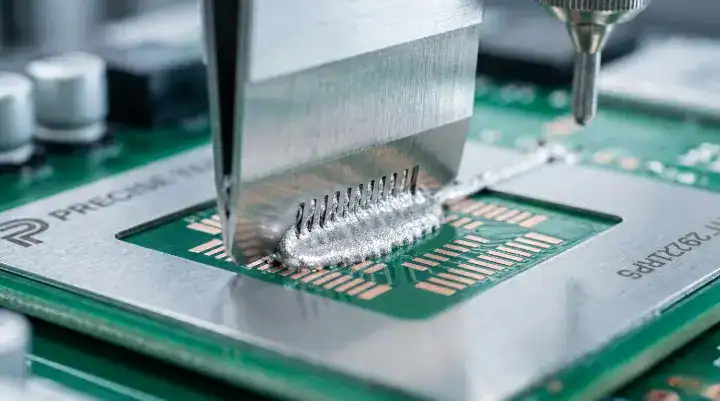
Board complexity drops your first pass yield exponentially rather than linearly; a board with 1,000 components has a significantly higher chance of failing than a board with 100 components on the exact same line. Every additional component, BGA pad, and through-hole pin multiplies your total defect opportunities.
A high-density board requires extreme precision. Placing an 01005 package demands vastly tighter tolerances than placing a standard 0603 resistor. If your design includes a mix of heavy mechanical parts, fine-pitch BGAs, and delicate sensors, your CM must constantly adjust their automated optical inspection protocols. Knowing how to balance AOI vs X-ray vs ICT inspection strategies becomes the only way to catch these distinct, complex failure modes early.
Keep these complexity factors in mind:
- High layer counts introduce registration alignment risks.
- Mixed SMT and THT assembly requires multiple distinct heating cycles.
- Fine-pitch components demand perfectly tensioned stencils.
Bottom line: Adjust your baseline yield expectations based on component density, and mandate strict 3D X-ray inspection for any board carrying multiple BGA packages.
How Much Does Low Yield Actually Cost You Per Board?
A low first pass yield of 80% on a 1,000-board order means 200 boards require rework, adding a hidden $10,000 to your bill assuming a $50 rework cost per board. The manufacturer with the lowest initial quote often ends up costing you 15% to 30% more overall when you factor in these hidden repair fees and timeline delays.
Purchasing managers often select the cheapest assembly quote, ignoring the massive financial drain of low yields. Reworking a board adds $50 to $100 in manual labor, extends your lead time by one to two weeks, and severely compromises long-term reliability. The defect cost multiplier is a financial reality showing that fixing an error at the solder paste stage costs 1x, fixing it after reflow costs 10x, and fixing a field failure costs 100x.
Consider these financial impacts:
- Manual desoldering destroys surrounding component integrity.
- Re-testing reworked boards consumes expensive engineering hours.
- Field failures trigger massive warranty and reputational damage.
| Production Stage | Defect Cost Multiplier | Estimated Cost to Fix | Real-World Example |
|---|---|---|---|
| Solder Paste Printing | 1x | $0.50 | Wiping the board clean and re-printing. |
| Component Placement | 5x | $2.50 | Manually adjusting a misaligned chip before reflow. |
| Post-Reflow | 10x | $50.00 | Desoldering a bridged QFN chip and replacing it. |
| Final Testing | 20x | $100.00 | Running full diagnostics to find a hidden short. |
| Field / Customer | 100x+ | $500.00+ | RMA processing, shipping, and brand damage. |
If a defect is caught before reflow, instruct your CM to fix it immediately for pennies; if you allow defects to reach testing, prepare to pay heavy rework labor rates.
Bottom line: Calculate your total cost of ownership by evaluating the CM’s historical FPY, rather than just choosing the lowest per-board quote.
What Yield Data Should You Demand From Your Contract Manufacturer?
You must demand a detailed yield report that includes FPY per process step, a defect Pareto chart, rework rates, scrap rates, and your calculated DPMO. If your contract manufacturer refuses to provide this granular data and only offers a blended overall yield, they are actively hiding systemic quality control failures.
Some CMs claim “100% yield” but achieve it by silently reworking failed boards for days, or worse, swapping failed units with new ones off the books. IPC-9261 provides a standardized methodology for calculating DPMO in PCB assembly, defining exactly what counts as a defect opportunity. Without this standard, comparing yield data between two factories is meaningless because each may count component, placement, and termination opportunities differently.
Watch out for these red flags:
- CM claims 100% yield without explaining their rework process.
- Factory refuses to share defect Pareto charts.
- Supplier provides “overall yield” but claims FPY is too hard to track.
| Yield Data Metric | Why You Need It | The “Green Flag” Answer | The “Red Flag” Answer |
|---|---|---|---|
| FPY by Process Step | Isolates where defects occur. | “We track paste, SPI, placement, and reflow yields.” | “We only track final testing yield.” |
| Defect Pareto Chart | Shows the top 20% of issues causing 80% of fails. | Provides a monthly breakdown of defect types. | “Our defects are random and vary too much.” |
| Standardized DPMO | Normalizes quality across different board complexities. | “We calculate DPMO using IPC-9261 standards.” | “We just count total failed boards.” |
| Rework Rate | Shows how much thermal stress boards endure. | “Our rework rate is tightly capped under 2%.” | “We rework boards until they pass.” |

If a CM provides IPC-standardized DPMO data, proceed with the partnership; if they only hand you a vague “99% pass rate” marketing slide, walk away immediately.
Bottom line: Write specific, granular yield data reporting requirements directly into your manufacturing master service agreement before signing anything.
How Can You Improve PCB Assembly Yield Through Better Design?
You can improve your PCB assembly yield by implementing a strict DFM design for manufacturing review to verify component spacing, pad sizes, and thermal reliefs before production begins. Teams utilizing a systematic DFM process achieve first-build yields 10% to 15% higher than teams relying on unverified baseline layouts.
Designing a board that functions in simulation is entirely different from designing a board that a machine can assemble cleanly. If you place heavy copper planes near small passive components without proper thermal reliefs, the paste will melt unevenly, pulling the component off the pad. Designing out these physical assembly risks is the fastest way to drive your FPY upward.
Implement these design strategies:
- Space tall components away from small SMDs to prevent shadowing.
- Standardize your BOM to reduce machine feeder changeovers.
- Add fiducial marks near fine-pitch components for precise camera alignment.
Bottom line: Never send a new layout to mass production without requiring a thorough DFM and DFA review from your assembly partner.
How Do You Set Yield Targets for Pilot Runs vs. Production Runs?
For a new product pilot run, you should target an initial 90% to 95% first pass yield, giving your team room to identify and resolve process bugs before scaling. Once those process parameters are dialed in, your mass production runs must strictly target 98% to 99% FPY depending on your IPC class requirements.
A drone startup came to us with a 4-layer mixed-assembly controller board — 320 SMT and 15 THT components including two BGA-256 packages. Their pilot run target was 95% FPY based on IPC Class 2 standards. The first pilot batch of 100 units hit 91% FPY. The defect Pareto showed three main issues: BGA voiding at 18%, 0402 tombstoning at 2.3%, and one through-hole connector with insufficient fill. We addressed each with specific process changes — vacuum reflow for BGA voiding, pad size ratio adjustment for the 0402s, and selective soldering parameter tuning. The second pilot run hit 97.8% FPY. The customer approved production at 2,000 units, which ran at 98.1% FPY. Executing thorough PCBA testing in product lifecycle phases is what gives customers confidence to scale.
Track these transition phases:
- EVT pilot runs establish the baseline FPY.
- DVT runs validate the specific factory process adjustments.
- PVT runs prove the factory can hold high FPY at volume.
| Production Phase | IPC Class 2 Target | IPC Class 3 Target | Primary Goal |
|---|---|---|---|
| Pilot Run (First Batch) | 90% – 95% | 95% – 98% | Identify process bugs and calibrate machines. |
| Pilot Run (Second Batch) | >95% | >98% | Validate process corrections before scaling. |
| Mass Production | 98%+ | 99%+ | Maintain consistent output and minimize rework. |
If your first pilot batch yields 85%, pause the run to conduct a root cause analysis; if your second batch hits your target, immediately lock in the machine parameters for volume manufacturing.
Bottom line: Treat your pilot run as a diagnostic tool rather than a volume generator, and enforce strict yield improvements before signing off on mass production.
What Questions Should You Ask Before Signing With a CM?
Before signing a contract, you must ask your CM how they define first pass yield, what their current DPMO sits at, and how they allocate the costs associated with rework and scrap. Asking these direct financial and operational questions exposes whether a factory relies on true process control or just aggressive manual rework to hit their shipment numbers.
Do not wait until your first batch of boards fails to figure out how your partner handles quality control. Asking for a documented first article inspection report on a sample board will immediately reveal their testing rigor. A CM who avoids giving straight answers about scrap budgets is a CM who plans to pass their inefficiency costs directly onto your final invoice.
Ask these critical questions:
- What is your internal threshold for halting a line due to low FPY?
- Do you charge extra for boards that require more than one rework cycle?
- Can you provide an anonymized defect Pareto chart from a similar project?
Bottom line: Vet your CM’s quality reporting transparency and scrap policies just as rigorously as you vet their component pricing and delivery timelines.
Conclusion
You now know how to strip away the illusion of “overall yield” and use true FPY data to hold your manufacturing partners accountable. Accepting vanity metrics only leads to expensive rework, bloated timelines, and a supply chain plagued by field failures.
At QueenEMS, we offer a free DFM/DFA engineering review on every order and run mandatory 3D AOI and X-Ray inspection on every BGA joint. These strict process controls allow us to maintain our 99.7% first-pass yield rate across standard and highly complex builds. We scale smoothly from prototypes to mass production without hiding our defect data.
We believe in transparent data, not marketing fluff. Contact us at QueenEMS today to discuss your next full turnkey project and see what real, verifiable process control looks like on the factory floor.
Written by the QueenEMS Engineering Team.
FAQ
Q: What is a good first pass yield for PCB assembly? A: For standard consumer electronics, target 95%+ FPY on production runs. For high-reliability products like medical or aerospace devices, target 99%+. Pilot runs should aim for 90-95% FPY on the first batch, improving to production targets after process adjustments. Check your manufacturer’s historical data before placing an order.
Q: What is the difference between first pass yield and overall yield? A: First pass yield counts only boards that pass all tests on the first attempt with zero rework. Overall yield includes boards that were reworked and retested until they passed. A CM reporting 98% overall yield may have an FPY of only 80%, meaning heavy rework costs. Always demand raw FPY metrics.
Q: How do you calculate DPMO for PCB assembly? A: You calculate DPMO using the formula: (total defects / total opportunities) x 1,000,000. IPC-9261 defines opportunities as the sum of component, placement, and termination opportunities. For a board with 200 components averaging 3 terminations each, your total opportunities equal 1,000 per board. Request a standardized DPMO report from your supplier today.
Q: What yield rate should I expect from a contract manufacturer? A: You should expect world-class SMT lines to achieve under 30 defects per million opportunities. If a CM cannot provide FPY broken down by process step like paste printing and reflow, it means they are not tracking quality properly. Audit their reporting tools before signing any agreements.
Q: Does low PCB assembly yield affect product reliability? A: Yes, low yield severely degrades reliability. Reworked solder joints are statistically less reliable than first-pass joints, leading to higher field failure rates under thermal cycling and vibration. Protect your brand reputation by enforcing strict FPY minimums.
Upload your files today · Free DFM check before production · Ship worldwide
Get your PCB prototypes in as fast as 24 hours. We handle FR4, Rogers, and hybrid boards up to 40 layers in volume production, with advanced builds subject to engineering review — free prototypes for 2–4 layer FR-4 boards, no minimum order.
Just upload your Gerber + BOM — we source every part, assemble, and inspect (AOI + X‑Ray) so you don't have to chase suppliers. Boards ship in as fast as 24 hours.