
Quick Answer: When an end of life electronics component notice hits, you typically have 6 to 12 months to execute a survival plan before the final order deadline. You must immediately choose between a Last-Time Buy (stockpiling inventory), qualifying an alternate part (taking 2-4 weeks), or executing a full PCB redesign (costing $15,000–$50,000). The safest financial response is usually finding a pin-compatible alternate to avoid tying up thousands in dead stock. Key takeaways:
- Over 470,000 electronic components went obsolete in 2023, shrinking advanced chip lifespans to just 2–5 years.
- A Last-Time Buy (LTB) quantity must include your projected monthly demand multiplied by remaining lifecycle months, plus a 15% safety factor.
- Qualifying a new alternate component typically requires 2 to 4 weeks of thermal and electrical testing.
- Proactive lifecycle monitoring requires only 2 hours of engineering time per quarter but prevents 6-month production halts.
Table of Contents
- What Happens When a Critical Component Goes End-of-Life?
- What Are Your Three Options When You Get an EOL Notice?
- How Do You Decide Between Last-Time Buy, Alternate Part, and Redesign?
- How Do You Calculate a Last-Time Buy Quantity That Won’t Over- or Under-Buy?
- How Do You Find and Qualify an Alternate Component Without Full Redesign?
- When Is a PCB Redesign Unavoidable — and How Do You Minimize the Cost?
- How Can You Monitor Component Lifecycles Before EOL Hits?
- What Should Your CM Be Doing About Component Obsolescence?
- How Do You Build an Obsolescence Management Plan Into Your Product Strategy?
- FAQ
You just received an email from your distributor stating that the main microcontroller on your flagship circuit board is obsolete. If you panic and buy blindly, you trap your operating capital in degrading inventory; if you do nothing, your assembly line halts in six months. Hardware teams regularly waste upwards of $50,000 on unnecessary board redesigns because they lack a systematic response plan. Here is your 72-hour survival guide for managing component obsolescence efficiently.
What Happens When a Critical Component Goes End-of-Life?
When a critical component goes End-of-Life (EOL), the manufacturer officially announces they are stopping production and typically gives you a 6 to 12-month window to place your final orders. This Product Discontinuation Notice (PDN) forces you to either stockpile the remaining inventory or permanently modify your hardware design. Data from Z2Data shows that nearly 750,000 electronic parts went obsolete in 2022, and over 470,000 in 2023, making this a recurring threat rather than a rare emergency.
Here is the reality: The days of relying on a single chip for 20 years are over. EOL component management pcb strategies are mandatory because advanced chip lifespans have dropped from legacy 10–30 year cycles to merely 2–5 years today.
- Your purchasing team has exactly 6-12 months to place a final Last-Time Buy (LTB) order.
- Your engineering team has roughly 3-6 months to test and validate any replacement parts.
- Your finance team must immediately reallocate budget to cover either bulk purchasing or redesign fees.
When a notice arrives, the clock starts ticking immediately.
Bottom line: You must initiate an obsolescence response plan within 72 hours of receiving an EOL notice, because global stock for that dying component will be drained by your competitors within weeks.
What Are Your Three Options When You Get an EOL Notice?

You have exactly three response options when you get an EOL notice: execute a Last-Time Buy to stockpile parts, qualify a form-fit-function alternate component, or execute a complete PCB redesign. A Last-Time Buy requires immediate cash, an alternate part requires 2–4 weeks of testing, and a redesign costs $15,000 to $50,000 in engineering fees.
We deal with EOL situations roughly twice a month across our active customer base at QueenEMS. Recently, a power management IC used by an industrial sensor client received an EOL notice with a 9-month LTB window. The client’s product lifecycle was projected at 4 more years (500 units/year).
Option 1 (LTB) required buying 2,300 ICs at $1.80 each, tying up $4,140 in inventory. Option 2 (Alternate) identified a pin-compatible part at $2.10/unit, requiring $2,500 in thermal testing. Option 3 (Redesign) was unnecessary. The client chose Option 2. Their net additional cost was $2,500 (one-time test) plus a $0.30/unit premium over 2,000 units, totaling $3,100. They saved over $1,000 upfront and eliminated all long-term physical storage risks.
| Response Option | Typical Timeline | Cost Range | Risk Level |
|---|---|---|---|
| 1. Last-Time Buy (LTB) | 1 – 2 weeks | High upfront (Cash tied up) | High (Component degradation) |
| 2. Alternate Part | 2 – 4 weeks | Medium ($1,000 – $3,000 testing) | Low (Maintains production flow) |
| 3. PCB Redesign | 3 – 6 months | Very High ($15,000 – $50,000) | Medium (Requires re-certification) |
Choose a Last-Time Buy if your product is retiring in less than 12 months. Choose to qualify an alternate part if your product will sell for another 2–5 years and pin-compatible options exist on the market.
Bottom line: Always prioritize finding a pin-compatible alternate part first, as it protects your cash flow and avoids the heavy engineering burden of a full redesign.
How Do You Decide Between Last-Time Buy, Alternate Part, and Redesign?
You decide your path using a three-dimensional matrix analyzing your remaining product lifecycle, the component’s criticality, and alternate availability. If your product only has 18 months of life remaining on the market, buying a 1.5-year supply is cheaper than paying an engineer $15,000 to redesign the board.
Think about this: Many customers blindly choose the LTB route because it seems like the easiest administrative fix. However, buying 5 years of stock requires massive cash outlays and introduces severe component degradation risks.
- Remaining Product Lifecycle: How many more years will you sell this specific hardware revision?
- Component Criticality: Is this a basic passive resistor or your core proprietary microcontroller?
- Alternate Availability: Are there 2+ suppliers offering an identical footprint replacement?
You must evaluate how this decision impacts your PCBA inventory JIT vs safety stock balance. Hoarding parts destroys a JIT strategy entirely.
Bottom line: You must force your engineering and procurement teams into a single meeting to calculate whether the cost of holding 5 years of inventory exceeds the one-time cost of validating a new chip.
How Do You Calculate a Last-Time Buy Quantity That Won’t Over- or Under-Buy?
You calculate a safe Last-Time Buy quantity using a strict formula: (Monthly Demand × Remaining Lifecycle Months × 1.15 Safety Factor) – Existing Inventory – Committed Orders. Applying this mathematical model prevents you from accidentally buying 1,000 units too few and facing a production halt, or 5,000 units too many that eventually go straight into the trash.
Guessing your final volume based on “gut feeling” is a guaranteed financial loss. Furthermore, physical storage becomes your next biggest threat. The JEDEC JESD625 standard defines strict requirements for handling and packing moisture-sensitive devices. If you store chips for 4 years without proper humidity control, they will fail during the reflow soldering process.
| Variable | Formula Component | Example Values |
|---|---|---|
| Monthly Demand | Projected sales per month | 200 units |
| Remaining Lifecycle | Months until product retirement | 24 months |
| Safety Factor | Buffer for yield loss/spikes | 1.15 (15% buffer) |
| Current Stock | Parts currently in your warehouse | 500 units |
| Final Calculation | (200 × 24 × 1.15) – 500 | 5,020 units to order |
Choose a 1.15 safety factor for standard commercial products, but choose a higher 1.30 safety factor if you are building critical medical devices where future shortages equal zero revenue.
Setting up a formal PCB assembly kitting and consignment agreement with your manufacturer is required if you expect them to hold these 5,020 units in their bonded warehouse for the next two years.
Bottom line: You must mathematically justify your LTB quantity and secure climate-controlled, ESD-safe storage before issuing a six-figure purchase order for dying components.
How Do You Find and Qualify an Alternate Component Without Full Redesign?
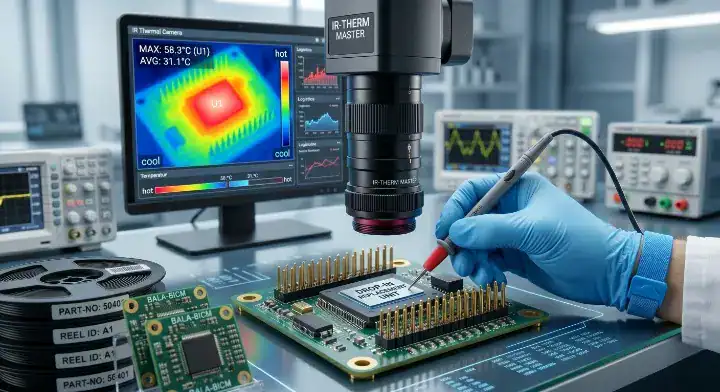
You qualify an alternate component by executing a strict three-point validation: checking for pin-to-pin compatibility, confirming matching electrical parameters (voltage, tolerance), and running thermal load testing. This targeted qualification process takes 2 to 4 weeks and completely bypasses the need to redesign your copper traces.
The catch? Finding a replacement on Google is not qualification. You must verify that the new part behaves identically under stress. Knowing how to secure a reliable component shortage alternative requires accessing independent distributor databases to verify the new part has at least two active sources.
- Pin Compatibility: Does it drop directly onto the existing PCB pads?
- Electrical Match: Do the input/output voltages and clock speeds align perfectly?
- Thermal Match: Does the new chip dissipate heat at the same rate, or will it melt your enclosure?
- Software Impact: Does the new chip require firmware rewrites?
When sourcing older replacement parts from brokers, your risk of buying fake chips spikes dramatically. Implementing strict how to prevent counterfeit components protocols—like mandatory X-ray inspection—protects your production batch.
| Qualification Parameter | Must Match Exactly | Acceptable Deviation | Test Required |
|---|---|---|---|
| Footprint (Package) | Yes (e.g., QFN-32) | None | DFM visual check |
| Voltage Ratings | Yes (Core VDD) | Higher max rating | Electrical probing |
| Thermal Output | No | ±10% variation | Thermal imaging under load |
| Firmware Drivers | No | Minor code updates | System level test |
Choose a drop-in pin-compatible alternate if your PCB is tightly packed, but choose to adapt your firmware if an electrically similar chip with a slightly different software address is available.
Bottom line: You must physically solder the alternate part onto three test boards and run full functional testing before authorizing the mass purchasing order.
When Is a PCB Redesign Unavoidable — and How Do You Minimize the Cost?
A PCB redesign becomes unavoidable when the obsolete component has zero pin-compatible alternates on the market, requires a completely different physical footprint, or forces a major shift in critical performance parameters like radio frequency output. A full redesign typically costs between $15,000 and $50,000 and demands 3 to 6 months of engineering validation.
When you hit this wall, you must manage the transition tightly. You cannot simply change the layout and hit print. Every footprint change requires generating an official engineering change notice ECN to formally document the new Gerber files and instruct the factory on the new assembly parameters.
- Group multiple minor improvements into this single redesign effort to maximize the ROI.
- Select a widely available, multi-sourced replacement chip to prevent another EOL crisis next year.
- Update your test fixtures to accommodate the new layout immediately.
Bottom line: You must treat an unavoidable redesign as a “Version 2.0” product launch, leveraging the $20,000 engineering expense to simultaneously fix legacy bugs and upgrade overall performance.
How Can You Monitor Component Lifecycles Before EOL Hits?

You monitor component lifecycles by integrating proactive API tools like SiliconExpert or IHS Markit directly into your CAD software, tracking the specific life stage of every part on your board from “Introduction” to “Decline.” Relying on manual spreadsheet checks guarantees you will miss critical notices, as 37% of parts become obsolete without any formal warning.
Your BOM for PCB assembly is a living document, not a static PDF. You must scrub it against lifecycle databases quarterly.
| Lifecycle Stage | What It Means | What To Do Now |
|---|---|---|
| Introduction | New chip, low volume, high price. | Avoid for mass production until proven. |
| Growth / Maturity | Stable supply, multiple sources. | Safe to use in all active designs. |
| Decline (NRND) | Not Recommended for New Designs. | Start searching for alternates now. |
| EOL / Obsolete | Production stopping / stopped. | Execute LTB or Redesign immediately. |
Choose SiliconExpert if you run a massive enterprise with thousands of SKUs, but choose Altium 365’s built-in lifecycle monitoring if you are a mid-sized team looking for affordable CAD integration.
| Proactive Tool | Coverage Focus | Cost Tier | Best For |
|---|---|---|---|
| SiliconExpert | 1B+ parts, predictive algorithms | High | Enterprise hardware teams |
| Z2Data | Deep supply chain mapping | Medium | Risk management professionals |
| Altium 365 | ECAD integrated alerts | Low | Mid-sized engineering teams |
Bottom line: You must automate your component lifecycle monitoring using API-driven tools, because manual BOM scrubbing will inevitably fail to catch sudden EOL announcements.
What Should Your CM Be Doing About Component Obsolescence?
Your contract manufacturer should be running quarterly BOM health checks on your active product lines and alerting you within 48 hours of any component moving into “Not Recommended for New Designs” (NRND) status. A passive CM who only informs you about an obsolescence issue when they fail to buy the parts is actively damaging your business.
At QueenEMS, we learned this the hard way and changed our entire process. A medical device client had been in stable production for 3 years. During a routine BOM review, we discovered their main FPGA was already in ‘last-time-buy’ status—the notice had been issued 4 months earlier, but their engineering team had missed it. The deadline was 5 weeks away.
We immediately sourced 18 months of supply and simultaneously started qualifying an alternate FPGA. If we had not caught it, their production would have halted within 6 months. Now, we proactively flag any risky component. This monitoring costs us about 2 hours of engineering time per customer per quarter—a trivial investment compared to the cost of a catastrophic production halt.
Because we actively manage global supply networks, our PCB assembly dual sourcing strategy heavily relies on having advanced warning to shift production loads safely.
Bottom line: You must fire any CM that treats component obsolescence strictly as “the customer’s problem” and partner with one that actively audits your BOM health every 90 days.
How Do You Build an Obsolescence Management Plan Into Your Product Strategy?
You build a resilient product strategy by adopting the DMSMS (Diminishing Manufacturing Sources and Material Shortages) framework heavily used in the aerospace industry, which mandates identifying alternate parts during the initial design phase rather than waiting for an emergency. True component obsolescence pcb assembly resilience starts on day one.
Consider this: When you launch a new hardware product, the components you choose define your future risk. If you select proprietary, single-source chips during the NPI PCB assembly phase, you guarantee a painful redesign down the road.
- Never design in a component that is already listed as “Decline” or “NRND.”
- Always add secondary and tertiary approved parts to your initial AVL (Approved Vendor List).
- Standardize your passive components across all product lines to maximize buying power.
Bottom line: You must demand your hardware engineers list at least two approved manufacturer part numbers (MPNs) for every critical IC on your BOM before approving the final prototype.
Component obsolescence is a mathematical certainty, not a random stroke of bad luck. Whether you choose to stockpile inventory, qualify an alternate, or redesign your board, your success depends on moving quickly with accurate data.
At QueenEMS, we protect your hardware lifecycle. We provide free BOM health scrubbing and DFM/DFA engineering reviews on every order. When EOL notices hit, our global sourcing team helps you secure critical LTB allocations or identify pin-compatible alternates to keep your lines moving. With our full turnkey service, we manage the entire transition from component sourcing to final testing.
Stop waiting for the next obsolescence crisis to halt your production. Contact us today to schedule a comprehensive BOM health check and secure your supply chain.
Written by the QueenEMS Engineering Team
FAQ
What is an EOL component in electronics manufacturing? An EOL (End-of-Life) component is a part that the original manufacturer has officially decided to stop producing, giving buyers a final 6 to 12-month window to place last-time orders before the supply is permanently cut off.
How much should I buy during a Last-Time Buy (LTB)? You should calculate your LTB quantity by multiplying your projected monthly demand by the remaining months of your product’s lifecycle, adding a 15% safety factor, and subtracting your current warehouse inventory. Buy exactly what the math dictates.
How long does it take to qualify an alternate PCB component? It typically takes 2 to 4 weeks to fully qualify a pin-compatible alternate component, which includes reviewing datasheets, sourcing physical samples, soldering them onto test boards, and running thermal and electrical load tests.
Who is responsible for monitoring component lifecycles? Your internal engineering and procurement teams own the primary responsibility, but a high-quality contract manufacturer will also run quarterly automated checks on your BOM to alert you immediately if a part moves to “Not Recommended for New Designs” status.
Is there a counterfeit risk when sourcing EOL components? Yes, the risk of buying counterfeit components increases drastically when sourcing obsolete parts from unauthorized third-party brokers. You must mandate strict X-ray and decapsulation testing when buying parts that are no longer available through franchised distributors.
Upload your files today · Free DFM check before production · Ship worldwide
Get your PCB prototypes in as fast as 24 hours. We handle FR4, Rogers, and Flex up to 60 layers — free prototypes for 2–4 layer boards, no minimum order.
Just upload your Gerber + BOM — we source every part, assemble, and inspect (AOI + X‑Ray) so you don't have to chase suppliers. Boards ship in as fast as 24 hours.