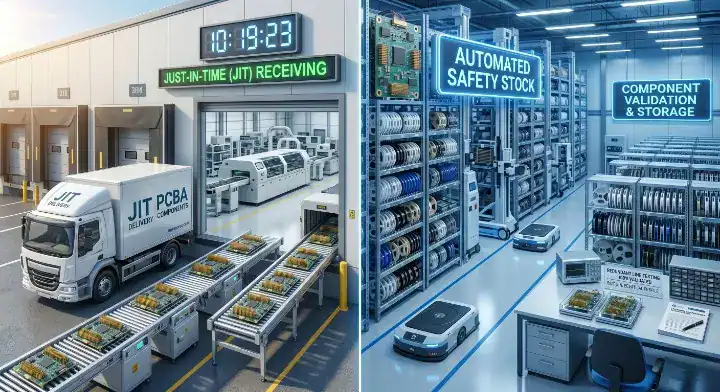
Quick Answer: The difference between JIT and safety stock is that JIT brings components to the factory floor exactly when needed with zero buffer, saving 10–15% in warehousing fees, while safety stock keeps a pre-purchased 30 to 90-day supply on hand to absorb supply chain shocks. For typical electronics manufacturing, relying purely on JIT causes catastrophic production delays; you must use a hybrid model instead. Key takeaways:
- The Bill of Materials (BOM) accounts for 60–70% of total PCBA costs, meaning your inventory strategy dictates your cash flow.
- A failed JIT delivery causes production line idle fees ranging from $500 to $2,000 per hour.
- Safety stock must cover Tier 3 components (like single-source MCUs) that suffer from 16-week lead times.
- Using a bonded inventory model drops annual component spending by up to 11% while maintaining zero production delays.
Table of Contents
- What Is the Difference Between JIT and Safety Stock for PCB Assembly?
- Why Does Pure JIT Fail in Electronics Manufacturing?
- How Do You Calculate the Right Safety Stock Level for PCB Components?
- Which Components Should You Buffer and Which Should You Order JIT?
- How Does Your CM Handle Inventory — and Why Should You Care?
- What Are the Hidden Costs of Both JIT and Safety Stock?
- How Do Tariffs and Lead Times Affect Your Inventory Decision in 2026?
- What Inventory Terms Should You Negotiate With Your CM?
Are you tying up 60% of your operating cash in excess electronic components sitting in a warehouse? Conversely, do you risk losing massive B2B contracts because a missing $2 chip halted your entire production line? Finding the perfect balance between zero inventory and hoarding parts determines whether your hardware startup survives. Here is exactly how to build a profitable inventory strategy.
What Is the Difference Between JIT and Safety Stock for PCB Assembly?
Just-in-Time (JIT) is an inventory model where components arrive at the contract manufacturer (CM) exactly when needed for production with zero warehouse buffer, while safety stock is a pre-purchased buffer inventory held at the CM or a third-party warehouse to absorb supply chain disruptions. Because the BOM for PCB assembly typically equals 60–70% of your total PCBA cost, choosing between holding cash and holding parts completely changes your financial risk profile.
Many procurement managers mistakenly view this as a binary choice. In reality, modern electronics supply chains demand a hybrid approach.
- JIT eliminates storage fees but exposes you to 100% production loss if a broker misses a delivery.
- Safety stock protects your assembly timeline but traps $10,000 to $50,000 in unused assets.
- A hybrid model applies JIT to fast-moving parts and safety stock to vulnerable custom ICs.
| Dimension | JIT (Just-in-Time) | Safety Stock | Hybrid Model |
|---|---|---|---|
| Capital Tied Up | $0 (Zero holding cost) | High (Requires upfront cash) | Medium |
| Storage Fees | None | 2-5% of inventory value monthly | Minimal |
| Disruption Risk | 100% line stoppage | Protected against 1-3 month delays | Protected on critical paths |
| Best Used For | Standard resistors / capacitors | Custom MCUs / Single-source ICs | Full BOM management |
Green flag: Choose JIT if you are sourcing commodity 10k resistors from five different global distributors. Red flag: Avoid JIT and choose safety stock if your product relies on a single-source wireless module with an unpredictable 16-week delivery window.
Bottom line: Pure JIT saves cash today but bankrupts you tomorrow when a single supply chain hiccup stops a $50,000 production run.
Why Does Pure JIT Fail in Electronics Manufacturing?
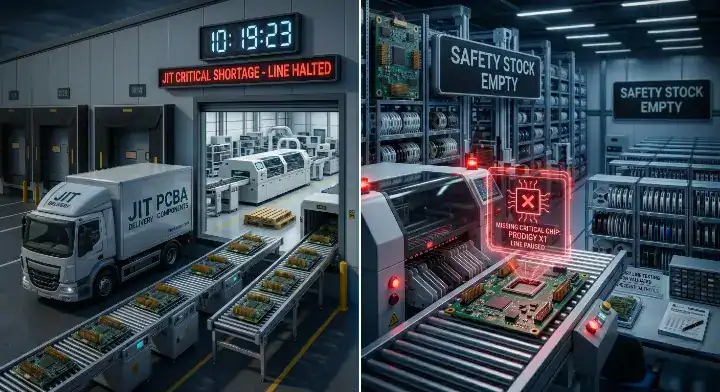
Pure JIT fails in electronics manufacturing because global component lead times fluctuate violently between 2 weeks and 24 weeks, making it mathematically impossible to time component arrivals perfectly without a buffer. A strategy designed for predictable automotive assembly lines collapses when a single fab in Asia delays an IC shipment.
At QueenEMS, we see this reality hit hardware founders every month. Pure JIT works in theory but fails in electronics reality. Last quarter, a smart home startup ran pure JIT on a 2,000-unit quarterly order. Every component was ordered exactly 3 weeks before production. In Q1, it worked perfectly.
In Q2, their main MCU (a single-source chip) had a 12-week lead time spike due to a sudden demand surge. Production was delayed 8 weeks. The 2,000-unit order shipped 2 months late, and they lost a $45,000 retail partnership because they could not deliver on time. After that disaster, they moved to a hybrid model: JIT for commodity passives (multi-source, 2-week lead) and a 3-month safety stock for critical ICs. Their buffer investment cost roughly $6,000 in pre-purchased ICs, acting as cheap insurance against losing $45,000+ in revenue per quarter. The math is not even close.
- Single-source dependencies destroy JIT schedules instantly.
- Customs holds routinely add 7 to 14 days of unexpected delays.
- Yield drops at the silicon fab level create instant global allocations.
Because supply chains are inherently unstable, you must establish a PCB assembly dual sourcing strategy to split your risk across different geographic locations.
Bottom line: You must transition to a hybrid model immediately, because a 100% JIT strategy assumes a perfect global supply chain that no longer exists in 2026.
How Do You Calculate the Right Safety Stock Level for PCB Components?
You calculate the exact safety stock quantity using a simplified formula: Safety Stock = (Maximum Daily Usage × Maximum Lead Time in Days) – (Average Daily Usage × Average Lead Time in Days). This method prevents you from overpaying for warehouse space while guaranteeing you have enough buffer to survive a vendor delay.
Procurement managers often know they need a buffer, but they guess the amount. Guessing leads to tying up cash. Your target service level also changes the math: a 95% service level keeps capital free for consumer goods, but a 99% service level doubles your required buffer quantity for life-saving medical devices.
| Component Type | Avg Weekly Usage | Normal Lead Time | Max Lead Time | Recommended Safety Stock |
|---|---|---|---|---|
| Standard Resistor | 5,000 pcs | 2 weeks | 3 weeks | 0 (Use JIT) |
| Power Management IC | 500 pcs | 8 weeks | 12 weeks | 2,000 pcs (4-week buffer) |
| Custom MCU | 200 pcs | 16 weeks | 24 weeks | 1,600 pcs (8-week buffer) |
If you are running consumer toys (mid-volume, 100-500 boards), calculate your buffer for a 95% service level. If you are building aerospace controls (low-volume, high-margin), double your buffer for a 99.9% service level to prevent absolute failure.
Bottom line: You should never guess your buffer numbers; run the simplified safety stock formula on your top 10 most expensive components to protect your cash flow.
Which Components Should You Buffer and Which Should You Order JIT?
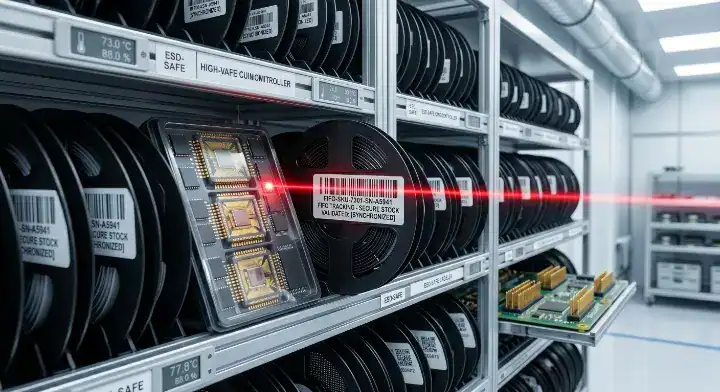
You should buffer Tier 3 critical ICs that take over 12 weeks to arrive, and strictly order Tier 1 commodity passives on a JIT basis to free up 20% of your working capital. Treating every line item on your BOM with the exact same inventory strategy is a massive financial error.
Data from Z2Data indicates that nearly 750,000 electronic parts went obsolete in 2022, and over 470,000 in 2023. When you buffer long-lead components, you must factor in this end-of-life (EOL) risk. Implementing strict EOL component management for PCB assembly prevents you from holding a warehouse full of dead stock.
| Risk Tier | Characteristics | Recommended Strategy | Example Components |
|---|---|---|---|
| Tier 1: Low Risk | Multi-source, < 4 weeks lead time. | 100% JIT | 0402 Capacitors, Standard LEDs |
| Tier 2: Medium Risk | 2-3 sources, 4-10 weeks lead time. | 4-week Safety Stock | Connectors, Standard Op-Amps |
| Tier 3: High Risk | Single-source, 12+ weeks lead time. | 12-week Safety Stock | Custom MCUs, FPGAs, Wi-Fi Modules |
Choose JIT for Tier 1 components because a component shortage alternative takes less than 24 hours to find on Digi-Key or Mouser. Choose a heavy buffer for Tier 3 components because an alternative literally does not exist without redesigning your board.
Bottom line: Do not waste capital buffering cheap resistors; spend your cash exclusively on protecting the custom microcontrollers that will paralyze your assembly line.
How Does Your CM Handle Inventory — and Why Should You Care?
Your contract manufacturer manages inventory using turnkey, consignment, or bonded models, directly deciding whether you pay an 8–12% component markup or assume 100% of the obsolescence risk yourself. If you do not ask how your chips are stored, your CM might mix your safety stock with other clients’ parts.
We offer three inventory models at QueenEMS. Turnkey is the simplest for the customer, but we add an 8-12% component markup for carrying the purchasing risk. Consignment means the customer pre-buys components and ships them to us; there is zero markup, but the customer bears the obsolescence risk.
Bonded inventory is the perfect middle ground. A drone manufacturer recently switched from turnkey to bonded inventory for their top 15 critical components. They pre-bought a 3-month supply, stored it in our bonded warehouse, and we pulled per production order. Their annual component spend dropped 11% due to volume pricing, and they eliminated 3 production delays over 6 months that spot-market volatility had previously caused. Setup took 2 weeks: we allocated dedicated shelf space and implemented barcode tracking per customer lot.
| Inventory Model | Who Owns the Stock? | Who Bears Obsolescence Risk? | Best For… |
|---|---|---|---|
| Turnkey | CM | CM | Startups needing zero purchasing hassle. |
| Consignment | Customer | Customer | Companies with established supplier discounts. |
| Bonded Inventory | Customer (Stored at CM) | Customer | High-volume production needing fast scaling. |
Furthermore, utilizing the IPC-1752A Materials Declaration Management standard helps track component lifecycle data relevant to your inventory planning. Reviewing our PCB assembly kitting and consignment instructions will clarify how to properly label these parts before shipping them to the factory.
Choose turnkey vs consigned assembly based strictly on whether you have a dedicated procurement manager on your team.
Bottom line: You must demand a bonded inventory agreement with dedicated, barcode-tracked shelf space to prevent your CM from accidentally using your safety stock on another client’s project.
What Are the Hidden Costs of Both JIT and Safety Stock?
The hidden cost of a failed JIT strategy is paying $500 to $2,000 per hour in production line idle fees while waiting for late parts, whereas the hidden cost of excessive safety stock is a 5% to 10% annual obsolescence write-off. Looking only at the upfront invoice price hides the true financial danger of both strategies.
Procurement teams frequently ignore these silent killers. If 5% of your $50,000 buffered components go EOL (End of Life) before you use them, your write-off cost is $2,500. However, that $2,500 loss is mathematically superior to stopping the line.
- JIT Hidden Costs: Expedited overnight shipping ($200+ per box), line idle penalties, and lost retail partnerships.
- Safety Stock Hidden Costs: Capital tied up, physical storage fees (often 2-3% per month), and insurance.
Bottom line: You lose significantly more money paying a $2,000 factory idle fee than you ever save by skipping a $500 safety stock investment.

How Do Tariffs and Lead Times Affect Your Inventory Decision in 2026?
In 2026, sudden 25% tariff fluctuations and geopolitical shifts are extending standard component lead times from 12 weeks to over 20 weeks, rendering historical safety stock formulas dangerously inaccurate. If you calculate your buffer using 2023 lead time data, your production line will starve.
Understanding your PCB assembly lead time calculation now requires factoring in customs delays. When tariffs change, companies panic-buy components globally, instantly draining distributor inventory and creating artificial shortages for everyone else.
Bottom line: You must update your lead time data in your ERP system weekly during 2026, or your pre-purchased safety stock will run out a full month before the factory finishes your boards.
What Inventory Terms Should You Negotiate With Your CM?
You must negotiate three critical inventory terms before signing a contract: a maximum 3% monthly storage fee for your unused components, zero liability for CM-caused obsolescence, and a strict First-In-First-Out (FIFO) usage guarantee. If these terms are not legally bound in writing, the CM holds all the leverage when parts expire.
Do not send thousands of dollars of chips to a factory blindly. Without FIFO rotation, a CM might use fresh chips for today’s order while letting your 6-month-old safety stock slowly degrade until the solderability fails. Additionally, poor storage protocols increase the risk of fake parts entering the mix; knowing how to prevent counterfeit components requires strict chain-of-custody tracking.
| Negotiation Term | What You Should Ask For | Acceptable Range | Red Flag |
|---|---|---|---|
| Storage Fees | Free storage for active accounts. | 1% – 3% of inventory value monthly. | CM demands > 5% monthly fee. |
| FIFO Guarantee | Strict barcode tracking and FIFO usage. | CM provides digital inventory logs. | CM relies on manual Excel tracking. |
| Shelf Life Liability | CM pays if parts expire due to their delay. | Shared liability if forecast drops. | CM refuses all liability for old stock. |
| MOQ Minimums | No penalty for keeping buffer under 5k units. | Small yearly holding fee for low volumes. | CM refuses to hold stock under $10k value. |
Choose a CM that provides real-time API access to your inventory logs. Avoid any CM that answers your inventory inquiries by sending a manually typed spreadsheet three days later.
Bottom line: Never ship $50,000 worth of safety stock to a CM without a signed agreement detailing exactly who pays for the chips if they expire on the warehouse shelf.
Managing PCBA inventory requires cold math, not guessing. Relying on pure JIT exposes you to catastrophic delays, while blindly hoarding components kills your cash flow. You need a data-driven hybrid strategy paired with a transparent manufacturing partner.
At QueenEMS, we protect your cash flow and your production schedule. We offer flexible bonded inventory programs, zero-markup consignment options, and strict FIFO barcode tracking to protect your safety stock. With our free DFM engineering review, 3D AOI inspection, and 99.7% first-pass yield rate, we turn your components into flawless hardware.
Stop letting supply chain shocks dictate your revenue. Contact us today to set up a secure, hybrid inventory model for your next PCB assembly production run.
Written by the QueenEMS Engineering Team
FAQ
What is the main difference between JIT and safety stock for PCB assembly? The main difference is that JIT brings components to the factory floor exactly when needed with zero buffer, saving storage fees, while safety stock keeps a pre-purchased 30 to 90-day supply on hand to absorb unpredictable supply chain delays.
How much safety stock buffer should I keep for electronics manufacturing? You should keep exactly enough to cover the maximum known lead time gap. Use the formula: (Max Daily Usage × Max Lead Time) – (Avg Daily Usage × Avg Lead Time). For high-risk custom ICs, this typically equals an 8 to 12-week supply.
Which components should I buffer and which should be JIT? You should buffer single-source, high-risk Tier 3 components (like custom MCUs and wireless modules) that have 12+ week lead times. Order Tier 1 commodity passives (like standard 0402 resistors) using a strict JIT model because they are readily available globally.
Should I use consignment or turnkey inventory with my CM? Choose turnkey if you are a startup needing zero purchasing hassle and are willing to pay an 8-12% component markup. Choose consignment or bonded inventory if you have high volume, want to save 11% on volume pricing, and have a team to manage the purchasing.
What are the hidden costs of running a pure JIT strategy? The hidden costs include paying $500 to $2,000 per hour in factory line idle fees when components arrive late, spending hundreds on expedited overnight shipping, and losing retail contracts due to severely delayed final deliveries.
Upload your files today · Free DFM check before production · Ship worldwide
Get your PCB prototypes in as fast as 24 hours. We handle FR4, Rogers, and Flex up to 60 layers — free prototypes for 2–4 layer boards, no minimum order.
Just upload your Gerber + BOM — we source every part, assemble, and inspect (AOI + X‑Ray) so you don't have to chase suppliers. Boards ship in as fast as 24 hours.