
Quick Answer: A pcb assembly dual sourcing strategy requires qualifying and maintaining two active contract manufacturers (CMs) for the exact same board, adding a typical 5–15% in upfront qualification costs but preventing 100% production losses during single-point failures. For mid-volume runs (1,000–5,000 units), expect $5,000–$10,000 in duplicate tooling fees, which acts as insurance against factory shutdowns. Key takeaways:
- 80% of PCB designs require component replacements, making agile dual-sourcing mandatory.
- Upfront NRE and fixture duplication typically costs $5,000–$15,000 per product.
- An 80/20 volume split is the most stable model for boards under 10,000 units annually.
- Reflow profiles must match within ±2°C across both CMs to maintain joint reliability.
Table of Contents
- Why Does Every Customer Need a Dual-Sourcing Strategy in 2026?
- What Are the Real Risks of Single-Sourcing Your PCB Assembly?
- How Do You Decide Which Products Need Supplier Diversification?
- How Do You Qualify a Second Source PCB Assembly Manufacturer?
- How Should You Split Volume Between Two CMs?
- How Do You Maintain Quality Consistency Across Two Manufacturers?
- What Does PCB Assembly Dual Sourcing Actually Cost?
- What Are the Common Second Source Mistakes That Backfire?
- How Do You Write a Dual Source Clause Into Your Contract?
Did you know that single-sourced hardware companies regularly lose over $100,000 per week when their only factory faces a sudden shutdown? At QueenEMS, our data shows that single-point supply chain failures cause an average 22-day shipping delay for B2B electronic devices. You are risking your entire product line if a fire, sudden tariff hike, or power outage hits your sole manufacturing partner. The guaranteed solution is implementing a strict pcb assembly dual sourcing strategy to split your risk.
Why Does Every Customer Need a Dual-Sourcing Strategy in 2026?
Every hardware company needs a dual-sourcing strategy in 2026 because regional conflicts and tariff policies can spike your unit costs by 25% overnight. Relying on two qualified CMs mitigates these geographic risks and absorbs capacity shocks during peak demand seasons. Altium 2026 data shows that 80% of PCB designs require component replacements due to changing availability or cost issues.
Here is the reality: having a backup name in your Rolodex is not a strategy. You must have active, qualified lines ready to run. You must analyze the shifting landscape of China vs USA PCB assembly to protect your margins. Many procurement managers learned the hard way that moving production during an active crisis takes 12 weeks.
- Tariff protection: Moving 30% of your volume can avoid heavy border taxes.
- Geopolitical hedging: Two facilities in different regions prevent total blackouts.
- Capacity scaling: A second CM absorbs Q4 order spikes without charging rush fees.
Understanding the PCB tariff China 2026 implications forces companies to look beyond single-region manufacturing. You pay a small premium today to survive tomorrow.
Bottom line: You must qualify a second factory before an emergency hits, because transferring production during a crisis takes 12 weeks and guarantees missed revenue.
What Are the Real Risks of Single-Sourcing Your PCB Assembly?
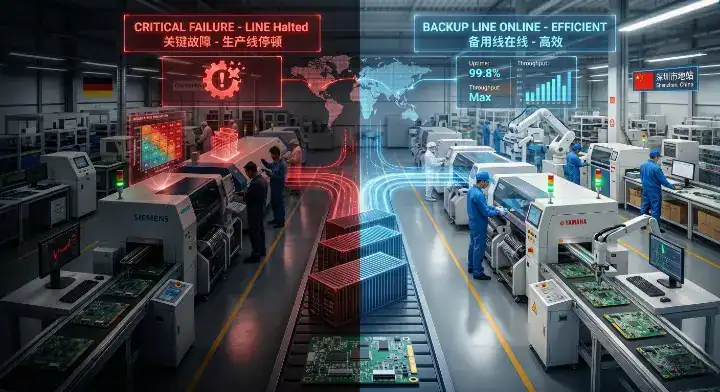
Single-sourcing your PCB assembly exposes you to 100% production halts if your manufacturer suffers a fire, flood, or local power outage. You also lose all pricing leverage, often paying 10–15% more during volume spikes because you have no alternative capacity. Without competition, your single CM has zero incentive to lower your component markup year over year.
Consider the numbers: relying on one supplier means their capacity limits become your revenue limits. If your demand jumps by 300% after a viral marketing campaign, a single CM will force you into a 6-month backlog.
| Risk Category | Single Source Exposure | Dual Source Mitigation |
|---|---|---|
| Facility Disaster | 100% loss of production for 8–12 weeks. | Reroute 100% volume to CM2 within 72 hours. |
| Component Shortage | Limited to one purchasing team’s network. | Two purchasing teams hunting global broker networks. |
| Pricing Power | CM controls annual price hikes (typically 3–5%). | Competitive bidding keeps markups 10% lower. |
| Capacity Crunch | Lead times extend from 3 weeks to 10 weeks. | Overflow volume shifts to the secondary line immediately. |
Choose single sourcing if your annual volume is under 500 units, but choose dual sourcing if a 3-week production halt costs you more than $10,000 in lost sales.
Bottom line: Single-sourcing is a massive financial gamble; you trade long-term security for a marginal 5% savings on initial tooling costs.
How Do You Decide Which Products Need Supplier Diversification?
You should dual-source high-margin products that generate over 30% of your revenue and have annual volumes exceeding 5,000 units. Low-volume prototypes or legacy boards under 100 units per year do not justify the $5,000–$10,000 duplicate qualification costs. It is mathematically incorrect to duplicate your entire product catalog.
The catch? You have to categorize your Bill of Materials (BOM) complexity first. A simple 2-layer board with 50 standard resistors is easy to move, but a 14-layer HDI board with custom BGAs requires massive engineering alignment.
| Annual Volume | BOM Complexity | Product Lifecycle | Dual Source Priority |
|---|---|---|---|
| > 5,000 units | Low to Medium | 3+ years | High (Start immediately) |
| 1,000 – 5,000 units | High (Custom ICs) | 2-3 years | Medium (Qualify, but split 90/10) |
| < 500 units | Medium | < 1 year | Low (Single source only) |
| Prototype (10-50) | Any | N/A | Do Not Dual Source |
Choose dual sourcing for your high-volume flagship devices, and keep your low-volume legacy boards single-sourced to save on NRE fees.
Bottom line: You must prioritize dual sourcing exclusively for products where the cost of a stockout is 10x higher than the cost of duplicate test fixtures.
How Do You Qualify a Second Source PCB Assembly Manufacturer?

You qualify a second source PCB assembly manufacturer by executing a 6-step framework that takes 4 to 8 weeks, culminating in a 50-unit pilot batch cross-comparison. Do not simply email your Gerber files and expect identical yields. You must use a golden board—a 100% verified, physically passed PCB from your primary CM—as the absolute reference standard.
What goes wrong? Clients frequently fail to realize that different CMs interpret stencils differently. Following the IPC-1791 standard provides a solid framework for qualifying trusted sources. Learning how to audit a PCB assembly factory protects your intellectual property during this exact phase.
We onboard roughly 3-4 “second source” customers every quarter at QueenEMS. A telecom client recently transferred a 480-component board to us as their backup source. First article yield was 91% vs 97% at their primary CM. The gap was not our capability—it was the reflow profile. After we received their primary CM’s reflow data and matched it within ±2°C, our yield hit 96.8%.
| Qualification Step | Typical Duration | Go/No-Go Criteria |
|---|---|---|
| 1. DFM Review | 3-5 days | Zero critical footprint errors found. |
| 2. Stencil & Fixture Setup | 7-10 days | Fixtures pass baseline calibration. |
| 3. First Article Build | 5-7 days | 3-5 boards pass 3D AOI & X-Ray. |
| 4. Pilot Batch (50 units) | 10-14 days | Yield must be within 2% of primary CM. |
| 5. Production Approval | 2-3 days | Client signs off on the golden board. |
Choose a rigorous 6-step qualification if your board has over 200 components, but choose a faster 3-step qualification for simple, 2-layer power distribution boards.
Bottom line: You must physically compare the pilot batch from the new CM against the golden board from your primary CM before authorizing mass production.
How Should You Split Volume Between Two CMs?
You should split volume using an 80/20 primary/backup model for established products, guaranteeing the backup CM at least 1,000 units annually to keep their SMT lines active. A 60/40 balanced split works better for high-volume consumer devices exceeding 50,000 units. You cannot simply give 100% to one factory and 0% to the other, or the backup will drop you.
Think about this: managing two relationships requires feeding both factories enough volume to justify their engineering support. Determining turnkey vs consigned assembly models for each CM changes how you allocate this volume.
- 80/20 Split: Maximizes volume discounts with the primary CM while keeping the secondary CM warm.
- 60/40 Split: Best for geopolitical hedging across two different countries.
- Product-Line Split: Factory A builds Product X, Factory B builds Product Y. Cross-train them as backups.
- Regional Split: EU factory builds for EU market, US factory builds for US market.
If you struggle with holding components for both locations, you must evaluate PCBA inventory JIT vs safety stock strategies to avoid tying up millions in cash.
| Split Model | How it Works | Best For | Drawback |
|---|---|---|---|
| 80 / 20 | Primary gets bulk; backup gets small runs. | Mid-volume B2B hardware (5k-10k/yr). | Backup CM gives you lower priority. |
| 60 / 40 | Near-equal distribution. | High-volume consumer goods. | Loses maximum tier pricing discounts. |
| Product Split | CM1 handles Board A, CM2 handles Board B. | Complex catalogs with 10+ products. | Takes 4 weeks to cross-train in a crisis. |
Choose the 80/20 model to protect your profit margins on standard orders, but choose the 60/40 model if your primary risk is US-China tariff instability.
Bottom line: You must award your secondary CM at least 15-20% of your annual volume, otherwise their engineers will forget how to build your product.
How Do You Maintain Quality Consistency Across Two Manufacturers?
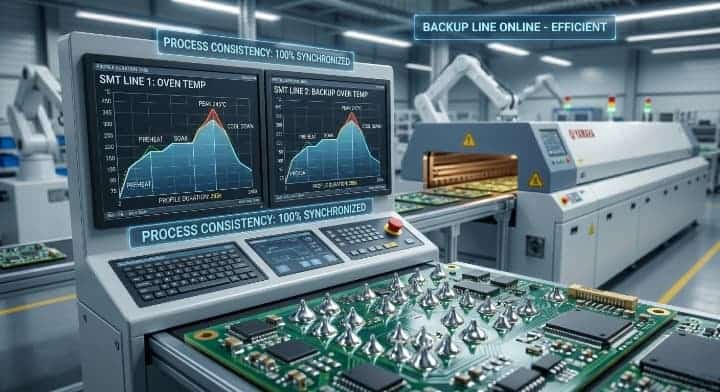
You maintain quality consistency by strictly locking down 5 core process parameters across both CMs: solder paste type, reflow profile, IPC class, test coverage, and the component sourcing AVL. A ±2°C deviation in reflow temperatures between two factories will cause severely mismatched solder joint reliability on the exact same board.
Why does this happen? Customers often think a Gerber file guarantees identical results. A reflow profile is the specific temperature-time curve applied during soldering; matching it within ±2°C is required for identical joint formation across different factories.
- Solder paste chemistry must match exactly (e.g., SAC305).
- Test coverage percentage must be identical.
- Approved Vendor List (AVL) for alternate components must be rigidly enforced.
- Operator skill levels (IPC-A-610 certified) must align.
Handling component shortages requires aligning both CMs; implementing proper EOL component management for PCB assembly guarantees both factories use the exact same replacement chips.
Bottom line: You must explicitly define your required solder paste and reflow temperature zones in your contract, rather than letting each CM use their default settings.
What Does PCB Assembly Dual Sourcing Actually Cost?
Setting up a dual-sourcing strategy costs between $5,000 and $15,000 in duplicate stencils, test fixtures, and first article inspections for a standard 4-layer board. However, this one-time 5-15% premium acts as supply chain insurance that routinely saves companies upwards of $100,000 when their primary line goes down.
Let the data speak: A medical device client single-sourced their patient monitor board with a US-based CM for 4 years. When equipment failure caused a 3-week shutdown, the client lost $180,000 in penalties. They came to QueenEMS to set up dual sourcing. Upfront investment: $8,500 for test fixture duplication and a 50-unit qualification run.
The following year, their primary CM hit a 2-week capacity crunch. We absorbed the overflow—building 800 boards in 10 days. The $8,500 qualification investment paid for itself 20x over in avoided penalties.
| Cost Item | Typical Upfront Cost | Annual Savings from Risk Mitigation |
|---|---|---|
| Duplicate Stencils & Tooling | $500 – $1,500 | Prevents 3-week delays ($50k+ saved) |
| Duplicate Test Fixtures (ICT) | $3,000 – $8,000 | Prevents shipping untested boards |
| First Article & Pilot Run | $1,500 – $5,000 | Avoids mass recall penalties |
| Split Volume Pricing Penalty | 2-4% unit cost increase | Negotiating leverage saves 5-8% long-term |
Choose to absorb the $8,500 upfront cost if you are building medical or industrial devices, but avoid dual sourcing if your product sells for under $10 and has a 6-month lifespan.
Bottom line: You must view the $5,000–$15,000 NRE duplication fee as a mandatory insurance policy rather than an unnecessary manufacturing expense.
What Are the Common Second Source Mistakes That Backfire?
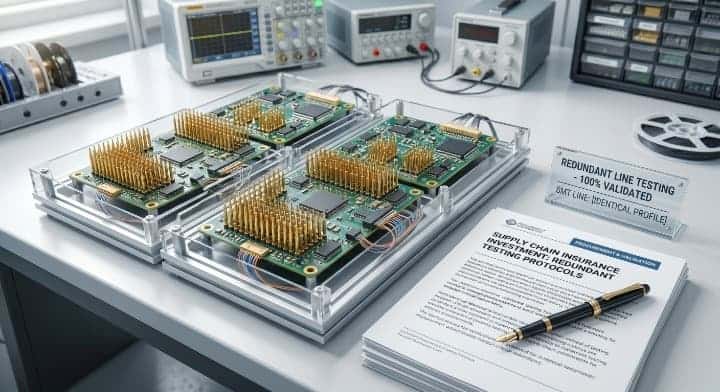
The most common dual-sourcing mistake is assuming your bill of materials (BOM) is perfectly standard, which causes a 10-20% component price variance between two CMs. You will also fail if you starve the secondary CM by giving them zero purchase orders for 12 months, causing them to reassign their engineers away from your project.
Here is the truth: Procurement teams frequently create artificial delays. If you do not execute a seamless transfer PCB assembly to new manufacturer protocol, you will generate two different versions of your product.
- Assuming “qualified” means “ready to scale to 10,000 units tomorrow.”
- Hiding the primary CM’s yield data from the secondary CM.
- Failing to duplicate custom testing firmware.
- Using two completely different component brokers.
Bottom line: You will destroy your secondary relationship if you only use them for chaotic, unrealistic 3-day emergency runs without ever awarding them stable, scheduled production.
How Do You Write a Dual Source Clause Into Your Contract?
You must write a dual-sourcing clause that explicitly grants you the legal right to use a second source while strictly protecting the intellectual property of both CMs. Your contract should guarantee a minimum 15% volume allocation to the secondary CM while avoiding exclusive single-source lock-ins with your primary partner.
Protect yourself: Contracts dictate survival. If you sign an exclusive volume agreement with CM1 to get a 3% discount, you forfeit your right to survive a crisis.
- Non-Exclusivity: Explicitly state you reserve the right to manufacture the exact same gerber files elsewhere.
- IP Protection: Prevent CM1 from claiming ownership over the test fixtures you paid for.
- Volume Commitments: Define the exact minimum order quantity (MOQ) the secondary CM needs to keep your account active.
- Golden Board Access: Guarantee your right to pull samples from CM1 to audit CM2.
Bottom line: You must refuse any manufacturing contract that demands 100% exclusivity, as it legally prevents you from building a resilient supply chain.
Developing a resilient supply chain means stopping single-point failures before they cost you your biggest clients. Managing two CMs requires precise data sharing, rigid qualification standards, and consistent volume splits.
At QueenEMS, we routinely serve as a reliable, high-yield secondary source for complex B2B hardware. With free DFM/DFA engineering reviews on every order, 3D AOI and X-Ray inspection on every BGA joint, and our 99.7% first-pass yield rate, we match and exceed your primary factory’s quality.
Stop risking your revenue on a single point of failure. Contact us today to qualify QueenEMS as your dedicated second source for full turnkey PCB assembly.
Written by the QueenEMS Engineering Team
FAQ
Can I use dual sourcing for small prototype runs? No, because spending $5,000 to duplicate tooling for 50 boards destroys your profit margins. Keep prototype runs under 100 units with a single quick-turn manufacturer. Contact our team to get free 2-4 layer FR4 prototypes for your initial validations.
What is the typical cost of qualifying a second CM? It costs between $5,000 and $15,000 depending on the complexity of your test fixtures and stencils. This one-time NRE investment protects you from catastrophic revenue loss. Review your current tooling budget and ask us for a transparent NRE quote.
How long does it take to qualify a backup PCB assembler? It takes 4 to 8 weeks to complete the full 6-step qualification process, including DFM review and the 50-unit pilot batch. Do not wait for a crisis to start this clock. Send your Gerber files to our engineering team today for a free initial review.
Should I hide my primary manufacturer’s data from my backup CM? No, keeping reflow profiles and yield data secret guarantees your backup CM will produce mismatched quality. Share your golden board parameters openly to align both factories. Schedule a technical call with our engineers to compare your current process data.
Upload your files today · Free DFM check before production · Ship worldwide
Get your PCB prototypes in as fast as 24 hours. We handle FR4, Rogers, and Flex up to 60 layers — free prototypes for 2–4 layer boards, no minimum order.
Just upload your Gerber + BOM — we source every part, assemble, and inspect (AOI + X‑Ray) so you don't have to chase suppliers. Boards ship in as fast as 24 hours.