
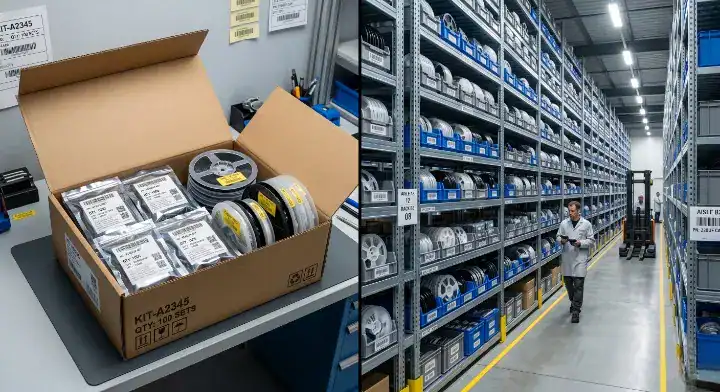
Quick Answer: Kitting requires you to pre-purchase and pre-package all components for a specific production run before shipping them to the factory, while consignment means storing your pre-purchased inventory at the contract manufacturer’s (CM) facility for ongoing, on-demand use. Implementing these models eliminates the standard 8–15% component markup charged by turnkey manufacturers, but requires you to purchase a mandatory 2–5% component overage to prevent costly production line stoppages due to setup waste. Key takeaways:
- Turnkey assembly adds an 8–15% markup to your BOM, which consignment entirely eliminates.
- SMT components must arrive in tape-and-reel packaging with a minimum of 200 parts per reel; using cut-tape forces a $500–$1,000 manual placement surcharge.
- You must add a 5% attrition allowance to your order quantities to cover inevitable pick-and-place machine waste.
- A formal consignment agreement protects your $30,000+ inventory from fire, flood, and expired shelf-life liabilities.
Table of Contents
- What Are Kitting and Consignment in PCB Assembly — and How Do They Differ?
- When Does Consignment Assembly Make More Financial Sense Than Turnkey?
- How Do You Prepare a Component Kit That Your CM Can Actually Use?
- What Packaging and Labeling Standards Does Your CM Require for Kitted Components?
- How Do You Handle Attrition, Overages, and Shortages in Kitting?
- What Liability and Ownership Terms Should a Consignment Agreement Include?
- How Do You Track Consignment Inventory at Your CM’s Facility?
- What Are the Most Common Kitting Mistakes That Delay Production?
Are you tired of paying an invisible 15% markup on every electronic component your factory buys for you? Conversely, have you ever tried buying your own parts, only to have the factory charge you a massive penalty because you shipped them in the wrong plastic bags? Mastering component logistics at QueenEMS allows hardware companies to slash production costs without losing control over their supply chain. Here is exactly how to execute a flawless kitting strategy.
What Are Kitting and Consignment in PCB Assembly — and How Do They Differ?
Kitting is a per-order logistics model where the customer pre-purchases and pre-packages all components needed for one specific production run, whereas consignment is an ongoing inventory model where customer-owned components are permanently stored at the CM’s facility. Understanding this difference dictates who pays for warehousing fees and who manages the daily stock levels.
Here is the reality: Deciding how to choose turnkey pcb assembly vs consigned assembly for your project fundamentally changes your financial risk.
- Turnkey assembly means the CM buys everything, adding an 8–15% component markup.
- Kitting means you buy exactly what is needed for one batch and ship a single box to the factory.
- Consignment means you ship 10,000 chips to the factory, and they pull 1,000 chips per month as needed.
| Dimension | Turnkey Assembly | Kitting (Per Order) | Consignment (Ongoing) |
|---|---|---|---|
| Component Markup | 8% – 15% added | 0% | 0% |
| Who Buys Parts? | Manufacturer | Customer | Customer |
| Storage Location | Manufacturer | Customer holds until build | Manufacturer |
| Best Used For | Fast prototypes | Highly custom small runs | High-volume production |
Choose turnkey assembly if you are a small startup with no dedicated procurement team, but choose consignment if you have established relationships with component brokers and want to permanently cut your unit costs by 10%.
Bottom line: You must transition from turnkey to a consignment model the moment your annual production volume exceeds 1,000 units, or you are simply throwing away profit margins on markup fees.
When Does Consignment Assembly Make More Financial Sense Than Turnkey?

Consignment assembly makes financial sense when your annual component savings (typically 10–15%) strictly exceed your added logistics overhead, which generally happens once you surpass 1,000 boards per year. If your BOM cost is $50 per board, avoiding a 10% markup saves you $5,000 annually per 1,000 units, easily justifying a $500 quarterly shipping cost.
At QueenEMS, we run the math for our clients daily. An industrial control client was spending $42 per board on turnkey assembly for a 4-layer board with 120 SMT components. Of that, roughly $28 went to components and $14 to assembly. Our turnkey component markup was 10% ($2.80 per board).
They had a reliable supplier in Shenzhen providing the exact same BOM for PCB assembly at $24 per board—a $4 per board savings. They switched to our consignment model, shipping parts to our warehouse quarterly.
- Annual volume: 4,000 boards.
- Annual component savings: $4 × 4,000 = $16,000.
- Added logistics cost: $800/quarter in shipping + $200/quarter storage fee = $4,000/year.
- Net annual savings: $12,000. Their breakeven point was 1,200 boards per year.
Bottom line: You should calculate your exact component markup spend today; if that number exceeds $5,000 annually, you are losing money by not running a consignment model.
How Do You Prepare a Component Kit That Your CM Can Actually Use?
You prepare a component kit by supplying all SMT parts in continuous tape-and-reel format with a minimum of 200 components per reel, keeping through-hole parts in rigid tubes, and separating every part number into clearly labeled bags. When customers ignore this and send loose cut-tape strips, pick-and-place machines cannot feed the parts automatically, forcing the CM to charge a $500 to $1,000 manual placement fee.
Think about this: An automated SMT feeder needs a physical “leader” tape to pull the components into the machine. If you send a strip of exactly 50 chips, the machine cannot grab it.
- SMT components must be on reels.
- Connectors and large ICs must be in rigid plastic trays.
- Loose parts dumped in a single ziplock bag will be immediately rejected.
You must also verify the moisture sensitivity level of your chips. If you open a factory-sealed bag of microcontrollers to “count them” before shipping them to your CM, you just exposed them to humidity, guaranteeing they will crack during the reflow process.
| Component Type | Acceptable Packaging | Unacceptable Packaging | Why It Matters |
|---|---|---|---|
| SMT Passives | Tape and Reel (>200 pcs) | Loose cut-tape strips | SMT feeders cannot grab short strips. |
| Microcontrollers | Sealed vacuum bags | Open plastic bags | Ambient humidity causes chip popcorning. |
| Through-Hole | Ammo pack / Tubes | Tangled in a box | Pins get bent and ruined during transit. |
| Connectors | Hard plastic trays | Bubble wrap | Trays allow robotic arm pickup. |
Choose tape-and-reel packaging for every component smaller than 10mm, but choose rigid trays for large, fragile components like BGA processors.
Bottom line: You must never send cut-tape components to a factory unless you explicitly want to pay premium hourly rates for a human to place each chip with tweezers.
What Packaging and Labeling Standards Does Your CM Require for Kitted Components?
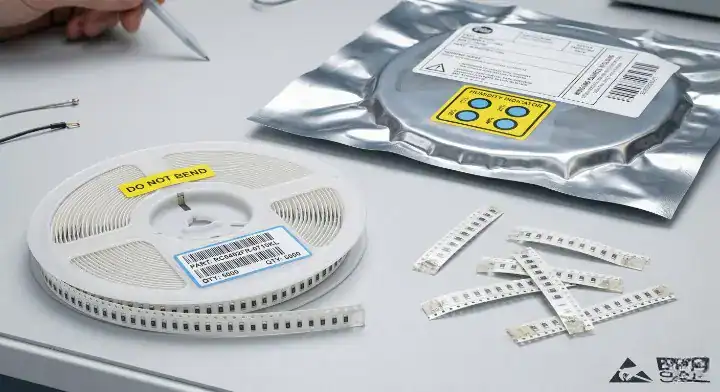
Your CM requires every package in a kit to feature a printed label displaying your company name, the exact manufacturer part number (MPN), the reference designators (e.g., C1, R5), and the total quantity enclosed. Furthermore, the JEDEC J-STD-033 standard dictates that moisture-sensitive components must arrive in sealed moisture-barrier bags containing fresh desiccant and a visible humidity indicator card.
A missing label stops the entire PCB assembly order process 12 steps dead in its tracks. A CM operator will never guess what a part is. If they receive an unlabeled reel of capacitors, they will quarantine your entire order until you provide documentation.
- Include a master packing list in the box.
- Label the outside of the box with the Project Name and Purchase Order number.
- Cross-reference the MPN on the label directly to your BOM.
Bottom line: You must label every single bag and reel with the exact reference designators listed in your BOM, or the factory receiving team will reject your shipment at the loading dock.
How Do You Handle Attrition, Overages, and Shortages in Kitting?
You handle attrition by multiplying your exact BOM quantity by a 2% to 5% overage factor for every single component, supplying the factory with extra parts to cover machine setup waste and dropped chips. If you need 1,000 resistors and send exactly 1,000 resistors, the factory will inevitably run out at board number 980.
The math is simple: Feeder loading loss is unavoidable. When the operator threads the tape into the SMT machine, the first 6 to 10 inches of tape are exposed and the components inside are lost.
| Component Type | Required Attrition % | Calculation Example (for 1,000 unit build) |
|---|---|---|
| 0402 / 0201 Passives | + 5% | 1,000 BOM qty × 1.05 = 1,050 pcs to order |
| 0805 / 1206 Passives | + 3% | 1,000 BOM qty × 1.03 = 1,030 pcs to order |
| Standard ICs / SOPs | + 2% or 5 extra | 1,000 BOM qty + 20 = 1,020 pcs to order |
| Expensive BGAs / MCUs | + 1% or 2 extra | 1,000 BOM qty + 2 = 1,002 pcs to order |
Choose a 5% attrition rate for microscopic, low-cost components, but choose a strict 1-2 piece overage for expensive $50 processors to protect your cash flow.
When establishing your PCBA inventory JIT vs safety stock balance, you must factor these attrition percentages into your purchasing formulas.
Bottom line: You must explicitly order and ship a 5% overage for all passive components, because halting a $50,000 production line over a missing $0.02 resistor is a massive procurement failure.
What Liability and Ownership Terms Should a Consignment Agreement Include?

A consignment agreement must legally document that you retain full physical ownership of the parts, while assigning the CM 100% financial liability for inventory damaged by poor storage, natural disasters, or expired shelf life due to their negligence. Without this written contract, your $30,000 component inventory is completely unprotected.
Procurement managers frequently skip this legal step. If you ship valuable inventory to a facility without a contract, what happens if the CM accidentally uses your microcontrollers to build another customer’s product?
- Ownership: Clearly states the components belong to you, preventing the CM’s creditors from seizing them if the factory goes bankrupt.
- FIFO Rotation: Mandates First-In-First-Out usage to prevent parts from degrading.
- Shelf Life: Dictates who pays if components expire while sitting in the warehouse.
- Insurance: Requires the CM to hold property insurance covering the full value of your consigned stock.
When dealing with a PCB assembly dual sourcing strategy, you will need two identical consignment agreements to protect your assets across both geographical locations. Furthermore, if you are executing an EOL component management for PCB assembly strategy, the agreement must specify how the CM will store these aging chips safely for 3-5 years.
| Consignment Term | What It Covers | Recommended Clause | Risk If Missing |
|---|---|---|---|
| Liability for Damage | Water, fire, or handling damage. | “CM reimburses 100% of replacement cost.” | You pay twice for the same parts. |
| FIFO Rotation | Age management of chips. | “CM guarantees First-In-First-Out usage.” | Solderability fails due to expired stock. |
| Physical Separation | How parts are stored. | “Customer stock kept in dedicated, labeled bins.” | Parts get mixed with other clients’ orders. |
| Shrinkage Allowance | Acceptable rate of lost parts. | “Max 1% annual inventory shrinkage.” | CM loses 5% of your parts with zero penalty. |
Choose to draft a strict consignment agreement if you are storing over $10,000 in inventory, but choose a simple per-order kitting document if you are just sending parts for a one-off prototype.
Bottom line: You must refuse to ship bulk inventory to any CM that will not sign a document accepting full financial liability for water, fire, and handling damage.
How Do You Track Consignment Inventory at Your CM’s Facility?
You track consignment inventory by requiring your CM to provide a digital, API-accessible portal or a strict monthly inventory report detailing current stock levels, recent usage, and scrap rates. The IPC-1601 printed board handling standard also provides guidelines on how facilities should log and track sensitive electronics, giving you a framework to audit their warehouse.
If you rely on emails asking “how many chips are left?”, your supply chain will collapse. You must audit their physical count against your expected PCB assembly cost ledger every 90 days.
Bottom line: You must demand monthly usage reports from your CM showing exact attrition rates, otherwise you will blindly reorder parts you do not actually need.
What Are the Most Common Kitting Mistakes That Delay Production?
The most common kitting mistake is sending SMT components in loose cut-tape, which halts production entirely until the client pays a manual placement fee. The second most common mistake is providing zero attrition overage, mathematically guaranteeing the factory will run short before the final board is built.
At QueenEMS, we see cut-tape mistakes at least once a month. A robotics startup recently shipped us their “complete kit” for a 200-unit run. Out of 180 unique SMT parts, 23 were in cut-tape strips of 50 pieces each. Our automated line requires a minimum of 200 pieces per reel.
We had two choices: return the cut-tape and delay them 2 weeks, or hand-place the components, adding $3.50 per board in manual labor ($700 total). The customer paid the $700 surcharge to avoid delays, but they were frustrated. To fix this industry-wide issue, we now send every kitting customer a one-page packaging specification sheet before they ship anything.
| Kitting Mistake | What Happens on the Floor | How to Prevent It |
|---|---|---|
| Sending Cut-Tape | Pick-and-place machine rejects parts. | Order tape-and-reel (min 200 pcs). |
| Zero Attrition Overage | Factory runs out of parts at 98% completion. | Multiply BOM qty by 1.05 before ordering. |
| No Reference Labels | Receiving team quarantines the box. | Label every bag with C1, R5, etc. |
| Opening Sealed IC Bags | Chips absorb humidity and crack in the oven. | Leave moisture-sensitive bags factory sealed. |
Another massive failure occurs when a customer sends exactly 200 components for a 200-board run. After feeder waste, we are short on 15 component types by board #198. Production stops. The customer overnights the missing 20 pieces, paying $85 in parts and $45 in overnight shipping.
Bottom line: You must treat your kitting shipment like a highly regulated medical transfer; label everything, leave sealed bags intact, and always provide 5% extra.
Taking control of your component procurement through kitting and consignment protects your profit margins, but it requires relentless attention to packaging, labeling, and legal liability. A single mislabeled bag of cut-tape components will instantly erase the 10% savings you fought so hard to achieve.
At QueenEMS, we make consignment and kitting flawless. We provide strict, easy-to-follow packaging guidelines, transparent consignment agreements, and dedicated bonded warehouse space for your inventory. With our 99.7% first-pass yield rate and free DFM/DFA engineering reviews, your components are always in safe hands.
Stop paying invisible markups on your high-volume production. Contact us today to set up a secure consignment assembly program and instantly cut your unit costs.
Written by the QueenEMS Engineering Team
FAQ
What is the difference between kitting and consignment in PCB assembly? Kitting is a per-order model where you package and ship the exact components needed for one specific production run, whereas consignment is an ongoing model where you store bulk inventory at the factory for them to pull from continuously.
What is the minimum reel length required for automated PCB assembly? Your SMT components must be supplied on a continuous tape-and-reel with a minimum of 200 to 300 components to provide enough physical “leader tape” for the pick-and-place machine feeders to grab.
How much component attrition percentage should I add to my kitted order? You must add a 5% attrition overage for microscopic passive components (like 0402 resistors) and a 1-2% overage for larger, expensive ICs to account for unavoidable machine setup waste and dropped parts.
Who pays for damaged components in a consignment assembly agreement? The contract manufacturer (CM) pays for the replacement of components if they are damaged by water, fire, or poor storage conditions while in their warehouse, provided you have a legally signed consignment liability agreement.
When does a consignment assembly model actually save money? Consignment saves you money when your annual component volume is large enough (typically over 1,000 boards per year) that the 10-15% savings from avoiding the CM’s markup strictly outweighs your added shipping and warehousing logistics costs.
Upload your files today · Free DFM check before production · Ship worldwide
Get your PCB prototypes in as fast as 24 hours. We handle FR4, Rogers, and Flex up to 60 layers — free prototypes for 2–4 layer boards, no minimum order.
Just upload your Gerber + BOM — we source every part, assemble, and inspect (AOI + X‑Ray) so you don't have to chase suppliers. Boards ship in as fast as 24 hours.