
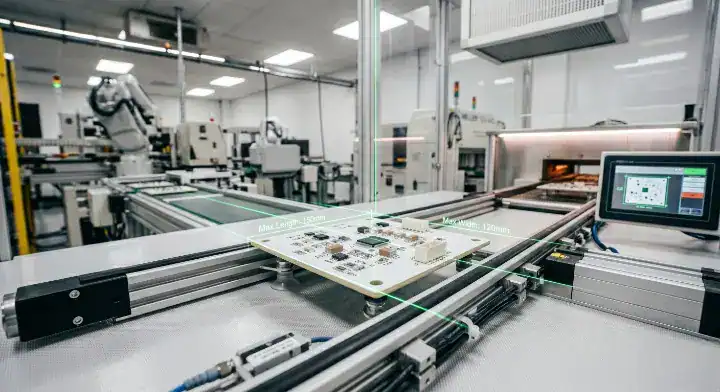
Quick Answer: There is no single maximum size that applies to every ceramic PCB process or supplier. Confirm the usable circuit area, finished-part limit and assembly handling envelope for the proposed material and copper build. A supplier’s master-card dimensions are not automatically the maximum finished board size, and a large design is not automatically unmanufacturable.
Check size feasibility before routing an expensive ceramic layout. The result depends on the ceramic grade, thickness, metallization, machining and equipment that will actually be used. The ceramic PCB guide explains those route choices; this article concentrates on the dimensions and alternatives that affect a large board.
Table of Contents
- 1. What Does a Supplier’s Maximum Size Mean?
- 2. Why Can Larger Ceramics Be Harder to Handle?
- 3. How Do DPC, DBC, LTCC and Thick Film Differ?
- 4. How Does Board Size Affect Cost and Yield?
- 5. Can Smaller Ceramic Sections Form a Larger Assembly?
- 6. When Should You Consider a Metal-Core or Hybrid Design?
- 7. How Does Thickness Change the Size Decision?
- 8. Can Denser Routing Reduce the Required Area?
- 9. What Can Power-Module Architectures Teach You?
- 10. Which Questions Should Be Answered Before Ordering?
1. What Does a Supplier’s Maximum Size Mean?
Ask for three separate dimensions: the starting panel or master card, the usable area for the circuit, and the maximum finished single piece. These numbers can differ because of handling borders, separation lanes, process features and product-specific restrictions.
Read the Usable Area Before Laying Out the Board
For a documented example, the 2026 Rogers curamik product information lists 127 × 178 mm as a maximum usable area. That is a specification for its stated product offering, not a universal DPC, DBC or ceramic-industry limit. Refer to the current product information and data sheet.
A proposed 200 × 150 mm board therefore needs a supplier-specific feasibility response. A smaller catalogue format is evidence that the design does not fit that offering; it is not proof that no other qualified line can make it.
Separate Fabrication from Assembly Limits
The fabricator may be able to supply a part that the assembler cannot transport or support in its standard equipment. Verify the outline, permitted support points, fixture envelope, component height and separation sequence with both parties.
| Dimension | What the answer should identify |
|---|---|
| Master-card size | Available starting format for the selected route |
| Usable area | Borders and process zones excluded from circuit placement |
| Finished part | Outline, cutouts and tolerances that can be supplied |
| Assembly envelope | Carrier, conveyor, stencil and inspection limits |
2. Why Can Larger Ceramics Be Harder to Handle?
Ceramics deform elastically; they do not have “zero flexibility.” Their brittle fracture behavior means flaws and tensile stresses deserve attention. A board does not necessarily shatter under every small bending load, and size alone does not predict when it will crack.
Span, Support and Edge Condition Matter
Larger unsupported spans can change the bending load during placement, transfer and mounting. Edge chips, holes and cutouts can create locally vulnerable regions. Review where a fixture supports the substrate and where clamps, vacuum tooling or components apply force.
The Kyocera material tables show that mechanical and thermal properties vary by ceramic grade. Do not turn one alumina modulus or flexural-strength value into a universal board-size rule.
Check the Actual Heating Pattern
Thermal gradients depend on the entire construction and process. High conductivity does not automatically mean higher thermal-shock risk: heat capacity, thermal expansion, strength, geometry and heat-transfer conditions also matter. Measure the populated board’s temperature history rather than assuming that a larger panel needs one prescribed slower profile.
For an existing failure, inspect the location and handling history using the ceramic assembly-cracking discussion. Changing panel size is only one possible corrective action.
3. How Do DPC, DBC, LTCC and Thick Film Differ?
Each process has different dimensional constraints, but the process name does not establish one maximum width, layer count or trace resolution.
| Route | Size-related information to obtain |
|---|---|
| DPC | Available ceramic blanks, deposition and plating envelope, flatness and patterning rules |
| DBC or AMB | Qualified ceramic/copper combinations, bonded format, edge geometry and separation method |
| LTCC | Tape system, fired dimensions, shrinkage compensation, layer registration and tooling limits |
| Thick film | Substrate format, printing and firing controls, registration and finished-feature tolerance |
LTCC involves co-firing a layered structure. Its shrinkage is material- and process-specific, and dimensional compensation belongs in the supplier’s design rules. Murata’s LTCC module-board leaflet describes its particular shrinkage-constraining process. Do not transfer a generic shrinkage percentage to all axes, tape systems or constrained-firing processes.
Get a drawing review for the finished dimensions. A quoted green-tape size, raw blank size or machine travel is not enough to establish the accuracy of the delivered circuit.
4. How Does Board Size Affect Cost and Yield?
Size can change nesting, handling, tooling and inspection, but no universal formula says that a 20% area increase causes a 10–15% yield reduction. Use quotations and representative process data for the proposed construction.
A Simple Nesting Calculation
Consider an illustrative layout, not a production claim: assume a usable rectangle of 120 × 170 mm after all required borders, square parts measuring 50 × 50 mm, and a 2 mm gap between adjacent parts. Two columns require 102 mm; three rows require 154 mm. Six parts fit this geometric arrangement.
This calculation does not include process yield, coupon space or restrictions not already excluded from the usable rectangle. Confirm those separately. A small outline change can alter parts per panel, while a larger area increase may leave the nesting count unchanged.
Now change only one assumption: reserve an additional 20 mm full-width strip at one end for a test feature. This is still a hypothetical geometry example, not a supplier requirement. The remaining rectangle is 120 × 150 mm. Three rows still need 154 mm and no longer fit; two rows and two columns need 102 × 102 mm, giving four positions in the same rectangular grid.
The reduction from six positions to four is a change in this assumed layout, not a measured decline in process yield. No parts have been fabricated or rejected. That distinction matters when comparing quotations: one supplier may reserve panel space for the requested tests while another quote may exclude them.
Ask for the panel drawing when a price depends on the nesting count. Check the part outline, gap convention, border and coupon reservation against that drawing. Some suppliers may include a separation allowance inside a stated cell size; others may quote it between finished outlines. Counting that allowance twice can make a feasible layout appear impossible, while omitting it can produce an unusable estimate. Keep the dimensional convention explicit before changing the product outline to save material.
Compare the Quote on Good Delivered Parts
Ask whether the price includes material loss, special fixtures, inspection and any expected reject allowance. Keep prototype tooling separate from repeat-order unit cost. A supplier’s yield figure is useful only with the construction, sample basis and acceptance criteria behind it.
5. Can Smaller Ceramic Sections Form a Larger Assembly?
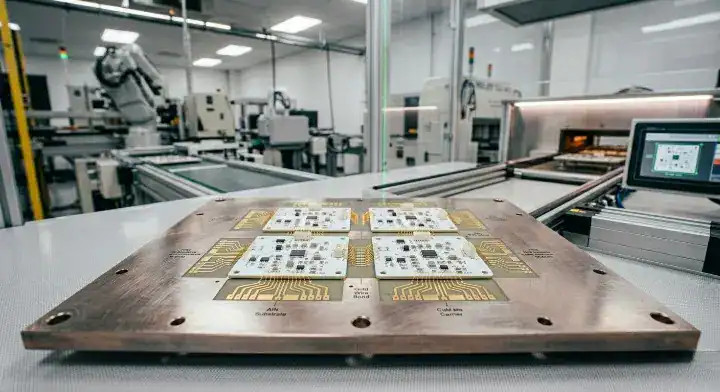
Yes. Separate ceramic sections can be mounted on a shared carrier and interconnected as a module. They remain separate substrates; the carrier does not turn them into one continuous ceramic circuit or eliminate all mechanical risk.
Choose the Attachment and Interconnect Together
Possible interconnections include suitable wires, ribbons, busbars, connectors or flexible circuits. Select them for current, parasitic inductance, insulation, temperature and assembly access. Gold wire bonding is not the universal solution for a high-current power module.
The attachment to a carrier is also a separate choice. It may use a qualified solder, sinter, braze or mechanical arrangement, depending on the construction. Do not confuse the AMB process that bonds copper to a ceramic with every method used to attach that finished substrate to a baseplate.
Include the Extra Interfaces in the Assessment
A segmented design adds joints, gaps and mounting details that can affect thermal resistance, stress and electrical performance. Compare the complete assembly with a single-piece candidate. Do not promise the same junction temperature or a fixed cost saving without calculations and representative testing.
Check the Accumulated Assembly Dimensions
Consider two hypothetical tiles placed end to end. Assume each tile is 50.0 mm ±0.1 mm long and the controlled gap is 1.0 mm ±0.2 mm. The nominal outer span is 50 + 1 + 50 = 101.0 mm. Adding the allowed dimensional extremes gives a worst-case span of 100.6 to 101.4 mm. All dimensions are assumed solely for this calculation; they do not describe a tested module or a supplier capability.
A housing designed around exactly 101.0 mm would therefore need further clearance analysis. Do the same check for the actual datum chain: if both tiles are positioned from independent carrier datums, the relevant location tolerances may differ from this simple end-to-end arrangement. Do not combine a tile-size tolerance with a fixture-position tolerance without first drawing how each dimension is referenced.
The arithmetic considers only lengths along one axis. It does not include tile rotation, local height differences, mounting deformation or thermal movement. Those effects can matter to a rigid busbar or a bonding tool even when the outer envelope fits. Review the joining method’s positional and height accommodation instead of expecting the interconnect to pull a brittle substrate into alignment.
Decide when the assembled dimensions will be inspected: before attachment, after attachment or after another process that could change the geometry. A conforming loose tile does not prove that the tiled assembly meets the housing or interconnection drawing. Keeping the substrate and assembly acceptance points separate helps identify whether an apparent size problem belongs to fabrication, positioning or joining.
6. When Should You Consider a Metal-Core or Hybrid Design?
Consider an insulated metal substrate when it can meet the thermal, electrical, dimensional and mechanical requirements at an acceptable cost. A dimension such as 150 × 150 mm is not an automatic changeover point.
The thermal conductivity of an IMS dielectric is a material property, not the complete board’s thermal resistance. Compare dielectric thickness, heat-source area, copper spreading, attachment and cooling. A large metal base does not automatically compensate for a restrictive insulating layer beneath a small hot component.
The metal-core manufacturing page identifies that alternative. A ceramic-versus-metal-core comparison should be applied to the actual thermal path, not a universal wattage or area threshold.
A hybrid layout can reserve ceramic for selected hot or electrically demanding regions and use another board for control routing. Assess the additional connections and tolerances before treating this as the lower-risk option. Metal-core boards also have mechanical and assembly limits; they are not immune to damage.
7. How Does Thickness Change the Size Decision?
Thickness changes stiffness, thermal resistance and the loads generated by the copper build. It does not create a universal table of safe sizes for alumina or AlN.
For a simple rectangular beam under the same bending moment, nominal bending stress varies inversely with the square of thickness. Real ceramic boards may not behave as that idealized beam: holes, support positions, flaws and two-dimensional loading matter. Use this relationship to understand the direction of the effect, not to certify a board as safe.
Increasing ceramic thickness can also increase through-thickness thermal resistance for otherwise unchanged geometry and conductivity. A thinner dielectric can affect electrical capacitance and insulation behavior. These trade-offs require the electrical, thermal and mechanical design to be checked together.
Ask for a supported construction at the proposed dimensions, including the fixture plan. Do not specify thickness as an unsupported percentage of the board diagonal.
8. Can Denser Routing Reduce the Required Area?
Denser routing may reduce area where interconnects are the limiting factor. It will not necessarily shrink heatsinks, creepage distances, connectors, component bodies or mechanical clearance.
Compare line-and-space rules for the actual finished copper. Moving from thick bonded copper to a finer plated process can also change current capacity, thermal spreading and assembly behavior. Do not assume a fixed percentage reduction in footprint.
Via-in-pad or multilayer routing requires a route that actually supports the proposed via structure, filling, planarity and registration. Organic-board HDI capabilities cannot be transferred automatically to a ceramic process. Discuss the stack and interconnect path with the supplier before rearranging the layout around a feature that is unavailable.
Keep the large current paths and insulation boundaries visible during this review. The smallest routable outline is not necessarily the most manufacturable power substrate.
9. What Can Power-Module Architectures Teach You?
Power modules illustrate several ways to separate electrical function from overall package size. A module can contain multiple ceramic sections or use a baseplate-free arrangement. Neither architecture establishes a universal tile size for the industry.
NGK identifies ceramic substrates as components of Si-IGBT and SiC-MOSFET power modules. Treat such application information as a starting point for architecture research. It is not evidence of the exact dimensions, lifetime or cooling performance of a proposed QueenEMS design.
Compare the proposed current loop, cooler interface, mounting points and insulation paths across the alternatives. A tiled architecture may make sense mechanically while introducing an unacceptable interconnect loop or assembly tolerance. Resolve those consequences before choosing a format.
10. Which Questions Should Be Answered Before Ordering?
Obtain a marked drawing showing the accepted finished outline and the process assumptions used for the quotation. It should distinguish routine capability from a construction that needs a trial.
- What usable area remains after borders, separation lanes and test features?
- Which ceramic grade, thickness and copper combination was assessed?
- How will the part be supported during fabrication, assembly and separation?
- Which dimensional, edge-condition and adhesion checks are included?
- Which changes would require different tooling or another feasibility review?
Adhesion should be evaluated with the agreed method and specimen. ASTM D3359 is a tape-test method for coating adhesion; it does not produce a quantitative copper peel value in N/mm. Its official scope should not be presented as proof that a large ceramic panel will survive assembly.
A quality-report example can help clarify the form of the deliverable. The measured characteristics and acceptance limits must still match this ceramic drawing. Agree any trials before committing to the ceramic order schedule.
FAQ
Can a 200 × 150 mm ceramic board be made as one piece? Ask suppliers for a construction-specific feasibility assessment. It may exceed a particular standard offering, but that is not proof of a universal industry limit.
What thickness should a 100 × 100 mm ceramic board use? Select it from the electrical, thermal and mechanical requirements and the qualified manufacturing options. There is no general minimum thickness that guarantees safe handling at that outline.
Does tiling guarantee lower cost? No. Include the carrier, interconnections, assembly operations and validation before comparing total cost.
Send QueenEMS the proposed outline, ceramic and copper stack, component layout and mounting concept through the ceramic substrate enquiry page. These inputs support a practical discussion of single-piece, segmented and alternative constructions.
Written by the QueenEMS Engineering Team
Upload your files today · Free DFM check before production · Ship worldwide
Get your PCB prototypes in as fast as 24 hours. We handle FR4, Rogers, and Flex up to 60 layers — free prototypes for 2–4 layer boards, no minimum order.
Just upload your Gerber + BOM — we source every part, assemble, and inspect (AOI + X‑Ray) so you don't have to chase suppliers. Boards ship in as fast as 24 hours.