
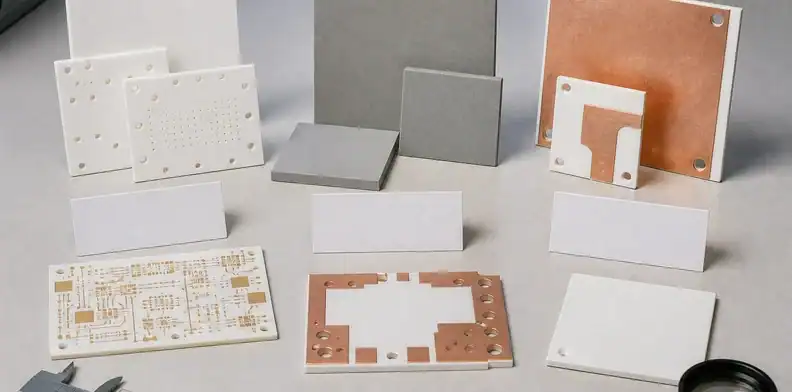
Ceramic PCB vs aluminum nitride substrate vs DBC is a confusing search because the three terms do not sit at the same level. One describes a board category, one describes a ceramic material or substrate family, and one describes a copper-bonding process used for power substrates.
The ceramic PCB guide introduces the material families and circuit processes used in this terminology comparison.
That terminology problem creates real purchasing risk. A buyer may ask for an “AlN ceramic PCB” when the drawing actually needs DPC. Another buyer may ask for “DBC ceramic PCB” when the product needs AMB for a power module. A third may ask a material factory for a complete assembled module when the factory mainly sells ceramic substrates.
Quick Answer: Ceramic PCB is the broad category for circuits built on ceramic materials such as alumina or AlN. Aluminum nitride substrate means an AlN ceramic base or circuit carrier, while DBC means direct bonded copper on ceramic; DBC can use ceramic materials such as alumina or AlN, but it is not the same thing as “AlN substrate.”
This terminology guide helps buyers prepare an unambiguous RFQ. The comparison of AMB and DBC substrates examines the two copper-bonding routes in more detail. The ceramic PCB manufacturing page and China supplier overview provide context for deciding which organization should quote each manufacturing step.
Table of Contents
- What does ceramic PCB mean?
- What is an aluminum nitride substrate?
- What is DBC, and why is it not the same term?
- Where do AMB, DPC, LTCC, thick film, and thin film fit?
- Which term should you use in an RFQ?
- How do buyers avoid supplier comparison mistakes?
- How should overseas buyers choose the right support path?
What does ceramic PCB mean?
Ceramic PCB is a broad buyer term for circuit structures built on ceramic instead of polymer laminate. It can include alumina, aluminum nitride, silicon nitride, LTCC, thick-film ceramic circuits, thin-film ceramic circuits, DPC ceramic boards, DBC substrates, AMB substrates, and related hybrid constructions.
The term is useful at the beginning of sourcing because it tells suppliers the design needs a ceramic base for heat, stability, insulation, package integration, RF behavior, or high-temperature service. It is not precise enough for quoting when the supplier must choose a material, conductor process, copper thickness, via route, finish, and inspection method.
Buyers often use “PCB” because they have Gerbers, pads, traces, and assembly needs. Material suppliers may use “substrate” because their product is the ceramic base or metallized ceramic carrier. Both sides can be right, but the quote can still go wrong when those words hide the actual process route.
| Buyer term | What it usually signals | What still needs definition |
|---|---|---|
| Ceramic PCB | Circuit on ceramic base | Material, conductor route, copper thickness, vias, finish |
| Ceramic substrate | Ceramic carrier or base | Whether it includes circuit pattern, copper, or assembly scope |
| Ceramic circuit board | Circuitized ceramic substrate | Process route, line/space, plating, bonding, inspection |
| Ceramic PCB assembly | Ceramic board plus components | Who supplies substrate, components, assembly, and test |
A complete RFQ should move from the broad term to the manufacturing route. Otherwise, a supplier may answer correctly for its own product category while missing the buyer’s project intent.
What is an aluminum nitride substrate?
An aluminum nitride substrate is a ceramic base or circuit carrier made from AlN. Buyers usually choose AlN when thermal conductivity, electrical insulation, package stability, or semiconductor-related thermal management matters. It can be bare ceramic, metallized ceramic, DPC, DBC, AMB, or another AlN-based construction depending on the supplier and application.
The phrase “AlN substrate” is therefore a material-centered term. It does not automatically define copper thickness, trace/space capability, metallization process, via structure, finish, or whether the supplier will provide assembly. A bare AlN plate and a patterned AlN power substrate are very different buying objects.
AlN is not a universal material upgrade. Compare it with an identified alumina or silicon-nitride grade for the thermal, mechanical and electrical requirements. Then choose a compatible metallization route such as DBC, AMB, DPC or thin film. LTCC describes a co-fired construction, so it belongs in a structural/process comparison rather than a list of interchangeable material names.
The QueenEMS article on ceramic PCB thermal conductivity explains AlN vs alumina vs silicon nitride as a material comparison. This page focuses on the terminology problem: AlN names the ceramic material, not the whole manufacturing route.
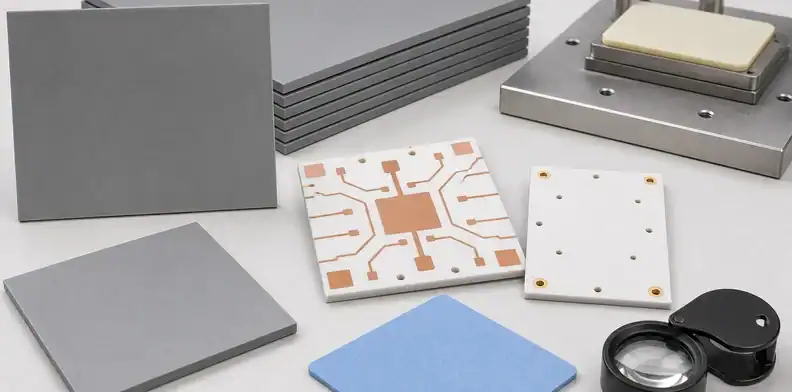
What is DBC, and why is it not the same term?
DBC means direct bonded copper, a process where copper is bonded directly to a ceramic substrate. DBC is commonly discussed in power electronics because it can provide copper area for current and heat spreading while the ceramic provides insulation.
DBC is a process/construction term, not a material name. A DBC substrate can use different ceramic materials depending on the supplier and application. That is why “DBC vs AlN” is not a clean comparison. A better comparison is “DBC on alumina vs DBC on AlN,” or “DBC vs AMB vs DPC for this power or thermal requirement.”
The confusion matters because DBC affects copper thickness, copper pattern, isolation spacing, thermal cycling behavior, edge clearance, and stress risk. Asking for “AlN” alone will not tell the supplier whether direct bonded copper is required. Asking for “DBC” alone will not tell the supplier which ceramic material is acceptable.
| Term | Level of meaning | Example RFQ clarification |
|---|---|---|
| AlN | Ceramic material | Is the substrate aluminum nitride, and what grade or property basis is used? |
| DBC | Copper bonding process | Is direct bonded copper required, and what copper construction is quoted? |
| DBC on AlN | Material plus process | Does the supplier support this construction for the design rules and cycling need? |
| DBC on alumina | Material plus process | Is the lower-cost route acceptable for the thermal and electrical requirement? |
DBC also does not mean fine-line ceramic PCB by default. A DBC power substrate may have strong copper and thermal value while being unsuitable for the smallest signal geometry a buyer associates with PCB traces.
Where do AMB, DPC, LTCC, thick film, and thin film fit?
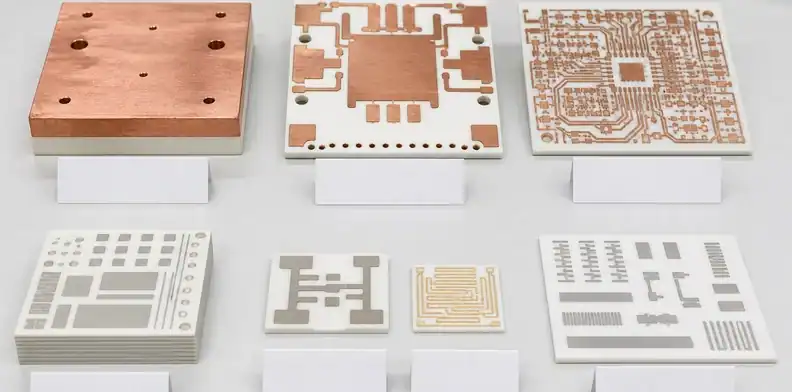
AMB, DPC, LTCC, thick film, and thin film are additional process or construction terms that help narrow the ceramic PCB category. They answer different questions than “AlN” or “ceramic PCB.”
AMB means active metal brazed construction and is often discussed for demanding power module substrates. DPC means direct plated copper and is often associated with plated copper on ceramic, vias, and finer circuit structures. LTCC means low-temperature co-fired ceramic, a multilayer ceramic route. Thick-film and thin-film ceramic circuits describe metallization methods that carry their own line, finish, and performance assumptions.
The right term depends on the design problem. Power modules may start with DBC vs AMB. Compact RF or package-like work may involve LTCC, thin film, or DPC. LED and thermal carrier projects may start with alumina vs AlN and then narrow to metallization route. Medical, sensor, or optical modules may care about material stability, finish, and assembly evidence as much as thermal conductivity.
| Term | Best first use | What it does not define alone |
|---|---|---|
| AMB | High-reliability power substrate discussion | Final copper pattern, ceramic grade, cycling evidence |
| DPC | Plated ceramic circuit discussion | Material choice, via limits, finish, assembly scope |
| LTCC | Multilayer ceramic package or RF module discussion | Finished module assembly and all RF evidence |
| Thick film | Printed/fired metallization discussion | Fine geometry and high-frequency suitability |
| Thin film | Precision metallization discussion | Copper thickness and power handling |
The ceramic PCB thickness and trace/space capability article is useful after the terminology is clear, because every route changes thickness, copper, and geometry limits.
Which term should you use in an RFQ?
Use the term that matches the information you actually know, then state what is open for supplier recommendation. Buyers do not need perfect terminology before contacting a supplier, but they do need to avoid mixing category, material, process, and assembly scope in one vague phrase.
When the material is fixed, identify AlN and the grade or approved property specification. When the process is fixed, state it separately, for example DBC on AlN with copper-pattern changes subject to design approval. If the route is open, give the heat, current, insulation and geometry requirements and ask the supplier to propose a material and metallization combination. The response should not mix the two columns.
| Buyer situation | Better RFQ wording |
|---|---|
| Material known, process open | “AlN ceramic substrate preferred; please recommend metallization route.” |
| Process known, material open | “DBC substrate required; please compare ceramic material options.” |
| Power module | “Review DBC vs AMB route for current, heat, cycling, and mounting.” |
| Fine circuit | “Review DPC, thin-film, or LTCC route for line/space, vias, and finish.” |
| Prototype only | “Mark which recommendations are prototype-only vs production-ready.” |
This wording helps the supplier answer within its real capability. It also makes quotes easier to compare because each supplier must state whether it is quoting category, material, route, or full build scope.
Turn the terms into one priced line item
A usable line item names the delivered state: patterned and finished substrate to drawing revision C; AlN grade or approved specification; DBC metal-to-ceramic construction; top and bottom finished copper thickness; ceramic thickness; outline and hole tolerances; selective finish; inspection deliverables; and quantity. Populate those fields from the approved drawing and supplier response. This is a line-item structure, not a recommendation for a particular dimension or finish.
The Rogers curamik product sheet lists ceramic/copper thickness combinations and surface options separately. That separation illustrates why an AlN plate price, a copper-clad blank price and a patterned finished-substrate price are different offers even if all three use the phrase “AlN substrate.” A supplier catalogue does not confirm QueenEMS availability.
| Requirement status | How to record it |
|---|---|
| Fixed by design | Identify the drawing field and revision; substitution needs approval |
| Offered alternative | State the changed grade, process, thickness or finish beside its price |
| Excluded from quote | Name omitted patterning, assembly, test or documentation explicitly |
| Awaiting a decision | List the unresolved input and who must supply it before release |
Review a revised quote against that line before comparing totals. If the cheaper version drops backside copper, leaves the ceramic bare or excludes the specified finish, the saving is attached to a different deliverable. Resolve the difference while the part is still a drawing.
How do buyers avoid supplier comparison mistakes?
Buyers avoid supplier comparison mistakes by comparing equivalent constructions. A low price for alumina thick film should not be compared directly with a DBC on AlN quote. A bare AlN substrate quote should not be compared with a ceramic PCB assembly quote. A material factory’s substrate quote should not be treated as the same deliverable as a prototype build with DFM, assembly, and documentation.
The first comparison step is scope. Does the quote include only ceramic material, metallized substrate, circuit pattern, finish, inspection report, assembly, components, test, or documentation? The second step is route. Does the quote name alumina, AlN, DBC, AMB, DPC, LTCC, thick film, or thin film? The third step is evidence. Does it state design rules, copper thickness, thermal assumptions, cycling support, and change-control limits?
Common comparison errors include:
- Treating “AlN substrate” and “DBC substrate” as mutually exclusive terms.
- Comparing a bare substrate quote with an assembled module quote.
- Assuming every ceramic supplier can handle vias, fine lines, cavities, and assembly.
- Choosing the lowest price without checking material substitution rights.
- Treating a prototype-only process suggestion as production-approved.
The manufacturer-evaluation article addresses supplier screening. Resolve the material and process terms before using that checklist to compare offers.
How should overseas buyers choose the right support path?
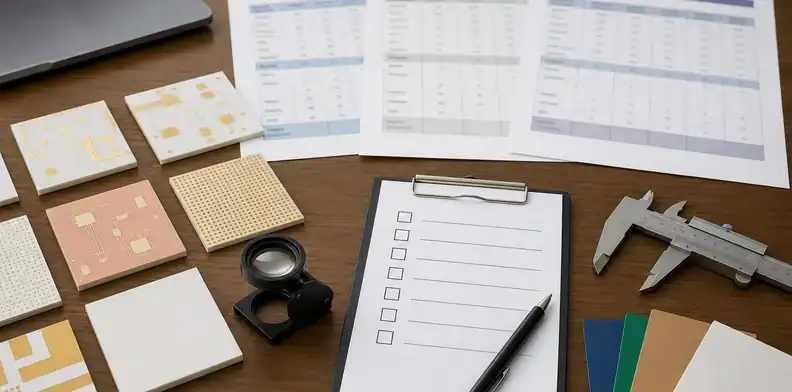
Overseas buyers should choose the support path by project stage. Material exploration can start with large ceramic material or substrate suppliers. A mature power module may need a DBC or AMB specialist. A small prototype, mixed PCB plus assembly project, or startup design usually needs help turning uncertain terminology into quote-ready drawings and supplier questions.
Large suppliers can be strong when the construction is already known and volume justifies their process. Smaller overseas teams may struggle when the supplier asks for exact process terminology, drawing notes, material grade, copper route, and assembly evidence before the buyer has resolved the design route.
QueenEMS fits the complementary path: overseas prototype and low-volume ceramic PCB projects where English communication, time-zone-friendly DFM feedback, PCB and assembly coordination, and documentation review matter. The goal is to help the buyer ask the substrate supply chain the right question, not to blur material terms further.
Send QueenEMS your ceramic terminology and RFQ package
Send the drawing, application requirements and existing supplier descriptions through the QueenEMS RFQ contact. Identify which material, process, metal thickness, finish and assembly scope are fixed, and which remain open. Request a quote that lists those fields separately so a bare plate cannot be mistaken for a finished circuit or assembled module.
FAQ
Is ceramic PCB the same as aluminum nitride substrate?
No. Ceramic PCB is a broad category, while aluminum nitride substrate names an AlN ceramic material or base. An AlN substrate may or may not include circuit patterns, copper bonding, plating, finish, or assembly.
Is DBC the same as AlN?
No. DBC is a direct bonded copper process, while AlN is a ceramic material. A buyer may request DBC on AlN, DBC on alumina, or another construction depending on the application.
Should I ask for DBC or AMB?
Ask for DBC vs AMB when the project is a power substrate or power module and copper bonding, current, heat, cycling, and mounting are central. For fine circuits or compact modules, DPC, thin film, or LTCC may be a better discussion.
Can a ceramic PCB supplier recommend the right term?
Yes, but only if the RFQ includes application, heat, current, voltage, geometry, assembly, and production expectations. A vague request for “ceramic PCB” leaves too much room for mismatched quotes.
What term should I use for prototype sourcing?
Use “ceramic PCB prototype” plus the known material or route if you have one. Then ask the supplier to mark whether AlN, alumina, DBC, AMB, DPC, LTCC, thick film, or thin film is standard, review-only, or not recommended.
Sources
- Ferrotec, Power Semiconductor Substrates
- CeramTec, Aluminum Nitride ceramic material
Written by the QueenEMS Engineering Team
Upload your files today · Free DFM check before production · Ship worldwide
Get your PCB prototypes in as fast as 24 hours. We handle FR4, Rogers, and Flex up to 60 layers — free prototypes for 2–4 layer boards, no minimum order.
Just upload your Gerber + BOM — we source every part, assemble, and inspect (AOI + X‑Ray) so you don't have to chase suppliers. Boards ship in as fast as 24 hours.