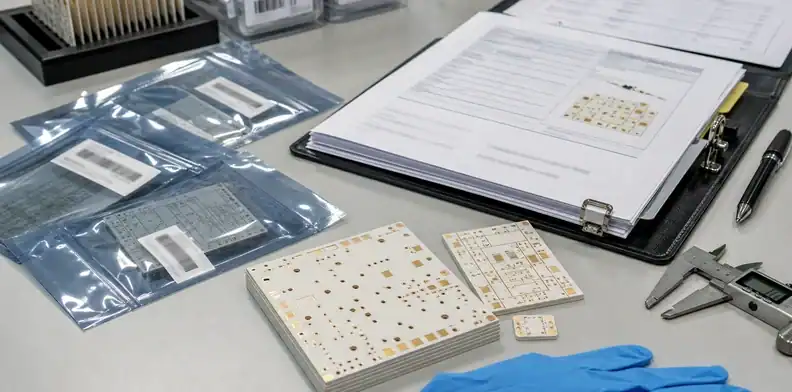
Quick Answer: A ceramic PCB for medical devices should be selected by patient-contact risk, cleaning or sterilization exposure, traceability, material declaration, assembly boundary, and regulatory documentation needs. Ceramic materials may help with insulation, heat, stability, or package reliability, but they do not automatically make a device biocompatible or implant-ready. For implantable or patient-contact use, the device manufacturer must define the contact category, biological evaluation plan, sterilization method, validation evidence, and change-control rules before a supplier quote is approved.
For substrate and metallization background, see the ceramic PCB guide; the contact and finished-device questions below need their own evaluation.
- Ceramic PCB is a manufacturing input, not a shortcut around medical-device biological evaluation.
- Medical buyers should separate non-contact electronics, patient-contact assemblies, and implantable components before quoting.
- The RFQ should ask for material, finish, process, cleaning, sterilization exposure, traceability, and change-control evidence.
Medical and implantable electronics create a different kind of sourcing risk. A board can be electrically correct and still be unacceptable if the material record, cleaning process, sterilization exposure, packaging, or change-control evidence does not match the device file. For overseas buyers, this is where “ceramic PCB” must turn into a controlled manufacturing record rather than a material label.
This article is not medical or regulatory advice. It is a buyer-side manufacturing guide for engineers and purchasing teams preparing a ceramic PCB RFQ for medical, diagnostic, wearable, surgical, or implantable-device development. Regulatory classification, biological evaluation, sterilization validation, and device approval remain the responsibility of the device manufacturer and its qualified regulatory team.
Table of Contents
- What does ceramic PCB solve in medical electronics?
- Is ceramic PCB automatically biocompatible?
- How should buyers classify patient-contact risk before RFQ?
- What changes for implantable or body-contact devices?
- How does sterilization exposure affect ceramic PCB selection?
- What material and process records belong in the quote?
- How should assembly, cleaning, and packaging be controlled?
- What supplier evidence should overseas buyers verify?
- How should buyers choose the right medical ceramic PCB partner?
What does ceramic PCB solve in medical electronics?
Ceramic PCB can solve heat, insulation, dimensional stability, miniaturization, or package-interface problems in medical electronics. It may appear in diagnostic instruments, sensor modules, optical heads, surgical tools, high-voltage isolation assemblies, implantable-device development, or compact electronics that need stable material behavior.
The medical decision starts with use case, not material family. A ceramic board inside a bench-top diagnostic instrument faces a different compliance path from a ceramic subassembly inside a patient-contact probe. An implantable assembly is a separate and much stricter case. The same material name may appear in all three, but the evidence package should not be the same.
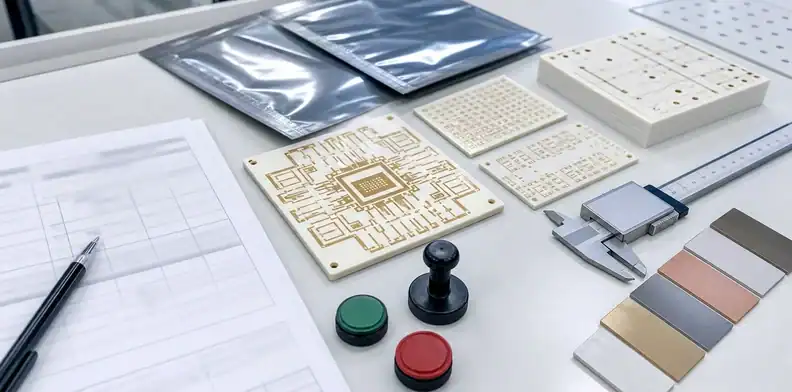
The buyer should define whether the ceramic item is a bare substrate, patterned ceramic PCB, metallized ceramic package, assembled PCBA, or part of a sealed module. That scope controls what the supplier can document and what the device manufacturer must validate.
Ceramic may be attractive because it can tolerate heat, provide electrical insulation, support stable small geometries, and work in package-like structures. The QueenEMS ceramic PCB manufacturer hub gives broader material and process context, but none of those properties replace the device’s biological evaluation, sterilization validation, or regulatory file.
Is ceramic PCB automatically biocompatible?
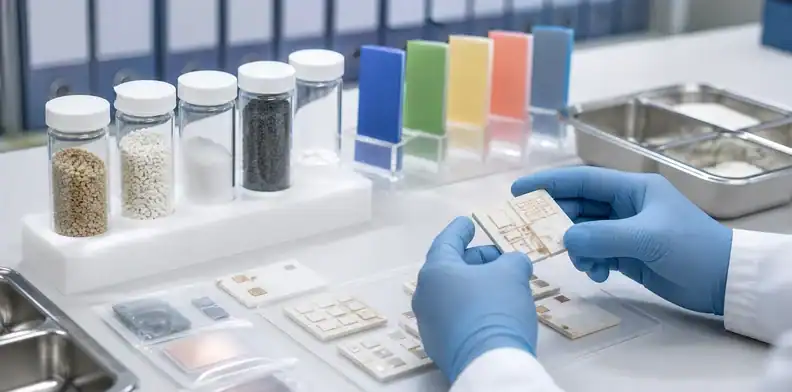
No, ceramic PCB is not automatically biocompatible just because the base material is ceramic. Biocompatibility is evaluated for the finished device or patient-contacting materials under the intended use, contact duration, contact type, processing, residues, packaging, and sterilization condition.
ISO 10993-1:2025 addresses biological evaluation within a medical-device risk-management process; ISO published it in November 2025 and withdrew the 2018 edition. Regulatory recognition is a separate matter. As checked on 5 September 2026, FDA recognition 2-313 is partial: it excludes the phrase “consumer products” in clause 6.5.11.3 and clause 6.9. The same record allows declarations of conformity to the recognized 2018 edition in support of premarket submissions until 1 July 2029. The regulatory owner should apply that record, its implementation notes and the intended market requirements to the device.
A ceramic PCB may include metallization, copper, nickel, gold, silver, solder, flux residue, cleaning chemistry, solder mask if used, adhesive, underfill, coating, sealant, labels, packaging, and assembly handling. Any patient-contacting or leachable/extractable material may matter depending on the device design.
Ask the biological-evaluation owner to identify the actual direct or indirect contact, the tissues involved and the exposure duration using the applicable framework. Keep that contact assessment distinct from the device’s regulatory class. A board drawing alone cannot establish either one.
How should buyers classify patient-contact risk before RFQ?
Buyers should classify patient-contact risk before RFQ because suppliers cannot quote the right documentation without knowing whether the ceramic PCB is inside a non-contact instrument, a reusable patient-contact assembly, a disposable device, or an implant-related module.
For non-contact medical electronics, the supplier may focus on electrical performance, cleanliness, material declarations, traceability, and normal manufacturing controls. For patient-contact assemblies, the buyer may need stronger controls around residues, cleaning, packaging, surface finish, adhesives, coatings, and sterilization exposure. For implantable devices, supplier documents become part of a much stricter design-control and regulatory process.
The RFQ should state the contact assumption in buyer-approved language. Do not ask a PCB supplier to classify the medical device from a board drawing. The supplier can answer manufacturing questions; the device manufacturer must own regulatory classification and patient-contact risk.
| Device context | Supplier focus | Buyer/regulatory owner focus |
|---|---|---|
| Non-contact instrument | Material, finish, cleanliness, traceability | Electrical safety and device file fit |
| Patient-contact accessory | Residues, cleaning, packaging, process control | Contact type, duration, biological evaluation |
| Sterile disposable module | Process, packaging, sterilization compatibility | Sterilization validation and shelf-life |
| Implant-related assembly | Full traceability and change control | Design controls, biological evaluation, regulatory approval |
What changes for implantable or body-contact devices?
Implantable or body-contact devices change the sourcing task from ordinary PCB procurement to controlled device-file support. The buyer must define contact type, duration, sterilization method, packaging, material acceptability, test plan, and change-control rules before releasing a supplier.
For implantable use, the supplier’s role is usually limited to controlled manufacturing evidence unless the supplier is specifically qualified for that device program. A ceramic PCB vendor should not be treated as the authority on whether a device is implantable. The device manufacturer must review materials, process residues, packaging, and the finished configuration with qualified regulatory and quality teams.
Suppose a prototype supplier proposes replacing the cleaning chemistry after the ceramic and finish have been approved. In this illustrative change review, the material certificate is unchanged, but the manufacturing history of the eventual device would differ. First identify the affected surfaces and ask whether residues could reach a direct or indirect patient-contact path. An enclosed board should not be treated as exposed without evidence, nor should an enclosure be assumed to prevent every relevant exposure.
Request the previous and proposed cleaning specifications, affected build identifiers and the supplier’s description of what remains after processing. Give that comparison to the device manufacturer’s biological-evaluation owner. The review should decide whether existing evidence remains representative, what further information is missing and whether additional evaluation is justified. A visual cleanliness check alone cannot answer the biological question.
Keep evaluation samples traceable to the actual chemistry, subsequent assembly and intended sterilization condition. Close the change only when the responsible team has documented its assessment and the production instructions match the accepted process. This example does not prescribe a new test battery: its lesson is that an unchanged ceramic grade cannot, by itself, justify a changed manufacturing process.
Trace the contact path through the finished package
For a hypothetical sealed sensor, draw the path from the ceramic core through metallization, attachment, feedthroughs, seal and outer enclosure to the tissue or fluid that actually contacts the device. Mark which surfaces are exposed and which are behind a claimed barrier. FDA’s September 2023 biological-evaluation guidance explains why representative test articles need to reflect the final manufacturing and sterilization condition. A clean ceramic coupon does not reproduce solder, residues, coatings or the completed seal.
| Item in the drawing | Supplier evidence | Question for the device evaluation |
|---|---|---|
| Ceramic and metallization | Grade, composition declarations and controlled finish stack | Which constituents or residues could reach the contact environment? |
| Seal and feedthrough | Materials, geometry, assembly record and agreed integrity result | Does the barrier remain effective under intended exposure and foreseeable changes? |
| Cleaning and sterilization | Actual process and specimen history | Does the evaluated article represent the finished configuration? |
| External contact surface | Material identity and processing record | What contact, duration and biological endpoints apply to this device? |
This is an evidence map, not a universal test battery. A hermeticity result addresses a defined package-integrity question; it does not independently establish biological safety. Conversely, a supplier material declaration does not establish that the seal remains intact during use. Keep the barrier assessment and the biological evaluation linked to the same revision, and document how a change to either side affects the existing evidence.
For implant-related prototypes, use clear language. A prototype used for engineering bench testing is not the same as a human-use device. If the sample is only for nonclinical fit or electrical testing, say so. If it may enter biological evaluation or sterilization validation, the supplier evidence requirements should be stronger from the start.
How does sterilization exposure affect ceramic PCB selection?
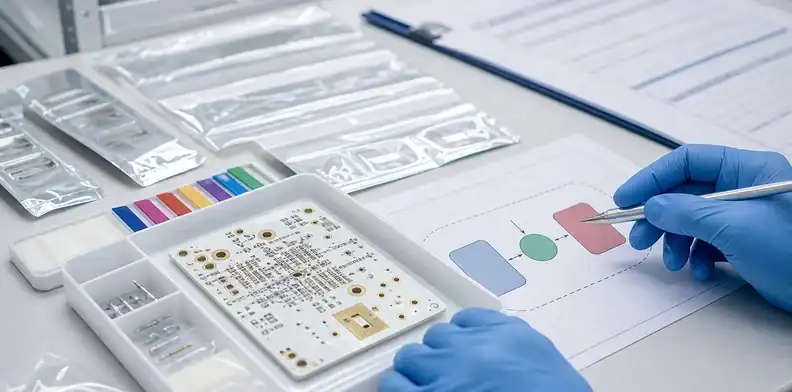
Sterilization exposure affects ceramic PCB selection because heat, moisture, radiation, ethylene oxide, plasma, or other processes can affect finishes, solder joints, adhesives, coatings, packaging, labels, and component materials even when the ceramic base remains stable. The board must be reviewed as part of the finished sterilized assembly.
FDA’s medical-device sterilization resources discuss common sterilization methods such as steam, ethylene oxide, radiation, and other approaches. A PCB supplier should not choose the sterilization method for the device, but it should answer whether the quoted materials and assembly process are compatible with the method named by the buyer.
The RFQ should name the intended sterilization method when known. It should also state whether the supplier must provide material declarations, cleaning records, packaging notes, process residues information, or lot traceability. If the sterilization method is not yet selected, the quote should identify that assumption as open rather than silently building parts with unknown exposure risk.
Repeated sterilization is a different problem from one-time sterilization. Reusable surgical tools, dental tools, or patient-contact modules may see cleaning and sterilization cycles that affect solder joints, seals, connectors, coatings, and markings. Disposable sterile products may focus more on packaging, lot identity, and sterilization validation.
What material and process records belong in the quote?
A medical ceramic PCB quote should include material and process records that can be tied to the device file: ceramic material, metallization route, copper or conductor thickness, surface finish, solder or attach process, cleaning method, packaging, traceability, and controlled-substitution rules.
The buyer should request a material declaration and process statement for the quoted item. For example, the quote may state alumina or AlN substrate, DPC or thick-film route, ENIG or other finish, solder mask presence or absence, assembly scope, cleaning process, and packaging method. If the quote only says “medical ceramic PCB,” it is not specific enough for a controlled project.
For regulated projects, the record must be stable. Purchasing should not accept a substitute ceramic grade, finish, adhesive, solder, coating, or packaging material without engineering and quality review. A lower-cost alternate can invalidate prior testing or force new review even if the Gerber file does not change.
| Record | Why it matters |
|---|---|
| Ceramic material and grade | Connects the quote to the approved device material file |
| Metallization and finish | Affects solderability, residues, contact surface, and change control |
| Cleaning process | Helps assess residue and contamination risk |
| Packaging and labels | Supports lot identity, handling, and sterilization path |
| Substitution rule | Prevents quiet material or process changes |
The ceramic supplier assessment checklist covers fabrication and quality questions to raise during sourcing. For a medical program, the device evaluation team should also approve which materials, substitutions and production records can support the intended submission.
How should assembly, cleaning, and packaging be controlled?
Assembly, cleaning, and packaging should be controlled by written assumptions because they can change residues, surface condition, sterility path, and traceability. A ceramic substrate alone may be stable, but the finished PCBA includes solder, components, flux, labels, bags, trays, and operator handling.
For assembly, the RFQ should define BOM/AVL, component sourcing owner, solder alloy, flux type if controlled, reflow or attach method, cleaning requirement, inspection method, and whether conformal coating, potting, adhesive, underfill, or sealant is allowed. Any material that remains on the product may matter more in medical use than in ordinary industrial electronics.
For cleaning, the buyer should state whether no-clean flux is acceptable, whether ionic or residue testing is required, and what handling or packaging constraints apply. For sterile or patient-contact products, the cleaning and packaging path should be aligned with the device manufacturer’s validation plan.
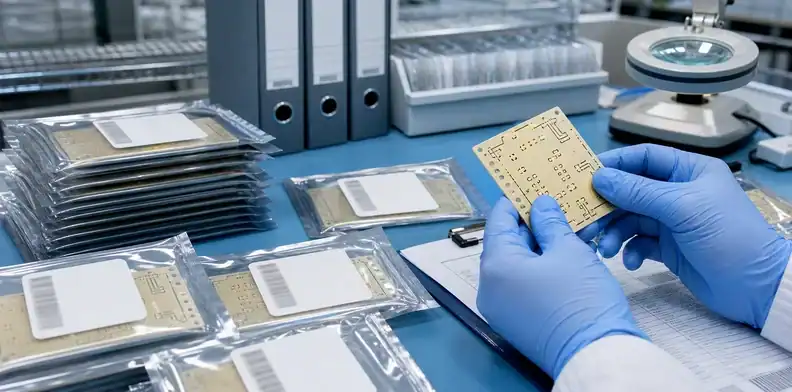
Packaging should support identity and protection. Lot labels, part number, revision, quantity, date code, bag type, tray type, ESD protection, moisture control, and carton marking may be part of receiving inspection. A receiving team cannot verify a medical build if the packaging does not preserve the lot record.
What supplier evidence should overseas buyers verify?
Overseas buyers should verify supplier evidence before commitment: quality system certificates where applicable, material declarations, process route, inspection records, change-control language, traceability, English DFM response quality, and whether the supplier understands the medical scope boundary.
Ask the supplier to state what it can and cannot certify. A PCB/PCBA supplier may provide manufacturing records, material declarations, inspection reports, and traceability, but it may not provide biological evaluation, sterilization validation, or regulatory approval for the finished medical device. That boundary should be written, not implied.
For prototype orders, verify that the supplier can preserve the build record if samples later support testing. For production orders, verify document control, revision control, lot traceability, packaging records, and approval gates for substitutions. Compare any certificate’s scope, named legal entity, facility address and validity period against the organization actually accepting the order.
Language and time zone matter because medical questions often involve revisions, deviations, and document requests. A useful supplier can answer in English with quote revision numbers, assumptions, and evidence attachments. A weak response stays vague about material, finish, cleaning, or change control.
How should buyers choose the right medical ceramic PCB partner?
Buyers should choose the partner by project stage and regulatory responsibility. A ceramic material or substrate specialist may be right for a controlled bare substrate. A medical device contract manufacturer may be needed for validated device assembly. An export-facing PCB/PCBA partner can be useful for prototypes, low-volume builds, DFM feedback, documentation requests, and controlled manufacturing communication.
QueenEMS can help overseas teams with quote-readiness review, ceramic route screening, PCB fabrication, PCBA coordination when appropriate, and manufacturing documentation communication. QueenEMS should not be treated as the party that approves biocompatibility, sterilization validation, implantability, or device regulatory clearance.
The most useful RFQ package includes Gerbers or ODB++ files, fabrication drawing, BOM/AVL, ceramic material target, surface finish, assembly scope, contact category from the device owner, sterilization method if known, cleaning and packaging notes, traceability needs, quality-document requests, and substitution-approval rules.
The first-prototype ordering guide explains the basic fabrication files. Add the approved contact assumptions, sterilization exposures, lot-record requirements and responsibility for regulatory review to those files before requesting samples that may later be used as evaluation evidence.
Use a specialist path when the deliverable is a validated sterile medical device or implantable assembly. Use a PCB/PCBA partner when the deliverable is a controlled prototype or small-batch manufacturing package that will feed the device manufacturer’s own validation work.
FAQ
Is ceramic PCB biocompatible?
Not automatically. Biocompatibility depends on the finished device or patient-contacting materials, contact type, contact duration, processing, residues, packaging, and sterilization condition. The device manufacturer must own the biological evaluation.
Can ceramic PCB be used in implantable devices?
Possibly, but only when the finished device design, material records, biological evaluation, sterilization validation, and regulatory pathway support that use. A supplier quote alone does not make a ceramic PCB implant-ready.
What should I send for a medical ceramic PCB quote?
Send Gerbers or ODB++ files, drawing, BOM/AVL, ceramic material target, finish, assembly scope, contact category, sterilization method if known, cleaning and packaging notes, traceability needs, and quality-document requirements.
Does sterilization damage ceramic PCB?
The ceramic base may tolerate many exposures, but the finished assembly includes finishes, solder, components, adhesives, coatings, labels, and packaging that may be affected. Review the exact sterilization method against the complete assembly.
What documents should a medical PCB supplier provide?
Ask for material declarations, process route, inspection records, traceability, packaging notes, applicable quality certificates, change-control language, and a clear statement of what device-level regulatory evidence remains with the buyer.
Send QueenEMS a medical ceramic PCB RFQ
Provide the fabrication files, BOM, approved contact assumptions, sterilization exposure, cleaning and packaging requirements, traceability needs and change-control notes through the QueenEMS manufacturing inquiry form. Request the available manufacturing records and the work included in the quote. Your device evaluation team should retain responsibility for biological safety, sterilization validation and regulatory submissions.
Sources
- ISO, ISO 10993-1:2025 Biological evaluation of medical devices
- U.S. FDA, Sterilization for Medical Devices
Written by the QueenEMS Engineering Team
Upload your files today · Free DFM check before production · Ship worldwide
Get your PCB prototypes in as fast as 24 hours. We handle FR4, Rogers, and Flex up to 60 layers — free prototypes for 2–4 layer boards, no minimum order.
Just upload your Gerber + BOM — we source every part, assemble, and inspect (AOI + X‑Ray) so you don't have to chase suppliers. Boards ship in as fast as 24 hours.