
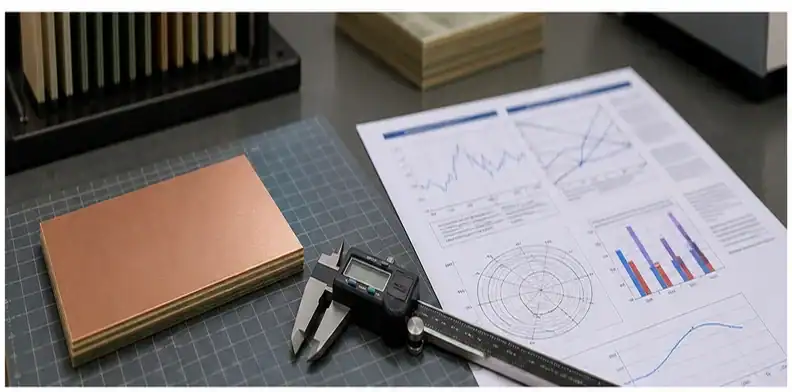
Quick Answer: A BT substrate datasheet should be read as a grade-specific engineering record, not as one universal number set. Typical package-grade BT data from public material pages includes Tg around 200-255 deg C for common low-CTE grades, Dk roughly 3.9-4.7 at 10 GHz depending on grade, Df about 0.008-0.012 at 10 GHz, X/Y CTE from about 7-14 ppm/deg C in selected MGC examples, and moisture absorption near 0.30-0.44% in published test conditions.
Key takeaways
- Treat every BT number as grade-specific; HL832NX, HL832NS, NSR, NSF, and NSA variants do not behave alike.
- Dk and Df control signal models, while Tg, CTE, stiffness, and moisture absorption control package reliability.
- Low-CTE and coreless-capable BT grades are selected for warpage control, not only for higher heat resistance.
- Use this parameter page as the fact base, then use the supplier-grade and project-decision pages for final selection.
A buyer who asks for a BT substrate datasheet is usually past the introduction stage. The real task is to convert material numbers into a stack-up, a simulation model, and a quotation boundary that a supplier can hold. One problem is that BT is a family of bismaleimide triazine laminate systems, so a single Dk, Df, Tg, or CTE value can mislead the design team if the grade and test condition are not named. This page keeps the focus on data reading. For material background, start with QueenEMS’ page on BT resin fundamentals. For supplier alternatives, move from this page into comparing BT grades across suppliers. For the surrounding decisions across material data, package needs, process limits, and purchasing evidence, use the full BT PCB reference.
Table of Contents
- BT substrate key parameters at a glance
- What Tg tells you about assembly margin
- How Dk and Df affect signal modeling
- Why CTE matters for package reliability
- Moisture absorption and reflow stability
- How BT grades change the datasheet values
- How to read the supplier datasheet correctly
- BT versus FR-4 as a datasheet comparison
BT substrate key parameters at a glance
A BT substrate datasheet is useful only when the value is tied to grade, frequency, test method, and construction. Public MGC data shows that one BT family can include several low-CTE and ultra-low-CTE variants, with different Tg, Dk, Df, moisture, stiffness, and CTE values.
| Parameter | Typical public range or example | Buyer use |
|---|---|---|
| Tg | About 200-255 deg C for several MGC low-CTE BT grades; higher values appear in NSF and NSA variants | Checks lead-free reflow and high-temperature margin |
| Dk at 10 GHz | About 3.9-4.7 in selected MGC examples | Feeds impedance, antenna, and package model assumptions |
| Df at 10 GHz | About 0.008-0.012 for many listed examples; some low-loss grades report lower values | Controls insertion-loss expectation |
| X/Y CTE | About 7-14 ppm/deg C in selected listed examples; ultra-low variants go lower | Controls die, ball, and substrate stress |
| Moisture absorption | About 0.30-0.44% under 85 deg C / 85% RH / 168 h examples | Affects reflow and delamination risk |
| Thermal conductivity | Roughly 0.6-0.8 W/mK in selected MGC rows | Useful for package heat spreading, not power substrate cooling |
Do not mix an RF value from a low-loss BT grade with a CTE value from a different low-shrinkage grade. The RFQ should name either the exact grade or the allowed equivalent family so that the supplier quotes the same material basis used by engineering.
Datasheet call: A BT substrate datasheet is ready for engineering use only after grade, frequency, and test condition travel with each value.
For this parameter group, keep one project copy of the supplier table beside the released stack-up. That copy should show the grade name, test frequency or method, and the reason the value was accepted for this package.
What Tg tells you about assembly margin
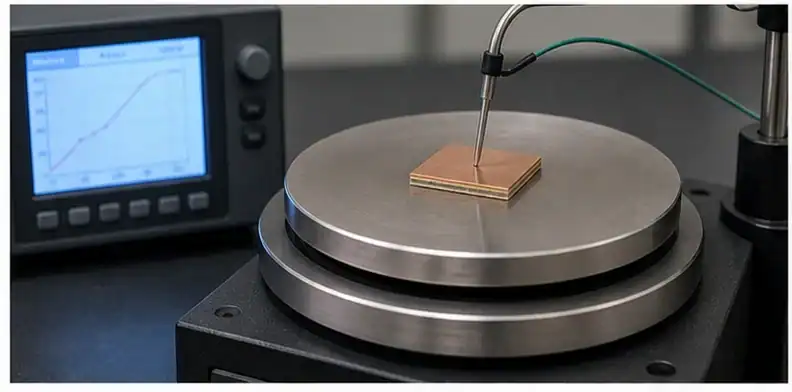
Tg tells the design team how much thermal margin the resin system has before the material changes mechanical behavior. For lead-free assembly, the most useful question is not simply whether BT has a higher Tg than ordinary FR-4; it is whether the named BT grade has enough margin for 260 deg C reflow, moisture exposure, and repeat thermal cycles.
Public MGC tables list glass-transition values by both DMA and TMA methods, and those values can differ. That difference is normal because each method measures a different material response. A drawing note that only says Tg 230 deg C without method or grade can create a quiet mismatch between simulation, procurement, and supplier quotation.
In a real order review, Tg should be checked with board thickness, copper distribution, and surface finish. A thin package substrate with ENEPIG, tight coplanarity, and multiple reflow cycles needs a different level of confidence than a simple module carrier.
Thermal rule: Quote the BT grade and Tg method together; a naked Tg number is too weak for release control.
The practical check is whether the value changes a real engineering model. If it changes impedance, warpage, reflow risk, or material approval, it belongs in the drawing note instead of staying only in an email.
How Dk and Df affect signal modeling
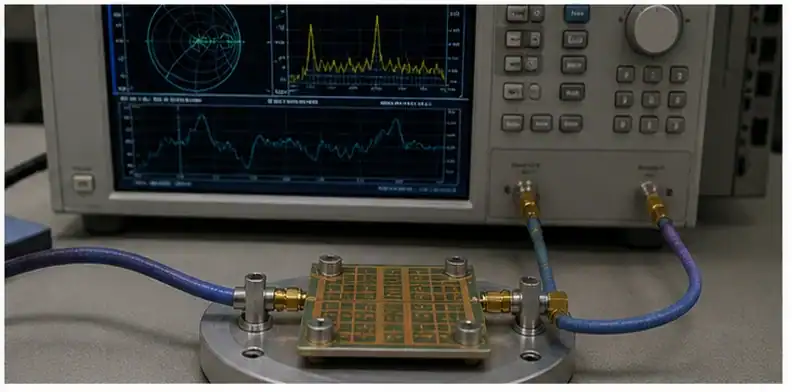
Dk and Df are the signal parameters in a BT substrate datasheet. Dk sets the effective electrical length and impedance model, while Df contributes dielectric loss. For package substrates, those values matter for high-speed memory interfaces, RF modules, SiP routing, and short controlled-impedance paths.
MGC’s public low-CTE table shows Dk variation by grade and frequency, with several listed values around the low-to-mid 4 range at 1, 5, and 10 GHz. That is why a buyer should not copy a single BT dielectric value into every simulation model. A high-speed module may need the low-transmission-loss BT family rather than a general package-grade material.
The supplier should also confirm whether the number is a typical value, design value, or guaranteed limit. Typical values help early analysis, but a production drawing often needs an approved material family and a test reference.
Modeling rule: For high-speed work, put Dk, Df, frequency, copper profile, and material grade in the same review package.
When two suppliers quote different BT values, do not average them. Compare the grade, resin family, glass style, and test condition first, then decide whether either value matches the design model.
Why CTE matters for package reliability
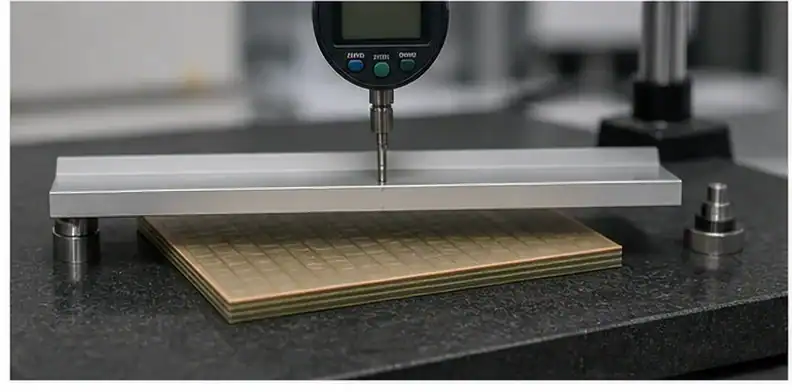
CTE is where BT substrate data becomes a package-reliability decision. Silicon has a much lower expansion rate than organic laminate, so the substrate must control stress across die attach, solder balls, vias, and thin cores. MGC’s public tables show lower X/Y CTE options, including low-CTE and ultra-low-CTE families intended to reduce package warpage.
The Z-axis value is also relevant, although many public summary tables emphasize X/Y. Z movement affects via strain and plated structure reliability during reflow and temperature cycling. A package substrate that looks acceptable in planar expansion can still fail the order review if via reliability or coplanarity is not controlled.
For memory, RF, and compact SiP designs, CTE should be discussed with die size and substrate thickness. Large die, thin substrate, asymmetric copper, and strict coplanarity push the buyer toward a lower-CTE or higher-stiffness option.
Reliability rule: CTE is not a marketing number; it is the bridge between material choice, package warpage, and solder-joint life.
A prototype can reveal whether the datasheet assumption was too optimistic. Record any CAM question, warpage result, or finish concern against the same parameter so the production quote does not restart from memory.
Moisture absorption and reflow stability
Moisture absorption affects how a BT substrate behaves before and during reflow. Published MGC rows include moisture values under an 85 deg C / 85% RH / 168 h condition, which gives the buyer a way to compare grades under a known exposure method rather than relying on a vague low-moisture claim.
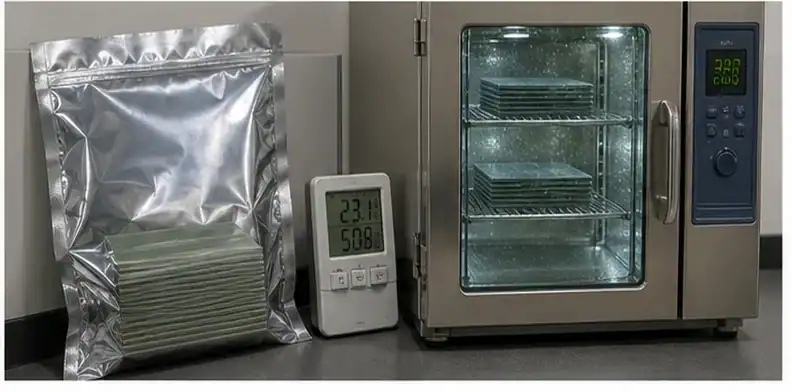
The practical risk is package damage after storage, baking, or delayed assembly. Moisture can increase stress during reflow, especially in thin substrates or packages with molding, die attach, or fine-pitch interconnects. A supplier quote should state packing, floor-life assumptions when relevant, and whether the material has been qualified for the planned assembly profile.
Reflow dimensional change should be treated as a separate acceptance concern. A grade that resists moisture may still require warpage checks, strip handling controls, or customer-specific coplanarity limits.
Assembly rule: Pair the moisture number with storage, bake, reflow, and warpage requirements before approving the material.
The buyer-side file should separate typical values from required limits. Typical data helps engineering screen the material, but shipment acceptance needs the values that the supplier is willing to control.
How BT grades change the datasheet values
BT grade names are not decorative. MGC lists HL832NX / GHPL-830NX as halogen-free BT for IC plastic packages, while NS, NSR, NSF, NSA, SR, and low-loss families target different CTE, shrinkage, stiffness, coreless, or high-frequency needs. A buyer comparing only the BT label can miss the reason one quote is faster or cheaper than another.
For example, a low-CTE glass grade may reduce package warpage, while a low-loss family may support high-frequency or high-speed signal devices. A coreless process can require prepreg behavior and shrinkage control that a cored package does not need. The engineering team should decide which problem the grade is solving before purchasing asks for alternates.
This is also why the planned article on when to choose BT over FR-4 should not replace the datasheet review. The switch decision tells you whether BT is needed; the datasheet tells you which BT is defensible.
Grade rule: Pick the BT variant for the failure mode it controls, then quote the exact family or approved equivalent.
Use the how bt grades change the datasheet values section as a cross-check against the supplier’s quote notes. A quote that omits the method, grade, or applicable condition should be clarified before PO release.
How to read the supplier datasheet correctly
Read a BT datasheet from the application backward. Start with the package type, die size, interconnect method, line width, thickness target, reflow profile, and reliability class. Then check whether the datasheet values support those requirements under the correct frequency, temperature, humidity, and test method.
A clean material review usually has four columns: required value, supplier value, test condition, and approval note. That format lets engineering see where a value is typical, where a guaranteed limit is missing, and where the supplier must confirm equivalency. It also prevents a quotation from silently swapping an ordinary package grade for a lower-loss or lower-CTE material.
Keep the wording short in the RFQ. A usable sentence is: quote HL832NX type A or approved equivalent; state Dk/Df at the modeled frequency, X/Y CTE, Tg method, moisture test condition, and any deviation before fabrication.
Review rule: The datasheet is accepted only after the supplier answers the exact grade, method, and deviation questions.
Do not let a material alternate pass because it has the same BT family name. The alternate should be mapped against this exact parameter group and any package-specific reliability concern.
BT versus FR-4 as a datasheet comparison
BT and FR-4 can share some vocabulary, but the datasheet decision is different. FR-4 datasheets usually support board-level laminate choice, while BT datasheets often support package-substrate reliability, low warpage, fine pitch, and semiconductor assembly. QueenEMS’ BT versus FR-4 differences page covers the broader comparison.
| Datasheet item | FR-4 reading habit | BT substrate reading habit |
|---|---|---|
| Tg | Board heat class and reflow margin | Package substrate heat, stiffness, and reflow stability |
| Dk/Df | Impedance and high-speed board routing | Package model, RF module, and compact interconnect behavior |
| CTE | Board-level reliability and plated holes | Die, ball, thin-core, and warpage control |
| Moisture | Storage and assembly sensitivity | Reflow, package integrity, and thin substrate handling |
The takeaway is not that BT is always better. It is that BT must be read at the grade and package level, while FR-4 decisions are often board-level material decisions.
For repeat orders, preserve the accepted datasheet revision. If the material maker updates the table or the supplier changes source, the buyer can see which number needs engineering review before the same part number is built again for a pilot, validation build, or production lot.
A final datasheet habit helps avoid quiet mistakes: keep the supplier’s material table, engineering model assumption, and purchase description in one review set. If Dk, Df, Tg, CTE, moisture, or thermal conductivity changes between quote and repeat order, the buyer can see exactly which package analysis must be reopened before the material is accepted again.
Sources
FAQ
What is the Dk of BT substrate?
Common package-grade BT examples sit around the low-to-mid 4 range at 10 GHz, but the value changes by grade. Use the specific supplier datasheet for the material in the stack-up.
What Tg should I expect from BT?
Several public MGC low-CTE BT grades show Tg values around 200-255 deg C by TMA or DMA. Higher-specialty grades can be above that, so quote the exact family.
Does BT absorb moisture?
Yes, but public low-CTE BT examples show controlled absorption values under defined 85 deg C / 85% RH tests. Moisture still needs storage and reflow controls.
Is one BT datasheet enough for all designs?
No. Use one datasheet only for the exact grade or approved equivalent named in the design release.
Send QueenEMS your BT substrate datasheet package
For a datasheet review, send QueenEMS the target BT grade, stack-up, impedance notes, reflow profile, package outline, and any customer material restriction through the QueenEMS contact page. QueenEMS can check whether the BT datasheet quote path quote is using the same Dk, Df, Tg, CTE, moisture, and thickness assumptions as your released design.
Written by the QueenEMS Engineering Team
Upload your files today · Free DFM check before production · Ship worldwide
Get your PCB prototypes in as fast as 24 hours. We handle FR4, Rogers, and hybrid boards up to 40 layers in volume production, with advanced builds subject to engineering review — free prototypes for 2–4 layer FR-4 boards, no minimum order.
Just upload your Gerber + BOM — we source every part, assemble, and inspect (AOI + X‑Ray) so you don't have to chase suppliers. Boards ship in as fast as 24 hours.