
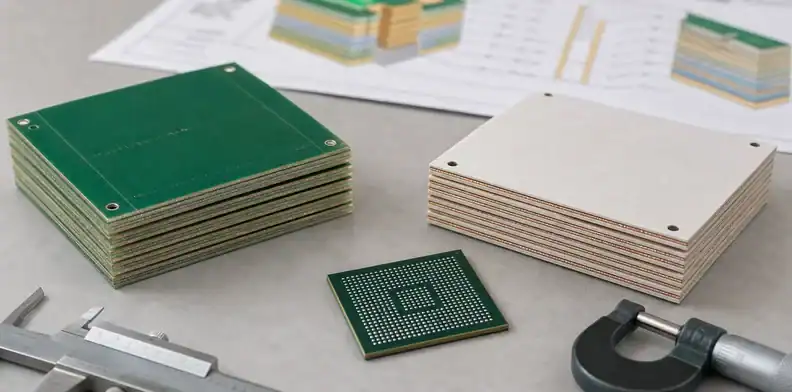
Quick Answer: BT and FR-4 differ most in Tg, CTE behavior, moisture absorption, dimensional stability, process window, and cost. Compare those properties against the design requirement first; use the separate selection article when deciding whether the project should switch materials.
For a step-by-step release decision, use when to choose BT substrate over FR4. This page keeps the focus on the material-property comparison.
Key takeaways
- High-Tg FR-4 is not the same as a true BT substrate, even when BT resin is part of a modified formulation.
- BT usually brings higher Tg and lower moisture absorption than standard FR-4, but it does not replace every high-speed or high-heat material.
- Upgrade to BT when the board behaves like a package substrate, not just because the design has a BGA.
- The RFQ should freeze the exact material system and test basis before prices are compared.
Table of Contents
- BT vs FR-4 material properties at a glance
- BT vs FR-4 side by side
- Is high-Tg FR-4 the same as BT?
- How do their thermal limits differ?
- Why does lower moisture absorption matter?
- Which property thresholds justify moving from FR-4 to BT?
- Is BT worth the cost premium?
- Material comparison summary
BT vs FR-4 material properties at a glance
Choose FR-4 first for ordinary control boards, interface boards, and cost-sensitive multilayer PCBs. Choose BT when the project needs package-style dimensional control, lower moisture absorption, higher assembly-temperature margin, or closer behavior to silicon and component packages.
The comparison is not about prestige. It is about the failure mode. If the risk is standard assembly and moderate signal speed, FR-4 may be enough. If the risk is package warpage, fine pitch, moisture, wire bonding, or substrate-like density, BT deserves review.
In a BT-versus-FR-4 decision, the first screen is whether a parameter difference creates a release trigger. Higher Tg, lower moisture uptake, tighter CTE behavior, or package-style stability only matters when the design actually uses that margin. The RFQ should show which requirement moved the job away from FR-4, so suppliers quote the same technical reason instead of guessing from a material label.
A practical comparison ties each quote to the trigger that ruled out FR-4. If the trigger is moisture, the evidence should cover material data and handling; if it is package stress, the record should cover CTE, stackup, and reliability notes.
Selection call: Move from FR-4 to BT only when the design has a named parameter reason and the supplier can price that same reason.
One useful shortcut is to ask what would fail if the board stayed on FR-4. If the answer is only that BT sounds better, the project is not ready to upgrade. If the answer names reflow margin, package warpage, moisture sensitivity, fine-pitch reliability, or a customer-controlled material requirement, the BT branch has a real engineering basis. To place this decision beside related material, application, and sourcing questions, use the complete BT PCB resource as the hub page.
BT vs FR-4 side by side
| Property | BT substrate | Standard FR-4 | High-Tg FR-4 |
|---|---|---|---|
| Tg | 180-210 deg C | 130-140 deg C | 170-180 deg C |
| Dk | Around 4.0 | 4.2-4.5 | Construction dependent |
| Df | 0.01-0.015 | Around 0.02 | Construction dependent |
| Moisture absorption | Below 0.3% | Often around 0.8-1.2% | Supplier dependent |
| Best use | Package-like substrates | Standard PCB work | Higher-temperature FR-4 boards |
Decision rule: Compare exact constructions and test methods, not one catalog row.
For this comparison, evidence should show why FR-4 was not enough. Ask for the BT grade or approved equivalent, the FR-4 fallback if any, and the test conditions behind Tg, CTE, Dk/Df, and moisture claims.
Evidence for this comparison should explain the FR-4 limit being escaped. A quote that names only a BT grade is weaker than one that connects the upgrade to reflow margin, moisture behavior, CTE control, dielectric loss, or fine-pitch package risk. The buyer can then compare a BT quote against a specific failure mode rather than a premium label.
A quick quote can start the comparison; it should not end it. The buyer still needs to know which BT advantage is being paid for and which FR-4 limit it solves.
Selection proof: The quote should state the parameter that made BT necessary and the FR-4 option it replaces.
Is high-Tg FR-4 the same as BT?
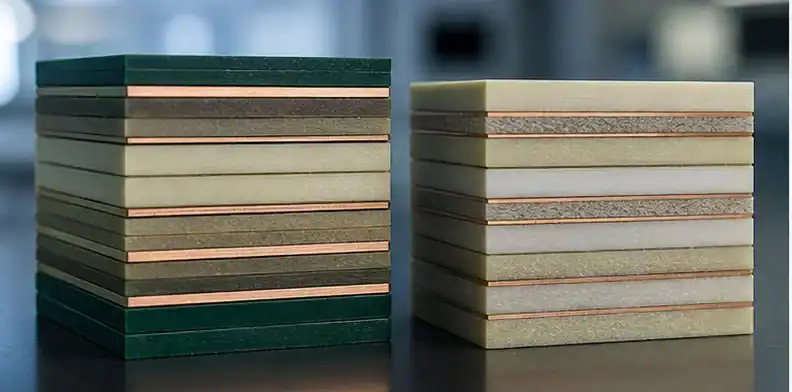
No. High-Tg FR-4 may use modified resin systems and may include BT resin in some constructions, but it remains an FR-4 laminate class unless the supplier quotes a true BT substrate construction. This distinction matters because the glass style, resin content, dielectric thickness, CTE, and package evidence may differ.
Ask the supplier to state the exact laminate family and whether the quoted construction is FR-4, BT-modified FR-4, or a BT substrate. That sentence belongs in the quote or stackup note.
The parameter table should be read as a decision map. Tg can point to assembly margin, CTE to package stress, moisture to storage and reflow risk, and Dk/Df to electrical behavior; none of those numbers replaces the supplier’s current datasheet.
The most useful engineering split is not one headline number. Tg helps the board survive soldering without entering a softer mechanical state, while moisture absorption affects package handling and reflow stress. CTE matters when the substrate sits close to a silicon package or fine-pitch array. Dk and Df matter only when the layout uses them in impedance, RF, or timing assumptions. A design may need one of these advantages and not the others, which is why a BT upgrade should name the controlling property rather than treating BT as a general premium material.
Turn each value into a switch condition. A moisture gap matters when packages see storage and reflow stress; a CTE gap matters near silicon or fine-pitch arrays; a Tg gap matters when assembly exposure erodes FR-4 margin. If none of those conditions is active, the comparison usually favors a controlled FR-4 grade.
For parameter review, keep the FR-4 baseline visible beside the BT value. Tg should answer soldering margin, moisture should answer storage and package stress, and Dk/Df should answer an electrical model. A supplier answer that cannot tie the number to the FR-4 weakness is not ready for award.
Selection rule: The winning material should solve a named FR-4 limit, not simply carry a higher-performance label.
How do their thermal limits differ?
BT usually gives more thermal margin than standard FR-4 because of its higher Tg and package-substrate heritage. That helps when boards see lead-free reflow, repeated assembly exposure, or package reliability stress.
Thermal margin is not the same as heat spreading. BT does not move heat like AlN or alumina ceramic. If the design is failing because the die or LED needs a better heat path, use the QueenEMS ceramic substrate options branch instead of forcing BT into the wrong job.
During a FR-4-to-BT switch, the first prototype often proves assembly and electrical behavior. The pilot order should not quietly return to a cheaper high-Tg FR-4 unless engineering has confirmed that the original trigger no longer matters.
The record should say why BT was selected over FR-4 and which alternates are allowed. That makes a later cost-down proposal a technical review, not a silent substitution.
Decision signal: The right quote names the FR-4 limitation that BT is solving and the evidence behind that choice.

Why does lower moisture absorption matter?
Lower moisture absorption matters when packages or dense boards face storage, reflow, field humidity, or delamination risk. Moisture can change electrical behavior, package stress, and reflow reliability.
For a purchasing record, ask for moisture absorption data and storage guidance for the exact construction. Do not copy a generic BT value into a drawing without supplier confirmation.
This is one reason high-Tg FR-4 is not a complete substitute. A laminate can show acceptable Tg and still carry more moisture into reflow than the package can tolerate. For a fine-pitch package substrate, that extra moisture can increase popcorning, interfacial stress, or post-reflow inspection risk. For a normal industrial controller board, the same difference may be irrelevant. The material decision should therefore follow the assembly and package exposure, not only the catalog temperature rating.
FR-4 will often look cheaper, but the comparison is incomplete unless it covers the parameter that caused concern. Paying for BT makes sense only when the extra margin protects assembly, moisture, package stress, or electrical behavior.
For a FR-4 comparison, cost should be tied to the reason for switching. Paying more for BT is defensible when it protects moisture behavior, package stability, reflow margin, or CTE control. Paying more because the material sounds stronger is not a technical decision.
Price rule: Compare FR-4 and BT against the same reliability trigger, not against material names alone.
Which property thresholds justify moving from FR-4 to BT?
Upgrade from FR-4 to BT when at least one requirement is truly driving the move: package-substrate construction, fine-pitch CSP or BGA substrate, memory package, low moisture target, lower expansion need, or a customer requirement naming BT.
Stay with FR-4 when the design can pass with a known grade and standard fabrication. The QueenEMS guide to FR-4 Tg grades explained is the better starting point for conventional boards.
The approval boundary should follow the parameter trigger. Engineering decides whether FR-4 margin is enough, purchasing compares offers after that choice, and quality checks that the shipped material matches the approved branch.
The risk in a FR-4 comparison is that a high-Tg FR-4 alternate may look acceptable while leaving the original moisture, CTE, or package-stress trigger unanswered. Any move back toward FR-4 should be approved against that trigger, not just against cost or lead time.
Approval should follow the trigger that moved the board off FR-4. Engineering owns that trigger, purchasing checks whether each offer solves it, quality verifies the shipped laminate route, and the supplier must state any return to high-Tg FR-4 as an exception.
Approval rule: Switching between BT and FR-4 requires engineering approval when the original selection trigger still applies.
Is BT worth the cost premium?
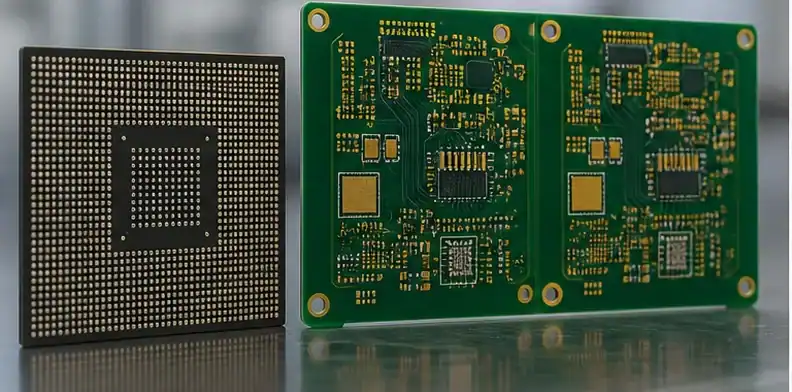
BT is worth the premium when it prevents a real qualification or package-reliability risk. It is not worth the premium when the design only needs ordinary FR-4 performance with a slightly higher Tg.
Cost control starts with the RFQ: line width, layer count, finish, panelization, and material source all change price. See the cluster article on what drives BT cost before final supplier comparison.
A weak supplier answer says the two materials are equivalent but never maps the changed Tg, moisture, CTE, Dk, or Df values. That gap usually means the comparison has not reached engineering depth yet. Ask for the exact FR-4 grade, the proposed BT route, and the property that justifies moving away from the original board material.
Before comparing price, write down the reason BT is being evaluated against FR-4. Ask the supplier to state any material or process exception that changes that reason.
Risk check: Pause the comparison when a quote changes the parameter that justified BT over FR-4.
Material comparison summary
The right choice is requirement-led. FR-4 is the baseline. High-Tg FR-4 is the upgrade for conventional boards needing more assembly margin. BT is the package-substrate branch when moisture, CTE, fine pitch, or package construction becomes central.
Release rule: Do not approve the material until engineering, purchasing, and the supplier agree on one named construction and one substitution rule.

The engineering difference becomes visible when the board stops behaving like a broad FR-4 panel and starts behaving like a package interface. Fine-pitch BGAs, memory packages, compact RF modules, and repeated reflow exposure put more pressure on dimensional stability than a standard controller board does. In that setting, BT earns its place by reducing the risk that heat history and moisture history move the board outside the assembly window.
High-Tg FR-4 can be an excellent answer for industrial electronics, power-control boards, and moderate-density assemblies. Its weakness in this comparison is not that it is low quality; it is that the FR-4 family covers a wide span of resin systems and glass styles. A buyer who only writes “high Tg FR-4” may still receive a material with dielectric, expansion, or CAF behavior that is acceptable for one design and marginal for another.
BT becomes easier to justify when three signals appear together: the design has a small package pitch, the assembly flow includes multiple heating cycles, and the product has a field environment where moisture or temperature swing is credible. One signal alone may not justify the cost jump. All three together usually deserve an engineering review before the RFQ is treated as a normal FR-4 board.
The practical comparison is also about supplier process capability. BT work may need tighter laminate handling, different drilling settings, cleaner resin-smear control, and more careful panel compensation. A factory that is strong with standard multilayer FR-4 can still need a separate process review before accepting a BT stackup with small vias, thin dielectric, or high-density package escape routing.
FR-4 remains the better default when the board is large, cost-sensitive, and not controlled by package stress. BT becomes easier to defend when the risk sits under the component rather than across the whole panel: small pads, dense escape routing, moisture-sensitive packages, or a customer reliability note that ordinary FR-4 cannot satisfy.
FAQ
Is high-Tg FR-4 the same as BT?
No. It may share some resin chemistry in certain materials, but the supplier must state whether the actual construction is FR-4, BT-modified FR-4, or true BT substrate.
When should I upgrade to BT?
Upgrade when package reliability, moisture, CTE, fine-pitch substrate work, or customer specification requires it. Do not upgrade only for marketing language.
Is BT more expensive than FR-4?
Yes, normally. The useful question is whether the cost prevents a failure mode that FR-4 cannot handle.
Can BT and FR-4 be mixed?
They can appear in a broader material strategy, but a single stackup needs clear approval rules and supplier confirmation.
Send QueenEMS a BT vs FR-4 stackup question
Use the QueenEMS contact page to send the stackup, Gerber or ODB++ files, BGA pitch, assembly profile, target reliability class, and the reason FR-4 is under review. QueenEMS can help compare high-Tg FR-4 against BT substrate build without turning the decision into a material-name debate.
Sources
Written by the QueenEMS Engineering Team
Upload your files today · Free DFM check before production · Ship worldwide
Get your PCB prototypes in as fast as 24 hours. We handle FR4, Rogers, and Flex up to 60 layers — free prototypes for 2–4 layer boards, no minimum order.
Just upload your Gerber + BOM — we source every part, assemble, and inspect (AOI + X‑Ray) so you don't have to chase suppliers. Boards ship in as fast as 24 hours.