
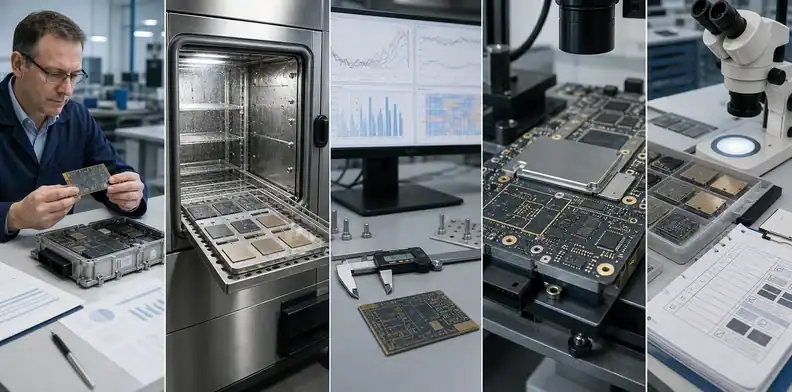
Quick Answer: BT PCB can be suitable for automotive electronics when the substrate serves a medium-power package, radar module, sensor, controller, or organic IC package that can meet the required thermal cycling, humidity, material, and acceptance evidence. It is not the right baseline for high-power inverter or IGBT thermal paths where ceramic substrates usually provide a stronger fit.
Key takeaways
- Automotive BT decisions should be made by package role and reliability evidence, not by the word automotive alone.
- Useful checks include IPC-6921 context, Class language where applicable, JEDEC-style thermal and humidity tests, and customer AEC-Q expectations.
- Radar, sensor, RF, and control modules may fit BT; high-power modules often need ceramic or another high-thermal substrate.
- A quote should state operating location, temperature exposure, finish, material grade, test plan, and acceptance evidence.
Automotive buyers often ask whether BT is automotive-grade. The better question is whether the exact BT substrate, finish, package, and supplier evidence match the vehicle location and customer approval path. A cabin sensor, radar module, ECU package, lighting controller, and traction inverter do not share one substrate rule. This article focuses on BT substrate reliability decisions, not whole-vehicle electronics architecture. The BT PCB material and sourcing guide puts this point in context with material selection, manufacturing limits, and supplier questions.
| Automotive use case | BT suitability | Evidence priority |
|---|---|---|
| Radar or ADAS signal package | Possible | Dk/Df, stack tolerance, thermal cycling |
| Cabin sensor module | Often possible | Humidity and dimensional evidence |
| Inverter power path | Usually weak | Ceramic substrate comparison |
| Release item | Supplier can provide | Module owner still proves |
|---|---|---|
| Material identity | Datasheet and revision | System qualification impact |
| Finish and inspection | Thickness or process record | Assembly reliability |
| Warpage data | Bare substrate measurement | Package-level coplanarity |
Table of Contents
- Is BT PCB suitable for automotive electronics?
- What reliability standards should automotive BT reference?
- How BT handles thermal cycling and humidity
- BT in automotive radar, sensors, and ADAS
- When automotive power needs ceramic instead
- What acceptance class and evidence apply?
- What to send for an automotive BT quote
- How to compare automotive BT quotes
- How to document the automotive reliability boundary
Is BT PCB suitable for automotive electronics?
BT PCB can be suitable for automotive electronics when it is used as an organic package substrate or module carrier and the reliability plan proves the build. MGC’s low-CTE BT material information lists automotive ECU examples, RF modules, sensor uses, and several compact package formats. That public material context supports BT as a candidate, but it does not replace project qualification. Decision signal: BT is automotive-capable only when the exact package and evidence package satisfy the vehicle environment.
What reliability standards should automotive BT reference?
Automotive BT references should include the applicable customer specification first, then the standards that support the substrate and package evidence. IPC-6921 is relevant for organic IC substrates, while IPC-6012 or IPC-A-600 language may apply to board-like acceptance and JEDEC methods often appear in package reliability plans. AEC-Q expectations may apply depending on the component or module path. Proof rule: Automotive wording must map to a named test or customer requirement, not only to a marketing grade.
How BT handles thermal cycling and humidity
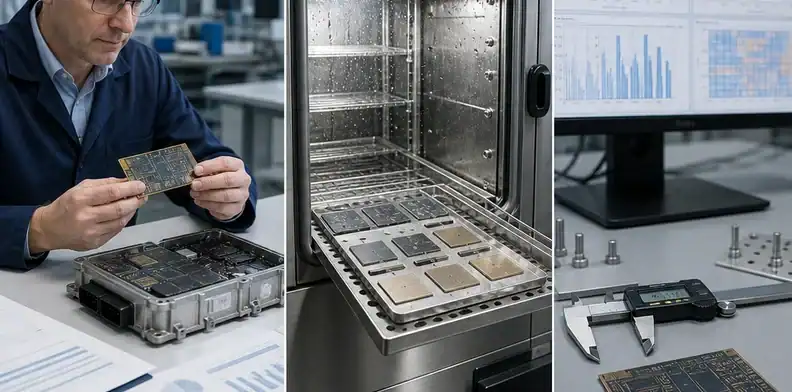
BT handles thermal cycling and humidity through a combination of material selection, package design, and process control. High Tg, low CTE, low shrinkage, and moisture resistance help, but they do not make the package immune to stress. Thermal cycling loads interfaces between die, copper, resin, solder, mold, and finish. Humidity adds swelling, corrosion, and insulation concerns depending on exposure. Test boundary: The BT supplier can prove substrate construction and outgoing evidence; the finished automotive package still needs qualification by the responsible product owner.
BT in automotive radar, sensors, and ADAS
BT may fit automotive radar, sensor, and ADAS-related modules when the package needs organic routing, stable dimensions, and manageable loss rather than a high-power thermal base. Radar and RF modules may use BT, modified BT, or hybrid substrate constructions depending on frequency, loss budget, antenna role, and package layout. For signal-oriented context, see BT in automotive radar AiP and BT PCB for RF. Application call: Radar and sensor BT quotes should include frequency or exposure details, not only the vehicle program name.
When automotive power needs ceramic instead
Automotive power needs ceramic instead when the substrate must carry high heat, high current, high isolation, or severe thermal cycling that an organic BT carrier cannot own with margin. Traction inverter modules, IGBT or SiC power modules, and other high-power assemblies often require alumina, AlN, Si3N4, DBC, AMB, or related ceramic substrate routes. See BT versus ceramic for power and QueenEMS’ ceramic for power modules. Material boundary: BT is a candidate for automotive signal and package work; ceramic is usually safer for power-module thermal substrates.
What acceptance class and evidence apply?
The applicable acceptance class depends on whether the item behaves like a printed board, an organic IC substrate, an assembled module, or a component inside a customer qualification program. IPC-6921 is a relevant reference for organic IC substrates, while IPC-6012 Class 3 or IPC-A-600 expectations may appear for board-like high-reliability builds. The BT quality standards article maps these standards in more detail. Acceptance rule: Automotive BT release should separate substrate conformance from package-level qualification.
What to send for an automotive BT quote
Send substrate files, package drawing, operating location, temperature and humidity exposure, finish requirement, material target, quantity stage, customer standard, and any AEC-Q or JEDEC-related requirement. If the project is radar or RF, add frequency, stack-up, controlled impedance, antenna notes, and loss budget. Keep the automotive evidence request separate from end-product qualification so the substrate quote does not imply tests the finished module still has to complete.
Extra buyer notes for automotive BT release
Automotive programs often include several approval layers. The substrate supplier may provide a material certificate, dimensional report, finish evidence, and inspection records. The module owner may run thermal cycling, humidity, vibration, electrical stress, or functional testing. The customer may still require PPAP-like documentation or internal release gates. A BT quote should not collapse those layers into one word such as qualified.
Location in the vehicle changes the risk. Cabin electronics and low-power sensors may use a less severe thermal profile than under-hood electronics. Radar modules may add RF loss and antenna geometry requirements. Lighting or power-adjacent controls may need stronger thermal and solder joint evidence. A buyer should describe the environment rather than only naming the vehicle platform.
Material substitution is especially sensitive in automotive work. A different BT grade may have similar Tg but different CTE, moisture, Dk, Df, thickness availability, or warpage behavior. If a supplier proposes an equivalent, engineering should review the datasheet and decide whether the change affects qualification. Purchasing should not approve the alternate only because it shortens lead time.
For prototype builds, ask the supplier to label any evidence that is prototype-only. A fast sample may not include the same inspection depth as production. Before pilot or PPAP-related work, the acceptance evidence should be tightened so the repeat order is not based on an informal prototype assumption.
The automotive RFQ should also say whether the BT substrate is safety-related, customer-visible, or part of a regulated system. That does not automatically change the material, but it changes the amount of evidence the buyer should request. A prototype ECU sensor carrier and a production ADAS module should not be released with the same evidence package.
Thermal class should be described as an operating profile, not only a peak temperature. A short reflow peak, a long cabin soak, an under-hood cycle, and a radar module with self-heating are different stresses. The supplier can only judge BT suitability if the heat exposure is tied to duration and package location.
Humidity language should be equally concrete. Tell the supplier whether the substrate is sealed inside a module, conformally coated, exposed to condensation, or near an external connector. Low moisture absorption helps, but enclosure and sealing choices decide how much moisture reaches the substrate over vehicle life.
For RF and radar, reliability evidence must sit beside electrical evidence. Dk, Df, copper roughness, antenna geometry, and stack tolerance can affect radar performance, while thermal cycling and humidity affect long-term package survival. A quote that covers only one side of that problem is not enough for release.
Buyers should also confirm who owns change control after qualification. If the substrate material, finish, copper thickness, supplier site, or inspection plan changes, the automotive program may need customer notification or requalification. Put that boundary in the sourcing record before the program enters repeat ordering.
Automotive BT examples and release logic
An automotive radar package may use BT or a hybrid organic construction when the design needs compact routing, controlled dielectric behavior, and manageable cost. The quote should include frequency band, antenna or RF path role, stack-up tolerance, and whether the substrate carries only interconnect or also participates in the RF structure. Treating the design as a generic BT PCB can miss loss and registration issues.
A sensor module for cabin or body electronics may use BT because the package is small and the power level is moderate. The release risk may come from humidity, thermal cycling, connector stress, or calibration drift rather than raw heat. The supplier evidence should therefore include material and dimensional stability, while the module owner proves finished sensor behavior.
A controller or ECU-adjacent substrate may face a more demanding temperature profile and longer service life. The buyer should ask whether the BT material is a low-CTE package grade, whether the finish is tied to the assembly method, and whether the supplier has a repeatable inspection plan. A quote that only lists layer count and board size is not ready for automotive review.
Power electronics create the clearest boundary. If the substrate is expected to move heat from SiC, IGBT, MOSFET, or other high-power devices, BT should not be forced into the job because it is cheaper or easier to source. Ceramic and metal-based routes exist for a reason, and the design owner should make that switch before the supplier spends time on a weak BT quote.
The release record should use neutral language. Instead of saying that a BT substrate is automotive certified, state the evidence actually provided: material family, finish, dimensional report, warpage check, inspection class, and any customer qualification status. That language is harder to misuse and easier to defend during supplier comparison.
Supplier answers that should slow release
Slow release when the supplier says automotive grade but cannot name the evidence. The answer should identify material, finish, inspection, and any standards or customer tests that are actually supported. Broad wording may be useful for marketing, but it is weak for an automotive sourcing record.
Slow release when the supplier substitutes material without a datasheet comparison. BT grades can differ in CTE, Dk, Df, moisture, thickness, and processing behavior. A substitute may be harmless for one control module and unacceptable for a radar or sensor package.
Slow release when the quote ignores warpage. Thin automotive packages may pass electrical checks and still fail assembly because of coplanarity. If the module has fine-pitch balls, a large die, or a tight enclosure height, ask for a flatness or warpage discussion before PO.
Slow release when qualification ownership is vague. The supplier may fabricate the substrate, but the component owner, module assembler, or vehicle customer may own the final reliability decision. A clear boundary prevents overclaiming and protects repeat orders.
Production handoff for automotive BT
Before a BT automotive substrate moves from sample to repeat order, the buyer should confirm three handoff items. First, the material and finish must match the evidence used during approval. Second, the inspection plan must be realistic for the order quantity, not only a one-time sample report. Third, the customer or module owner should know which changes require reapproval.
This handoff is especially important for overseas sourcing because engineering, purchasing, supplier quality, and the factory may sit in different time zones. A short release note can prevent later confusion: quote this BT substrate with the named material family, stated finish, listed inspection evidence, and no material substitution without engineering approval.
If the project is still early, do not overstate the qualification. Use controlled language such as prototype material review, pilot reliability evidence, or production-approved substrate only when the proof exists. Careful wording protects both the buyer and the supplier.
One more practical check is traceability. Automotive buyers should know whether the substrate lot can be tied back to material batch, finish date, inspection record, and shipment label. That traceability does not prove reliability by itself, but it makes later containment and corrective action possible.
How to compare automotive BT quotes
Compare automotive BT quotes by environment, evidence scope, material identity, and change-control boundary. The strongest supplier answer explains what is proven by the substrate lot and what still belongs to module qualification.
How to document the automotive reliability boundary
Document the boundary between substrate evidence and vehicle or module qualification before the PO is released. A BT substrate supplier can support material identity, construction, inspection, and finish evidence, but the buyer still owns the higher-level qualification plan for the finished automotive product. Boundary rule: The substrate quote can support automotive evidence, but it should not replace module-level qualification.
Share the automotive module drawing, operating environment, customer standard, material target, finish, and required evidence list using the QueenEMS contact page. A review of automotive BT substrate review scope can show whether BT belongs in the quote or whether ceramic, RF laminate, or a different package route is the cleaner baseline.
FAQ
Is BT automotive-grade?
BT can be used in automotive-related packages, but the exact material, construction, supplier evidence, and customer qualification path must support the claim.
What tests matter for automotive BT?
Thermal cycling, humidity exposure, warpage, dimensional inspection, surface finish checks, and customer-specific qualification evidence are common decision points.
Can BT be used for automotive radar?
Yes, in some radar or ADAS modules, especially when the design needs organic package routing. Frequency, loss budget, and stack-up still decide suitability.
When should automotive power avoid BT?
Avoid BT when the substrate must carry major heat or isolation responsibility. Ceramic routes are usually better for IGBT, SiC, and inverter power modules.
Sources
- Mitsubishi Gas Chemical, Low-CTE BT resin laminate lineup
- Global Electronics Association, IPC-6921 organic IC substrate standard
Written by the QueenEMS Engineering Team
Upload your files today · Free DFM check before production · Ship worldwide
Get your PCB prototypes in as fast as 24 hours. We handle FR4, Rogers, and Flex up to 60 layers — free prototypes for 2–4 layer boards, no minimum order.
Just upload your Gerber + BOM — we source every part, assemble, and inspect (AOI + X‑Ray) so you don't have to chase suppliers. Boards ship in as fast as 24 hours.