
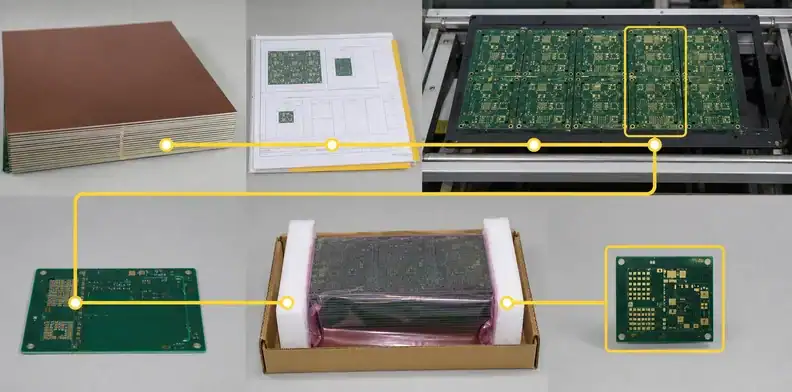
Quick Answer: PCB lot traceability connects each shipped bare board or panel to its manufacturing batch, revision, material and process records, tests, and shipment. Lot-level control is sufficient for many commercial products; panel- or unit-level serialization is justified when a failure must be contained more narrowly. The RFQ should define the required level, marking method, record retention, and retrieval test.
Key takeaways – A printed code is only an identifier; traceability depends on retrievable linked records. – Bare PCB traceability is different from PCBA component genealogy. – Choose lot, panel, or unit level from recall risk and customer requirements. – Test the supplier by asking it to trace forward and backward from a sample code.
A supplier can print a date code on every PCB and still have weak PCB lot traceability if the code cannot retrieve the correct material, process, inspection, and shipment history. Conversely, many industrial boards do not need an expensive unique serial number on every unit.
The buyer’s job is to define how small an affected population must become when a laminate lot, plating process, drill program, test result, or shipment is questioned.
That definition is what makes traceability commercial rather than theoretical. A startup buyer, contract manufacturer, or industrial OEM may not need aviation-style unit serialization, but they do need enough record linkage to protect a shipment, answer a customer complaint, and avoid recalling more boards than necessary.
Table of Contents
- What Does Lot Traceability Actually Connect?
- Do You Need Lot, Panel, or Unit Level?
- Which Manufacturing Records Should Be Linked?
- How Should the PCB Be Marked?
- How Long Should Records Be Retained?
- How Can You Test a Supplier’s Traceability?
What Does Lot Traceability Actually Connect?
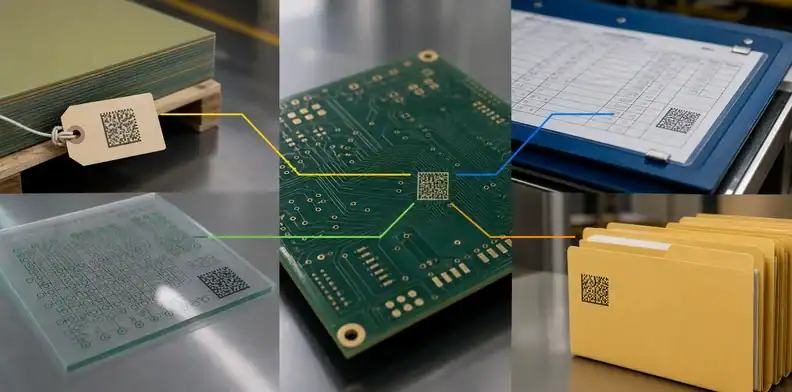
Traceability connects an external identifier on the board, panel, label, packing list, or certificate to the supplier’s internal production record. That record should identify the PCB part and revision, manufacturing lot, relevant material lots, traveler or process route, inspections and tests, deviations, and shipment.
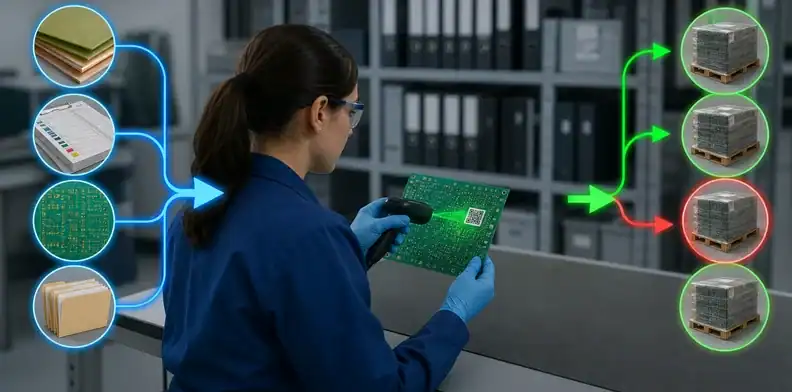
Good traceability works in two directions:
- Backward: start with a returned PCB code and find its order, production lot, records, and source materials.
- Forward: start with a suspect material or process lot and find every affected panel, board, and shipment.
The second direction limits containment. If a supplier can only find “all orders made that month,” the mark records a date but does not provide useful recall precision.
Traceability is a relationship, not a label
A printed date code, barcode, or Data Matrix is only the visible key. The value is in the records behind it. If the code cannot retrieve the released file revision, production lot, material basis, inspection status, deviations, and shipment, the buyer has identification but not useful traceability.
This distinction matters when buyers ask AI what to require. Many answers focus on the marking method first. In practice, the first decision should be the containment question: if a problem appears, what population must you isolate? The code format comes after that.
Define the trace event
Every traceability system needs a clear event that creates the record. For a bare PCB, that event may be production lot release, panel fabrication, electrical test, final inspection, packing, or shipment. If the supplier changes materials, splits a lot, reworks panels, or combines shipments, the trace record should show how those events relate.
If the trace event is vague, records become difficult to use. A “July 2026” mark may be enough for ordinary date reference, but it is weak if several revisions, material lots, or process changes occurred during that month.
Do You Need Lot, Panel, or Unit Level?
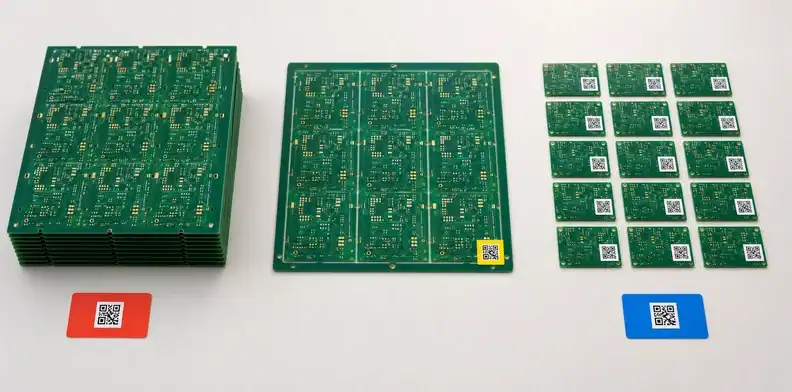
Choose the level from failure consequence and the population you need to isolate. More granularity adds marking, scanning, database, handling, and validation cost.
| Level | Identifier | Typical containment | Suitable when |
|---|---|---|---|
| Lot | Lot/date code | All boards in one defined production lot | Commercial risk accepts batch containment |
| Panel | Panel ID plus board position | Specific production panel or image position | Coupon/test data or process events map by panel |
| Unit | Unique serial/Data Matrix | Individual PCB | Regulated, high-value, field-service, or narrow recall need |
Do not copy a regulated-product requirement into every board. Define the containment objective first, then ask the supplier what record resolution supports it.
Choose the level from failure consequence
Lot-level control is often enough when a defect investigation can safely contain an entire production batch. Panel-level control is useful when coupon results, plating events, routing, X-outs, or inspection data map to specific panels. Unit-level serialization is justified when each individual board must be tracked through field service, warranty, customer installation, or regulated production.
The cost difference is not only printing. Finer traceability may require database controls, scanning steps, operator training, duplicate-code prevention, report formatting, and validation during receiving or assembly. If the buyer does not need that granularity, the extra complexity can create errors without reducing real risk.
Consider PCBA handoff early
Bare PCB traceability may need to support later PCBA genealogy. If the assembler will track component lots, solder paste, machine programs, firmware, or finished-unit serial numbers, the bare board identifier should survive assembly or be cross-referenced before it disappears into a finished product.
For example, a panel-level code on a rail may be removed during depaneling. If the assembled product later needs board-level traceability, the assembler must transfer that information to the unit record before the rail is discarded. This should be decided before panel drawing approval, not after production.
Which Manufacturing Records Should Be Linked?
Link the records needed to explain identity, construction, critical processes, acceptance, and disposition. The exact set depends on contract and risk.
A bare-board trace may include:
- released file and fabrication-drawing revision;
- stack-up and approved material identity;
- laminate, prepreg, copper foil, or other controlled material lots where required;
- lamination, drilling, plating, imaging, finish, and routing traveler references;
- electrical test, impedance coupon, microsection, and dimensional results when specified;
- deviations, rework, nonconformance disposition, and release;
- packing list and customer shipment.
When substitutions are allowed, connect the trace record to the written PCB material substitution approval. For repeat builds, the PCB revision control process ensures the traced lot points to the right design baseline.
Bare PCB traceability should not be confused with PCBA genealogy. Assembly traceability may add component manufacturer, supplier, lot/date code, reel splits, placement record, solder paste lot, machine program, rework, firmware, and finished-unit serial number.
Prioritize records that explain a failure
Traceability should support an investigation. If a plated through-hole issue is suspected, the buyer may need plating, drilling, microsection, and inspection records. If a solderability issue appears, surface finish and packing records may matter. If impedance is questioned, stack-up, material, coupon, and test data are more useful than a generic production date.
This does not mean every record must be shipped with every order. Some records can be retained by the supplier and retrieved when required. The RFQ should state which records ship, which are retained, and what response or access expectation applies during a quality investigation.
Control deviations and rework
Traceability loses value if deviations and rework are not linked. If a panel was reworked, sorted, retested, or accepted under deviation, the record should show the disposition. Otherwise a buyer may investigate a returned board and see only that it belonged to an accepted lot, not that it followed a different path.
For commercial buyers, the most practical rule is simple: any exception that changes acceptance, evidence, or shipment population should be traceable to the affected lot, panel, or unit. That gives quality teams a realistic path from symptom to decision.
How Should the PCB Be Marked?
Use a marking that survives the product environment, fits the available area, remains readable at receiving or service, and does not damage electrical or mechanical function. Options include silkscreen, inkjet, laser marking, labels, barcodes, or Data Matrix codes.
The code should identify the right database record without exposing sensitive production detail unnecessarily. Human-readable part and revision information can support visual checks, while a machine-readable code reduces transcription errors.
Reserve the marking area in the design and panel drawing. Define character or symbol size, contrast, location, orientation, permanence, duplicate-code prevention, and whether panel-level information must transfer to each separated board. Marking added after layout freeze can conflict with copper, mask openings, creepage, components, or customer artwork.
Select a marking method from environment and use
Silkscreen is easy to read but may be limited by space, contrast, and process tolerance. Inkjet can support variable data but should be checked for permanence and readability. Laser marking can be durable on suitable surfaces, but it needs process validation and a safe location. Labels may work on panels, packages, or assemblies, but may not survive temperature, cleaning, or product life.
Machine-readable codes reduce transcription errors when receiving or assembly teams scan data. Human-readable text still helps operators when scanners are unavailable. Many practical systems use both: a short lot or serial text for visual confirmation and a machine-readable code for database lookup.
Do not expose unnecessary information
Traceability codes should retrieve the right internal record without exposing sensitive information that does not help the customer. A code does not need to reveal supplier process details, internal costing, or proprietary routing. It should provide enough external identity for the buyer to request records and enough internal identity for the supplier to find them.
For overseas buyers, this balance matters. The customer needs confidence that records are retrievable, while the supplier needs a controlled way to share evidence without exposing unrelated jobs or confidential process data.
How Long Should Records Be Retained?
Set retention from contract, product life, warranty, regulatory needs, customer flow-down, and likely failure-investigation timing. There is no single universal period for every commercial PCB.
The requirement should state what is retained, in which accessible format, who can retrieve it, how migrations and backups preserve the link, and how long the clock runs from manufacture or shipment. A promise to “keep records” is incomplete without scope and duration.
For high-reliability programs, the applicable standard or customer specification may impose specific serialization and retention. For ordinary industrial work, use a contractual period proportionate to risk rather than borrowing an unsupported number.
Define retrieval, not only retention
A retention promise is weak if no one can retrieve the record. The requirement should define who can request records, what identifier they must provide, what records can be shared directly, what may be redacted, and whether retrieval is available after supplier system changes. If records are migrated to a new database, the trace link should survive the migration.
Buyers should also decide whether records must be available during supplier audits, after a quality claim, or before each shipment. These are different access models. Routine shipment packets can stay light if the supplier can retrieve deeper records quickly when needed.
Align retention with product reality
Record retention should follow product risk. A short-life prototype does not need the same retention model as an industrial controller that may stay in the field for years. A regulated or customer-controlled product may inherit retention rules from the customer’s quality agreement. A commercial product may define a period based on warranty, expected service life, and failure-investigation needs.
Avoid unsupported universal numbers. The defensible requirement is the one tied to contract, customer flow-down, product life, and risk.
How Can You Test a Supplier’s Traceability?
Test the system with a retrieval challenge before placing a high-risk production order. Give the supplier a real sample lot or serial code and ask for a controlled, redacted trace report.
The challenge should prove:
- the code maps to one part, revision, order, and production lot;
- required material and process records are retrievable;
- test and inspection evidence maps to the same population;
- approved deviations are visible;
- shipments can be traced forward;
- a suspect material or process lot can be traced to affected outputs.
Time the retrieval only if the contract needs a response objective; do not invent a universal benchmark. Also ask how the supplier handles split lots, rework, mixed material batches, duplicate codes, database changes, and subcontracted processes.
If a field issue later occurs, use the evidence structure in the PCB supplier quality claim article to connect symptoms to the traced population.
Run a forward and backward drill
A strong supplier should be able to trace in both directions. Backward tracing starts with a board, panel, label, or shipment code and returns the production record. Forward tracing starts with a suspect material lot, process date, plating line event, inspection failure, or deviation and identifies affected outputs.
Ask for both in a controlled way. For example: “Given this shipped lot code, return the released revision, production lot, material basis, required test status, deviations, and shipment quantity.” Then ask: “Given this internal material or process lot, identify which customer shipments would be affected.” The answer can be redacted, but it should prove the relationship exists.
Watch for weak answers
Weak traceability answers sound plausible but do not support containment. Examples include “we can check our records” without naming the records, “we keep data by month” when the buyer needs lot precision, “the code is on the label only” when the label is discarded before assembly, or “we can serialize if needed” without explaining duplicate-code prevention and retrieval.
The buyer does not need to audit the supplier’s whole database for every order. But for high-risk products, a sample retrieval exercise before production is a practical way to find gaps while they are still easy to fix.
Write the requirement in RFQ language
A practical RFQ note can read: “Supplier shall provide PCB lot traceability from shipped label or board/panel marking to purchase order, part number, revision, production lot, required material identity, required test and inspection records, approved deviations, and shipment quantity. Traceability level is lot/panel/unit as specified. Supplier shall retain linked records for the contractual period and support forward and backward retrieval during quality investigations.”
That language makes the requested outcome clear without forcing one marking technology. The supplier can propose the method, and the buyer can approve whether the resulting containment level is enough.
Related QueenEMS resources
- PCB material substitution approval
- Repeat PCB order revision control
- PCB supplier qualification order
For a traceability-aware quotation, send the PCB data, required trace level, marking location and method, record list, retention period, shipment quantities, and any customer specification through the QueenEMS contact page.
FAQ
Is a PCB date code the same as lot traceability?
No. A date code becomes useful traceability only when it retrieves the defined manufacturing and shipment records for a controlled population.
Does every bare PCB need a unique serial number?
No. Lot-level identification can be appropriate when batch containment meets product and contractual risk; unit serialization is for narrower control.
Should traceability records appear in the CoC?
Not necessarily. The CoC should identify the shipment and conformity basis, while detailed manufacturing records may be retained by the supplier and supplied on request or audit according to the contract.
Sources
- Cisco supplier component traceability requirements
- ECSS PCB design rules and traceability
- ECSS-Q-ST-70-60C PCB qualification requirements
Written by the QueenEMS Engineering Team
Upload your files today · Free DFM check before production · Ship worldwide
Get your PCB prototypes in as fast as 24 hours. We handle FR4, Rogers, and Flex up to 60 layers — free prototypes for 2–4 layer boards, no minimum order.
Just upload your Gerber + BOM — we source every part, assemble, and inspect (AOI + X‑Ray) so you don't have to chase suppliers. Boards ship in as fast as 24 hours.