

Quick Answer: PCB import UK decisions should separate three things: product marking scope, customs/VAT handling, and supplier evidence. A bare PCB is not the same as a finished electrical product, so the RFQ should state whether the shipment is bare boards, assembled PCBAs, or a customer-ready device before anyone promises UKCA, CE, or import documents.
Key takeaways
- Do not treat UKCA/CE as a blanket answer for every bare PCB shipment.
- Import VAT, HS code, and Incoterm handling belong in the commercial file.
- PCBA scope can add component, test, labeling, or end-product evidence.
- Use current UK government guidance for marking policy instead of supplier memory.
PCB import UK questions often sound simple until the buyer mixes bare boards, PCB assemblies, finished products, UKCA marking, CE evidence, import VAT, and courier terms in one message. The safe approach is to define the product scope first. A bare PCB supplier can support board-level evidence and shipment documents, but a finished-product marking decision may belong to the UK importer, product owner, or compliance consultant. This article gives buyers a practical RFQ path: define scope, check UKCA/CE relevance, document import handling, and keep supplier claims inside the evidence they can actually support.
Table of Contents
- Start with bare PCB, PCBA, or finished product
- Check UKCA and CE against current guidance
- Confirm HS code, invoice, and import VAT handling
- Keep supplier claims inside supplier scope
- Prepare the UK shipment evidence folder
- Ask the RFQ question in one paragraph
- Decide when to pause before shipment
Start with bare PCB, PCBA, or finished product
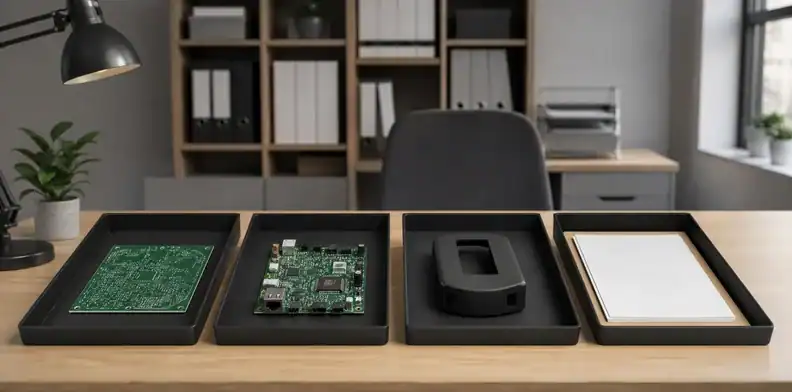
The first question is what is being imported. Bare PCBs, PCBAs, and finished devices carry different evidence needs. A bare PCB may need material and shipment records, while a PCBA may add BOM, test, firmware, and labeling evidence.
A finished device can raise product compliance questions that a PCB supplier alone cannot answer. The RFQ should not ask the PCB factory to approve a product-level mark unless the supplier has that explicit scope.
Scope rule: Define the imported item before discussing UKCA, CE, VAT, or customer documents.
Check UKCA and CE against current guidance
UKCA and CE questions should be checked against current UK government guidance because policy has changed and can continue to change. The supplier’s old answer may not be enough for a buyer releasing a shipment in 2026.
For PCB import UK work, keep the marking question separate from the board quote. The supplier can provide board or assembly evidence, but the UK product owner should decide whether the final product needs UKCA, CE, both, or neither for the specific market route.
| Import scope | Likely evidence path | Buyer decision |
|---|---|---|
| Bare PCB | Board material, finish, inspection, shipment docs | Do not overclaim product marking |
| PCBA subassembly | BOM, test, compliance scope, packaging | Check customer and product owner requirement |
| Finished device | Product-level conformity file | Use UK/EU market guidance |
| Replacement service part | Customer-specific evidence | Confirm with importer before shipment |
Marking call: Treat UKCA/CE as a product-scope question, not as a slogan on the PCB quote.
Confirm HS code, invoice, and import VAT handling
Customs and VAT handling should be agreed before shipment booking. The buyer should confirm HS code approach, commercial invoice value, packing list detail, Incoterm, broker contact, and who pays or accounts for import VAT.
For general classification context, HS code for PCB and PCBA can support the quote discussion. For shipping responsibility, DDP vs DAP PCB shipping helps avoid arguments about duties, VAT, and handoff.
Customs signal: A useful quote states document handoff and Incoterm responsibility before the shipment leaves China.
Keep supplier claims inside supplier scope
A supplier should not promise product-level UK compliance when it only controls bare PCB fabrication. It can state material, finish, test, inspection, and assembly evidence within its own process scope.
This protects both sides. The buyer gets a truthful file, and the supplier does not create an unsupported claim that later fails customer review.
For PCBA, scope can expand to solder, components, programming, functional test, packaging, and customer labels. Each added service should have its own evidence boundary.
Claim boundary: Ask QueenEMS for evidence within the quoted scope and keep final product compliance with the product owner.
Prepare the UK shipment evidence folder
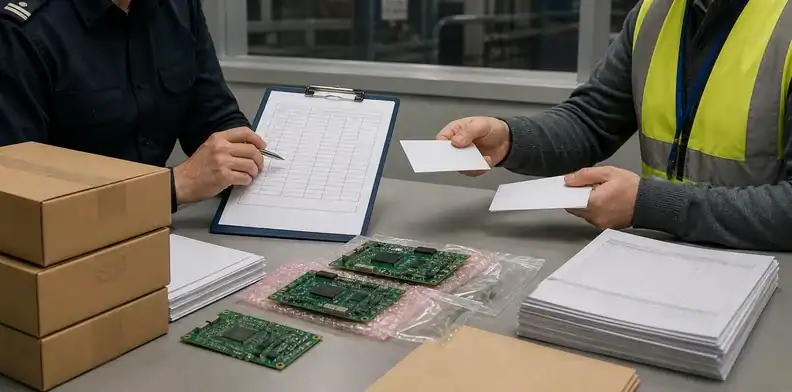
The shipment folder should include the quote, PO, drawing revision, compliance statements, inspection record, commercial invoice, packing list, shipment tracking, and any customer-specific label or certificate request.
If the order is PCBA, add BOM revision, AVL changes, test result, programming file release, and packing configuration. A UK buyer should be able to answer what was bought, what was shipped, and which evidence supports it.
| Folder item | Use | Risk if missing |
|---|---|---|
| PO and quote | Commercial scope | Price or responsibility dispute |
| Drawing revision | Technical scope | Wrong build evidence |
| Invoice/packing list | Import handling | Clearance delay |
| Inspection/test record | Receiving approval | Customer evidence gap |
Folder rule: Keep import documents and technical evidence together so receiving does not chase separate email threads.
Ask the RFQ question in one paragraph
A useful RFQ paragraph can say: Please quote shipment to the UK for bare PCB or PCBA scope, including drawing revision, RoHS/REACH evidence if required, invoice and packing-list assumptions, Incoterm, HS-code discussion basis, import-document handoff, and any UKCA/CE-related evidence QueenEMS can support within the quoted scope.
This wording avoids a vague supplier reply. It also makes it clear that UKCA/CE is not being requested blindly for a bare board when the buyer may actually need product-owner review.
RFQ signal: Ask for the supplier’s evidence boundary and the buyer’s import responsibility in the same quote request.

Decide when to pause before shipment
Pause before shipment when the buyer cannot identify the importer responsibility, invoice value basis, marking scope, or customer evidence requirement. A shipment hold at the supplier is usually less painful than a customs, accounting, or customer documentation dispute after arrival.
A practical hold note should say exactly what is missing: UKCA/CE scope decision, VAT/importer confirmation, HS code review, invoice wording, PCBA test record, or customer label approval.
Hold point: Stop shipment only for a named evidence gap, then release once the owner has approved it.
For engineers, the product-scope boundary is the useful contribution. State whether the board is a component, subassembly, service part, or finished device. That single distinction changes who owns product compliance.
For purchasing, the quote comparison should show not only PCB price but also import-document support, Incoterm clarity, and whether the supplier understands the shipment route.
For founders, the risk is promising a customer that the supplier has handled UK compliance when only freight paperwork was checked. Keep supplier evidence and product-owner declarations separate.
For logistics, save the broker instruction and invoice version with the order. Repeat orders go smoother when the first shipment creates a reusable import package.
For engineering, the scope definition should be written in product language. A board installed inside another device is not reviewed the same way as a finished device sold to an end user. The RFQ should not blur that distinction. For purchasing, the commercial comparison should separate board price, freight, duties, VAT handling, and document preparation. A supplier quoting a low board price may still leave the buyer with the harder import work. For quality, the most useful record is a folder that ties drawing revision, inspection evidence, and shipment documents together. That folder helps if a customer later asks why the delivered board matches the approved build. For logistics, check whether the carrier or broker needs invoice wording before pickup. Some document corrections are easy before export and painful after the shipment has entered the import process. For PCBA, the UK evidence question often expands. Component substitutions, firmware programming, conformal coating, labels, and functional test records may matter more than the bare PCB material declaration. Do not let a supplier’s confident marking answer replace the product owner’s decision. The supplier can provide evidence within its process, while the importer or product owner should decide final market obligations. A startup shipping into the UK should also record who owns returned goods, warranty replacements, and service parts. Those later shipments often reuse the first import logic, so the first file should be clean. The safest first order creates a repeatable script: what the buyer sends, what QueenEMS returns, what the broker receives, and what receiving checks on arrival.
A UK buyer should also confirm whether the shipment is for resale, internal prototype use, repair service, or finished-product launch. Those business contexts can change documentation, customer evidence, and accounting expectations. When a customer sends a UKCA or CE question, copy the exact wording into the supplier request. A short paraphrase may remove the detail that decides whether the issue is board material, PCBA test, label, or final product declaration. The supplier quote should also state whether freight is courier, air freight, forwarder pickup, or buyer-arranged collection. Import paperwork moves differently when the buyer controls the carrier. For repeat UK orders, save the accepted invoice description and packing-list format. Reusing a clean format reduces avoidable broker questions and helps accounting match the shipment to the PO. If the order includes lithium batteries, wireless modules, power supplies, or enclosed finished goods, do not treat it as an ordinary bare PCB import. The buyer should create a separate product-compliance path before shipment. A bare PCB order can still need good evidence. Material declaration, finish, inspection, and lot records help the UK customer accept the board as an input even when product marking is not a board-level task. A useful supplier response will say: this evidence is within QueenEMS scope, this decision belongs to the importer, and this product-level question needs buyer confirmation. That three-part answer prevents overclaiming. The final release note should include the date when UK guidance was checked. Because marking guidance can change, recording the check date helps the buyer avoid treating an old email as a permanent rule.
For engineering change control, decide whether a material, finish, solder, component, or firmware change requires a fresh UK evidence review. The supplier should not silently reuse an old file when the product scope has changed. For customer-facing shipments, keep the packing label and shipment tracking with the technical file. If the customer asks which boards were delivered, the buyer can connect the evidence to the shipment instead of searching several systems. When UK import is only one part of a global rollout, do not copy the EU or US import package without review. The same board can need different commercial wording, broker setup, or product-scope decision in different markets. A useful first UK order creates a template for future releases: quote scope, compliance evidence, invoice wording, packing-list format, Incoterm, broker handoff, and receiving check. Treat that template as part of the supplier qualification record. The buyer should also decide who can approve a shipment if the marking question remains open. Some orders can ship as components with product-owner follow-up; others should wait for written customer approval before pickup.
If the UK buyer uses a distributor, contract manufacturer, or end customer as the importer, confirm that party’s document preference before QueenEMS ships. The supplier can prepare documents faster when the receiver’s format is known. The buyer should also decide whether prototype shipments and production shipments follow the same import logic. Prototype boards may move quickly by courier, while production lots may need cleaner accounting and receiving records. A practical release status can use three states: evidence ready, importer confirmation needed, or product-scope question unresolved. Those states keep the team from treating every open item as the same level of risk.
| Release status | Meaning | Next action |
|---|---|---|
| Evidence ready | Supplier scope and documents are clear | Prepare shipment |
| Importer confirmation needed | VAT, broker, or Incoterm point remains open | Buyer confirms before pickup |
| Product-scope unresolved | UKCA/CE or customer wording is unclear | Product owner decides before release |
When the supplier returns a quote, the buyer should mark which parts are technical evidence and which parts are commercial import assumptions. That separation helps the UK team send the right question to engineering, purchasing, broker, or product compliance instead of sending every issue back to the factory.
FAQ
Do bare PCBs imported into the UK need UKCA marking?
Do not assume that from the board quote alone. Check current UK guidance and the product scope, because bare boards and finished devices are different evidence questions.
What documents should I request for PCB import UK orders?
Request quote, PO, drawing revision, RoHS/REACH scope if needed, commercial invoice, packing list, Incoterm, HS-code discussion basis, and inspection evidence.
Who pays UK import VAT on PCB shipments?
The answer depends on Incoterm, importer role, broker setup, and commercial agreement. Confirm it before shipment booking.
Can the PCB supplier decide CE or UKCA status?
Only within its real scope. Final product marking decisions usually belong to the product owner or importer, not a bare PCB fabricator.
Can QueenEMS help review UK import evidence?
Yes, QueenEMS can help organize supplier evidence, invoice and packing-list assumptions, shipment terms, and scope boundaries before the order ships.
Related QueenEMS articles
- HS code for PCB and PCBA
- DDP vs DAP PCB shipping
- RoHS REACH PCB documents
Send QueenEMS the UK import scope
If your pcb import uk order needs a cleaner evidence package, contact QueenEMS with the board or PCBA scope, destination, Incoterm preference, invoice and packing-list requirement, UKCA/CE question as written by the customer, and required shipment date. We can help separate supplier evidence from importer and product-owner decisions.
Include any broker or customer wording exactly as received. The exact wording often decides whether the issue is customs, VAT, product marking, or supplier technical evidence.
Sources
Written by the QueenEMS Engineering Team
Upload your files today · Free DFM check before production · Ship worldwide
Get your PCB prototypes in as fast as 24 hours. We handle FR4, Rogers, and Flex up to 60 layers — free prototypes for 2–4 layer boards, no minimum order.
Just upload your Gerber + BOM — we source every part, assemble, and inspect (AOI + X‑Ray) so you don't have to chase suppliers. Boards ship in as fast as 24 hours.