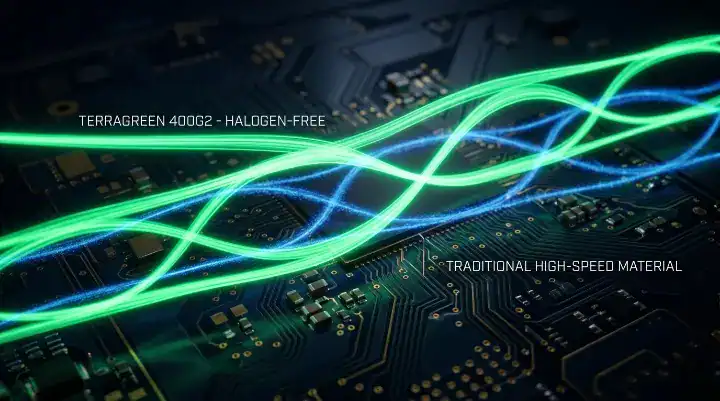
For decades, hardware engineers accepted a painful trade-off: if your design required halogen-free environmental compliance, you had to sacrifice electrical performance. This TerraGreen 400G2 guide explains how Isola broke that rule. With a Dissipation Factor (Df) of 0.0015, this flagship halogen-free laminate actually beats its non-halogen-free sister product, Tachyon 100G (Df 0.0021), by 30%. From a fabrication engineer’s perspective, we will break down the TerraGreen 400G family, compare it directly against EMC’s EM-892K2, and provide real-world processing data to help you confidently specify this ultra-low-loss material for 5G, AI, and 800G applications.
Table of Contents
- What Is TerraGreen 400G2 and How Does It Beat Tachyon 100G on Loss?
- How Do 400GE, 400G, and 400G2 Differ Inside the TerraGreen Family?
- Where Does TerraGreen 400G2 Sit in Isola’s Tachyon / Astra / TerraGreen Lineup?
- Which 5G and AI Applications Require TerraGreen 400G2 Today?
- How Does TerraGreen 400G2 Compare to EM-892K2 and Megtron 8?
- What Makes 2nd Gen Ultra Low Dk Glass and CAF Performance Critical?
- What Stackup and Design Rules Apply to TerraGreen 400G2 Boards?
- How Do Fabricators Process TerraGreen 400G2 vs Tachyon 100G?
- When Should You Still Choose Tachyon 100G Over TerraGreen 400G2?
- How Will Halogen-Free Material Selection Evolve Toward 1.6T and M9?
- Frequently Asked Questions
What Is TerraGreen 400G2 and How Does It Beat Tachyon 100G on Loss?
TerraGreen 400G2 is Isola’s flagship halogen-free high-speed digital laminate with Dk 3.10 and Df 0.0015 at 10 GHz — 30 percent lower loss than Tachyon 100G while meeting full halogen-free compliance. This is highly counterintuitive, as traditional halogen-free flame retardants typically increase a laminate’s dielectric loss.
Isola achieved this breakthrough by combining a novel halogen-free resin chemistry with 2nd Generation Ultra Low Dk glass. The resulting material not only offsets the typical “halogen-free penalty” but surpasses the industry-standard Tachyon 100G. For signal integrity teams, this means you no longer have to compromise channel margin when a European telecom customer or an automotive OEM mandates strict environmental compliance.
Bottom line: TerraGreen 400G2 proves that halogen-free compliance is no longer a performance handicap; it is actually the pathway to achieving M7-M8 boundary loss characteristics (Df 0.0015).
How Do 400GE, 400G, and 400G2 Differ Inside the TerraGreen Family?
The TerraGreen high-speed digital portfolio consists of three distinct tiers: 400GE (Entry), 400G (Mid-tier), and 400G2 (Flagship). Hardware teams must select the appropriate tier to avoid over-engineering and over-spending.
Per Isola’s official TerraGreen 400G2 documentation, the laminate delivers Dk 3.10 and Df 0.0015 at 10 GHz with 2nd Generation Ultra Low Dk glass, achieving halogen-free compliance while exceeding the loss performance of non-halogen-free Tachyon 100G. As a baseline comparison, The standard TerraGreen 400G uses Low Dk glass with HVLP3 copper, delivering Dk 3.15 and Df 0.0017 — the mid-tier in Isola’s halogen-free high-speed family. Furthermore, TerraGreen 400G2 is classified under IPC-4101 slash sheet /134, the category for halogen-free ultra-low-loss laminates used in high-speed digital applications.
| Variant | Dk @ 10 GHz | Df @ 10 GHz | Glass Style | Copper | Positioning |
|---|---|---|---|---|---|
| TerraGreen 400GE | ~3.4 | ~0.0023 | E-glass | RTF3 (Rz < 2.5 µm) | Entry HF, 10G-25G PCIe Gen4/5 |
| TerraGreen 400G | 3.15 | 0.0017 | Low Dk (spread weave) | HVLP3 | Mid-tier HF, 56G-100G |
| TerraGreen 400G2 | 3.10 | 0.0015 | 2nd Gen Ultra Low Dk | HVLP3 | Flagship HF, 100G+ AI/5G/800G |
Bottom line: Do not pay for TerraGreen 400G2 on a 10G-25G PCIe board; dropping to 400GE saves 30-40% in material costs while providing sufficient margin for lower-speed NRZ designs.
Where Does TerraGreen 400G2 Sit in Isola’s Tachyon / Astra / TerraGreen Lineup?
Isola offers three distinct high-performance product families. TerraGreen 400G2 handles halogen-free digital, Tachyon 100G handles standard digital, and Astra MT77 handles RF/microwave analog signals.
From a fabrication standpoint, the simplest way to understand Isola’s high-performance portfolio is this: if your board carries only high-speed digital signals and halogen-free compliance is not required, use Tachyon 100G high-speed digital laminate specifications. If halogen-free is required or you want the lowest possible Df, use TerraGreen 400G2. If your board carries RF or mmWave signals at 28 GHz and above, use Astra MT77. And if your board needs both RF and digital on the same lamination — a 5G AAU with mmWave beamforming plus eCPRI digital backhaul, for example — use an Astra MT77 + Tachyon 100G hybrid or an Astra MT77 + TerraGreen 400G2 hybrid if halogen-free is mandatory. We have processed all three materials in our facility and the press recipes, desmear cycles, and drill parameters are close enough that a fab qualified on any one of the three can qualify the other two within a single engineering lot. That interoperability is the real strategic value of staying within the Isola ecosystem.
| Product Family | Positioning | Df @ 10 GHz | Halogen-Free | Key Applications |
|---|---|---|---|---|
| Tachyon 100G | HSD (Non-HF) | 0.0021 | ❌ | 100G/400G switch, AI SerDes |
| TerraGreen 400G2 | HSD Halogen-Free | 0.0015 | ✅ | 5G infra, AI 800G, European OEMs |
| Astra MT77 | RF/mmWave | 0.0017 | ❌ | 77GHz radar, 5G mmWave AAU |
Bottom line: TerraGreen 400G2 is the direct high-performance, halogen-free evolution within the Isola ecosystem, sharing massive processing similarities with Tachyon and Astra.
Which 5G and AI Applications Require TerraGreen 400G2 Today?
This ultra-low-loss laminate sees massive adoption in 5G NR massive MIMO active antenna units (AAUs), O-RAN distributed units (DUs), and 800G Ethernet switch line cards bound for regions with strict environmental regulations.
A recent 14-layer 5G O-RAN distributed unit board used TerraGreen 400G2 on all eight high-speed signal layers carrying 25 Gbps eCPRI and 112 Gbps PAM4 fronthaul channels, with FR408HR on six power and ground layers. The customer mandated halogen-free compliance for deployment in a European mobile carrier’s network — Tachyon 100G was not an option. Insertion loss on the qualification coupon measured 0.48 dB/inch at 28 GHz on 4 mil TerraGreen 400G2 stripline traces with HVLP3 copper — roughly 15% better than the 0.56 dB/inch we typically measure on equivalent Tachyon 100G construction. The 400G2’s lower Df directly translated to approximately 1.8 dB of additional margin across the 22-inch worst-case fronthaul channel. Material cost ran approximately 12% higher than Tachyon 100G on a per-layer basis, driven by the 2nd Gen Ultra Low Dk glass premium. Total board cost increase was roughly 8% because material represents only a fraction of the build cost on a 14-layer board. The customer accepted the 8% premium as justified by the halogen-free compliance and improved channel margin.
For hardware engineers navigating these compliance hurdles, understanding how to specify halogen-free PCB requirements in your design is mandatory before locking the BOM.
Bottom line: If your end product ships to European telecom carriers or major automotive OEMs, TerraGreen 400G2 secures the 112G signal margin while ticking the required halogen-free boxes.
How Does TerraGreen 400G2 Compare to EM-892K2 and Megtron 8?
TerraGreen 400G2 (Df 0.0015) and EM-892K2 (Df ~0.0013) directly compete as halogen-free ultra-low-loss laminates, while Megtron 8 (Df 0.0010-0.0012) represents the non-halogen-free absolute baseline for AI platforms.
Choosing between Isola and EMC is a matter of supply chain ecosystem rather than raw SI performance. If your project targets NVIDIA platforms, reviewing the EM-892K2 halogen-free M8 specifications for AI servers reveals that EMC is heavily qualified as a second source across the GB200 ecosystem. Conversely, TerraGreen 400G2 is strongly preferred by major European telecom OEMs (such as Nokia) and teams already utilizing Isola materials who want to avoid qualifying a new vendor. When comparing against the Panasonic Megtron 8 M8-grade manufacturing guide, Megtron 8 offers a slightly lower Df but fails the standard halogen-free requirement (unless opting for the rarer R-5595 HF variant).
| Material | Manufacturer | Dk | Df @ 10 GHz | Halogen-Free | Price Tier | M-Grade |
|---|---|---|---|---|---|---|
| TerraGreen 400G2 | Isola | 3.10 | 0.0015 | ✅ | Med-High | M7-M8 Edge |
| EM-892K2 | EMC | ~3.0 | ~0.0013 | ✅ | Medium | M8 Core |
| Megtron 8 | Panasonic | 3.0-3.1 | 0.0010-0.0012 | ❌ | High | M8 Core |
| Tachyon 100G | Isola | 3.02 | 0.0021 | ❌ | Medium | M7 Core |
Bottom line: You do not choose between TerraGreen 400G2 and EM-892K2 based on Df alone; you choose based on whether your ODM sits in the European telecom supply chain or the Taiwanese AI server supply chain.
What Makes 2nd Gen Ultra Low Dk Glass and CAF Performance Critical?
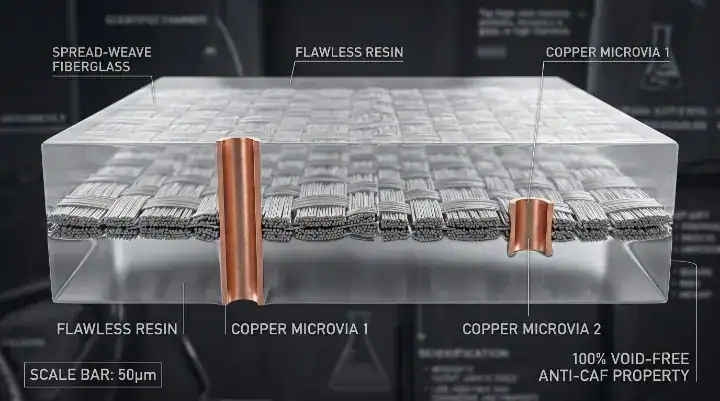
The 2nd Gen Ultra Low Dk glass in TerraGreen 400G2 actively reduces skew, while the halogen-free resin system provides naturally superior adhesion, driving excellent Conductive Anodic Filament (CAF) resistance.
As AI switches push toward tighter 0.8 mm BGA pitches, the risk of copper migration (CAF) between dense vias skyrockets under high voltage and humidity. Isola officially notes that the halogen-free resin chemistry in the 400G2 system bonds exceptionally well to the glass weave, preventing the microscopic gaps where CAF pathways form. Furthermore, the spread-weave nature of the Ultra Low Dk glass mitigates fiber weave effect, drastically reducing differential skew on long 112 Gbps PAM4 traces without requiring expensive zigzag routing.
Bottom line: The internal mechanics of 400G2 do more than just lower insertion loss; they fundamentally improve the mechanical reliability of dense, high-layer-count motherboards.
What Stackup and Design Rules Apply to TerraGreen 400G2 Boards?
Because this material targets dense, ultra-fast routing, designing for TerraGreen 400G2 often requires multi-lamination structures and strict impedance monitoring.
Per IEEE 802.3 800GBASE specifications, the host PCB channel insertion loss budget at 28 GHz Nyquist constrains laminate Df choices — TerraGreen 400G2’s Df of 0.0015 comfortably meets this threshold for halogen-free designs where Megtron 8’s non-halogen-free 0.0010-0.0012 is not permissible. To achieve these strict channels on high-layer-count boards, fabricators heavily rely on HDI PCB fabrication with sequential lamination, dropping microvias directly into the ultra-low-loss inner layers.
Bottom line: Always pair TerraGreen 400G2 with HVLP3 copper (Rz < 1.5 µm) and verify that your fabricator can accurately model the rough-copper impact on your 100 Ω differential pairs.
How Do Fabricators Process TerraGreen 400G2 vs Tachyon 100G?
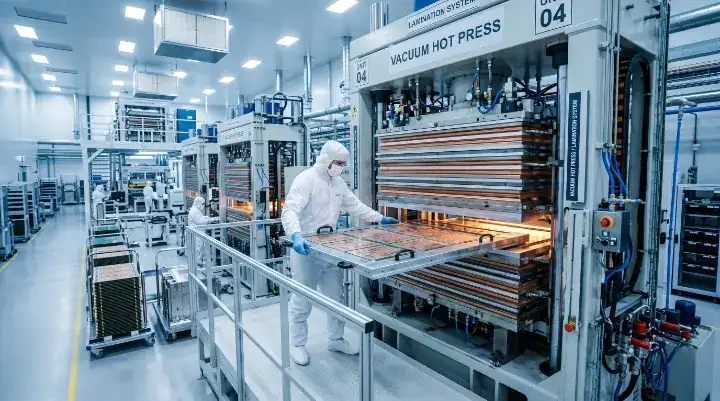
Despite their chemical differences, both laminates are FR-4 compatible. However, the halogen-free resin in 400G2 cures slightly harder and possesses a narrower flow window during lamination.
We qualified TerraGreen 400G2 alongside Tachyon 100G for the same customer’s 5G AAU product line — the customer needed halogen-free compliance on the European market variant and standard (non-HF) on the North American variant. Both materials ran on the same FR-4 lamination press at 200°C for 60 minutes. Both used standard permanganate desmear with no plasma. Drill parameters were nearly identical: we dropped chipload by 18% from FR-4 baseline for Tachyon 100G and 20% for TerraGreen 400G2 — the 400G2 prepreg cures slightly harder due to the halogen-free resin chemistry, which increased drill bit wear by approximately 10% compared to Tachyon 100G. First-pass yield landed at 94% for TerraGreen 400G2 versus 96% for Tachyon 100G across 40 panels each — the difference traced to a tighter lamination flow window on the 400G2 prepreg, which we corrected by adding 5 minutes of vacuum hold before pressure ramp. After the correction, yield on the next 60 panels matched Tachyon 100G at 96%.
Any factory familiar with Tachyon 100G processing and application details can adapt to 400G2 in a matter of days.
Bottom line: Processing is 95% identical to standard high-speed digital laminates, but a first-run lamination parameter validation is mandatory to lock in the resin flow.
When Should You Still Choose Tachyon 100G Over TerraGreen 400G2?
If TerraGreen 400G2 boasts a better Df and halogen-free compliance, why does Tachyon 100G still dominate? The answer lies in Tg specifications, legacy qualifications, and absolute cost.
Tachyon 100G has a Tg of 215°C, providing superior thermal stability for extreme-environment applications compared to TerraGreen 400G2’s Tg of 200°C. Additionally, major tech companies have spent millions generating precise IBIS-AMI models and qualification data for Tachyon 100G over the past decade; switching materials requires massive re-qualification efforts. Finally, if the end product is completely exempt from halogen-free requirements, Tachyon 100G remains slightly cheaper and easier to source in bulk.
Bottom line: Stick with Tachyon 100G for legacy designs and extreme thermal environments, but pivot to TerraGreen 400G2 for any new 112G design where halogen-free is a hard requirement.
How Will Halogen-Free Material Selection Evolve Toward 1.6T and M9?
As data centers migrate from 800G to 1.6T networks operating at 224 Gbps PAM4, the boundaries of Df performance will tighten, pushing M8 materials like TerraGreen 400G2 to their physical limits.
The next battlefield will be securing halogen-free compliance while meeting the Df ≤ 0.0010 requirement of the next-generation M9 CCL grade for AI server platforms. Isola will inevitably release a successor to 400G2 targeting this exact M9 tier to compete with Doosan and Panasonic.
Bottom line: TerraGreen 400G2 safely covers the current 112G / M8 era, giving hardware teams a stable halogen-free bridge while the industry develops M9-class environmental solutions.
Frequently Asked Questions
Is TerraGreen 400G2 really lower loss than Tachyon 100G? Yes. TerraGreen 400G2 delivers Df 0.0015 at 10 GHz versus Tachyon 100G’s 0.0021 — a 30 percent reduction. The improvement comes from Isola’s 2nd Generation Ultra Low Dk glass combined with a novel halogen-free resin system that breaks the historical trade-off between halogen-free compliance and dielectric loss. On a 22-inch trace at 28 GHz, TerraGreen 400G2 saves approximately 1.8 dB of channel margin compared to Tachyon 100G.
Should I choose TerraGreen 400G2 or EM-892K2 for halogen-free AI builds? It depends on your supply chain. Choose EM-892K2 if your project targets NVIDIA platforms where EM-892K2 is already qualified at H200 and GB200, or if you need M8-grade Df below 0.0013. Choose TerraGreen 400G2 if you are already in the Isola ecosystem with Tachyon 100G or Astra MT77, or if your OEM is a European 5G equipment maker. Both deliver halogen-free ultra-low loss; the differentiator is supplier ecosystem, not raw performance.
Do I need TerraGreen 400G2, or is the cheaper 400G or 400GE good enough? Match the material to your signal speed. For designs under 25 Gbps NRZ, TerraGreen 400GE at Df 0.0023 is sufficient and costs 30-40 percent less. For 25-56 Gbps PAM4, TerraGreen 400G at Df 0.0017 covers most channel budgets. TerraGreen 400G2 at Df 0.0015 is justified when running 56 Gbps PAM4 or above on traces exceeding 15 inches, or when the design requires absolute minimum halogen-free dielectric loss.
Does TerraGreen 400G2 process the same as Tachyon 100G? Nearly identical. Both run on standard FR-4 lamination at 200 degrees Celsius for 60 minutes with permanganate desmear and no plasma. TerraGreen 400G2 has a slightly tighter lamination flow window due to its halogen-free resin, which may need a 5-minute vacuum hold adjustment. Drill parameters are within 5 percent of Tachyon 100G. A fab qualified on Tachyon 100G can qualify TerraGreen 400G2 within a single engineering lot.
Why would anyone still use Tachyon 100G if TerraGreen 400G2 is better? Three reasons. First, Tachyon 100G has higher Tg at 215 degrees versus 200 degrees, which matters for high-reliability applications with extreme thermal cycling. Second, the industry has years of Tachyon 100G qualification data and IBIS-AMI models that would need rebuilding for TerraGreen 400G2. Third, if your product does not require halogen-free compliance, there is no regulatory driver to switch. For new designs where halogen-free is mandatory, TerraGreen 400G2 is the better choice.
At QueenEMS, we seamlessly process Isola’s entire high-speed portfolio, from entry-level Tachyon to hybrid Astra MT77 + TerraGreen 400G2 stackups. If your team is navigating strict halogen-free SI constraints, contact us today for a free DFM review and stackup optimization.
Upload your files today · Free DFM check before production · Ship worldwide
Get your PCB prototypes in as fast as 24 hours. We handle FR4, Rogers, and hybrid boards up to 40 layers in volume production, with advanced builds subject to engineering review — free prototypes for 2–4 layer FR-4 boards, no minimum order.
Just upload your Gerber + BOM — we source every part, assemble, and inspect (AOI + X‑Ray) so you don't have to chase suppliers. Boards ship in as fast as 24 hours.