
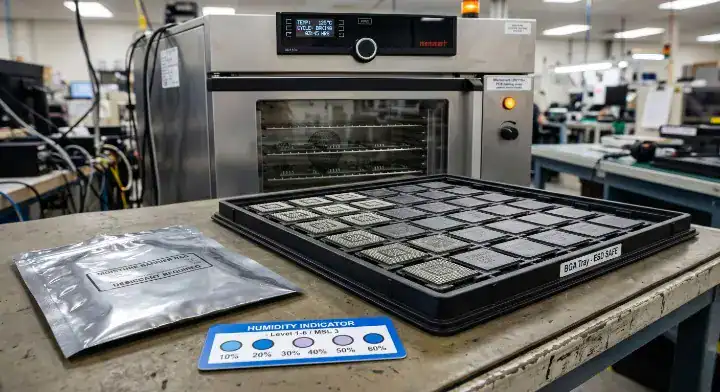
Moisture Sensitivity Level (MSL) is a component-package classification that matters during PCB assembly. Before reflow, buyers should check the MSL label, remaining floor life, dry-pack condition and any required bake record. Bare-board moisture handling needs a separate review rather than a component MSL label.
Quick Answer: Moisture Sensitivity Level PCB control means keeping moisture-sensitive components and boards within their allowed exposure before reflow. MSL 3 parts, for example, are commonly limited to 168 hours of floor life at reference conditions, while MSL 5A parts may be limited to 24 hours, so buyers should ask for label, HIC, bake, dry-storage, and release records before assembly.
Key takeaways
- MSL ratings mainly apply to nonhermetic surface-mount packages, while bare PCB storage is handled as a related but separate moisture-control risk.
- J-STD-020 classifies component moisture sensitivity; J-STD-033 controls handling, packing, shipping, baking, and use.
- Resealing a reel does not automatically reset floor life; approved drying or baking is what restores usable exposure time.
- A buyer should request order-level evidence, not just a supplier statement that “MSL is controlled.”
Moisture Sensitivity Level PCB problems happen when components or boards absorb moisture and then face rapid SMT reflow heat. The visible “popcorn” failure is only the obvious version; less visible damage can include internal delamination, cracked packages, lifted bonds, poor solder joints, or latent failures that appear after shipment.
For a buyer, the goal is not to memorize every bake table. The goal is to make sure the EMS partner controls MSL from receiving through storage, opening, placement, reflow, rework, and final release. This guide explains what to check, what evidence to request, and how to avoid mixing component MSL rules with bare-board moisture handling.
Table of Contents
- What Does Moisture Sensitivity Level Mean?
- Why Does Popcorning Happen During Reflow?
- How Do J-STD-020 and J-STD-033 Differ?
- Which MSL Floor-Life Limits Matter Most?
- What Should Buyers Check on MBB and HIC Labels?
- When Should Components Be Baked?
- Do Bare PCBs Need Moisture Control Too?
- How Should SMT and Rework Track MSL Exposure?
- What Should RFQ and PO Requirements Say?
- What Evidence Should Release the Build?
What Does Moisture Sensitivity Level Mean?
Moisture Sensitivity Level is a classification that tells an assembler how long a moisture-sensitive surface-mount device can be exposed to factory air before reflow risk becomes unacceptable. It is mainly a component-package control system, not a generic label for every PCB material risk.
Plastic-encapsulated ICs, BGAs, QFNs, LGAs, some modules, and other nonhermetic packages can absorb moisture through package materials. When those parts are heated quickly during reflow, absorbed moisture can expand into vapor and stress the package internally.
Buyers often search for “Moisture Sensitivity Level PCB” because the failure appears during PCB assembly. The more precise question is: which components, boards, and process steps need moisture control before soldering?
For procurement, the MSL rating should be treated as production data. It belongs next to the manufacturer part number, package type, peak reflow requirement, dry-pack label, and handling instruction.
Why Does Popcorning Happen During Reflow?
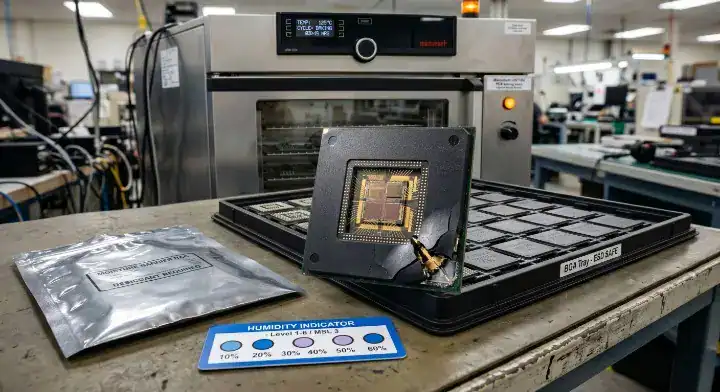
Popcorning happens when absorbed moisture expands rapidly during high-temperature reflow and creates internal mechanical stress. The part may crack, bulge, delaminate, or fail internally even if the outside still looks acceptable.
The risk increases with moisture exposure, package construction, reflow temperature, package thickness, and whether the part is exposed more than once through assembly or rework. Lead-free reflow profiles can make the issue more severe because peak temperatures are typically higher than older tin-lead processes.
The practical buyer lesson is simple: visual inspection before reflow does not prove a moisture-sensitive part is safe. A sealed reel with a valid label, humidity indicator card, and controlled floor-life record is more useful evidence than a “looks fine” statement.
How Do J-STD-020 and J-STD-033 Differ?
J-STD-020 and J-STD-033 work together, but they answer different questions. J-STD-020 is about classifying a component’s moisture/reflow sensitivity. J-STD-033 is about how downstream users handle, pack, ship, store, dry, and use those moisture-sensitive devices.
This difference matters during sourcing. The component manufacturer provides the MSL rating and reflow sensitivity information. The distributor, broker, kitting team, EMS provider, and assembler must preserve that status until the part reaches reflow.
| Standard | Practical role | Buyer question |
|---|---|---|
| IPC/JEDEC J-STD-020 | Classifies moisture/reflow sensitivity of nonhermetic SMD packages | What is the part’s MSL and peak reflow rating? |
| IPC/JEDEC J-STD-033 | Defines handling, packing, shipping, drying, and use | Was this reel handled within floor-life and dry-pack rules? |
| IPC-1601 | Provides printed board handling and storage guidance | Were bare boards protected from moisture uptake and contamination? |
Do not accept “we follow IPC” as a complete answer. Ask which standard applies to the component, the bare board, and the assembly process step under review.
Which MSL Floor-Life Limits Matter Most?
The most important floor-life limits are the ones printed on the actual component label or defined by the manufacturer. General MSL tables are useful for planning, but the order should be controlled by the device label, datasheet, and approved handling record.
Common reference limits include unlimited floor life for MSL 1, one year for MSL 2, four weeks for MSL 2A, 168 hours for MSL 3, 72 hours for MSL 4, 48 hours for MSL 5, and 24 hours for MSL 5A at typical reference conditions. MSL 6 is special because it requires mandatory baking before use and must follow the time limit stated on the label.
These numbers are not a license to ignore environment. Higher humidity, higher temperature, repeated opening, poor resealing, and unclear exposure history all increase risk. The useful buyer action is to ask how floor life is started, paused, logged, and reset for your order.
If the EMS team cannot show exposure history for moisture-sensitive reels, treat the parts as uncontrolled until they are verified, baked when appropriate, or replaced.
What Should Buyers Check on MBB and HIC Labels?
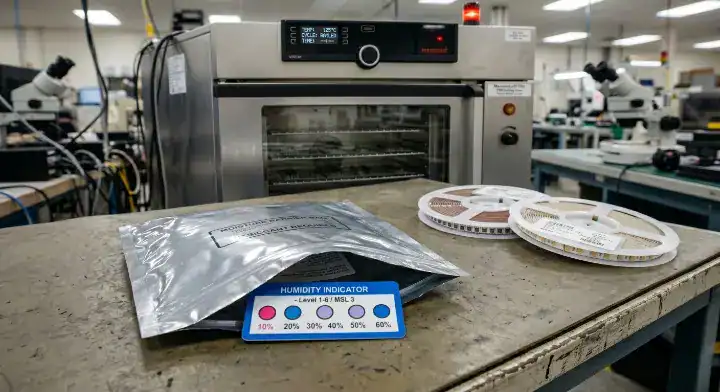
Buyers should check the moisture barrier bag, humidity indicator card, desiccant, and label evidence before assuming a part is safe for SMT. The label should identify the part, MSL, floor life, peak reflow temperature, seal date or relevant packing data, and any manufacturer-specific handling note.
Ask for photos when the order uses BGAs, QFNs, expensive ICs, broker-sourced components, old stock, or partial reels. The useful photo set includes the sealed MBB, warning label, humidity indicator card, desiccant condition if visible after opening, reel label, and receiving record.
Humidity indicator card interpretation should follow the applicable standard and supplier procedure. A card that shows moisture exposure should trigger review, not a casual “it is probably okay.” If the 10% indicator or relevant card threshold has changed color according to the procedure, the supplier should document the disposition.
This is also where counterfeit and shortage risk overlaps with MSL risk. If parts came from an alternate channel, combine MSL checks with the controls in QueenPCB’s guide to preventing counterfeit components and the article on PCB component shortage alternatives.
When Should Components Be Baked?
Components should be baked when their floor life has expired, their dry-pack evidence is compromised, the HIC indicates unacceptable exposure, the manufacturer requires it, or the handling record is not trustworthy enough for reflow release. Baking is not a universal shortcut; the time and temperature depend on package, thickness, carrier material, and manufacturer limits.
One common mistake is assuming that resealing a reel resets the clock. Resealing protects remaining parts from additional exposure, but it does not erase exposure that already occurred. Approved drying or baking is what resets usable floor life under the applicable process.
Another mistake is defaulting to aggressive baking without checking packaging and component limits. Some parts cannot tolerate high-temperature baking in tape-and-reel, tubes, trays, or certain packaging. Ask whether parts must be removed from carriers, baked at lower temperature, or handled under a component-specific procedure.
For buyers, the release record should say what was baked, why it was baked, the time and temperature used, who approved it, and when the floor-life clock restarted after cooling.

Do Bare PCBs Need Moisture Control Too?
Yes, bare PCBs can absorb moisture and may need storage or baking control, but that is not the same as a component MSL rating. Bare-board moisture risk depends on laminate, board thickness, layer count, surface finish, storage time, packaging, humidity, and the number of thermal cycles during assembly.
IPC-1601 is commonly referenced for printed board handling and storage guidance. The buyer should ask whether boards were vacuum sealed, packed with desiccant or humidity indicators when needed, stored in controlled conditions, and opened close to assembly.
This distinction matters because some articles blur “component MSL” and “PCB moisture sensitivity.” In a real build, both can matter, but the evidence is different. Component evidence comes from MSL labels, MBB/HIC status, floor-life logs, and bake records. Bare-board evidence comes from board packing, storage, age, bake history, and supplier handling procedure.
If your build includes thick boards, high-layer-count boards, ENIG or other sensitive finishes, long storage, or multiple reflow cycles, ask the EMS partner to confirm board moisture handling before SMT starts.
How Should SMT and Rework Track MSL Exposure?
SMT teams should track MSL exposure from the moment a dry pack is opened until the part is placed and reflowed. The log should show open time, return-to-dry-storage time, bake time when used, remaining floor life, and the order or lot using the material.
The rework stage is easy to forget. A component that survives the first reflow may still face localized heat during removal, replacement, or repair. If rework uses new moisture-sensitive parts, those parts need the same floor-life control as the original SMT operation.
Solder paste and shop humidity also matter. High humidity can affect paste handling, stencil printing, and general process stability. QueenPCB’s guide to PCBA soldering paste defects can help buyers separate moisture-sensitive component risk from solder paste process risk.
For urgent builds, review MSL control before asking for a quick shipment. QueenPCB’s quick turn PCB assembly service can only be reliable when material status, dry storage, and reflow readiness are confirmed before the line starts.
What Should RFQ and PO Requirements Say?
RFQ and purchase order language should make MSL handling visible before the build begins. Do not wait until a failure appears after reflow to ask whether the supplier followed J-STD-033.
Use practical language such as:
- identify MSL-rated components before assembly
- handle moisture-sensitive devices according to IPC/JEDEC J-STD-033 or approved manufacturer instructions
- provide MBB/HIC label photos for high-risk, broker-sourced, or long-stored components
- track floor life after dry-pack opening
- document bake time, temperature, and restart time when baking is required
- notify the buyer before substituting parts with different MSL or reflow limits
- retain shipment release evidence for the lot
This requirement is especially important when you source components yourself and send them to the assembler. If parts arrive with missing labels, unknown exposure, or damaged dry pack, the EMS provider needs authority to hold, bake, or reject the material instead of silently taking risk.
What Evidence Should Release the Build?
The build should be released only when component status, board status, process controls, and inspection evidence are traceable to the order. A supplier statement is useful, but shipment approval should rely on records.
Ask for an evidence package that matches your risk level:
| Release evidence | Why it matters |
|---|---|
| BOM with MSL-sensitive components marked | Shows which parts require floor-life control |
| MBB/HIC and reel label photos | Confirms dry-pack status and part identity |
| Floor-life or dry-storage log | Shows exposure was controlled before reflow |
| Bake record when used | Shows recovery action and restart time |
| Reflow profile or process confirmation | Confirms thermal exposure was planned |
| AOI/X-ray/test report | Shows the lot passed assembly checks |
| Defect or rework record | Shows whether moisture-related issues appeared |
If defects appear after assembly, use a structured report instead of a vague failure note. QueenPCB’s article on reading a PCBA failure analysis report explains how to separate symptom, root cause, corrective action, and verification.
For remote buyers, combine MSL records with the broader evidence approach in evaluating PCB assembly quality remotely. The decision should be release, hold for missing evidence, bake and reprocess if allowed, replace material, or escalate to engineering review.
FAQ
Can I ignore MSL if the components look normal?
No. Moisture-related damage can be internal, and parts may look normal before reflow even when floor-life control has been lost.
Does baking always fix expired floor life?
No. Baking can restore usable floor life only when the component and packaging can tolerate the approved bake process and the procedure follows the applicable standard or manufacturer instructions.
Is MSL a PCB rating or a component rating?
MSL is mainly a component package rating for moisture/reflow sensitivity. Bare PCBs also need moisture-control handling, but that is usually managed through printed-board storage and baking guidance such as IPC-1601.
What is the biggest buyer mistake with MSL control?
The biggest mistake is asking about MSL after assembly instead of defining evidence requirements in the RFQ, PO, BOM review, and receiving process.
Should broker-sourced components get extra MSL review?
Yes. Broker-sourced, old-date-code, partial-reel, or shortage-substitute components should receive extra label, dry-pack, HIC, exposure, and authenticity checks before release to SMT.
Sources
- IPC/JEDEC J-STD-033 standard store page
- ANSI preview: IPC/JEDEC J-STD-020E
- IPC-1601A table of contents
- Texas Instruments: MSL Ratings and Reflow Profiles
Review MSL Risk Before SMT Assembly
If your BOM includes BGAs, QFNs, LGAs, broker-sourced ICs, old stock, or moisture-sensitive modules, send QueenPCB your BOM, component labels, Gerber files, assembly drawing, and delivery target. Our team can review which parts need MSL tracking, dry-pack evidence, baking records, or extra release checks before SMT starts.
You can also contact QueenPCB with your BOM and assembly files for quotation and manufacturability review.
Written by the QueenEMS Engineering Team.
Upload your files today · Free DFM check before production · Ship worldwide
Get your PCB prototypes in as fast as 24 hours. We handle FR4, Rogers, and hybrid boards up to 40 layers in volume production, with advanced builds subject to engineering review — free prototypes for 2–4 layer FR-4 boards, no minimum order.
Just upload your Gerber + BOM — we source every part, assemble, and inspect (AOI + X‑Ray) so you don't have to chase suppliers. Boards ship in as fast as 24 hours.