Quick Answer: PCB gold fingers are plated edge contacts used when a board must mate with a card-edge connector or socket. For repeated mating, specify electroplated hard gold over a nickel underplate, define the bevel and keepout area on the fabrication drawing, and request thickness evidence such as XRF data instead of relying on a generic “gold finish” note.
Key takeaways:
- Use hard gold for repeated insertion; use ENIG only when the edge is inserted very few times.
- Do not describe hard-gold edge fingers as “IPC-4556 plating”; IPC-4556 is an ENEPIG specification, so call out the actual finish stack.
- Put gold thickness, nickel underplate, bevel angle, solder-mask clearance, and copper pullback in the fabrication notes.
- Ask for inspection evidence before shipment when edge-contact reliability matters.
PCB gold fingers look simple, but most failures start with vague fabrication notes. If a drawing only says “gold plated edge,” the factory may not know whether you expect ENIG for solderability, ENEPIG for contact/solder/wire-bond flexibility, or electroplated hard gold for sliding wear. That difference matters when the product will be inserted into a socket during test, service, or field use.
The safest way to specify PCB gold fingers is to treat them as a mechanical contact interface, not just a surface finish. The plating stack, edge geometry, panel orientation, and inspection evidence all need to match the connector and the expected number of mating cycles.
Table of Contents
- What Are PCB Gold Fingers Used For?
- When Do PCB Gold Fingers Need Hard Gold?
- How Does the PCB Gold Finger Plating Process Work?
- Does IPC-4556 Apply to PCB Gold Fingers?
- What PCB Gold Finger Design Rules Prevent Bevel Damage?
- What Keepout and Copper Pullback Should Buyers Check?
- How Should Panels Be Planned for Gold Finger PCB Manufacturing?
- Which Defects Cause Gold Finger Failures?
- How Should PCB Gold Finger Inspection Be Verified?
- When Should You Avoid PCB Gold Fingers?
What Are PCB Gold Fingers Used For?
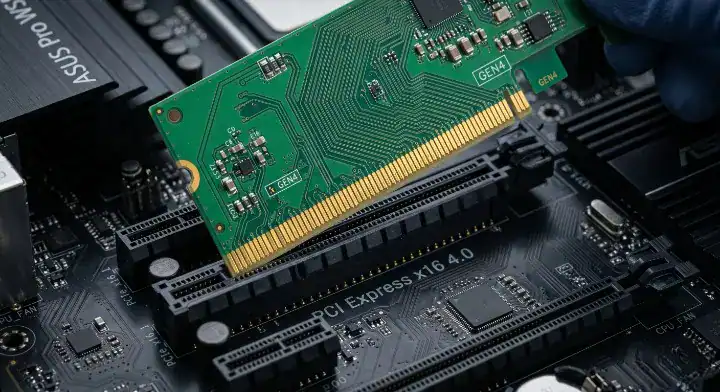
PCB gold fingers are plated copper pads along the edge of a printed circuit board. Their job is to make repeatable electrical contact with a mating socket, card-edge connector, spring contact, or test fixture.
They are common on plug-in modules, PCIe-style cards, industrial control boards, memory modules, test coupons, and removable daughter cards. The gold layer resists oxidation at the contact surface, while the nickel underplate helps isolate the copper base and support the contact layer.
For buyers, the important point is not that the fingers are “gold.” The important point is whether the finish can survive the sliding motion, contact pressure, contamination risk, and expected service life.
| Buyer question | Design implication | What to send the factory |
|---|---|---|
| Is this inserted once or often? | Drives ENIG vs hard gold decision | Expected mating-cycle range |
| Does it fit a defined connector? | Drives pad length, bevel, and thickness | Connector datasheet or drawing |
| Is it a high-speed interface? | Drives return-path and impedance planning | Stackup and impedance notes |
| Will it be tested repeatedly? | May require harder finish even before field use | Test-fixture contact count |
If the connector is part of the product architecture, specify it as a controlled interface from the first RFQ, not as a last-minute surface-finish upgrade.
When Do PCB Gold Fingers Need Hard Gold?
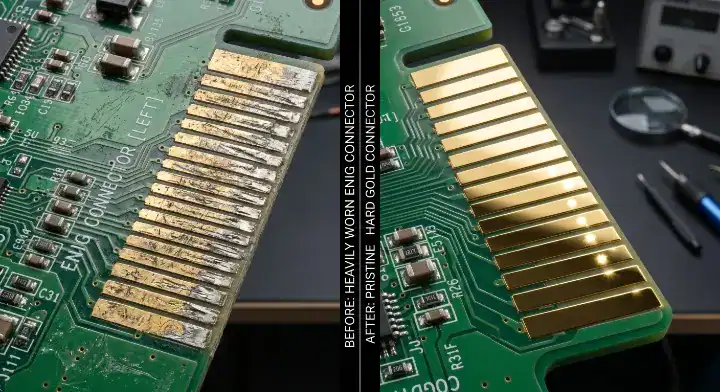
PCB gold fingers need electroplated hard gold when the edge contacts will experience repeated insertion, sliding friction, or frequent test-fixture contact. ENIG can be acceptable for very low-use edges, but it is not designed as a durable sliding wear surface.
This is the most common buyer mistake. ENIG is excellent for flat SMT pads, oxidation protection, and solderability, but the immersion gold layer is thin. In real-world forum discussions, engineers frequently report that ENIG on edge connectors can scrape through after sliding contact, which turns a cost-saving choice into a field-reliability problem.
Use this decision rule:
| Expected use | Practical finish choice | Why |
|---|---|---|
| Factory programming or one-time insertion | ENIG may be acceptable | Low wear exposure |
| Occasional service insertion | Light hard gold or reviewed ENEPIG may be considered | Needs more wear margin |
| Repeated field insertion or test cycling | Electroplated hard gold | Built for sliding contact wear |
| Mixed soldering, contact, and wire-bond needs | ENEPIG may be reviewed separately | Different finish family and standards |
The right answer depends on the mating connector, contact force, environment, and test plan. PCB gold finger insertion cycles are a system requirement, not a plating-only guarantee. If you do not know the cycle count, ask the mechanical or reliability engineer before approving the finish.
How Does the PCB Gold Finger Plating Process Work?
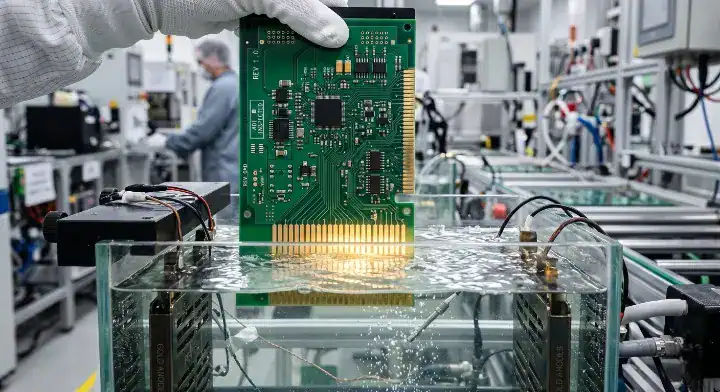
In the PCB gold finger plating process, the fabricator prepares the exposed copper contact area, applies the nickel underplate, and selectively electroplates hard gold on the edge contacts. Because electroplating needs an electrical connection to the panel, gold finger PCB manufacturing must plan the plating bus and edge orientation before routing and beveling.
Specify PCB gold fingers by finish type, gold thickness, nickel underplate, plated area, bevel requirement, and inspection method. The PCB gold finger plating thickness should use the same unit and acceptance basis as the fabrication drawing and connector requirement. A vague note such as “gold fingers” leaves too much room for interpretation.
A practical drawing note should name the finish stack clearly. For repeated contact, that usually means electroplated hard gold over nickel on the finger area only, with the rest of the PCB using a solderable finish such as ENIG, immersion silver, HASL, or OSP depending on the assembly.
The exact thickness should be confirmed with the manufacturer and connector requirement, but common industry language often distinguishes thin ENIG from thicker electroplated hard gold. The key is to avoid mixing units or standards in a way that hides the actual finish.
Example callout structure:
- Finish: selective electroplated hard gold on edge contacts.
- Underplate: nickel underplate before gold.
- Gold thickness: state the required microinch or micrometer value.
- Bevel: state angle and whether one or both sides require beveling.
- Mask/silkscreen: keep clear of all mating surfaces.
- Inspection: XRF thickness report required for first article or production lot.
If a buyer sends only Gerber files with no fabrication drawing, the plating requirement can be missed or quoted incorrectly. Gold fingers deserve their own fabrication note.
Does IPC-4556 Apply to PCB Gold Fingers?
IPC-4556 should not be used as shorthand for electroplated hard gold fingers. IPC describes IPC-4556 as a specification for Electroless Nickel/Electroless Palladium/Immersion Gold, or ENEPIG, on printed boards; that is a different surface-finish family from selective electroplated hard gold.
This matters because many buyers search for “IPC-4556 gold fingers” after seeing ENEPIG and hard gold discussed together. ENEPIG can be used as a contact finish in some designs, but it is not the same as a cobalt- or nickel-hardened electroplated gold layer built for repeated sliding wear.
For electrodeposited gold coatings, ASTM B488 is the more relevant standard family to understand at the coating level because it covers electrodeposited gold coatings for engineering uses. Your PCB supplier may still use internal process specs and IPC acceptance criteria, but the drawing should not claim that IPC-4556 alone controls hard-gold edge fingers.
| Term on drawing | What it usually means | Risk if misused |
|---|---|---|
| ENIG | Electroless nickel immersion gold | Good solder finish, weak wear surface |
| ENEPIG / IPC-4556 | Nickel, palladium, immersion gold | Different finish family; not hard gold shorthand |
| Hard gold | Electroplated gold alloy over nickel | Needs selective plating planning and inspection |
| “Gold plated edge” | Ambiguous | Quoting error, wrong finish, or missing bevel |
The safest buyer language is specific: call out the finish, area, thickness, and acceptance evidence instead of relying on one standard number.
What PCB Gold Finger Design Rules Prevent Bevel Damage?
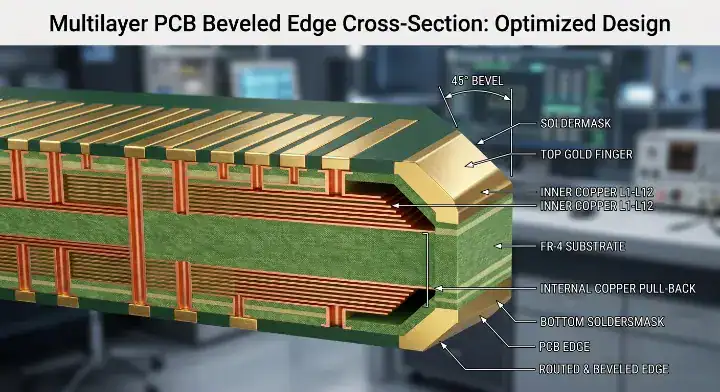
The bevel makes insertion easier and reduces scraping at the connector entrance, but it must match the board thickness and the mating connector. Many boards use 30° or 45° bevels, while some connector families have their own geometry.
Do not assume that every thin board can be beveled safely. The thinner the board, the less mechanical margin the fabricator has near the plated contact edge. If the board is very thin, or if the fingers sit too close to internal copper, beveling can expose copper, crack the edge, or damage the plated contact.
Buyers should verify four items before release:
- Finished board thickness at the connector.
- Bevel angle and bevel side.
- Distance from finger pads to board outline.
- Connector datasheet requirements for entry geometry.
For standard FR-4 plug-in modules, 1.6 mm is common, but the connector datasheet always wins. If your design uses 0.8 mm, 1.0 mm, or rigid-flex construction, request a DFM review before approving the plating order.
What Keepout and Copper Pullback Should Buyers Check?
Keep solder mask, silkscreen, vias, components, and inner copper away from the mating and bevel zones. These keepouts prevent contamination, plating shadows, exposed copper, and mechanical cracking during routing. PCB gold finger solder mask clearance should be dimensioned from the mating surface and bevel entry instead of being left to a generic mask expansion.
The two most important checks are simple. First, the contact face should be free of solder mask and legend ink. Second, inner copper should be pulled back from the beveled edge so the bevel does not cut into a buried plane or trace.
Use this checklist during CAM review:
- No solder mask on the mating surface.
- No silkscreen over pads or bevel entry.
- No vias or plated holes too close to the finger edge.
- No SMD pads close enough to create solder or flux contamination.
- Inner copper pulled back from the routed and beveled outline.
- Finger pads aligned to the mechanical outline and connector datum.
These details look small in CAD, but they decide whether the final edge connector feels smooth, mates fully, and avoids intermittent contact resistance.

How Should Panels Be Planned for Gold Finger PCB Manufacturing?
Selective electroplated hard gold often needs panel planning because the finger area must be electrically connected during plating. If the panel orientation blocks the plating bus or hides the edge inside the array, the factory may need to re-panelize the job.
For buyers, the practical lesson is to tell the supplier about gold fingers before the quotation is finalized. The panel can then place edge connectors toward rails, leave enough handling border, and protect the finished edge during assembly and depaneling.
Poor panel planning can create avoidable cost or quality risk:
| Panel issue | Manufacturing risk | Buyer prevention |
|---|---|---|
| Fingers face inward in array | Harder selective plating access | Ask for panel review before fabrication |
| Break tabs placed on finger edge | Contact damage during depaneling | Keep tabs away from connector edge |
| No handling rail | Finger contamination during assembly | Add rail or protective handling method |
| Bevel done after assembly without protection | Scratched contacts or debris | Confirm process sequence |
If the same supplier handles fabrication and assembly, ask whether the gold finger edge remains protected through SMT, cleaning, inspection, and final packing.
Which Defects Cause Gold Finger Failures?
Most PCB gold finger failures come from the wrong finish, poor edge geometry, contamination, plating thickness variation, or adhesion problems. The visible symptom may be an intermittent connection, but the root cause is often upstream in design or fabrication.
Watch for these failure modes:
- Gold wear-through that exposes nickel or copper after sliding contact.
- Peeling or flaking from poor surface preparation or plating adhesion.
- Solder mask residue on the contact area.
- Exposed inner copper at the bevel.
- Rough or chipped bevel edges that scrape the mating socket.
- Finger dimension errors that prevent full connector engagement.
- Contact resistance drift after test cycling.
Avoid writing “must withstand 1,000 insertions” unless the connector, plating, contact force, environment, and test method all support that requirement. A better procurement requirement is to define the expected mating conditions and ask the supplier what finish stack and inspection plan they recommend.
How Should PCB Gold Finger Inspection Be Verified?
For critical PCB gold fingers, request evidence that proves the contact area was built as specified. The most useful evidence is usually XRF thickness measurement, visual inspection of the plated edge, and first-article confirmation against the fabrication drawing.
XRF is commonly used to measure plating thickness without cutting the board. It does not prove every reliability outcome by itself, but it helps confirm whether the nickel and gold layers are within the agreed range.
Ask for inspection evidence when:
- The board is used in field-replaceable hardware.
- The product has repeated test-fixture insertion.
- The connector is safety-, medical-, automotive-, or industrial-control related.
- The design mixes solderable surface finish with selective hard gold.
- The first article uses a new supplier or new panel layout.
The buyer should also verify that the final package protects the fingers from abrasion and fingerprints. Clean contacts can still fail if they are rubbed against trays, foam, or loose hardware during shipping.
When Should You Avoid PCB Gold Fingers?
Avoid PCB gold fingers when the design needs a locking connector, sealed interface, high-vibration retention, high-current cabling, or a one-time low-cost connection that does not justify selective plating. Edge contacts are useful, but they are not automatically more reliable than a proper connector system.
Choose another interface when mechanical retention is the real risk. Locking wire-to-board connectors, board-to-board mezzanine connectors, card guides, or cabled assemblies may handle vibration and service abuse better than a sliding card edge.
Use this final decision filter:
| If your product needs… | Consider instead |
|---|---|
| Frequent module replacement | Hard-gold edge fingers with controlled connector |
| One-time factory programming | ENIG pads or simple debug connector |
| High vibration | Locking connector or retention hardware |
| Waterproof enclosure | Sealed connector or internal harness |
| High current | Connector rated for current and temperature rise |
When in doubt, send the connector datasheet, stackup, Gerbers, and expected mating count with the RFQ. QueenEMS can review the edge geometry, surface finish choice, and fabrication notes before the board moves into production.
FAQ
Are “gold finger PCB,” “gold fingers PCB,” and “PCB gold finger” the same?
These searches normally refer to the same board feature: plated contacts along a PCB edge. “PCB gold fingers” is the clearest technical term for the contacts; the mating card-edge connector or socket is a separate component.
Can I use ENIG instead of hard gold for PCB gold fingers?
Yes, but only for very low insertion counts or non-critical factory-use edges. For repeated sliding contact, electroplated hard gold is usually safer because ENIG is primarily a solderable surface finish, not a high-wear contact surface.
Is IPC-4556 the standard for hard gold PCB gold fingers?
No. IPC-4556 is associated with ENEPIG plating, so it should not be used as shorthand for electroplated hard gold fingers. Call out the actual finish stack, thickness, and inspection requirement instead.
What should I put in a gold finger fabrication note?
State the selective hard-gold area, nickel underplate, gold thickness, bevel angle, solder-mask clearance, copper pullback, and XRF or first-article evidence requirement. Attach the connector datasheet if the finger geometry must match a socket.
Do PCB gold fingers increase lead time?
Usually yes. Selective hard gold can add process steps for masking, panel planning, electroplating, beveling, and inspection. The exact lead-time impact depends on board complexity, panel layout, and whether the finish is approved before quotation.
What causes PCB gold fingers to peel or fail?
Common causes include poor cleaning before plating, weak adhesion, incorrect finish selection, insufficient contact-area keepout, exposed copper at the bevel, and contamination during assembly or packing. Request DFM review and plating evidence for critical boards.
Sources
- IPC-4556 amendment page
- ANSI / ASTM B488-18(2025) standard page
- Electronics Stack Exchange discussion on ENIG edge connector wear
- QueenEMS guide: ENIG vs hard gold vs soft gold
- QueenEMS DFM PCB design guide
Written by the QueenEMS Engineering Team
Upload your files today · Free DFM check before production · Ship worldwide
Get your PCB prototypes in as fast as 24 hours. We handle FR4, Rogers, and Flex up to 60 layers — free prototypes for 2–4 layer boards, no minimum order.
Just upload your Gerber + BOM — we source every part, assemble, and inspect (AOI + X‑Ray) so you don't have to chase suppliers. Boards ship in as fast as 24 hours.