

Quick Answer: IPC standards are a centralized set of over 300 active electronics manufacturing rules that dictate PCB quality, requiring specific metrics like 25μm copper plating for Class 3 high-reliability boards versus standard consumer tolerances. Key takeaways:
- IPC Class 3 demands ≥ 75% through-hole barrel fill, while Class 2 accepts ≥ 50%.
- J-STD-001J and IPC-A-610J are the latest 2024/2025 assembly standards.
- The IPC organization officially rebranded to the Global Electronics Association in June 2025.
- Failing to specify an IPC class on your purchase order defaults production to Class 2.
You design a perfect board, send it to a manufacturer, and receive a batch that fails in the field because the factory used default consumer-grade tolerances. Relying on vague instructions leads to overpaying for unnecessary specifications or suffering catastrophic product failures. By mastering the exact ipc standards applicable to your production stage, you guarantee reliability while controlling your manufacturing budget.
Table of Contents
- What are IPC standards and who creates them?
- How is the system of IPC standards organized?
- Which IPC standards govern PCB design rules?
- Which IPC standards cover bare PCB fabrication?
- Which IPC standards apply to PCBA and soldering?
- How do IPC standards define Class 1, 2, and 3?
- How do you choose IPC standards classes for PCBs?
- Do IPC standards cover cable and box build prep?
- What are the 2025-2026 IPC standards revisions?
- How do you specify IPC standards on PCB orders?
What are IPC standards and who creates them?
The ipc standards are technical guidelines developed by the Global Electronics Association that dictate the quality and reliability of electronic assemblies. Over 300 active standards are maintained by 3,000+ industry volunteers from 90+ countries, establishing clear pass/fail criteria for manufacturing.
How did the association evolve?
The organization was founded in 1957 to standardize bare board manufacturing practices across the United States. On June 23, 2025, it officially renamed itself the Global Electronics Association, reflecting its worldwide reach. The legacy acronym remains intact for all document numbers and certification programs.
Why do these guidelines matter?
Here is the catch: without unified rules, every factory would define acceptable quality differently, resulting in unpredictable product lifespans.
- They provide a common language between hardware designers and contract manufacturers.
- They establish objective, measurable criteria for automated optical inspection machines.
- They protect buyers by setting legal baselines for purchase contracts.
Who actually writes the rules?
Industry committees comprising OEMs, EMS providers, and material suppliers draft these documents based on real-world data. This collaborative process means the rules reflect practical factory capabilities rather than theoretical perfection.
Key Takeaway: Bottom line: Always verify your manufacturing partner holds active IPC CIT certifications to confirm they understand the latest industry requirements.
| Standard Number | Coverage Area | Current Version | Companion Standard |
|---|---|---|---|
| IPC-A-610 | Assembly visual acceptance | Rev J | J-STD-001 |
| J-STD-001 | Soldering process requirements | Rev J | IPC-A-610 |
| IPC-A-600 | Bare board visual acceptance | Rev K | IPC-6012 |
| IPC-6012 | Bare board performance specs | Rev F | IPC-A-600 |
| IPC-2221 | Generic design guidelines | Rev C | IPC-2222 |
| This table highlights the top five mandatory standards every hardware team must reference. |
How is the system of IPC standards organized?
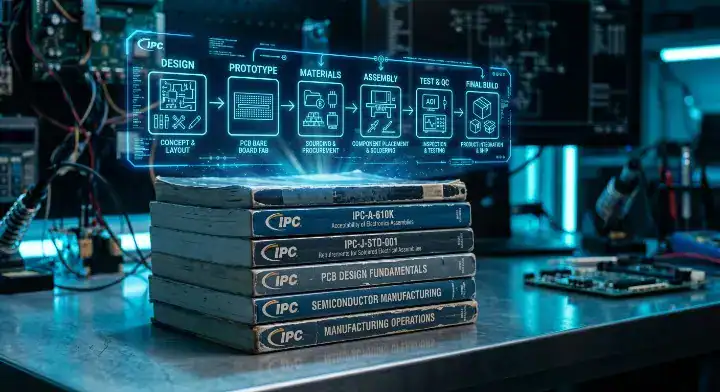
The system of ipc standards is organized sequentially to match the product lifecycle, covering design, fabrication, assembly, inspection, and rework. This hierarchical structure means engineers can reference a specific document for their exact production phase without parsing irrelevant data.
What is the standards tree?
The architecture acts as a flowchart starting from baseline material requirements down to final product acceptance. Every standard links to a predecessor, resulting in a cohesive quality control loop.
How do prefixes work?
But wait, there is more: the document naming conventions reveal the exact purpose of the text. For instance, IPC-A-610J indicates “Acceptability” (A), series 610, and revision J.
- J-STD indicates a Joint Industry Standard developed collaboratively with JEDEC and ECIA.
- A-prefix documents focus purely on visual acceptance criteria and inspection photographs.
What is the IPC standards map?
Mapping the documents to your supply chain prevents specification gaps between different vendors. A complete map helps your procurement team know exactly what to cite on a purchase order.
Key Takeaway: Bottom line: Use the production phase map to assign the correct standard to your fab notes, preventing costly factory delays.
| Design | Fabrication (Bare Board) | Assembly (PCBA) | Test & Inspection | Rework & Repair |
|---|---|---|---|---|
| IPC-2221 (Generic) | IPC-6012 (Performance) | J-STD-001 (Soldering) | IPC-A-610 (Visual) | IPC-7711 (Rework) |
| IPC-2222 (Rigid) | IPC-A-600 (Acceptance) | IPC/WHMA-A-620 (Cables) | IPC-9261 (Yield) | IPC-7721 (Repair) |
| IPC-2223 (Flex) | IPC-4101 (Materials) | IPC-7530 (Reflow Profile) | IPC-A-600 (Visual) | |
| This map categorizes the primary standards by their specific role in the manufacturing chain. |
Which IPC standards govern PCB design rules?
The IPC-2220 series of ipc standards governs PCB design rules, establishing baseline requirements for component placement, trace routing, and material selection. IPC-2221C serves as the generic foundation for all printed board designs across the industry.
What does the IPC-2220 series include?
The series branches out based on the specific board technology you are developing. IPC-2222 covers rigid organic printed boards, while IPC-2223 dictates rules for flexible circuits. Each document provides formulas for calculating trace widths based on current load and temperature rise.
How do technology addendums work?
Consider this fact: specialized technologies require their own design parameters to prevent field failures.
- IPC-2224 focuses on PCMCIA forms and thin-profile boards.
- IPC-2226 targets high-density interconnect (HDI) structures and microvia implementation.
How does design impact production?
Producibility levels are established during design to match standard manufacturing capabilities. Designing beyond a factory’s capability, which means ignoring these standard levels, drives up fabrication costs exponentially.
Key Takeaway: Bottom line: Always design your PCB according to IPC-2221C and the specific sub-standard for your board type to guarantee factory readiness.
| Standard Series | Design Focus Area | Key Metric Addressed |
|---|---|---|
| IPC-2221 | Generic Routing & Layout | Clearances, Thermal Relief |
| IPC-2222 | Rigid FR4 Boards | Substrate thickness, Hole sizes |
| IPC-2223 | Flexible Circuits | Bend radius, Polyimide constraints |
| IPC-2226 | HDI Boards | Microvia aspect ratios |
| Adhering to these design rules ensures your board is actually manufacturable by standard facilities. |
Which IPC standards cover bare PCB fabrication?
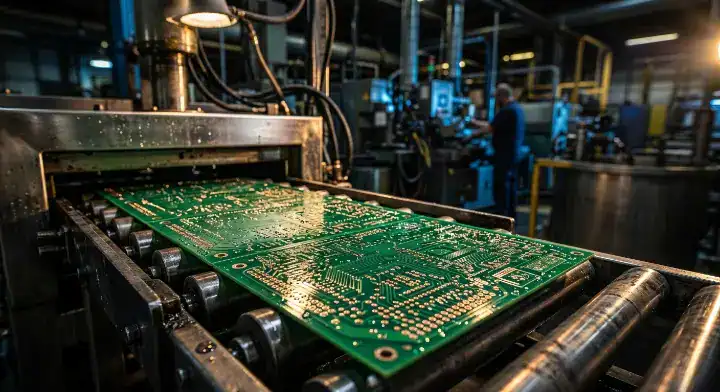
The primary ipc standards covering bare PCB fabrication are IPC-6012F for physical performance specifications and IPC-A-600K for visual acceptability. These documents define exactly how a blank circuit board must perform and appear before any components are added.
What is the difference between 6012 and 600?
IPC-6012 defines the physical performance and qualification requirements, dictating the minimum copper plating thickness inside vias. IPC-A-600 provides the visual interpretations and photographs showing target, acceptable, and nonconforming conditions for factory floor workers.
Are there industry-specific requirements?
Here is the reality check: standard specifications do not cover extreme operating environments. The IPC-6012 series uses specialized addendums to address harsh conditions.
- IPC-6012FS adds strict rules for space and military avionics.
- IPC-6012EM dictates specific cleanliness criteria for medical devices.
- IPC-6012FA focuses on automotive vibration and thermal resistance.
How do we handle fab defects?
Many clients experience copper delamination because their previous supplier ignored thermal stress testing. At QueenEMS, we implement strict IPC-2221 D coupon testing on every high-layer build, resulting in a 99.7% first-pass yield on bare boards.
Key Takeaway: Bottom line: Specify both IPC-6012F and the applicable industry addendum on your fabrication drawing to prevent premature board failure.
| Industry Addendum | Target Sector | Key Stringent Requirement |
|---|---|---|
| IPC-6012FS | Space/Military Avionics | Eradication of via voiding, tighter wicking |
| IPC-6012EM | Medical Implants/Devices | Absolute ionic cleanliness, tighter registration |
| IPC-6012FA | Automotive Electronics | Heavy vibration resistance, thick copper specs |
| Selecting the correct addendum forces the manufacturer to apply application-specific testing. |
Which IPC standards apply to PCBA and soldering?
J-STD-001J and IPC-A-610J are the primary ipc standards governing printed circuit board assembly and soldering processes. J-STD-001 outlines the detailed manufacturing processes, while IPC-A-610 defines the final visual acceptance criteria for the joints.
Why do you need both standards?
IPC-A-610 is a results-based inspection document detailing what a finished joint must look like to pass quality control. J-STD-001 is a process control document specifying the exact materials, flux types, and thermal profiles required to build that reliable joint.
What is the Joint Industry Standard?
The truth is: the J-STD prefix means the rule was developed collaboratively by IPC, JEDEC, and ECIA. This synergy guarantees that component manufacturers and assembly houses agree on thermal limits.
- Both documents are updated simultaneously to prevent contradicting rules.
- The official organization mandate suggests purchasing both documents together for full compliance.
What changed in the J revision?
Released in March 2024 after 3.5 years of development, J-STD-001J incorporates input from experts across 27 countries. It makes the documentation far more intuitive and consistent for global operators, addressing new lead-free alloy behaviors.
Key Takeaway: Bottom line: Require your contract manufacturer to comply with both J-STD-001J for their process and IPC-A-610J for their final inspection.
| Document | Nature of Standard | Primary User in Factory |
|---|---|---|
| J-STD-001J | Process-oriented (How to do it) | Manufacturing Engineers, SMT Operators |
| IPC-A-610J | Results-oriented (What it looks like) | Quality Assurance, AOI Programmers |
| Understanding this synergy prevents factory disputes over how a joint was formed versus how it looks. |
How do IPC standards define Class 1, 2, and 3?
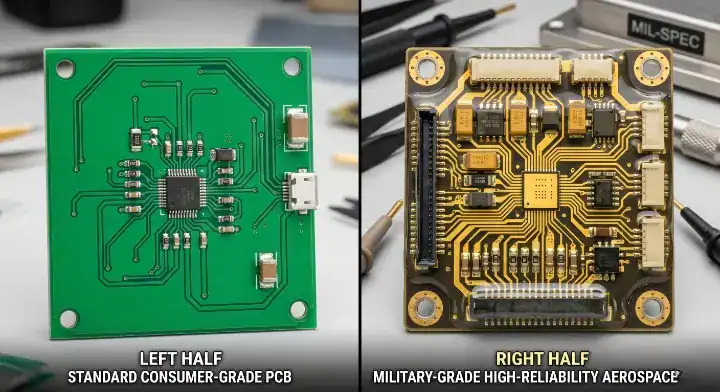
The ipc standards classify electronics into Class 1 for general products, Class 2 for dedicated service products, and Class 3 for high-reliability electronics. Each class dictates progressively tighter tolerances for manufacturing defects, barrel fill percentages, and copper specifications.
What are the exact physical differences?
Specific metrics separate the classes drastically during fabrication. Class 3 requires a through-hole barrel fill of ≥ 75%, whereas Class 2 only requires ≥ 50%. A Class 2 board allows minor cosmetic imperfections that do not affect function, but Class 3 is strictly zero-tolerance.
How does plating thickness vary?
Keep this in mind: the amount of copper inside your vias determines their survival during severe thermal cycling.
- Class 3 requires plated copper thickness of ≥ 25μm.
- Class 3A (aerospace) demands ≥ 37μm, which is 12μm more than standard Class 3.
How do costs and inspections change?
Moving from Class 2 to Class 3 incurs a cost premium of approximately 20% due to mandatory 100% automated optical inspection and stricter cleanliness protocols. Even when using no-clean flux, Class 3 often requires a full wash process to guarantee longevity.
Key Takeaway: Bottom line: Never specify Class 3 unless your application strictly requires it, as the zero-defect tolerance significantly increases your unit cost.
| Feature | Class 1 (General) | Class 2 (Dedicated) | Class 3 (High-Reliability) |
|---|---|---|---|
| Typical Product | Toys, cheap consumer tech | Laptops, telecom, appliances | Medical, military, automotive |
| THT Barrel Fill | Not specified | ≥ 50% | ≥ 75% |
| Min Annular Ring | 90° breakout allowed | 90° breakout allowed | No breakout allowed (0.05mm min) |
| Cosmetic Defects | Allowed | Allowed if function is okay | Strictly prohibited |
| Inspection Level | Visual sampling | AOI + Sample visual | 100% AOI + X-Ray + Full Visual |
| Cost Premium | Baseline | +5% to 10% | +20% or higher |
| This comparison shows why over-specifying classes drains your hardware budget rapidly. |
7How do you choose IPC standards classes for PCBs?
You choose ipc standards classes by evaluating your product’s operating environment, desired lifespan, and the direct consequences of a field failure. If you do not explicitly state a requirement on your purchase order, factories will automatically default your build to Class 2.
What are the three decision questions?
First, ask if a failure risks human safety or causes critical mission downtime. Second, determine if the device operates in harsh vibration or extreme thermal environments. Third, verify if industry regulations legally force you into a specific reliability tier.
What happens if you choose poorly?
You need to know this: over-specifying a smart home gadget to Class 3 wastes 20% of your budget and extends lead times needlessly.
- Under-specifying an engine controller leads to deadly field failures.
- Mismatched classes, like pairing a Class 1 bare board with a Class 3 assembly, downgrade the final product to Class 1.
Can every factory build Class 3?
Many startups assume any factory can handle aerospace requirements, resulting in failed compliance audits upon delivery. At QueenEMS, we employ fully certified IPC CIT operators and run 3D AOI plus X-Ray inspection on every single BGA joint, guaranteeing true Class 3 compliance.
Key Takeaway: Bottom line: If your device answers “yes” to safety-critical or harsh environment questions, you must explicitly demand Class 3 and verify the factory’s certification.
| Application Scenario | Failure Consequence | Operating Environment | Recommended Class |
|---|---|---|---|
| Smart doorbell | Nuisance | Moderate outdoor | Class 2 |
| Industrial robot arm | Production line stoppage | High vibration/dust | Class 3 |
| Implantable pacemaker | Loss of life | Internal body chemistry | Class 3 + IPC-6012EM |
| Following this decision matrix prevents both dangerous under-specification and costly over-specification. |
Do IPC standards cover cable and box build prep?
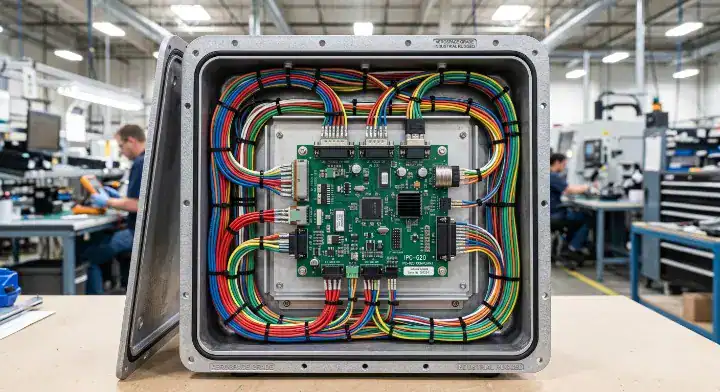
Yes, ipc standards like IPC/WHMA-A-620E specifically dictate the acceptance criteria for cable, wire, and harness assemblies used in box builds. These rules guarantee that internal connections are crimped, routed, and secured to withstand intense mechanical stress.
What does the 620 standard cover?
IPC/WHMA-A-620 provides visual criteria for wire preparation, soldering to terminals, and crimping of contacts. It also dictates how wires should be bundled and secured using cable ties or lacing tape to prevent chafing against the chassis.
What about rework and repair?
Do not ignore this step: fixing a broken wire or board trace requires its own set of controlled rules to maintain reliability.
- IPC-7711 covers the safe rework of electronic assemblies.
- IPC-7721 details the modification and physical repair of printed boards.
How do mixed assemblies work?
A complete box build often involves mixing rigid boards, flex circuits, and heavy wiring harnesses. Every individual component must meet its specific standard, because a perfect Class 3 PCBA will still fail if connected by a cheap Class 1 wire harness.
Key Takeaway: Bottom line: Apply IPC/WHMA-A-620E to all your custom cable drawings to prevent loose connections inside your final enclosure.
| Standard Number | Focus Area | Critical Checkpoints |
|---|---|---|
| IPC/WHMA-A-620 | Cables and Harnesses | Crimp height, pull force, insulation damage |
| IPC-7711 | Component Rework | Heat application, pad lifting prevention |
| IPC-7721 | Board Repair | Trace splicing, epoxy repair of burns |
| Box builds rely heavily on these specific standards to maintain system-level integrity. |
What are the 2025-2026 IPC standards revisions?
The 2025-2026 ipc standards revisions include the newly released J-STD-001J, IPC-A-610J, and the official organizational rebrand to the Global Electronics Association. These updates reflect the latest manufacturing tolerances for miniaturized components and advanced lead-free solder alloys.
Did the organization change its name?
On June 23, 2025, the governing body officially rebranded to the Global Electronics Association (GEA), changing its web presence to electronics.org. Concurrently, the IPC Education Foundation transitioned its name to the Electronics Foundation.
Will old certifications expire?
Breathe a sigh of relief: the legacy brand name for the standards themselves remains entirely unchanged.
- Your existing IPC CIS or CIT certifications stay fully valid.
- Current training materials and factory posters require no immediate replacement.
What are the newest document versions?
The industry is now operating on IPC-A-610J and J-STD-001J, both finalized in early 2024, alongside IPC-A-600K for bare boards. IPC-6012F and IPC/WHMA-A-620E are also the mandatory baseline revisions for new manufacturing contracts entering 2026.
Key Takeaway: Bottom line: Update your internal quality management system to reference the J revisions for assembly and K revisions for bare boards.
| Standard | 2025-2026 Revision | Major Focus of Update |
|---|---|---|
| IPC-A-610 | Rev J | Advanced component miniaturization rules |
| J-STD-001 | Rev J | Intuitive global layout, new alloy profiles |
| IPC-A-600 | Rev K | High-density interconnect visual criteria |
| IPC-6012 | Rev F | Stricter microvia reliability metrics |
| Staying current with these revisions prevents your factory from using outdated thermal profiles. |
How do you specify IPC standards on PCB orders?
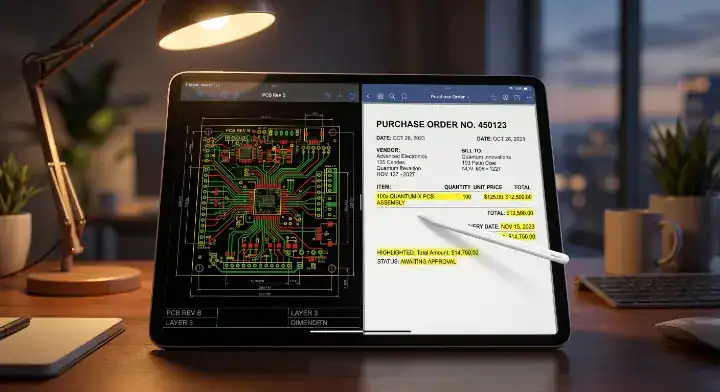
You specify ipc standards on PCB orders by explicitly writing the exact document number, revision letter, and desired class directly into your fabrication notes. Vague requests like “build per IPC” are legally meaningless and shift all liability to the buyer when defects occur.
What goes on a bare board PO?
A proper fabrication note must define the rules clearly for the board house. You must state “Fabricate per IPC-6012F Class 3 and inspect per IPC-A-600K Class 3” to establish a binding contractual requirement for the bare PCB.
What goes on an assembly PO?
This is non-negotiable: the contract manufacturer needs distinct instructions for their soldering processes and final visual inspections.
- Specify IPC-A-610J Class 2 for visual acceptance.
- Specify J-STD-001J Class 2 for the actual soldering processes.
Should you always use the newest version?
Buyers often blindly request the newest revision, triggering costly re-qualifications for already FDA-approved medical devices. At QueenEMS, our engineers conduct a free DFM review upfront, verifying that clients with locked medical designs safely manufacture using their originally filed H-revision rules.
Key Takeaway: Bottom line: Detail the exact standard number, revision letter, and class on your PO to establish clear legal accountability with your factory.
| Required Call-out | Example Text | Why it matters |
|---|---|---|
| Document + Rev + Class | “Per IPC-A-610J Class 3” | Sets exact legal acceptance criteria |
| Surface Finish Rules | “ENIG per IPC-4552” | Prevents cheap finish substitutions |
| Coupon Testing | “Test per IPC-2221 D Coupon” | Confirms via reliability under stress |
| A complete purchase order leaves zero room for factory interpretation or downgraded quality. |
Applying the correct manufacturing guidelines prevents catastrophic field failures, speeds up your time-to-market, and keeps your production budget under control. Whether you are navigating the transition to the Global Electronics Association or determining if your medical device requires Class 3 precision, having a capable manufacturing partner is half the battle. QueenEMS delivers a 99.7% first-pass yield and full turnkey services tailored to your exact compliance needs. If you need a certified partner to handle your next high-reliability build, contact us today to start your project. We build it right, the first time.
FAQ
Can I mix a Class 1 bare board with a Class 3 assembly process? Yes, but the final product is classified by the lowest standard used, which means your product legally becomes a Class 1 device. A high-reliability assembly process cannot fix a cheaply fabricated bare board, resulting in premature failure.
What is the best way to prove a factory meets Class 3 requirements? Request their active IPC CIT (Certified IPC Trainer) or CIS certificates immediately. Factories capable of Class 3 will also provide comprehensive 3D AOI and X-ray inspection reports for every batch.
How do I know if my product needs the IPC-6012FA automotive addendum? If your device handles engine controls, braking, or ADAS (Advanced Driver Assistance Systems), yes, it requires the FA addendum. This adds strict vibration and thermal cycling tests not found in standard Class 2 requirements.
Do the 2025 GEA rebranding changes invalidate my current product warranties? No, the transition to the Global Electronics Association does not alter the technical validity of the published standards. Your existing contracts citing the old acronym remain fully legally binding.
Can I just write “Manufacture to highest IPC standards” on my drawing? No, because factories legally default to Class 2 when exact specifications are missing. You must cite specific documents like IPC-A-610J Class 3 to enforce strict quality control. Reach out to our engineering team today if you need help writing your fab notes.
Upload your files today · Free DFM check before production · Ship worldwide
Get your PCB prototypes in as fast as 24 hours. We handle FR4, Rogers, and hybrid boards up to 40 layers in volume production, with advanced builds subject to engineering review — free prototypes for 2–4 layer FR-4 boards, no minimum order.
Just upload your Gerber + BOM — we source every part, assemble, and inspect (AOI + X‑Ray) so you don't have to chase suppliers. Boards ship in as fast as 24 hours.