

Quick Answer: PCBA defect Pareto analysis ranks assembly defects by frequency, cost, severity, or rework time so engineers can focus on the “vital few” problems first. It does not prove root cause by itself; it tells the team where to start fishbone, 5 Whys, DFM review, process adjustment, and corrective action.
Key takeaways:
- Use clean defect categories before building the chart; mixed categories create false priorities.
- Rank by count for yield loss, by cost for scrap/rework spend, and by severity for reliability risk.
- Compare before/after Pareto charts only after the inspection method and sample window stay consistent.
- Do not promise a fixed rework reduction such as 50%; let the data show whether the corrective action worked.
PCBA defect Pareto analysis is useful because assembly teams rarely have equal problems. A small number of defect modes—such as solder bridges, insufficient solder, tombstoning, misalignment, missing parts, BGA voiding, or lifted pads—often consume most of the rework attention.
The mistake is treating the Pareto chart as the solution. It is only the prioritization step. The value comes when the chart is tied to inspection data, root-cause tools, IPC acceptance criteria, and controlled corrective action.
Table of Contents
- What Is PCBA Defect Pareto Analysis?
- Which Data Should Feed the Pareto Chart?
- How Should PCBA Defects Be Classified?
- Should You Rank by Count, Cost, or Severity?
- How Do Inspection Stages Change the Result?
- When Does Pareto Point to Process Drift?
- How Do You Turn Pareto Data into Root Cause?
- What Corrective Actions Should Buyers Expect?
- How Should Before/After Pareto Charts Be Compared?
- What Should QueenEMS Receive for Defect Review?
What Is PCBA Defect Pareto Analysis?
PCBA defect Pareto analysis is a quality method that ranks defect categories from largest to smallest so the team can see which issues create the biggest share of rejects, rework, cost, or risk. ASQ describes Pareto charts as useful when analyzing the frequency of problems or causes and when teams need to focus on the most significant items.
In PCB assembly, a Pareto chart usually combines bars for defect categories with a cumulative line. The left side shows the largest contributors. The right side shows smaller categories that may still matter, but normally should not consume the first corrective-action effort.
The chart answers one practical question: “Which defect family deserves engineering attention first?” It does not answer “why did it happen?” That second question needs root-cause analysis.
Which Data Should Feed the Pareto Chart?
Use data from consistent inspection points: solder paste inspection (SPI), automated optical inspection (AOI), X-ray, in-circuit test (ICT), functional test (FCT), final inspection, and rework logs. Mixing these sources without labels can hide where the defect was created.
A useful Pareto dataset should include:
- Defect category.
- Board part number and revision.
- Lot, line, shift, and date.
- Inspection stage where the defect was detected.
- Component reference designator or area.
- Rework action and disposition.
- Count, cost, time, or severity value.
If the dataset only says “bad solder,” the chart will not drive a useful process fix. Separate the defect into bridge, open, insufficient solder, non-wetting, solder ball, or tombstoning when the evidence supports that detail.

How Should PCBA Defects Be Classified?
Classify PCBA defects by the failure mode that drives the corrective action, not by a vague symptom. A solder bridge, missing component, reversed polarity, BGA void, lifted pad, cold joint, and test failure should not all collapse into one “assembly defect” bucket.
Good classification makes ownership visible:
| Defect family | Likely first review | Typical evidence |
|---|---|---|
| Solder paste volume | Stencil / printer / SPI | SPI height and volume data |
| Placement error | Feeder / nozzle / program | AOI image, placement log |
| Reflow wetting issue | Profile / pad / finish | Reflow profile, solder joint image |
| BGA hidden defect | Reflow / layout / component | X-ray and cross-section if needed |
| Functional failure | Test / design / component | ICT/FCT log and schematic review |
| Board damage | Handling / rework / fixture | Photos, route, rework record |
The goal is not to create too many categories. The goal is to use categories that point to different corrective actions.
Should You Rank by Count, Cost, or Severity?
Rank by the metric that matches the decision. Defect count is useful for yield improvement, but it may understate low-frequency failures that are expensive, safety-related, or difficult to rework.
Use count when the goal is first-pass yield. Use rework time when the bottleneck is technician capacity. Use cost when scrap and component loss dominate. Use severity when reliability or customer escape risk matters more than volume.
| Ranking metric | Best use | Watch-out |
|---|---|---|
| Defect count | High-volume yield improvement | May ignore expensive rare failures |
| Rework minutes | Labor bottleneck reduction | Needs accurate technician logging |
| Scrap cost | Material-loss control | Can bias toward high-cost components |
| Severity score | Reliability-risk review | Must be defined consistently |
| Customer escape | Field-risk prevention | Small sample sizes can mislead |
For critical products, build two views: one by occurrence and one by risk or cost. The “largest bar” is not always the first problem to fix.
How Do Inspection Stages Change the Result?
Inspection stage changes the Pareto result because defects detected at SPI, AOI, X-ray, ICT, and FCT represent different process windows. A solder-paste defect caught at SPI is cheaper to correct than a latent solder-joint weakness found after functional test.
Do not combine all stages into one chart until you understand the detection point. A Pareto chart for SPI may point to stencil aperture or paste behavior. A Pareto chart for AOI may point to placement, tombstoning, polarity, or visible solder defects. A functional-test Pareto may point to design, component, programming, or hidden assembly issues.
A better reporting structure is:
- Overall defect Pareto.
- Pareto by inspection stage.
- Pareto by part number or product family.
- Pareto by line, shift, or batch when volume supports it.
This prevents the team from blaming the wrong process.
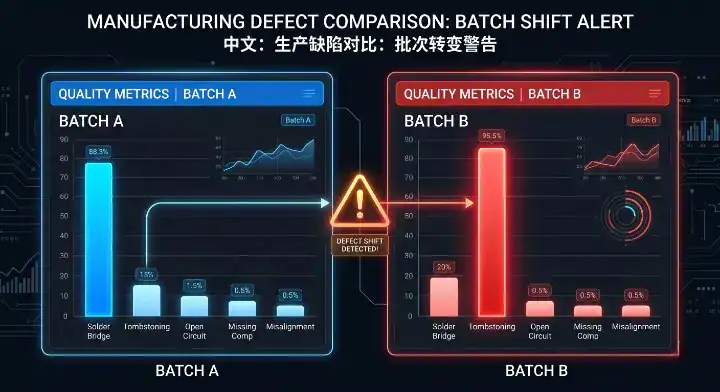
When Does Pareto Point to Process Drift?
Pareto points to process drift when the leading defect category changes suddenly between lots, shifts, materials, or equipment settings. A one-time spike is not proof, but it is a signal to check what changed.
Look for these drift clues:
- Solder bridges increase after stencil cleaning interval changes.
- Tombstoning appears after changing passive component supplier.
- Insufficient solder rises after paste storage or printer setup changes.
- BGA voiding shifts after reflow profile adjustment.
- Missing parts increase on one feeder lane or nozzle group.
When the Pareto shape changes, compare it with the process history. The best question is not “Which defect is largest?” but “What changed before this defect became largest?”

How Do You Turn Pareto Data into Root Cause?
Turn Pareto data into root cause by selecting the top defect family, then using fishbone analysis, 5 Whys, process data, and physical evidence to test likely causes. A Pareto chart prioritizes; it does not diagnose.
For example, if solder bridging becomes the top category, the investigation may check stencil thickness, aperture design, paste viscosity, squeegee pressure, printer alignment, pad design, component pitch, reflow profile, and cleaning interval. The correct cause must be supported by evidence.
Use this sequence:
- Define the defect precisely.
- Confirm the inspection images and sample count.
- Segment the data by product, line, shift, and location.
- List likely causes with a fishbone diagram.
- Test the top causes with process data or controlled trials.
- Document corrective action and verification.
This is where Pareto becomes a quality-improvement system instead of a decorative chart.
What Corrective Actions Should Buyers Expect?
Buyers should expect corrective actions that address the verified cause, not vague promises such as “operator retraining” or “improve inspection.” If the top defect comes from stencil design, the action should involve stencil or aperture change. If it comes from handling damage, the action should involve fixture, tray, routing, or workstation control.
Strong corrective actions include:
- Stencil aperture or thickness revision.
- Printer parameter adjustment and SPI limit review.
- Feeder/nozzle maintenance tied to placement data.
- Reflow profile review with thermal evidence.
- DFM change for pad geometry or component spacing.
- Work-instruction change with audit evidence.
- Rework method control aligned with IPC-7711/7721 scope.
IPC-A-610 provides acceptance criteria for electronic assemblies, while IPC-7711/7721 covers rework, repair, and modification procedures. Buyers should ask suppliers to connect defect disposition and rework methods to the applicable acceptance and rework framework.

How Should Before/After Pareto Charts Be Compared?
Compare before/after Pareto charts only when the product mix, inspection method, sample window, and defect definitions remain consistent. Otherwise, an apparent improvement may be a measurement change instead of a process improvement.
A good comparison includes:
- Same product family or clear segmentation.
- Same inspection stage and criteria.
- Same defect definitions.
- Similar volume or normalized defect rate.
- Clear date of corrective action.
- Notes on material, fixture, program, or operator changes.
Do not claim that PCBA defect Pareto analysis “cut rework by 50%” unless the baseline, corrective action, and follow-up window prove it. A safer claim is that the analysis identified the leading rework drivers and verified whether the corrective action reduced them.
What Should QueenEMS Receive for Defect Review?
QueenEMS can review PCBA defect trends faster when the buyer sends data that links symptoms to board design, inspection evidence, and production context. A screenshot of a chart alone is not enough.
Send these files:
- Gerber, BOM, CPL, and assembly drawing.
- Photos or AOI/X-ray images for top defect categories.
- Defect count by category and inspection stage.
- Lot size, sample size, and date range.
- Rework records and disposition notes.
- Reflow profile, SPI data, or test logs when relevant.
- Any customer acceptance criteria or IPC class requirement.
With the right data, the conversation moves from “there are too many defects” to “these two defect families deserve the next engineering action.”
FAQ
Can PCBA defect Pareto analysis prove root cause?
No. It identifies which defect categories deserve priority, but root cause still requires evidence from inspection images, process data, 5 Whys, fishbone analysis, or controlled trials.
Should I rank PCBA defects by count or cost?
Use both when the decision matters. Count helps first-pass yield; cost, severity, rework time, and customer escape risk help prevent expensive low-frequency problems from being ignored.
How many defects are needed for a useful Pareto chart?
A larger sample is better, but even a pilot run can show early signals if the categories are clean. Treat low-volume charts as directional until more production data confirms the pattern.
What is the biggest mistake in defect Pareto reporting?
The biggest mistake is mixing unlike data: different products, inspection stages, criteria, or defect definitions. That makes the chart look precise while pointing to the wrong action.
What should I ask my PCBA supplier after seeing a Pareto chart?
Ask what evidence supports the top category, which root-cause tool was used, what corrective action was chosen, and how the supplier will verify that the defect rate actually changed.
Sources
- ASQ Pareto chart overview
- IPC-A-610 standard page
- IPC-7711/7721 table of contents PDF
- Practical guide to Pareto charts for quality improvement
- QueenEMS PCBA failure analysis report guide
- QueenEMS remote PCB assembly quality guide
Written by the QueenEMS Engineering Team
Upload your files today · Free DFM check before production · Ship worldwide
Get your PCB prototypes in as fast as 24 hours. We handle FR4, Rogers, and hybrid boards up to 40 layers in volume production, with advanced builds subject to engineering review — free prototypes for 2–4 layer FR-4 boards, no minimum order.
Just upload your Gerber + BOM — we source every part, assemble, and inspect (AOI + X‑Ray) so you don't have to chase suppliers. Boards ship in as fast as 24 hours.