Quick Answer: Scale PCB assembly by treating the pilot as a production-system test, not only a functional board test. Release volume after the team closes design changes, reconciles the production BOM, validates fixtures and test coverage, reviews process yield and defect causes, approves packaging and traceability, and defines who may release the remaining material and build quantity.
Key takeaways – A successful prototype does not automatically prove production readiness. – Pilot quantity should be chosen by learning objectives and risk, not a universal number. – Separate long-lead material authorization, pilot build authorization, and balance release. – Use pass criteria that cover product, process, supply chain, test, quality, and cash exposure.
A PCB assembly ramp up fails when a team multiplies the prototype quantity before it has stabilized the system that will build, test, and deliver the product. The board may function on the engineer’s bench while the production BOM contains unresolved alternates, feeder packaging differs from prototype supply, the fixture is unfinished, or inspection evidence cannot distinguish a process problem from a design problem.
The first production order therefore needs gates. Engineering must decide what the pilot proves. Purchasing must see material and excess-inventory exposure. Quality must define acceptance evidence. The business owner must decide how much cash and customer schedule to place behind the available evidence. The manufacturer must return a clear record of what is ready, what remains open, and what will trigger the next release.
Table of Contents
- Define what ramp-up must prove
- Choose a pilot lot from risk and learning
- Freeze the product baseline before scaling
- Reconcile the production BOM and material commitment
- Validate process, inspection, and test capacity
- Use evidence-based pilot pass criteria
- Release the balance without hiding cash exposure
- Control the next lots and supplier changes
- FAQ
Define what ramp-up must prove
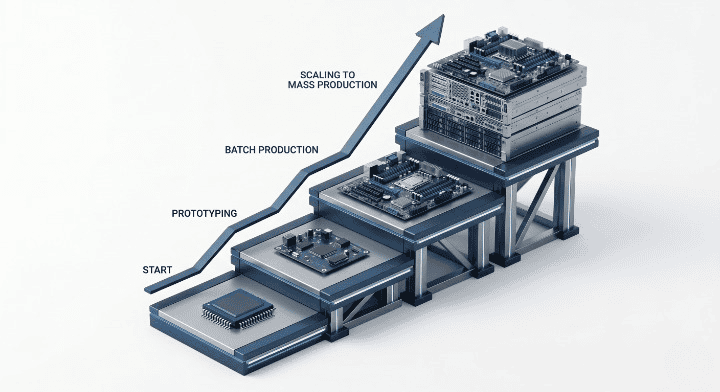
Production ramp-up is the controlled transition from a small build to a repeatable manufacturing and supply system. The duration and quantity depend on board complexity, component availability, test development, regulatory or customer requirements, factory capacity, and the amount of change remaining. A simple assembly with a mature BOM may move quickly. A dense board with BGAs, programmed devices, custom mechanics, and functional calibration needs more evidence.
Define the questions before choosing quantity. A pilot may need to prove:
- the released design and fabrication package build without unresolved engineering interpretation;
- the production BOM and approved sources can support the planned volume;
- stencil, placement, reflow, selective soldering, cleaning, coating, and manual operations are stable;
- inspection and test detect the defects that matter to the product;
- programming, serialization, labels, packaging, and traceability work at the required cycle time;
- yield loss and rework have understood causes rather than unexplained averages;
- the manufacturer can repeat the result with the intended people, equipment, and material controls.
A prototype may answer only some of these questions. Hand-placed cut-tape components do not validate reel handling. An engineer’s bench test does not validate production fixture coverage or false-failure control. Manual repair can hide a process that would be expensive at volume.
Write the ramp objective as a decision: “Release the next 1,000 units after criteria A through F are accepted,” not “build 100 and see what happens.” The objective determines the data the supplier must return.
Choose a pilot lot from risk and learning
There is no safe universal pilot quantity. Select enough assemblies to expose the intended process and collect decision-quality evidence, while limiting the cost of a wrong design, wrong BOM, or unstable operation. A pilot that is too small may never repeat a sensitive placement or exercise another production shift. A pilot that is too large can turn one unresolved assumption into avoidable inventory and rework.
Consider five inputs:
| Pilot input | Question to answer | Effect on lot choice |
|---|---|---|
| Product maturity | Are schematics, layout, firmware, mechanics, and test requirements frozen? | More open change favors a smaller commitment |
| Process novelty | Which packages or operations are new to this factory and line? | New BGA, fine-pitch, press-fit, coating, or calibration may require deliberate sampling |
| Defect detectability | Will inspection and test find the important failure modes? | Weak coverage requires fixture or method work before a large release |
| Material exposure | Which parts are long lead, NCNR, MOQ-driven, or lifecycle-sensitive? | High exposure favors staged procurement and explicit owner approval |
| Demand risk | How firm is customer demand and what does a delayed release cost? | Business risk determines the acceptable balance between learning and speed |
The supplier should explain how the proposed lot uses production-intent equipment, documentation, and material presentation. A nominal pilot built through a special engineering route may prove the design but not the standard line. Conversely, forcing every production automation step into an early learning build may create unnecessary fixture expense before the design is stable.
For first orders, distinguish engineering samples, pilot assemblies, and saleable production units. State whether pilot units may ship to customers, require segregation, or need a later retrofit. The distinction affects acceptance, labeling, and inventory decisions.
Freeze the product baseline before scaling
Ramp-up needs one controlled baseline. Identify PCB fabrication revision, assembly drawing, BOM, centroid or placement data, approved alternates, firmware and programming files, test specification, mechanical drawings, label artwork, and packaging instructions. Record approved deviations and remove superseded files from the active package.
Close DFM and DFA questions that can change form, fit, function, reliability, acceptance, price, or schedule. A supplier may optimize internal panelization or machine settings within its authority, but it should not silently change a customer-controlled pad, material, component, polarity, coating boundary, or test requirement. The PCB CAM question process shows how to keep proposed changes traceable.
Use an engineering change cutoff for the pilot. A late improvement may be worth including, but the team must understand that it resets affected evidence. Changing a component, stencil aperture, firmware, or test limit after half the lot has run can create two populations under one label.
Define configuration identity for the finished assembly. Revision marking, serial or lot code, firmware version, and traceability record should let the team connect a failure to the data and process used. This becomes more important when ramp lots overlap or when some units receive rework.
Before releasing a larger lot, incorporate accepted pilot changes into controlled documents. Do not make production depend on a handwritten setup note or the memory of the technician who supported the pilot.
Reconcile the production BOM and material commitment
Prototype sourcing and production sourcing have different constraints. Parts bought as cut tape may need reels, trays, tubes, bake handling, or feeder leaders. The apparent online availability of a small quantity does not prove the required production quantity, date code, source, or pack format.
Run a line-level BOM review before the pilot and again before the balance release. Confirm exact manufacturer part numbers, approved alternates, lifecycle status, source, on-hand inventory, required quantity, attrition allowance, purchase multiple, proposed buy, lead time, and projected unused balance. Pay special attention to programmed devices, custom parts, allocation-controlled ICs, connectors, displays, and parts with storage limits.
Separate three authorizations:
- Long-lead or constrained material commitment needed to protect the schedule.
- Pilot build material and assembly authorization.
- Remaining material and production balance release after the gate.
Each authorization should state the maximum quantity or value and cancellation exposure. The article on PCBA NCNR components explains how MOQ, pack quantity, excess inventory, and ownership should be reconciled before purchase.
Do not assume alternate qualification can wait until a shortage occurs. Engineering should identify which substitutions are already approved and what evidence a new proposal requires. Procurement should verify source quality and quote validity. Quality should define traceability and storage controls for customer-owned or excess stock.
Validate process, inspection, and test capacity
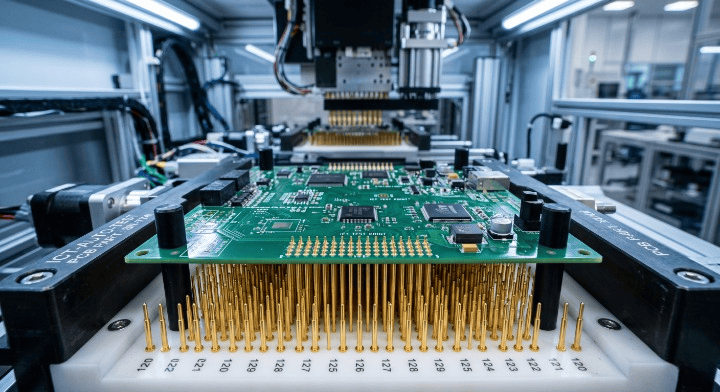
The pilot should use a documented process flow that can scale. Review solder paste, stencil and aperture strategy, feeder and placement setup, reflow profile, selective or wave solder operations, manual assembly, cleaning, coating, depaneling, programming, inspection, test, repair, and packaging. Not every product needs every operation, but every required operation needs an owner and acceptance method.
Inspection equipment is useful only when the program and review criteria fit the assembly. SPI can monitor paste deposition; AOI can assess visible placement and solder features; X-ray can examine hidden joints; electrical and functional tests can find different classes of failure. None of these methods alone proves complete product quality. Build a coverage plan around likely failure modes and customer requirements.
Test economics should be based on cycle time, coverage, repeatability, false failures, maintenance, and expected volume. Flying probe, functional fixtures, boundary scan, ICT, cable fixtures, and manual procedures each have suitable applications. Avoid universal break-even quantities: board access, fixture complexity, labor, throughput, and product life change the calculation.
Validate the fixture using known-good units and deliberate fault conditions where practical. Confirm software version, limits, calibration, operator instructions, data retention, and the process for suspected false failures. A fixture that passes every board without demonstrating detection can create false confidence.
Capacity validation includes the bottleneck outside SMT placement. Programming, functional test, manual connector insertion, coating cure, final assembly, and packaging may control output. The supplier’s ramp plan should show the slowest operation and the contingency when equipment or staffing changes.
Use evidence-based pilot pass criteria
A pilot passes when the agreed evidence supports the next commitment, not merely when enough boards eventually work after rework. Define criteria before the build and review both conforming output and the path required to achieve it.
Use a decision record across six areas:
| Gate area | Evidence to review | Example decision question |
|---|---|---|
| Product | functional results, fit, configuration, required qualification | Does the released design meet intended use? |
| Process | first-pass yield by operation, defect Pareto, rework cause, profile or setup records | Are dominant defects understood and controlled? |
| Supply | BOM exceptions, source status, lead times, inventory and excess | Can the planned lot be built from approved material? |
| Test | coverage, limit review, false failures, fixture capacity, data retention | Will production test find meaningful failures at the required rate? |
| Quality | inspection evidence, traceability, concessions, corrective actions | Are acceptance and change controls ready? |
| Business | committed cash, remaining material, schedule, demand, recovery plan | Is the next release proportionate to current evidence? |
Yield should be segmented. First-pass yield, final yield after repair, defect rate by operation, and test false-failure rate describe different conditions. A high final yield can hide repeated rework. A lower pilot yield may be acceptable when every loss has a verified cause and corrective action; an unexplained but apparently good average may be less trustworthy.
Review the defect Pareto and verify closure of high-risk causes. Confirm that corrective actions are incorporated into drawings, programs, work instructions, fixtures, or control plans. A verbal promise to “watch the next run” is not a stable control.

Release the balance without hiding cash exposure
The owner or authorized manager needs a concise balance-release record. It should show what the pilot proved, what remains open, the production quantity proposed, material already committed, additional cash required, projected excess inventory, delivery milestones, and the financial consequence of a hold or cancellation.
Use three possible outcomes:
- Release: all blockers are closed and the remaining commitment is supported by evidence.
- Conditional release: a limited quantity or material list is approved while named actions remain open, with a cap and deadline.
- Hold: the unresolved product, process, supply, test, or demand risk is larger than the benefit of proceeding.
Conditional release is useful only when the boundary is real. Name the MPNs, quantity, value, allowed operations, and person who can lift the next hold. Avoid “proceed at risk” without identifying whose risk, how much exposure, and which requirement remains unresolved.
Compare the cash tied up with the learning still missing. The production unit price may improve at a larger quantity while the total commitment, NCNR material, fixture cost, and rework exposure increase. Owners should see both unit economics and worst-reasonable exposure.
The supplier should acknowledge the release and return updated dates. Purchasing then reconciles the acknowledgment with the PO, engineering confirms the controlled revision, and quality confirms the evidence plan. This closes the gap between a management decision and the factory work order.
Control the next lots and supplier changes
Ramp-up does not end at the first balance release. Define monitoring for the next lots: first-pass yield, dominant defects, rework, test escapes or returns, cycle time at the constraint, material shortages, inventory variance, and on-time milestone performance. Choose metrics that lead to action rather than an impressive dashboard.
Set escalation rules based on product risk and baseline performance. A change in defect mix may matter even when total yield appears stable. Repeated manual touch-up, rising false failures, growing WIP, or unexplained material adjustments can signal that the process is losing control.
Supplier changes require notification and approval according to the accepted order. Material, component source, equipment, process, test limits, sub-tier supplier, or manufacturing site changes may affect previous evidence. Define what the supplier can manage internally and what must return to the buyer.
Changing manufacturers between pilot and production is possible, but the new factory inherits none of the unrecorded learning. Transfer the released data, approved deviations, BOM source record, stencil and profile requirements where applicable, fixtures, inspection programs, test software, defect history, and open corrective actions. Revalidate the parts of the process that changed rather than assuming equivalence.
Use a formal review after each ramp stage and update the baseline. The objective is not to prevent improvement; it is to make improvement repeatable and visible. QueenEMS can review the production package, component exposure, pilot evidence, and proposed release gate together. Send the controlled files and target quantity through the contact page for a ramp-up assessment.

FAQ
How many units should a PCBA pilot lot include?
There is no universal quantity. Choose enough units to exercise production-intent processes and collect evidence for the identified risks, while limiting exposure to an unresolved design, BOM, fixture, or demand assumption. Ask the manufacturer to explain what the proposed quantity can and cannot prove.
Can long-lead parts be ordered before the pilot passes?
Yes, under a controlled material authorization when schedule benefit justifies the exposure. List the exact parts, maximum quantity or value, ownership, cancellation terms, and next decision gate. Do not treat a material release as automatic approval for full assembly production.
Which yield number should decide mass-production release?
No single number is enough. Review first-pass yield, final yield, defect Pareto, rework causes, test false failures, and corrective-action closure against product-specific criteria. The trend and explanation matter alongside the result.
Does a passed functional test prove the pilot is ready to scale?
It proves only the functions and conditions covered by that test. The team must also review design configuration, process stability, sourcing, inspection coverage, traceability, packaging, and capacity before releasing volume.
Should pilot and mass production use the same manufacturer?
Using the same manufacturer preserves process learning, but it is not mandatory. A transfer requires controlled documentation and revalidation of changed equipment, programs, people, material sources, fixtures, and acceptance evidence.
Sources
Upload your files today · Free DFM check before production · Ship worldwide
Get your PCB prototypes in as fast as 24 hours. We handle FR4, Rogers, and hybrid boards up to 40 layers in volume production, with advanced builds subject to engineering review — free prototypes for 2–4 layer FR-4 boards, no minimum order.
Just upload your Gerber + BOM — we source every part, assemble, and inspect (AOI + X‑Ray) so you don't have to chase suppliers. Boards ship in as fast as 24 hours.