

Quick Answer: Calculate PCB assembly lead time from the release date, then follow the longest dependent path through bare-board fabrication, component readiness, assembly, inspection, testing, and shipping. For eligible ready-to-build quick-turn jobs, QueenEMS currently describes a 3–7 business-day assembly window, but the quotation must state what is ready, what is excluded, and whether the date is shipment or delivery.
Key takeaways:
- The clock should start only after the released files, commercial approval, and material plan are clear.
- Board fabrication and component sourcing often run in parallel, so adding every stage produces a misleading total.
- The missing component, unresolved engineering question, or unfinished test fixture usually controls the ship date.
- A useful quotation gives one dated schedule with assumptions, dependencies, and a change-control rule.
PCB assembly lead time is a critical-path schedule, not a single factory speed. A supplier may quote “five days,” yet the buyer may be counting from the purchase order while the supplier is counting from file approval and material readiness. That difference creates late launches even when the assembly line finishes on time.
This guide shows you how to build a schedule that engineering, purchasing, and the contract manufacturer can all audit. It separates turnaround from delivery, explains what can run in parallel, and gives you the inputs needed for a credible quotation.
Table of Contents
- How do you calculate PCB assembly lead time?
- When does the manufacturing clock actually start?
- Which stages control PCB assembly lead time?
- Why does component availability dominate the schedule?
- How do turnkey and consigned builds change timing?
- What changes from prototype to production?
- How can you reduce PCB assembly lead time safely?
- What should a credible lead-time quotation include?
- How do working days become a delivery date?
- What files produce an accurate schedule?
How do you calculate PCB assembly lead time?
Calculate PCB assembly lead time by mapping dependencies and finding the longest path to shipment. Do not simply add board fabrication, sourcing, assembly, test, and freight, because several activities can overlap.
Use this planning model:
Estimated ship date = release date + critical-path production time + approved contingency
Estimated delivery date = estimated ship date + transit and customs time
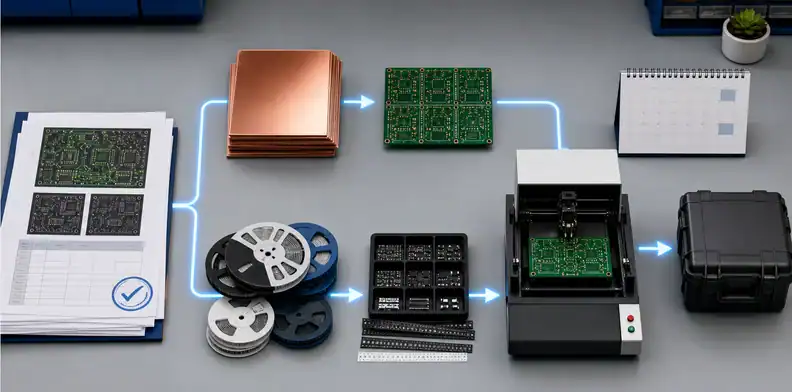
The critical path is the chain of dependent tasks that cannot slip without moving the final date. If bare boards need six working days and the complete component kit needs nine, while both start together, the material-ready date is normally controlled by the nine-day component path. Assembly starts only after both paths and any required tooling are ready.
Build a dependency table first
| Schedule gate | Starts when | Finishes when | Can overlap? |
|---|---|---|---|
| Engineering release | Commercial and technical inputs are received | Open questions are resolved | Limited |
| Bare-board fabrication | Stack-up and fabrication data are released | Accepted boards are available | Yes, with sourcing |
| Component sourcing | Approved bill of materials (BOM) and alternates are released | Complete approved kit is available | Yes, with fabrication |
| Tooling and programming | Assembly data and test plan are released | Stencil, programs, and fixtures are ready | Often |
| Assembly and inspection | Boards, parts, and tooling are ready | Build passes defined inspection | No, for that lot |
| Functional test and pack-out | Test method and assembled boards are ready | Release documentation is complete | Partly, by lot |
A schedule built this way exposes the real constraint. It also tells purchasing which date to protect and engineering which unresolved input can stop the build.
When does the manufacturing clock actually start?
The manufacturing clock should start at an agreed release milestone, not automatically when a purchase order is emailed. A purchase order can arrive while the BOM, stack-up, centroid data, alternates, or test instructions are still incomplete.
Define one of these dates in writing:
- Request for quotation (RFQ) received: useful for measuring quotation response, not production.
- Commercial release: price, quantity, Incoterm, and payment conditions are accepted.
- Technical release: fabrication and assembly files are complete enough to build.
- Material release: the approved component plan is available and purchase is authorized.
- Production release: all blocking technical and commercial questions are closed.
For a turnkey order, the safest start point is usually production release, followed by a separate material-ready milestone. For a consigned build, it may be the later of technical release and physical kit acceptance. Write the rule into the quotation so both parties measure the same interval.
An engineering change after release is not a small administrative event. It may invalidate a stencil, placement program, fabrication panel, inspection program, or purchased material. The schedule should therefore state whether a revision pauses the clock, moves the release date, or creates a new build revision.
Which stages control PCB assembly lead time?
PCB assembly lead time is usually controlled by readiness gates before placement and by verification requirements after reflow. Machine placement time matters, but it is only one part of the schedule.
Before the line
The pre-line path can include design-for-manufacturing (DFM) review, design-for-assembly (DFA) review, stack-up confirmation, bare-board fabrication, BOM validation, component purchasing, incoming inspection, stencil preparation, placement programming, and test-fixture preparation. Any missing input can hold the job before a single component is placed.
On the line
The assembly path depends on board side count, component mix, package pitch, surface-mount technology (SMT), through-hole technology (THT), selective soldering, cleaning, coating, and rework rules. A straightforward SMT-only prototype and a mixed-technology assembly should not share one generic turnaround assumption.
After assembly
The release path may include solder paste inspection, automated optical inspection (AOI), X-ray for hidden joints, electrical test, functional test, visual acceptance, documentation, packaging, and customer source inspection. IPC-A-610 provides assembly acceptance criteria, while J-STD-001 addresses requirements for soldered electrical and electronic assemblies; the purchase package must state the applicable revision and class rather than say only “per IPC.”
The schedule is credible only when each required gate has an owner, an input, and an acceptance condition.
Why does component availability dominate the schedule?
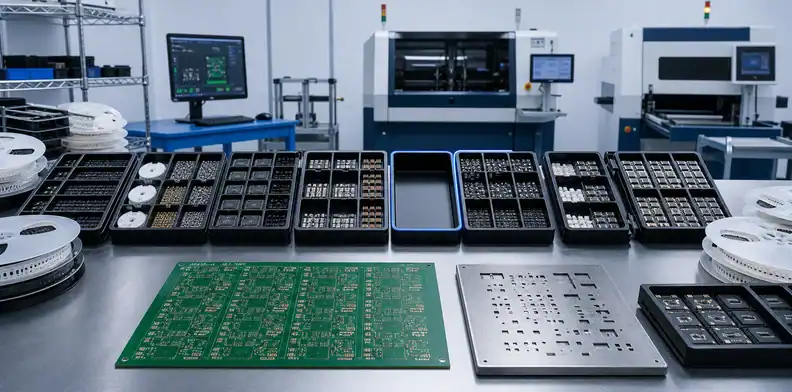
Component availability dominates when the assembly cannot start without a complete, approved kit. Ninety-nine available line items do not compensate for one unavailable processor, connector, transformer, or programmed device.
Availability is more than a distributor quantity shown on the quotation day. The sourcing plan should address:
- exact manufacturer part number and approved manufacturer list;
- quantity including process attrition and any engineering spares;
- authorized source and traceability requirement;
- date when stock is reserved or ordered;
- lifecycle, allocation, and end-of-life risk;
- approved alternate and who may authorize substitution;
- incoming inspection or programming requirements.
NIST SP 800-161 Rev. 1 treats supply-chain risk as a managed lifecycle issue rather than a one-time purchasing check. For a printed circuit board assembly (PCBA) schedule, that means documenting source, approval, change, and contingency decisions instead of assuming an online stock indication will remain available.
Use the QueenEMS BOM preparation guide to clean the part list before quotation. If alternates are permitted, define them by exact part number or controlled performance criteria; never let “equivalent” become an unrestricted substitution.
If the schedule is already constrained by unclear files or high-risk components, send the BOM, stack-up, and assembly data for a PCB DFM review. The useful output is a list of blocking questions and sourcing risks, not an unsupported promise to save a fixed number of days.
How do turnkey and consigned builds change timing?
Turnkey and consigned builds move schedule responsibility to different parties. Neither method is automatically faster; the better choice is the one that makes the critical material path visible and controllable.
| Model | Supplier controls | Buyer controls | Main schedule risk |
|---|---|---|---|
| Full turnkey | Boards, parts, assembly, test, pack-out | Approval and specifications | Long-lead or approval-dependent parts |
| Partial turnkey | Agreed subset of boards and parts | Remaining consigned items | Split ownership and mismatched arrival dates |
| Consigned | Assembly, inspection, defined tooling | Complete accepted kit and replenishment | Late, short, damaged, or untraceable material |
A turnkey supplier can begin board and component procurement in parallel after release. However, the quotation still needs a material assumption: “from approved BOM and purchasing authorization” is more meaningful than “from PO.”
A consigned kit removes some purchasing time from the assembler’s scope, but it creates a receiving gate. The assembler must verify quantities, packaging, moisture controls where applicable, markings, traceability, and discrepancies. If one reel is short or one item does not match the BOM, the job may wait even though the shipment arrived.
For partial turnkey, create a responsibility matrix with every line item assigned to one owner. Record required-on-site dates and a shortage escalation path. That simple control prevents both parties from assuming the other owns the same component.
What changes from prototype to production?
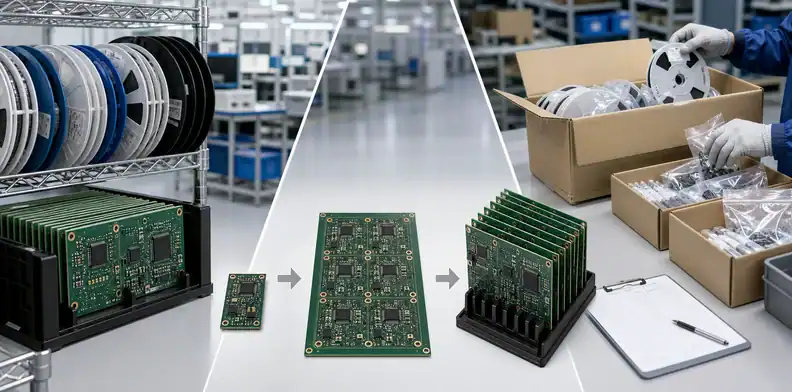
The schedule expands from prototype to production because the decision changes from “can we build it?” to “can we repeat it under controlled conditions?” Quantity matters, but process qualification, test readiness, material commitment, and release controls often matter more.
Prototype
A prototype emphasizes rapid technical learning. It may use a small quantity, flexible manual steps, a limited test setup, and expedited sourcing. Before using a quick-turn PCB assembly service, confirm whether the quoted window includes bare boards and parts or begins after both are ready.
Pilot build
A pilot build verifies production data, panelization, stencil design, placement programs, reflow profile, inspection criteria, test coverage, repair rules, work instructions, and packaging. It should produce a closure list rather than quietly carry open prototype deviations into volume.
Volume production
Production adds forecast commitments, lot planning, incoming controls, fixture capacity, sampling or inspection requirements, line scheduling, yield review, and change notification. The QueenEMS pilot-to-production guide explains why a stable ramp requires more than multiplying the prototype quantity.
Use separate dates for prototype approval, pilot release, and production release. A prototype that powers on is not automatically a released production process.
How can you reduce PCB assembly lead time safely?
Reduce PCB assembly lead time by removing uncertainty before release and by overlapping independent work. Do not cut inspection or testing without a documented risk decision.
The highest-value actions are usually:
- Freeze the correct revision and use consistent filenames across the package.
- Provide exact manufacturer part numbers, quantities, do-not-substitute items, and controlled alternates.
- Release stack-up, surface finish, copper, impedance, panel, and acceptance requirements early.
- Supply centroid data, polarity and orientation information, and a readable assembly drawing.
- Define inspection and functional-test inputs before tooling starts.
- Allow board fabrication, approved component purchasing, stencil work, and test development to overlap where risk permits.
- Set response owners for engineering questions and approve a maximum response time internally.
Standardization can shorten the path when it is technically acceptable: available laminate constructions, common component packages, established finishes, reusable test interfaces, and stable packaging reduce special handling. But replacing a specified material or component solely to meet a date can create qualification or field risk.
The PCB prototype-to-production decision guide can help determine whether the project is ready for a faster repeat build or still needs a controlled pilot.
What should a credible lead-time quotation include?
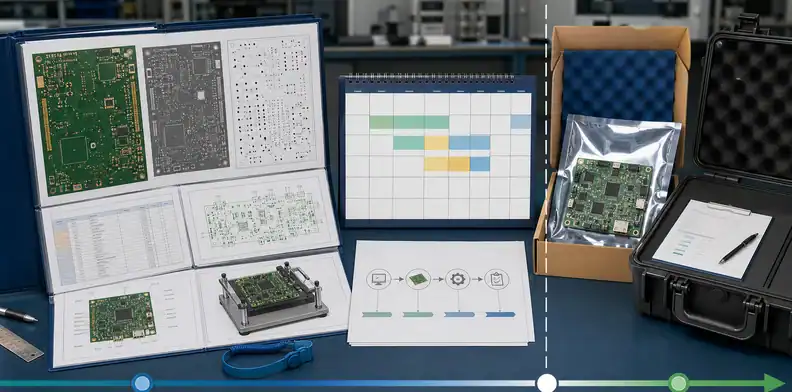
A credible quotation states a dated scope and the assumptions behind it. “Seven working days” is incomplete if it does not identify the start event, finish event, material status, testing scope, and shipping treatment.
Require these fields:
| Quotation field | Example of a useful entry |
|---|---|
| Source revision | Gerber/BOM/XY package Rev C dated July 10 |
| Start milestone | After technical release and purchasing authorization |
| Material status | Stock reserved, quoted lead time, or buyer-consigned |
| Board scope | Included, supplier-furnished, or buyer-supplied |
| Assembly scope | SMT/THT sides, coating, programming, box build |
| Inspection and test | Named methods, sample quantity, customer fixture dependency |
| Ship milestone | Ex-works ship date or carrier handoff date |
| Delivery assumption | Service level, destination, customs responsibility |
| Change rule | Schedule re-quoted after revision or material substitution |
| Open risks | Specific long-lead items, approvals, or missing inputs |
Ask for a calendar ship date alongside the working-day duration. Also distinguish committed dates from planning estimates. A committed date should follow technical and material review; a planning estimate can guide the project before every dependency is confirmed.
For a complete input list, use the PCB assembly quotation file guide. The schedule should become more specific as those inputs become controlled.

How do working days become a delivery date?
Convert working days into a delivery date with a calendar, not mental arithmetic. Factory working days, public holidays, time zones, carrier pickup cutoffs, transit days, and customs are separate variables.
Use this sequence:
- Confirm the production-release date in the supplier’s time zone.
- Add factory working days using the supplier’s holiday calendar.
- Confirm whether the stated day is completion, inspection release, or carrier handoff.
- Add the selected transport service and pickup cutoff.
- Add any customs, importer, or destination handling assumption.
- Record the resulting ship date and expected delivery range.
For example, a five-working-day production duration released late on a Friday does not imply delivery the following Wednesday. The first counted day may be Monday, the carrier may collect after final inspection, and international transit follows its own calendar.
Use a range when the carrier or customs path is not controlled. Do not convert an estimate into a guarantee by choosing the earliest possible arrival date. Procurement should plan against the agreed commitment and track material-ready, production-start, test-release, and ship milestones separately.
What files produce an accurate schedule?
An accurate schedule needs one controlled build package and clear commercial assumptions. The supplier cannot estimate dependencies that are hidden in an incomplete archive.
Send these items when applicable:
- Gerber or ODB++ fabrication data, drill files, drawing, and readme;
- approved stack-up, impedance requirements, copper weights, and finish;
- BOM with manufacturer, exact part number, quantity, alternates, and consignment status;
- centroid or pick-and-place file with side, rotation, and reference designator;
- assembly drawings, polarity notes, special process instructions, and depanelization requirements;
- programming files and device-specific instructions;
- inspection standard, class, X-ray or other special requirements;
- functional-test procedure, limits, fixture ownership, and sample expectations;
- quantity, delivery destination, Incoterm, packaging, and target date;
- revision history and authorization for any change or substitution.
Run an internal cross-check before release: BOM designators should match the assembly drawing and centroid file, board revision should match the purchase order, and the test procedure should match the programmed firmware. The QueenEMS PCB DFM checklist provides a broader pre-release review structure.
For a schedule and quotation, send the controlled build package, quantities, destination, required inspection and test, and target delivery date through the QueenEMS contact page. The resulting quotation should identify the release milestone, material assumptions, critical path, ship date, and delivery estimate.
FAQ
Can I calculate lead time before every component is selected?
Yes, but treat it as a planning range and list the unresolved components as risks. A committed ship date should follow an approved BOM and a material-availability review.
What is the difference between turnaround and delivery time?
Treat turnaround as the supplier’s defined manufacturing interval. Delivery time also includes carrier handoff, transit, customs, and destination handling, so the quotation should give both the ship milestone and the delivery assumption.
Can a consigned kit make assembly faster?
Yes, when the kit is complete, accepted, traceable, correctly packaged, and on site before the production slot. A late or discrepant kit can make the consigned path slower than turnkey sourcing.
How do I know whether a quick-turn promise is realistic?
Check whether bare boards, all components, tooling, programming, inspection, functional test, coating, and shipping are included. A realistic promise names the start date, exclusions, open risks, and committed ship date.
Should testing be removed to protect the ship date?
No, not by default. Define the product and customer risk, applicable acceptance criteria, test coverage, and approval authority before changing inspection or test scope.
Sources
- NIST SP 800-161 Rev. 1: Cybersecurity Supply Chain Risk Management Practices
- IPC-A-610J, Acceptability of Electronic Assemblies
- J-STD-001J, Requirements for Soldered Electrical and Electronic Assemblies
- QueenEMS quick-turn PCB assembly service
- QueenEMS BOM preparation guide
Written by the QueenEMS Engineering Team
Upload your files today · Free DFM check before production · Ship worldwide
Get your PCB prototypes in as fast as 24 hours. We handle FR4, Rogers, and hybrid boards up to 40 layers in volume production, with advanced builds subject to engineering review — free prototypes for 2–4 layer FR-4 boards, no minimum order.
Just upload your Gerber + BOM — we source every part, assemble, and inspect (AOI + X‑Ray) so you don't have to chase suppliers. Boards ship in as fast as 24 hours.