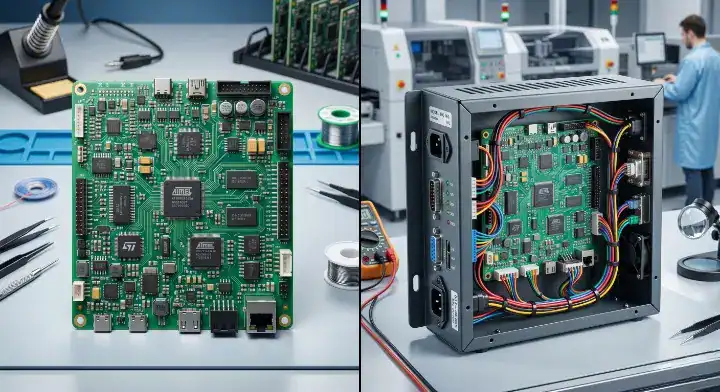
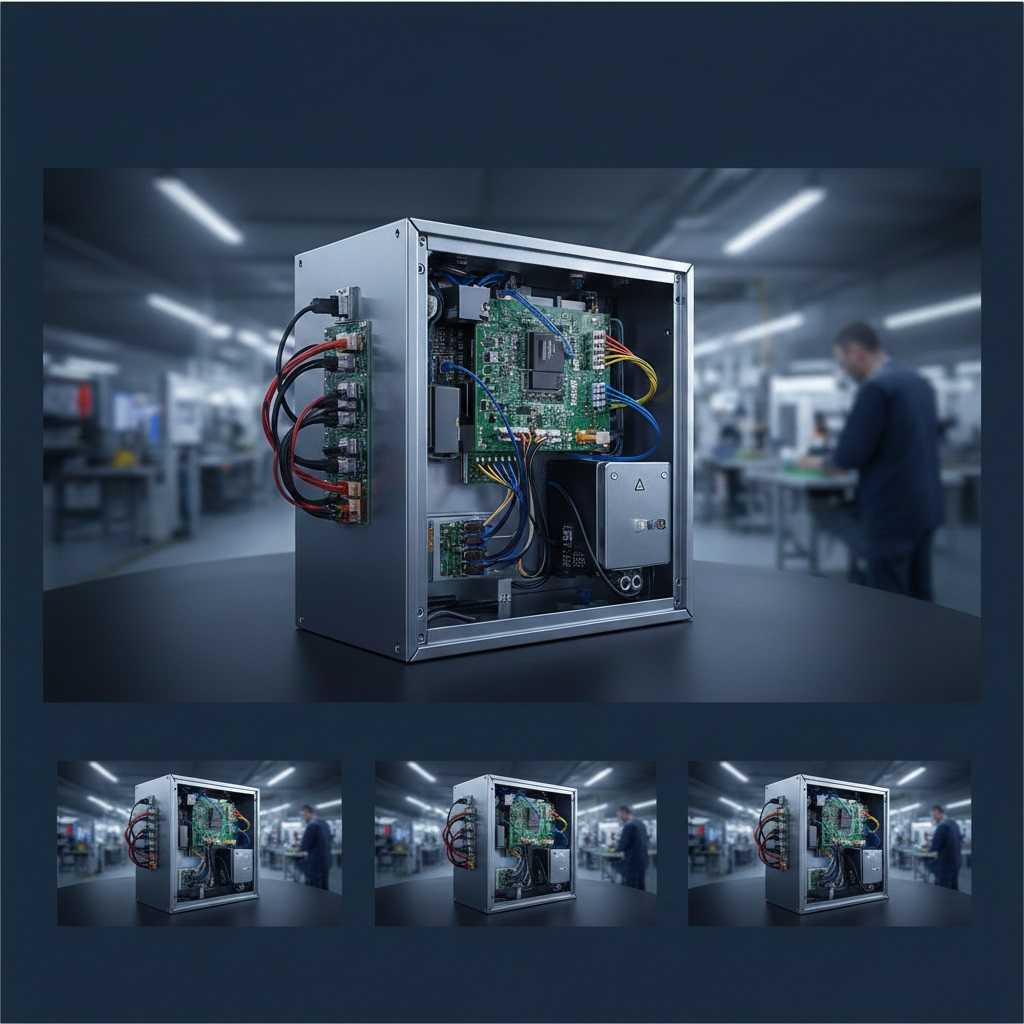
Professional-technician-performing-box-build-assembly-by-integrating-PCBA-into-metal-enclosure

You finalize a brilliant electronic design, hand it off to your vendors, and weeks later receive a batch of printed circuit boards and metal enclosures that simply do not fit together. This disconnected manufacturing approach causes an average of 30% in budget overruns, primarily because isolated sub-tier vendors rarely cross-communicate. Partnering with a reliable quick-turn PCB assembly provider who also acts as a true box build manufacturer solves this fragmentation by handling the entire mechanical and electrical ecosystem under one single roof, stopping the vendor blame game permanently.

Quick Answer: A genuine box build manufacturer integrates printed circuit boards, cables, enclosures, and firmware into a ready-to-ship product, reducing production lead times by 2–4 weeks. A qualified partner will identify and resolve up to 40% of potential mechanical interference issues during pre-production 3D analysis. Key takeaways:

  • In-house wire harness and mechanical assembly validation prevents field failures.
  • System-level testing catches errors that standard board-level checks miss.
  • Complete 3D mechanical DFM stops enclosure mismatches before tooling begins.
  • Consolidated supply chain management eliminates multi-vendor logistical delays.

Table of Contents

  1. What Does a Box Build Manufacturer Actually Do?
  2. How Is Box Build Assembly Different from Standard PCBA?
  3. What Core Capabilities Should Your EMS Partner Have?
  4. How Do You Evaluate Cable and Harness Assembly Quality?
  5. What Testing Protocols Should Your Box Build Partner Offer?
  6. Why Does DFM Review Matter Before Production Starts?
  7. How Should Your Assembly Provider Handle Firmware Loading?
  8. What Certifications Should a Box Build Partner Hold?
  9. How Do Supply Chain and Enclosure Sourcing Work?
  10. What Questions Should You Ask Before Choosing a Partner?

What Does a Box Build Manufacturer Actually Do?

Box build manufacturer comparing bare PCBA with a fully integrated electronic box assembly cleanup

A box build manufacturer is a facility that integrates printed circuit boards, cables, enclosures, and firmware into a final, market-ready product. If you need a deeper breakdown, reading a box build assembly complete guide can help clarify how this full-system integration reduces overall production costs by 15–25% simply by eliminating multi-vendor shipping and handling fees.

What Is Included in the Integration Scope?

The scope extends far beyond basic soldering and requires heavy mechanical coordination.

  • Routing and terminating complex wire harnesses.
  • Assembling plastic or metal sub-housings.
  • Loading secure bootloaders and application firmware.
  • Executing full system-level functional validation.

Why Do OEMs Choose Consolidated Assembly?

Managing five different suppliers creates massive logistical friction and increases the risk of component damage during transit. Here is the reality: Handing off sub-assemblies to different factories introduces severe quality blind spots. By consolidating the process, you gain a single point of engineering accountability, resulting in faster product launches. Key Takeaway Bottom line: Partnering with a single facility for the entire build reduces supply chain delays and prevents vendors from blaming each other for integration failures.

Assembly StageSingle Vendor SystemMultiple Vendors Approach
Logistics1 direct shipping route4+ fragmented shipping routes
AccountabilitySingle point of contactDisconnected
Lead Time4–6 weeks8–12 weeks
Data shows single-source integration significantly shrinks both lead times and administrative overhead.

How Is Box Build Assembly Different from Standard PCBA?

Box build manufacturer services encompass the entire electromechanical product realization, whereas standard PCBA only covers soldering components to a bare board. Expanding the scope requires 40% more testing infrastructure to validate real-world performance, which means higher upfront capability requirements for the factory.

How Does Component Level Compare to System Level?

Standard board assembly validates solder joints and individual component placement. System integration evaluates how that completed board interacts with physical buttons, displays, and external power supplies. According to the IPC-A-630 standard for enclosures: Box build assembly requires three specialized IPC standards where standard PCBA only requires one: IPC-A-610 covers solder quality, IPC/WHMA-A-620 governs cable harnesses, and IPC-A-630 sets the bar for enclosure manufacturing — which is why pure PCBA houses cannot simply add box build as an afterthought.

  • PCBA output: Anti-static bags filled with fragile boards.
  • Box Build output: Finished enclosures ready for retail packaging.
  • PCBA focus: Electrical connectivity.
  • Box Build focus: Complete electromechanical harmony.

What Does the Final Deliverable Look Like?

If you only utilize a bare board provider, you are left to figure out the mechanical fit and final packaging yourself. Here is the difference: You receive a product ready for your end customer rather than a component requiring further engineering and assembly labor on your end. Key Takeaway Bottom line: Standard PCBA gives you the brain of the device, but a full assembly provides the complete, tested body ready for market deployment.

FeatureStandard PCBAFull Integration Build
Final OutputBare populated boardFinished, enclosed product
Quality FocusSolder joint integrityFull device functionality
Material SourcingElectronic parts onlyPlastics, metals, cables, screws
Understanding this distinction helps procurement teams allocate budgets accurately for final product realization.

What Core Capabilities Should Your EMS Partner Have?

Box build manufacturer technician accurately routing complex wire harness inside a metal enclosure cleanup

A true box build manufacturer possesses in-house mechanical assembly stations, custom tooling machines, and dedicated functional test bays. Facilities with these native capabilities maintain 99% higher quality control rates compared to brokers who subcontract the physical work to third parties.

How Do You Verify Genuine In-House Operations?

Engineers on Reddit’s r/PrintedCircuitBoard frequently ask: “How do I know if an EMS company is actually doing box build in-house vs just outsourcing it to someone else?” You must request a live video call showing their mechanical assembly area and wire harness stations, rather than relying on static website photos. Ask specifically if their DFM team understands both PCB layout and mechanical enclosure tolerances; true in-house partners have experts cross-trained in both. If they only populate boards and subcontract the enclosure work, you face severe cost markups and quality risks resulting in unmanageable delays.

What Equipment Proves Their Competence?

Look for specific physical assets that prove they are an actual factory.

  • Dedicated ESD-safe mechanical assembly bays.
  • Automated wire cutting and stripping machines.
  • Ultrasonic welding equipment for plastics.
  • Custom 3D printing stations for testing assembly jigs.

Here is the proof: A broker cannot show you active operators routing cables into your specific housing on a Tuesday afternoon. Key Takeaway Bottom line: Always demand a virtual or physical tour of the mechanical and cable assembly areas to verify you are not paying a middle-man markup.

CapabilityTrue ManufacturerBroker/Subcontractor
Factory TourLive video availableExcuses or stock photos
EngineeringMechanical & ElectricalElectrical only
Cost ControlDirect transparencyHidden sub-tier markups
Verifying physical assets prevents you from signing contracts with disguised procurement brokers.

How Do You Evaluate Cable and Harness Assembly Quality?

When a box build manufacturer handles cable and harness assembly, they physically connect the PCBs to power sources and external peripherals. Choosing the right connective solution requires understanding the nuances of wire harness vs cable assembly. Per IPC/WHMA-A-620E, the only industry-consensus standard for cable and wire harness assemblies, Class 3 workmanship criteria apply to any harness destined for medical or aerospace applications — requiring pull-force testing on every crimped terminal.

Why Do Routing and Strain Relief Matter?

Poor routing causes wires to chafe against metal enclosures, resulting in short circuits over time. Proper strain relief prevents connector pins from snapping when end-users inevitably tug on external power cords.

  • Correct connector pitch validation before crimping.
  • Pull-force testing on all crimped terminals.
  • Custom routing paths to avoid thermal hotspots.
  • Braided sleeving for high-friction environments.

How Do Quality Checks Prevent Field Failures?

We had a customer come to us after their previous EMS vendor delivered a batch that passed PCBA-level ICT but showed 100% failure at system functional test. The root cause? The cable harness vendor used a different connector pitch than specified, and no one caught it because the two suppliers never cross-checked the BOM. When we took over the project, we rebuilt the harness in-house, ran a 48-hour burn-in on the full assembled units, and achieved 99.1% first-pass yield at system functional test. The stark reality is: Every cable connector must go through continuity testing before it enters the box, not after. Key Takeaway Bottom line: Never accept a harness that has not undergone individual continuity testing prior to being plugged into the main system board.

Defect TypeDetection MethodField Impact
Wrong PitchPre-assembly BOM checkComplete mechanical failure
Loose CrimpPull-force testingIntermittent power loss
MiswiringContinuity testingShort circuits
Pre-testing individual cables isolates defects early, keeping system-level debug time near zero.

What Testing Protocols Should Your Box Build Partner Offer?

A qualified box build manufacturer conducts system-level testing to evaluate the complete, enclosed product under simulated operating conditions. Implementing 48-168 hours of burn-in testing can expose and eliminate approximately 70% of early-life component failures before shipping.

Why Is Board-Level Verification Insufficient?

A common complaint on the Electronics Stack Exchange asks: “My box build passed PCB-level testing but failed after full system integration — what testing should I have required?” System-level functional tests differ entirely from In-Circuit Testing (ICT). Referencing a comprehensive functional testing guide reveals that passing ICT only verifies solder joints on the bare board, not whether the assembled unit powers on or communicates correctly. You must require tests on the fully integrated unit because mechanical stress during enclosure assembly can crack delicate components.

What Specific Stress Tests Are Necessary?

You must mandate rigorous safety and environmental checks.

  • Hi-pot testing for high-voltage safety and insulation breakdown.
  • Extended thermal burn-in cycles to catch premature component death.
  • Environmental Stress Screening (ESS) for extreme temperatures.
  • Independent continuity checks for cables prior to integration.

Listen to the data: Cables and harnesses require isolated continuity checks before joining the main assembly to rule out connector faults. Key Takeaway Bottom line: Specify system-level functional and environmental stress tests in your PO to guarantee the product survives real-world operation.

Test MethodTarget FlawTypical Cost Range
In-Circuit Test (ICT)Bad solder jointsLow-Medium
Hi-Pot TestInsulation breakdownLow
Functional TestSystem non-operationMedium-High
Allocating budget for functional validation dramatically reduces warranty claims and customer returns.

Why Does DFM Review Matter Before Production Starts?

Box build manufacturer engineer performing 3D mechanical DFM interference check on CAD software cleanup

A capable box build manufacturer performs Design for Manufacturability (DFM) to analyze your product design, preventing assembly errors and reducing material waste. Factories running concurrent PCB and mechanical 3D modeling alongside a free PCB DFM check can cut rework costs by 20–40%, resulting in faster market entry.

Who Is Responsible for Mechanical Mismatches?

Users on the EEVBlog Forum frequently ask: “We went straight to production without DFM and the enclosures don’t fit our PCBA — who’s responsible?” DFM must analyze the PCB layout and the mechanical enclosure simultaneously because they directly impact each other. A connector position misaligned with an enclosure cutout results in a 100% rework rate for the entire batch. A reliable partner provides this review for free before tooling begins, and both parties must sign the final DFM report to establish clear accountability.

Can 3D Checks Really Save Projects?

A robotics startup approached us for a 200-unit NPI run of their industrial control box, featuring a 6-layer PCBA and a custom aluminum enclosure. During our DFM review, we identified that 3 connector positions on the PCBA conflicted with the enclosure mounting bracket by 1.8mm—invisible on the 2D drawing but obvious in our 3D interference check. We flagged this before tooling, saving the customer an estimated $6,000 in re-tooling costs and 3 weeks of delay. The final 200-unit batch was delivered with 0 dead-on-arrival units.

  • 3D interference checks map exact physical spacing.
  • Thermal routing simulation prevents overheating inside the box.
  • Cable routing analysis stops pinched wires during closure.

Consider this: Catching an error on a computer screen costs zero dollars, while discovering it on the assembly line costs thousands. Key Takeaway Bottom line: Always demand a signed, 3D mechanical DFM report before authorizing any physical production or custom tooling.

DFM Check TypePreventable IssueAverage Cost Saved
3D InterferenceConnector misalignment$5,000+ (Tooling)
Thermal RoutingHeat dissipation failure$2,000+ (Board Spin)
Cable RoutingPinched wiresAssembly labor hours
Catching interference issues in software prevents scrapping thousands of physical enclosures.

How Should Your Assembly Provider Handle Firmware Loading?

Box build manufacturer performing firmware flashing and system level functional testing on assembled unit cleanup

A secure box build manufacturer manages firmware loading by flashing compiled code onto microcontrollers to dictate the device’s operational logic. Executing this step within the assembly facility saves an average of 3 days of transit time and prevents unauthorized code tampering.

What Are the Security Protocols for Flashing Code?

Transferring intellectual property requires strict data security measures.

  • Secure server environments for code hosting.
  • Advanced encryption key management protocols.
  • Limited operator access to raw binary files.
  • Automated wiping of flashing rigs after production runs.

How Does On-Site Configuration Benefit Production?

Flashing the boards immediately after mechanical assembly allows operators to run live diagnostic scripts right on the production line. Here is the advantage: You isolate software bugs from hardware defects immediately, which means faster troubleshooting and higher yield rates. Key Takeaway Bottom line: Require your assembly partner to utilize encrypted servers and secure key management when handling your proprietary firmware.

Flashing LocationSecurity RiskDebugging Speed
In-House (EMS)Low (with encryption)Immediate
Third-PartyHigh (data transfer)Delayed by days
OEM FacilityLowestSlowest overall
Integrating software flashing at the factory level creates a closed-loop environment for faster hardware validation.

What Certifications Should a Box Build Partner Hold?

Every certified box build manufacturer holds industry validations of their quality management systems and operational standards. Reviewing the IPC standards for PCB assembly helps set the correct baseline for quality expectations. According to IPC-A-610, a complete box build requires compliance with three separate standards: IPC-A-610 for solder quality, IPC/WHMA-A-620 for cable harnesses, and IPC-A-630 for electronic enclosures — which means your partner must be proficient in all three, not just board assembly.

Which General Standards Dictate Quality?

At a basic level, the facility must operate under strict, audited guidelines.

  • ISO 9001:2015 for general quality management systems.
  • IPC-A-610 certification for acceptable solder joint criteria.
  • RoHS compliance tracking for environmental safety.
  • UL/CE certification support capabilities.

Are There Specific Credentials for Niche Industries?

If you build medical devices, your partner must carry ISO 13485 credentials to guarantee process traceability. Here is the rule: Request PDF copies of their certificates and check the expiration dates against the issuing body’s registry to verify they are active. Key Takeaway Bottom line: Validate that the manufacturer holds current ISO 9001 and IPC-A-610 credentials to guarantee consistent production quality.

CertificationTarget IndustryFocus Area
ISO 9001:2015General ElectronicsQuality Management
ISO 13485Medical DevicesTraceability & Safety
AS9100AerospaceHigh-Risk Reliability
Matching the factory’s credentials to your industry’s regulatory demands prevents costly compliance failures later.

How Do Supply Chain and Enclosure Sourcing Work?

A complete box build manufacturer consolidates your supply chain by procuring all electronic components, custom plastics, and metalwork internally. Centralizing this procurement effort slashes labor hours by up to 50% because your team stops chasing individual vendor shipments.

How Are Custom Plastics and Metals Handled?

Managing tooling for custom injection-molded plastics or CNC-machined aluminum requires specific mechanical expertise.

  • Supplier auditing for raw material quality.
  • First Article Inspection (FAI) on all custom metals.
  • Inventory buffering for long-lead plastics.
  • Automated BOM cross-referencing to prevent shortages.

Why Is Vendor Consolidation Highly Profitable?

Letting the factory buy the enclosures shifts the inventory holding costs and quality inspection burden entirely to them. Consider this fact: When the factory controls the entire BOM, they can align component arrivals perfectly, which means your project never waits on a single missing screw. Key Takeaway Bottom line: Shift the liability of material defects and shipping delays to the manufacturer by utilizing full turnkey sourcing.

Sourcing StrategyLiability HolderOEM Admin Effort
Consigned (You Buy)OEMHigh
Partial TurnkeySharedMedium
Full TurnkeyManufacturerLow
Turnkey material management allows your engineering team to focus on new product development rather than chasing tracking numbers.

What Questions Should You Ask Before Choosing a Partner?

Evaluating a box build manufacturer involves auditing their communication protocols, testing depth, and exact in-house capabilities. OEMs spend billions outsourcing electronics manufacturing every year, but a massive portion is wasted on the wrong partners, resulting in severe cost overruns and customer loss.

How Do You Audit Their True Process?

You must ask specific process-oriented questions during your initial vetting phase to expose weaknesses.

  • “What percentage of your wire harnesses are built inside this specific building?”
  • “Can you provide a redacted DFM report from a previous client?”
  • “What is your procedure when an enclosure fails incoming quality inspection?”
  • “How do you handle firmware version control on the assembly line?”

What Guarantees Long-Term Success?

You need a partner capable of scaling smoothly from a 50-unit NPI prototype run to a 10,000-unit mass production batch. The critical indicator: Factories that refuse to run low-volume pilot builds will likely struggle to support your iterative design changes. Key Takeaway Bottom line: Interrogate the facility on their exact testing procedures and in-house capabilities to avoid signing with an under-equipped vendor.

Question to AskRed Flag AnswerGreen Light Answer
Do you do harness work?“We have a great partner.”“Yes, let me show you the line.”
Do you offer DFM?“We check the Gerber files.”“We run 3D mechanical interference checks.”
Do you do NPI?“Our MOQ is 1,000 units.”“We support low-volume pilot runs.”
Asking direct, specific questions strips away marketing fluff and reveals the factory’s actual operational limits.

Conclusion

Bringing an electronic product to market requires perfect synchronization of hardware layout, software programming, and mechanical design. Relying on fragmented suppliers leaves you vulnerable to finger-pointing, budget overruns, and severe delivery delays when sub-assemblies inevitably fail to mate correctly. QueenEMS eliminates these operational risks by providing a truly unified, fully integrated manufacturing environment under one roof. We protect your timelines with rigorous in-house testing, 3D mechanical DFM analysis, and complete supply chain transparency. If you want to stop managing disconnected vendors and start shipping reliable products, contact us today to discuss your next system integration project. We build absolute quality from the bare board to the final box.

Frequently Asked Questions

Can a manufacturer handle both PCB assembly and enclosure integration?

Yes, a full-capability facility handles PCBA, cable fabrication, and enclosure integration under one roof. This eliminates multi-vendor coordination, resulting in a lead time reduction of 2 to 3 weeks on average.

What certifications are required for building enclosed electronics?

At minimum, ISO 9001:2015 for quality management. For medical applications, ISO 13485 is required. Ask for active IPC-A-610 Class 2 or Class 3 compliance certificates.

How long does a typical complete integration project take?

A standard NPI run with custom enclosures and functional testing takes 4 to 8 weeks after PCBA completion. Custom enclosure tooling adds 2 to 4 weeks.

How do I know if an assembler is doing the work in-house?

Request a live video call showing their mechanical assembly and wire harness stations. A genuine in-house facility will show you active operators building products. Contact us today to schedule a live facility walkthrough.


Get Your Boards Built — Fast, Right, Hassle-Free

Upload your files today · Free DFM check before production · Ship worldwide

⚡ Need Bare Boards — Yesterday?

Get your PCB prototypes in as fast as 24 hours. We handle FR4, Rogers, and Flex up to 60 layers — free prototypes for 2–4 layer boards, no minimum order.

⏱ Want Assembled Boards Without the Headache?

Just upload your Gerber + BOM — we source every part, assemble, and inspect (AOI + X‑Ray) so you don't have to chase suppliers. Boards ship in as fast as 24 hours.