

Quick Answer: Decision: consigned-parts attrition plan. Controlled object: line-item kit instruction showing package format, received quantity, usable quantity, planned loss, traceability, shortage action, and leftover disposition. Design-owned boundary: manufacturer part and revision, approved lot mixing, MSL handling, presentation format, minimum usable quantity, and ownership. Supplier discretion: supplier handling loss inside an agreed part-specific allowance when the consumption and remainder are reported. Stop rule: shortage below the next safe build quantity, broken traceability, expired floor life, damaged presentation, or an unapproved alternate.
Consigned component attrition becomes real when the kit reaches the assembly floor. A buyer may send the exact BOM quantity plus a small spare amount, but the assembler still needs feeder setup losses, polarity checks, damaged tape allowance, moisture-sensitive handling, and a rule for parts that fail incoming inspection. A small shortage can stop the line even when the purchase order looked complete.
The decision should be made before the kit ships. Engineering confirms whether the supplied parts match the BOM and assembly process. Purchasing defines shortage, scrap, and leftover ownership. The assembler confirms package format and handling limits. Without that split, a consigned kit can move cost out of turnkey sourcing while moving risk into the buyer’s schedule.
Table of Contents
- Start with how the parts will be presented
- Set spare quantity by risk, not habit
- Define shortages before the line stops
- Preserve traceability and moisture control
- Clarify who owns leftovers
- Send a consigned-kit instruction with the RFQ
Start with how the parts will be presented
Consigned component attrition depends on packaging, machine loading, polarity, moisture condition, and whether the parts arrive ready for automated assembly.
Start with the released BOM, AVL, assembly drawing, placement data, package format, supplied quantity, spare quantity, moisture condition, labels, target build quantity, and leftover rule. The turnkey vs consigned PCB assembly page is the support link because consigned kits change who controls purchasing risk and who absorbs shortage risk.
Customer-supplied material changes the assembly conversation. The assembler may not control purchasing, packaging, labeling, or lot condition, yet still has to load the parts onto machines and account for losses. Attrition planning gives both sides a practical way to prevent a small material problem from stopping the line.
Set spare quantity by risk, not habit
A spare allowance should reflect component value, package size, placement difficulty, package format, and order quantity rather than one universal percentage.
Packaging format often drives the spare quantity. Full reels are easier for automated placement than short cut tape. Trays and tubes may work well for larger parts but still need labels, orientation, and protection. Moisture-sensitive devices can lose usability when dry-pack evidence is missing or floor-life history is unknown.
For a consigned kit, the instruction should match the assembler’s real handling limits: “Cut tape below the assembler’s setup minimum requires written approval before shipment; unused parts return in labeled ESD packaging unless the buyer approves controlled storage for the next release.” This is credible because it ties attrition to package form, leftover ownership, and the next release instead of using a generic spare-parts percentage.

Define shortages before the line stops
The assembler needs a written rule for shortages, damaged packaging, mixed lots, missing labels, and parts that fail incoming inspection.
A shortage rule should be agreed before assembly starts. The buyer and assembler should know whether the job pauses, whether the assembler may request emergency purchase, whether partial build is allowed, and who pays for downtime caused by unusable consigned parts. That decision should not be invented after the SMT line is loaded.
Preserve traceability and moisture control
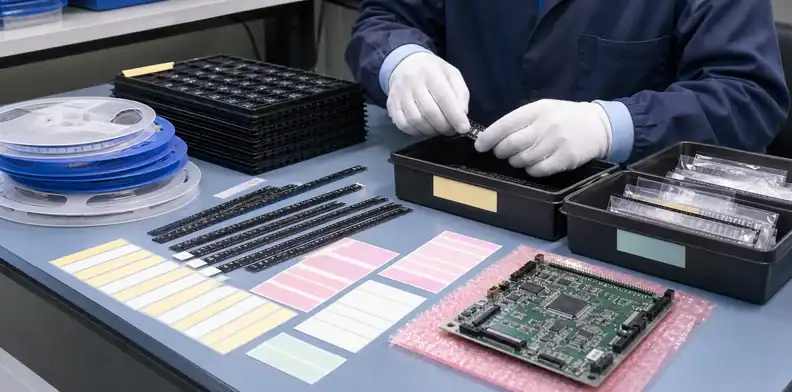
Customer-supplied parts still need traceability, correct labels, dry-pack status when applicable, and a receiving record that connects them to the build.
Traceability can be lost when parts arrive in mixed bags, unlabeled strips, or partial reels without source information. The receiving record should connect the supplied material to the BOM line, lot or date code when available, quantity received, quantity accepted, and any condition warning that may affect assembly.
Clarify who owns leftovers
Leftover ownership should be settled before assembly, including scrap reporting, return packaging, storage duration, future use, and disposition of partial reels.
Leftover ownership is a commercial decision with quality consequences. Returned material needs protective packaging and a count; stored material needs a retention rule and future-use record. Scrapped material should be reported with a reason. Otherwise repeat orders begin with uncertain inventory and nobody knows whether the remaining stock is usable.
That record should travel with the next PO so the buyer does not pay twice for parts already sitting in controlled storage.
Send a consigned-kit instruction with the RFQ
A quote-ready kit instruction tells the assembler what is supplied, how it is packaged, how much attrition is allowed, and what report should come back.
A quote-ready consigned kit instruction does not need legal complexity. It should list each supplied line, package form, received quantity, allowed attrition, shortage escalation, leftover disposition, and report format. That gives the assembler enough information to quote labor and risk instead of guessing the condition of the kit.

Production record for the consigned-parts attrition plan
Controlled object
Controlled object: line-item kit instruction showing package format, received quantity, usable quantity, planned loss, traceability, shortage action, and leftover disposition.
Failure boundary
Failure boundary: SMT stoppage, lost moisture history, unusable cut tape, mixed lots, disputed shortages, or excess components disappearing after the build.
Design-owned conditions
Design-owned conditions: manufacturer part and revision, approved lot mixing, MSL handling, presentation format, minimum usable quantity, and ownership.
Supplier discretion
Supplier discretion: supplier handling loss inside an agreed part-specific allowance when the consumption and remainder are reported.
Required proof
Required proof: incoming count and condition, reel or bag labels, moisture records, issue quantity, actual usage, scrap reason, and returned balance.
Production stop
Production stop: shortage below the next safe build quantity, broken traceability, expired floor life, damaged presentation, or an unapproved alternate.
Repeat-order baseline
Repeat-order baseline: kit revision, received and consumed quantities, attrition by line, shortage decisions, storage state, and leftover location.
RFQ inputs
RFQ inputs: BOM, AVL, placement data, package and reel details, consigned quantities, MSL information, build quantity, attrition rules, and return instructions.
FAQ
Can the supplier decide the consigned-parts attrition plan?
Discretion for consigned-parts attrition plan: supplier handling loss inside an agreed part-specific allowance when the consumption and remainder are reported. Engineering control for consigned-parts attrition plan: manufacturer part and revision, approved lot mixing, MSL handling, presentation format, minimum usable quantity, and ownership.
What stops this consigned-parts attrition plan?
Stop rule for consigned-parts attrition plan: shortage below the next safe build quantity, broken traceability, expired floor life, damaged presentation, or an unapproved alternate. Disposition owner for consigned-parts attrition plan: the named engineering approver.
Which proof closes the consigned-parts attrition plan?
Evidence for consigned-parts attrition plan: incoming count and condition, reel or bag labels, moisture records, issue quantity, actual usage, scrap reason, and returned balance. Revision link for consigned-parts attrition plan: the quoted dataset.
What survives into the next order?
Reorder baseline for consigned-parts attrition plan: kit revision, received and consumed quantities, attrition by line, shortage decisions, storage state, and leftover location.
For a focused consigned-parts attrition plan, send QueenEMS BOM, AVL, placement data, package and reel details, consigned quantities, MSL information, build quantity, attrition rules, and return instructions. Redline request: consigned-parts attrition plan. Open assumptions: consigned-parts attrition plan. Approver: consigned-parts attrition plan owner.
Written by the QueenEMS Engineering Team
Sources
Upload your files today · Free DFM check before production · Ship worldwide
Get your PCB prototypes in as fast as 24 hours. We handle FR4, Rogers, and Flex up to 60 layers — free prototypes for 2–4 layer boards, no minimum order.
Just upload your Gerber + BOM — we source every part, assemble, and inspect (AOI + X‑Ray) so you don't have to chase suppliers. Boards ship in as fast as 24 hours.