
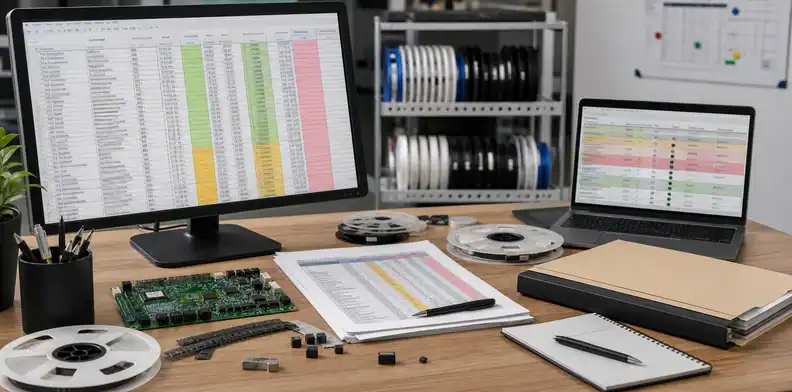
Quick Answer: PCBA AVL cleanup should make every component line quotable from one approved sourcing rule before the RFQ is sent. Before asking for assembly pricing, confirm the exact MPN, approved manufacturers, allowed alternates, no-substitution lines, sourcing owner, MOQ or NCNR exposure, and the approval path for any exception.
Key takeaways – Treat the AVL as a sourcing control, not as a loose list of preferred brands. – Clean up conflicts before the supplier buys parts, not after a low quote wins. – Separate exact MPN lines, approved alternates, proposed alternates, and hold lines. – Keep the accepted AVL interpretation with the RFQ and PO record.
PCBA AVL cleanup before RFQ matters because the assembly quote is only as controlled as the sourcing data behind it. A BOM can look complete while the approved vendor list is outdated, incomplete, or unclear about which manufacturer part numbers are truly released.
That creates a quiet quoting problem. One assembler may price exact MPNs and expose shortages. Another may assume broader substitution authority. A third may use a distributor suggestion that was never approved by engineering. The prices then look comparable, but the sourcing risk is not the same.
This article is for buyers, engineers, and founders who are close to sending a PCBA RFQ. The goal is simple: make the AVL clean enough that a supplier can quote the intended build without guessing what may be bought, substituted, held, or escalated.
Table of Contents
- Make every BOM line point to one sourcing rule
- Separate approved alternates from supplier suggestions
- Clean up obsolete, MOQ, and NCNR exposure
- Define who may approve an AVL exception
- Send one quote-ready AVL package
- Lock AVL cleanup before NCNR buys
- Keep AVL exceptions out of informal messages
Make every BOM line point to one sourcing rule
Every BOM line should point to one clear sourcing rule before the RFQ leaves the buyer’s team. The supplier needs to know whether the line is exact-MPN only, approved alternate allowed, customer-supplied, supplier-sourced, source-only, do-not-populate, or hold for approval.
The fastest way to find AVL trouble is to compare the BOM and AVL side by side. The BOM for PCB assembly should carry the information production needs: reference designator, quantity, description, package, manufacturer, MPN, sourcing status, and any approved alternate note. The AVL should then support that BOM line instead of contradicting it.
A common buyer problem is a BOM that names one exact MPN while the AVL lists several manufacturers without saying whether all are approved for this build. That may be acceptable for commodity resistors, but it can be unsafe for connectors, regulators, crystals, sensors, optocouplers, RF parts, programmed ICs, or safety-related components.
Use a clean status model:
| Line status | What the assembler may do |
|---|---|
| Exact MPN only | Quote and buy the named manufacturer part number only |
| Approved alternate allowed | Quote one or more named alternates already released |
| Proposed alternate | Price conditionally; wait for buyer approval before purchase |
| Customer supplied | Do not buy; verify kit quantity, label, and delivery date |
| Hold | Do not buy or place until engineering closes the line |
This is where practical experience shows up in the quote. A sourcing team may think the AVL is “close enough” because all parts look similar. The assembly floor only sees whether the selected reel fits the footprint, passes polarity checks, matches the test plan, and can be traced back to the approved source.
The buyer should also remove stale internal part numbers that no longer connect to a manufacturer part number. Internal numbers are useful for ERP control, but a supplier cannot quote from an internal code alone unless the RFQ also names the approved manufacturer, package, rating, and source rule.
One useful RFQ note is: “Quote each component against the BOM MPN unless the AVL marks another MPN as approved for this build. Do not buy proposed alternates without written approval.” That sentence keeps the AVL from becoming an uncontrolled shopping list.
Separate approved alternates from supplier suggestions
An approved alternate is not the same thing as a supplier suggestion. An approved alternate has already passed the buyer’s engineering, sourcing, compliance, or quality rule; a supplier suggestion is an option that still needs review.
Many RFQ delays happen because these two categories are mixed together. A supplier may offer a faster part during quoting, and the buyer may assume it is already allowed because it appears near the AVL. That assumption can lead to wrong footprints, different electrical limits, altered firmware behavior, or a receiving dispute when the part arrives.
Use PCBA approved alternates as the decision boundary. The alternate decision should answer which parameters cannot change, whether the supplier may choose between approved parts, whether buyer approval is needed for each lot, and whether the quote should show exact pricing by MPN.
For RFQ comparison, ask suppliers to label each line:
| Quote label | Meaning for comparison |
|---|---|
| Exact | Supplier priced the released BOM MPN |
| Approved alternate | Supplier priced a named alternate already allowed |
| Conditional alternate | Supplier priced an option that needs approval |
| Shortage exposed | Supplier could not quote a safe option |
| Buyer-supplied | Supplier expects consigned material |
This table helps purchasing compare quotes without hiding engineering risk. A lower quote based on a conditional alternate is not directly comparable with a quote based on exact MPNs. It may still be useful, but it should be reviewed as a sourcing decision, not as a simple price discount.
The buyer should also define substitution authority by component class. Passive components may allow controlled alternates by value, voltage, tolerance, package, and dielectric. ICs, connectors, safety components, programmed devices, crystals, optoelectronics, and RF parts usually need stricter approval.
Community and forum discussions around BOM substitutions often show the same anxiety: teams want flexibility, but they do not want the contract manufacturer to change the product silently. The best answer is not “never allow alternates.” The better answer is a written alternate rule that protects the design while letting the supplier surface real availability problems early.
When a supplier asks for alternate authority, do not answer only by email. Update the AVL interpretation, quote condition, or release record so the same question does not reopen during PO release or repeat ordering.
For prototypes, the buyer may choose wider sourcing flexibility to get boards assembled quickly. For a pilot or production lot, the same loose rule can be dangerous because the first accepted shipment becomes the reference for future reorders, warranty support, and troubleshooting. Write the alternate rule according to the build stage, not according to the supplier’s shortest lead time.
The RFQ should also say whether alternates may be quoted side by side. A useful supplier response might show “released MPN price,” “approved alternate price,” and “conditional suggestion” in separate lines. That format lets purchasing see the commercial option without allowing an unapproved part to slip into the firm production price.

Clean up obsolete, MOQ, and NCNR exposure
AVL cleanup should expose parts that are obsolete, hard to source, sold only in high MOQ packages, or non-cancellable and non-returnable before the supplier commits money. These issues often matter more to the order than the quoted placement cost.
A quote can look complete while a hidden sourcing problem sits behind one line. A connector may require a full tray. A regulator may have a long distributor lead time. A sensor may be available only from a broker. A selected part may be technically fine but create excess inventory because the build quantity is far below the package minimum.
Connect these lines to PCBA NCNR components before the PO is released. NCNR approval should not be buried inside a total assembly price. It should identify the part, quantity, supplier, MOQ, excess stock, cancellation rule, and whether the buyer accepts the financial exposure.
Useful AVL cleanup fields include:
| AVL field | Why it helps before RFQ |
|---|---|
| Lifecycle status | Flags obsolete, NRND, or end-of-life parts |
| Approved source | Separates authorized channels from risky sources |
| MOQ or package quantity | Shows excess stock before purchase approval |
| NCNR status | Prevents surprise financial commitment |
| Last approved alternate review | Shows whether flexibility is current |
| Country or compliance note | Supports regulated or customer-restricted builds |
An engineer may focus on whether the substitute works. A buyer may focus on whether the part can be purchased this month. A founder may care most about whether the unused reel becomes stranded inventory. All three questions belong in the RFQ record because the chosen answer changes cost, lead time, and risk.
This is also where turnkey and consigned decisions become visible. If the buyer owns a large reel already, the AVL should say the part is customer-supplied for this build. If the assembler must buy the part, the quote should show whether the material commitment is included, conditional, or excluded. The turnkey vs consigned PCB assembly decision should be clear before AVL cleanup is considered finished.
Define who may approve an AVL exception
Every AVL exception should have an approval owner before the supplier asks for permission. Otherwise, the quote can stall while purchasing, engineering, quality, and management each assume someone else owns the decision.
An exception is any sourcing change outside the cleaned AVL rule. It may be a substitute MPN, a different manufacturer, a different distributor, a date-code condition, a package-lot change, an alternate finish, a non-authorized source, or a proposal to buy a larger quantity than the build requires.
The approval owner depends on the risk:
| Exception type | Typical owner |
|---|---|
| Same electrical value, same package passive | Engineering or component owner |
| Different IC, connector, crystal, RF, or sensor | Engineering plus test or firmware owner |
| Broker, non-authorized source, or traceability gap | Quality and purchasing |
| MOQ, NCNR, or excess inventory | Purchasing and business owner |
| Compliance or customer-restricted source | Quality, compliance, or customer approval |
The supplier may provide useful evidence, such as datasheets, distributor quotes, lifecycle notes, date-code availability, and delivery options. The supplier should not approve the exception unless the buyer gave that authority in the RFQ.
This boundary is important for E-E-A-T because it reflects how real PCBA orders fail. The issue is rarely one missing field. It is usually a handoff gap: engineering believes the AVL is controlled, purchasing believes the supplier will ask before buying, and the supplier believes the RFQ allows reasonable substitutions.
Use short decision language. For example: “Supplier may propose alternates for availability, but QueenEMS or the buyer must receive written approval before purchase for ICs, connectors, crystals, RF parts, programmed devices, safety-related parts, and any NCNR commitment.” That gives the quote team room to help without creating a hidden design change.
Keep the exception rule proportional. A two-board engineering sample may need a fast written approval in the RFQ email thread, while a regulated production build may need a signed ECO, updated AVL, customer approval, and lot traceability. The key is not paperwork volume; it is whether the final record lets receiving, rework, and repeat-order teams understand why that part was allowed.
An exception log is especially useful when several suppliers quote the same build. One supplier may expose a shortage honestly, while another may quietly use a broad substitute. Asking every bidder to return the same exact/approved/conditional/hold labels makes quote comparison fairer and makes the final supplier choice easier to defend internally.
Send one quote-ready AVL package
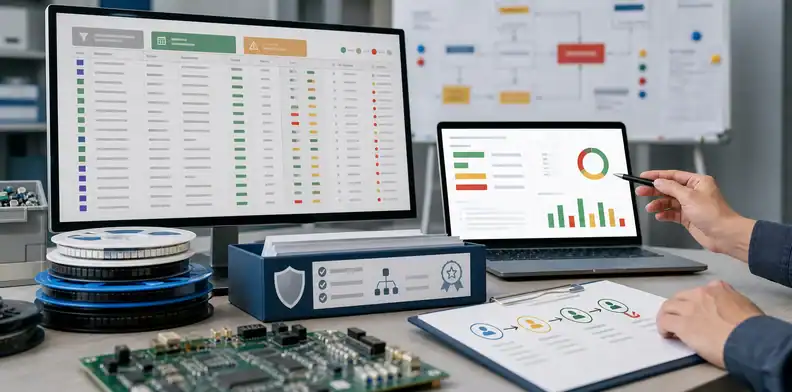
The final RFQ should include one controlled BOM, one current AVL or AML, one sourcing-scope note, and one exception log. The package should let the assembler quote approved material without rebuilding the buyer’s sourcing policy from email fragments.
A practical package has four parts. First, the BOM identifies what is placed on the board and in what quantity. Second, the AVL identifies what manufacturer or source is allowed. Third, the sourcing note says whether the assembler buys the parts, receives consigned material, or quotes a hybrid model. Fourth, the exception log lists unresolved lines and who can approve them.
The PCB assembly RFQ files package should carry that AVL cleanup record along with Gerber or ODB++ data, centroid, assembly drawing, test requirements, and delivery terms. That way, assembly pricing is connected to the same controlled release that production will use later.
Before sending the RFQ, run a final buyer-side read:
| Question | Pass condition |
|---|---|
| Does every BOM line have a sourcing status? | Yes, exact, alternate, consigned, source-only, or hold |
| Are approved alternates separated from proposals? | Yes, conditional parts are labeled |
| Are MOQ and NCNR risks visible? | Yes, exposure is listed before purchase |
| Can the supplier quote without guessing? | Yes, file set and approval owners are named |
| Can a repeat order use the same record? | Yes, decisions are saved with the PO package |
For PCBA projects where AVL cleanup affects quotation, sourcing, or production release, send QueenEMS the BOM, AVL or AML, approved alternate list, supplier quote notes, sourcing model, MOQ or NCNR concerns, and the approval owner for open lines. We can help return a quote-ready AVL interpretation, conditional sourcing log, and cleaner PCBA RFQ package before material is purchased.
Lock AVL cleanup before NCNR buys
AVL cleanup is most valuable before non-cancellable or non-returnable parts are purchased. Once the supplier buys NCNR material, a simple line-item cleanup can become a cost dispute rather than an engineering correction.
Buyers should ask the supplier to flag AVL lines with long lead time, MOQ exposure, lifecycle concern, or no approved alternate before the quote is treated as final. That makes the commercial risk visible early enough to decide.
- NCNR or MOQ exposure by BOM line
- Lifecycle or availability risk
- Approved alternate status
- Buyer approval needed before purchase
Keep AVL exceptions out of informal messages
AVL exceptions often begin as a useful supplier comment: a part is unavailable, expensive, or risky. The problem comes when that comment becomes the real build decision without updating the BOM, AVL, or quote record.
The better workflow is to keep one exception list with line number, supplier suggestion, buyer decision, and whether the exception is temporary or permanent. This gives purchasing speed without losing engineering control.
- BOM line and reference designators
- Supplier proposed part and reason
- Buyer disposition and approval owner
- Temporary lot exception or AVL update
FAQ
Can I send a PCBA RFQ without a cleaned AVL?
Yes, but the quote should be marked budgetary or conditional. A production quote needs clear approved sourcing rules, because component substitutions can change cost, lead time, function, and purchasing liability.
What’s the difference between an AVL and an approved alternate?
An AVL lists approved manufacturers, sources, or sourcing routes; an approved alternate is a specific part or option released for a specific BOM line or product rule. The RFQ should show whether the supplier may choose from the list or must ask first.
How do I know which AVL lines need engineering review?
Review any line that changes footprint, pinout, tolerance, voltage, temperature, lifecycle, firmware behavior, compliance, test result, or customer approval. Commodity passives may be flexible, but active and mechanical parts often need tighter control.
Should MOQ and NCNR exposure be in the AVL?
Yes, at least as a sourcing note linked to the affected line. MOQ and NCNR exposure can decide whether the buyer approves the quote, changes the part, buys excess stock, or uses consigned material.
What should QueenEMS check before quoting from my AVL?
QueenEMS should check BOM-to-AVL alignment, exact MPN rules, allowed alternates, sourcing owner, MOQ or NCNR exposure, open exceptions, and whether the quote is production-ready or still conditional.
Sources
Written by the QueenEMS Engineering Team
Upload your files today · Free DFM check before production · Ship worldwide
Get your PCB prototypes in as fast as 24 hours. We handle FR4, Rogers, and Flex up to 60 layers — free prototypes for 2–4 layer boards, no minimum order.
Just upload your Gerber + BOM — we source every part, assemble, and inspect (AOI + X‑Ray) so you don't have to chase suppliers. Boards ship in as fast as 24 hours.