
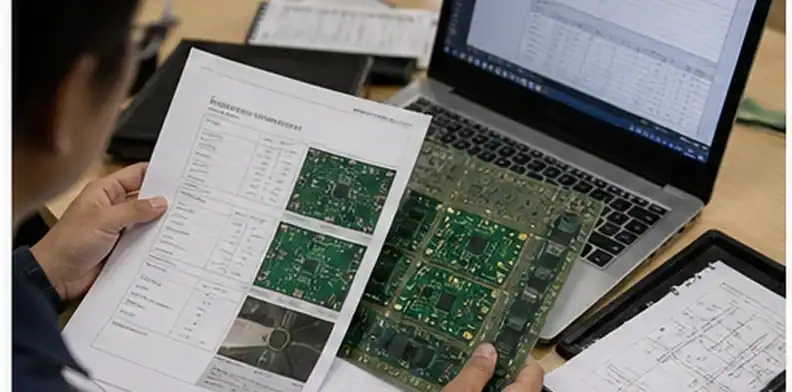
Quick Answer: PCB manufacturing for U.S. companies should compare technical scope, quality evidence, delivery responsibility, landed cost, compliance limits, and revision-control risk before choosing a supplier. Offshore PCB sourcing can work well when the board package is complete and the buyer knows what cannot be delegated. It becomes risky when price is compared without tariffs, freight, documentation, export-control, or production-repeat assumptions.
Key takeaways – Compare landed cost, not only supplier unit price. – Keep compliance-sensitive projects out of casual RFQ workflows. – Ask for quality evidence before shipment, not after a problem. – Separate prototype learning from production release.
PCB manufacturing for U.S. companies often means balancing domestic expectations with overseas cost, capability, and lead-time options. A lower fabrication price can be useful, but only when the supplier is quoting the same technical board, the same evidence package, and the same delivery responsibility.
This page gives U.S. buyers a practical comparison path. It is not legal or customs advice. It shows which engineering and purchasing questions should be closed before a purchase order is issued.
Table of Contents
- What should a U.S. buyer confirm first?
- Which files make the quote buildable?
- How should capability be checked before RFQ?
- What quality evidence should be requested?
- How do tariffs, freight, and landed cost fit?
- When should compliance questions be escalated?
- Can prototype and production use one supplier?
- When is offshore PCB manufacturing a poor fit?
- What should U.S. buyers send for review?
What should a U.S. buyer confirm first?
A U.S. buyer should first confirm the project boundary: bare PCB only, turnkey PCBA, consigned assembly, prototype, pilot, or production. Each boundary changes files, cost, lead time, quality evidence, and supplier responsibility.
The buyer should also decide whether the project has compliance, customer, defense, medical, export-control, or domestic-sourcing restrictions. Those questions should be escalated internally before the supplier is asked to quote. A general overseas quote is not the right path for every program.
For ordinary commercial electronics, the first comparison should be technical fit plus landed cost. Unit price alone is too narrow.
Which files make the quote buildable?
A buildable quote needs the released fabrication dataset, drill output, drawing notes, layer stack, laminate callout, finished-thickness target, copper requirement, surface finish, solder mask, controlled-impedance notes, special tolerances, and quantity. For PCBA, add BOM, AVL, centroid, assembly drawing, programming, and test instructions.
The drawing is the control document for many quote assumptions. It should state what cannot change without approval: material, stackup, finish, controlled impedance, UL or customer notes, special tolerances, and inspection evidence.
For quote-package detail, use QueenEMS’ PCB assembly quote file checklist when the order includes assembly.
How should capability be checked before RFQ?
Capability should be checked against the actual board instead of a supplier brochure. Ask whether the specific layer count, minimum line/space, drill structure, annular ring, material, copper, finish, impedance, and panel requirements are standard, review-required, or not recommended.
A supplier that can build simple FR-4 prototypes may not be the right source for HDI, rigid-flex, RF laminate, ceramic substrate, heavy copper, or Class 3-style evidence. The quote should show where engineering review is needed.
If the project has unusual materials or stackup, ask whether the supplier proposes any substitution. Material changes should be approved by engineering before price is treated as final.
What quality evidence should be requested?
Quality evidence should be requested before shipment and, for some items, before fabrication begins. Common records include job-level COC, electrical-test status, outgoing QC summary, impedance report, microsection when required, material statement, packing photos, and test or assembly evidence for PCBA.
The right evidence depends on the product. A quick engineering prototype does not need the same package as a production board for industrial controls or customer-qualified hardware. The buyer should ask what evidence is included and what is optional.
Evidence also protects reorders. If the first accepted lot used a special stackup, alternate material, or supplier-approved process note, the record should be attached to the next RFQ.
How do tariffs, freight, and landed cost fit?
Tariffs, freight, brokerage, taxes, and delivery terms belong in landed-cost comparison. They should not be guessed after the supplier unit price is chosen. A quote that looks cheaper at the factory gate can become more expensive after import and delivery responsibilities are added.
Ask the supplier to state Incoterm, ship-to location, transport method, carton or pallet count, export document set, and quote validity. Then purchasing can compare supplier invoice price against the cost to receive usable boards at the U.S. destination.
For delivery-term comparison, QueenEMS’ DDP vs DAP PCB shipping article gives a practical structure.
When should compliance questions be escalated?
Compliance questions should be escalated when the project involves controlled technology, customer flow-down clauses, ITAR/EAR concerns, domestic-source requirements, cybersecurity hardware, medical obligations, or contract restrictions. The supplier should not be asked to guess whether the project is allowed for offshore sourcing.
The buyer’s internal team should decide what files can be shared, which countries or supplier types are allowed, and what documentation must be retained. That decision belongs before RFQ release, not after a low quote arrives.
For ordinary commercial boards, this may be a quick check. For restricted programs, it can decide whether overseas PCB manufacturing is excluded entirely.
Can prototype and production use one supplier?
Prototype and production can use one supplier when the prototype process is close enough to the intended production process. That means material, stackup, finish, test, panelization, and quality evidence can be repeated.
Sometimes the best prototype supplier is not the best production supplier. A very fast prototype path may rely on shortcuts that are acceptable for engineering samples but weak for repeat orders. A production supplier may need more front-end review but provide better documentation and consistency.
Before production release, compare the prototype build record with the production requirement. QueenEMS’ PCB prototype to production switch signals can support that decision.
When is offshore PCB manufacturing a poor fit?
Offshore PCB manufacturing is a poor fit when the buyer cannot share files, cannot tolerate transport time, lacks import ownership, has unresolved compliance restrictions, or needs immediate engineering iteration beside the factory. It is also a poor fit when the supplier cannot document quality evidence for the product risk.
Offshore sourcing can still be strong for many commercial prototypes, pilot lots, and production builds. The deciding factor is whether technical scope, communication, delivery, and compliance boundaries are controlled.
If any boundary is unclear, pause the quote. A delayed decision is cheaper than a wrong shipment.
What should U.S. buyers send for review?
Send QueenEMS the board files, drawing, stackup, quantity breaks, delivery destination, preferred Incoterm, quality evidence requirements, and any customer or compliance constraints that affect sourcing. For PCBA, add BOM, AVL, centroid, assembly drawing, programming, and test files.
The review should separate buildability, quote assumptions, evidence needs, landed-cost boundary, and internal approval questions. That lets U.S. buyers compare suppliers without mixing engineering risk and purchasing assumptions.
For a quote-ready package, send the controlled file set through the QueenEMS contact page. QueenEMS can identify which questions must close before offshore PCB manufacturing is a safe option.
FAQ
Should U.S. companies use overseas PCB manufacturing?
Yes for many commercial projects, when files are complete and compliance, landed cost, quality evidence, and delivery terms are controlled. It is not suitable for every restricted or urgent program.
What is the biggest offshore PCB quote mistake?
The biggest mistake is comparing unit price without freight, import responsibility, evidence, and technical assumptions. Landed cost and build scope should be compared together.
Are tariffs part of the supplier quote?
Not always. The quote should state the Incoterm and responsibility boundary so purchasing can determine which costs are included and which require separate review.
Can QueenEMS review U.S. PCB manufacturing quotes?
Yes. Send the files, supplier quote, destination, evidence needs, and known restrictions so the technical and commercial assumptions can be checked before PO release.
Written by the QueenEMS Engineering Team
Upload your files today · Free DFM check before production · Ship worldwide
Get your PCB prototypes in as fast as 24 hours. We handle FR4, Rogers, and Flex up to 60 layers — free prototypes for 2–4 layer boards, no minimum order.
Just upload your Gerber + BOM — we source every part, assemble, and inspect (AOI + X‑Ray) so you don't have to chase suppliers. Boards ship in as fast as 24 hours.