
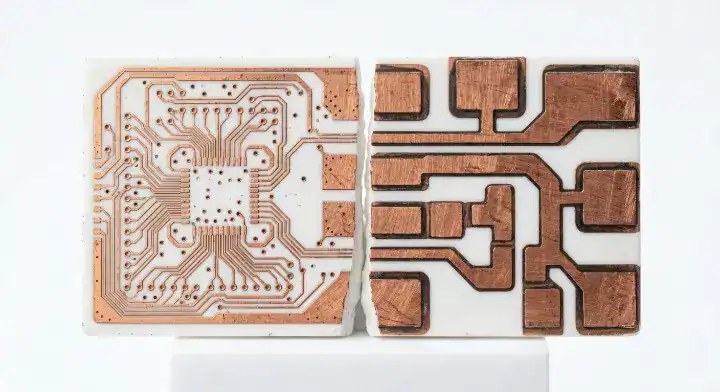
Quick Answer: DBC bonds copper foil to ceramic for heavy-copper power structures, while DPC builds copper by deposition and plating for finer geometry and plated features. Choose between them from the released copper thickness, minimum line/space, via requirement, substrate, thermal-cycle profile and inspection plan—not from a fixed current threshold.
Use the ceramic PCB guide to select the insulating substrate before comparing how DBC and DPC form its conductors.
Key takeaways:
- Copper and geometry: DBC usually serves bonded heavy-copper layouts; DPC is selected when deposited or plated geometry is the limiting requirement.
- Vias: Ask the supplier to confirm the complete hole and metallization route instead of assuming every DPC or DBC construction supports the same via structure.
- Reliability: Define the substrate, copper pattern, assembly profile and thermal-cycle test before comparing processes.
- RFQ control: Release Gerber or ODB++, stackup, copper callouts, line/space limits, finish and acceptance evidence together.
Table of Contents
- What Is the Core Difference Between DPC and DBC Ceramic PCB?
- How Does the Manufacturing Process Differ Between DPC and DBC?
- What Copper Thickness and Line Width Can Each Process Achieve?
- Which Process Handles Thermal Cycling and Reliability Better?
- Can You Get Plated Through Holes on DBC or DPC Ceramic PCB?
- How Does DPC vs DBC Ceramic PCB Cost Compare?
- When Should You Choose DBC Over DPC (and Vice Versa)?
- How Do You Inspect and Qualify DPC vs DBC Boards from Your Supplier?
What Is the Core Difference Between DPC and DBC Ceramic PCB?
Copper Interface and Patterning
Start the comparison with a cross-section, not a process acronym. The cross-section should show ceramic material and thickness, copper on both sides, dielectric openings, pad finish and any drilled or plated feature. This gives engineering and purchasing one physical construction to approve.
The core difference is how copper is attached and patterned. DBC uses a bonded copper-foil structure, while DPC uses an adhesion/seed layer followed by copper build-up and patterning. Supplier capability varies by ceramic grade, copper thickness, artwork, surface finish and feature size, so the drawing and stackup must control the decision.
Here is the breakdown of how these parameters compare side-by-side:
| Decision field | DBC review | DPC review |
|---|---|---|
| Copper structure | Bonded copper foil and etched pattern | Deposited seed layer with plated copper build-up |
| Primary fit | Heavy-copper power and thermal structures | Finer geometry, plated features and precision pads |
| Drawing evidence | Copper thickness, isolation gap, edge shape and flatness | Line/space, via construction, plating thickness and surface planarity |
| Qualification | Bond/interface evidence and thermal-cycle plan | Adhesion, plating uniformity, geometry and via evidence |
Treat the supplier’s reviewed capability sheet as the limit. The released drawing should state copper thickness, minimum finished line/space, pad flatness and any plated-hole requirement; engineering should approve any change before tooling.
Choose DBC when bonded heavy copper is the controlling requirement; choose DPC when geometry, plated features or pad planarity controls the build.
How Does the Manufacturing Process Differ Between DPC and DBC?
What the Fabricator Must Confirm
The CAM response should identify the selected ceramic blank, usable process area, finished copper range, conductor tolerance, edge method and surface finish. Any deviation from the released stackup belongs in a numbered question that engineering can approve or reject before the quotation becomes an order.
The fabrication order is a supplier-controlled flow. A deposited adhesion/seed layer can be followed by patterned plating and later seed removal; do not specify a generic etch sequence as the only valid DPC route. Orbray’s ceramic processing information also lists direct copper plating on alumina and AlN, illustrating that the conductor process and substrate material are separate callouts.
One representative DPC flow is shown below; the supplier must confirm its actual sequence:
- Cleaning and preparing the fired substrate using the qualified process.
- Applying the specified adhesion metal and copper seed stack.
- Checking seed continuity before the patterned copper build.
- Applying photoresist and exposing the circuit pattern.
- Building copper to the supplier-confirmed finished thickness and uniformity.
- Stripping the resist and etching away the ultra-thin seed layer.
What Copper Thickness and Line Width Can Each Process Achieve?
DBC is normally screened for bonded heavy-copper layouts, while DPC is screened for finer deposited or plated features. Finished copper, line/space and pad tolerances vary together, so use the supplier’s reviewed capability for the exact ceramic and artwork. The same evidence should be checked when deciding how to evaluate a ceramic PCB manufacturer.
Current alone is not a safe selection rule. Trace width, copper thickness, temperature rise, spreading resistance, attachment method and allowable voltage drop must be evaluated together in the electrical and thermal design.
| Design constraint | Evidence to release | Likely route to evaluate |
|---|---|---|
| Heavy copper or large power pads | Copper thickness, current/temperature-rise model, isolation geometry | DBC first; compare AMB when the reliability case requires it |
| Fine conductors or dense pads | Finished line/space, pad tolerance, inspection method | DPC or another deposited-film route |
| Plated holes or filled vias | Hole drawing, metallization, fill and acceptance criteria | Confirm a DPC-compatible or alternate metallization route |
A compact sensor or RF layout may favor DPC, while a power module with large copper areas may favor DBC. The supplier must confirm the actual finished geometry and copper build for the released artwork.
As copper becomes thicker, lateral etching and conductor edge shape become more important. Ask the fabricator to confirm the finished isolation gap, top and bottom conductor widths and inspection method for the released copper thickness.
A supplier table can show how copper build changes the routing window. In Rogers’ curamik product information, the table headed “Typ. width of / spacing between conductors” pairs the 0.3 mm DBC copper option with a ≥0.5 mm conductor-width/spacing entry, and the 0.5 mm option with ≥0.7 mm. These are that product family’s published screening values, not universal DBC design rules or QueenEMS capabilities.
Suppose a proposed drawing uses 0.5 mm copper and 0.6 mm spacing. Under the cited table it requires a supplier exception or a drawing change; it cannot be released merely because a different copper build has a smaller published spacing. Ask the supplier to return the finished top and bottom conductor widths, minimum gap and pad edge position for the actual etch profile. Confirm component-land fit after any revision.
If reducing copper compromises the electrical or thermal design, compare a plated route with confirmed thickness and spacing, enlarge the layout, or separate fine-pitch interconnect from the power substrate. A split construction adds joints and mechanical interfaces that must be qualified; it is not an automatic cost or reliability improvement.
Do not release tooling until the supplier confirms finished line/space against the selected copper thickness and etch or plating route.
Which Process Handles Thermal Cycling and Reliability Better?
Build the Qualification Profile
Translate the product environment into a written profile before asking suppliers for reliability data. Record assembly state, mounting condition, electrical bias when applicable and inspections performed between intervals. Data from a different ceramic, copper pattern or attachment stack should be treated as reference only.
Thermal-cycle performance depends on the ceramic, copper thickness, copper pattern, edge geometry, attachment material and test profile. A thinner copper build can reduce mismatch stress in some layouts, while DBC or AMB constructions may be better suited to other power-module designs; qualification must follow the application load case.
Copper lifting after assembly should trigger a joint fabrication-and-assembly review. Check the stored reflow profile, surface preparation, copper-to-ceramic interface evidence, pad geometry and handling history before assigning the cause.
Coefficient-of-thermal-expansion mismatch concentrates stress near copper edges and attachment interfaces. The qualification plan should therefore name the temperature range, dwell time, ramp rate, cycle count, sample size and failure criteria that represent the actual product.
For incoming inspection, request lot traceability plus the agreed interface or adhesion evidence. Engineering should review any void, crack, peel or plating deviation against the drawing and qualification plan rather than relying on an undocumented universal limit.
A copper-interface failure requires containment and documented disposition; process selection alone does not waive assembly-profile or incoming-material checks.
Can You Get Plated Through Holes on DBC or DPC Ceramic PCB?
Do not assume a standard DBC flow includes plated through holes. DPC and other secondary metallization routes can support plated or filled features, but the supplier must confirm drill method, sidewall metallization, copper build, fill, planarity and inspection for the exact ceramic and thickness.
For any connection through the ceramic, show the finished hole or via in the fabrication drawing and specify whether it is open, plated, filled or capped. A process acronym is not a sufficient via specification.
A supplier-confirmed DPC-compatible via route may include:
- Drilling or laser processing the ceramic to the approved finished-hole geometry.
- Applying the confirmed sidewall activation, seed or metallization sequence.
- Building copper and any optional fill or cap to the released cross-section.
- Inspecting hole geometry, coverage, continuity, fill and planarity with the agreed method.
Release a cross-section callout for each via type and obtain written confirmation of the metallization and inspection route.
How Does DPC vs DBC Ceramic PCB Cost Compare?
Compare Quotes on One Revision
A useful comparison sheet records the quoted file revision, assumed panel or blank, process route, included tests, scrap/yield assumptions, tooling ownership and repeat-order validity. A lower unit price is not comparable when one supplier omitted via fill, interface evidence or production qualification.
There is no reliable public unit-price rule for DPC versus DBC. Quote results depend on ceramic type and size, copper, artwork utilization, finish, inspection, qualification, quantity and delivery plan.
| Quote driver | Why it changes DBC cost | Why it changes DPC cost |
|---|---|---|
| Ceramic and thickness | Affects bonded panel choice and handling | Affects drilling, deposition and plating route |
| Copper and geometry | Heavy copper and tight isolation increase etch difficulty | Fine geometry, vias and plating thickness add process control |
| Quantity and panel use | Changes setup allocation and yield exposure | Changes mask, setup and inspection allocation |
| Qualification evidence | Interface and thermal-cycle records add scope | Adhesion, via and geometry records add scope |
Prototype cost is driven by setup, material minimums and inspection scope. Ask suppliers to separate non-recurring charges from unit price so the production comparison remains meaningful.
Compare quotations against one controlled RFQ revision. Confirm that each supplier priced the same substrate, copper, finished dimensions, surface finish, inspection evidence, sample quantity and production forecast.
Choose the lowest-cost route only after every mandatory drawing and qualification requirement is included in the quotation.
When Should You Choose DBC Over DPC (and Vice Versa)?
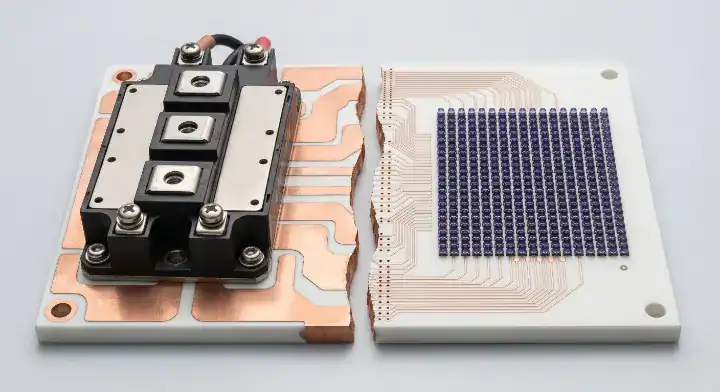
Evaluate DBC for power layouts dominated by bonded copper area and DPC for layouts dominated by conductor definition, plated features or pad planarity. Automotive or high-reliability use adds a qualification decision; it does not make one process universally correct.
Application screen:
- DBC candidate: large power pads, bonded heavy copper and a documented interface qualification plan.
- DPC candidate: fine conductors, precision pads, plated features or a combined signal-and-thermal layout.
- Escalate for engineering review: conflicting copper, geometry, via, flatness or thermal-cycle requirements that one substrate cannot satisfy.
A mixed-function module can expose conflicting requirements: the power stage may need bonded heavy copper while the gate-drive or sensing area needs finer conductors and vias. Resolve that conflict in the architecture review, which may lead to separate substrates or a qualified hybrid construction rather than forcing one process across the entire module.
For a process review, send the ceramic callout, stackup, Gerber or ODB++, copper thickness, smallest finished line/space, via cross-sections, surface finish, assembly profile and qualification plan. QueenEMS can return DFM questions and identify which assumptions must be resolved before quotation.
How Do You Inspect and Qualify DPC vs DBC Boards from Your Supplier?
Lot Evidence and Disposition
Define which records travel with prototypes, pilots and production lots. The package may include material identity, dimensional results, interface or adhesion evidence and an electrical/thermal report. When a result misses the specification, hold the affected lot and issue a written deviation rather than accepting an email assurance.
Qualification should combine drawing inspection with process-specific evidence. DBC reviews usually emphasize the bonded interface and copper-edge condition; DPC reviews emphasize adhesion, plated thickness, feature geometry and any through-ceramic connection.
Do not copy an acceptance number from a generic article into the purchase order. Name the applicable standard or customer specification, test method, specimen geometry, sample plan and pass/fail rule in the drawing or quality clause.
| Evidence | DBC review | DPC review |
|---|---|---|
| Drawing and lot identity | Substrate, copper, finish and revision | Substrate, seed/plating route, finish and revision |
| Geometry | Isolation gap, copper edge and flatness | Line/space, pad tolerance, via geometry and planarity |
| Interface/adhesion | Agreed bond or interface evidence | Agreed adhesion and plating-uniformity evidence |
| Reliability | Application-specific thermal/mechanical test | Application-specific thermal/mechanical test |
A lot should be held when the agreed bond, adhesion, geometry, via or reliability evidence is missing or out of specification. Quality and engineering should document the disposition before production or assembly continues.
Visual inspection is necessary but not sufficient when the drawing requires internal-interface, adhesion or plated-via evidence.
Conclusion
A controlled DPC-versus-DBC decision prevents late routing, copper and qualification conflicts. Keep the process choice tied to the same drawing revision that the supplier quotes and the buyer approves.
Provide the stackup, ceramic grade, copper callouts, Gerber or ODB++, via drawing, finish, quantity and qualification profile using the QueenEMS contact form. The DPC/DBC review can identify the preferred route, quotation assumptions and unresolved drawing items.
Written by the QueenEMS Engineering Team
Frequently Asked Questions
Can I use a standard SMT reflow profile on DPC? Use a profile qualified for the actual finish, components, attachment materials and ceramic assembly. Record the measured board profile and investigate any copper lifting as a fabrication/assembly interface issue.
Is DPC replacing DBC in every application? No. DPC and DBC solve different copper, geometry and assembly problems, and both remain valid when the drawing and qualification plan fit the process.
What is the minimum order quantity for DPC or DBC? MOQ is supplier- and design-specific. Request separate prototype, pilot and production quotations using the same controlled file set.
Can a DBC design include a through-ceramic connection? Only when the supplier confirms a secondary drilling/metallization route for the exact construction. Put the finished via cross-section and acceptance evidence on the drawing.
Upload your files today · Free DFM check before production · Ship worldwide
Get your PCB prototypes in as fast as 24 hours. We handle FR4, Rogers, and Flex up to 60 layers — free prototypes for 2–4 layer boards, no minimum order.
Just upload your Gerber + BOM — we source every part, assemble, and inspect (AOI + X‑Ray) so you don't have to chase suppliers. Boards ship in as fast as 24 hours.