
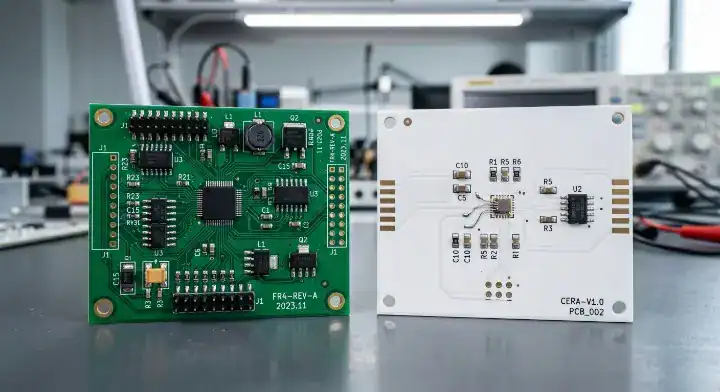
Quick Answer: Use FR4 where the required routing, assembly and environment can be met with a qualified laminate construction. Evaluate ceramic where a local thermal, electrical or packaging requirement justifies it, and consider a ceramic submodule alongside an FR4 control board. Neither a fixed operating temperature nor a universal power-density threshold decides the choice, and replacing the substrate does not automatically fix the complete cooling path.
The ceramic PCB vs FR4 decision becomes clearer when the system is divided into functions. A processor and its connectors may need dense multilayer routing, while a nearby power stage needs a short path to a heat sink. Requiring both functions to use the same substrate can hide a useful architecture or force an unnecessary whole-board material change.
Preserve the parts of the design that already meet their requirements. Compare a new substrate only against a defined limitation, such as an attachment area that runs too hot, an insulation construction that cannot be qualified, or a package that requires a different metallized base. This keeps cost analysis connected to the engineering problem.
Table of Contents
- Separate substrate properties from assembly requirements
- Find the bottleneck before replacing the board
- Preserve FR4 where routing determines the architecture
- Use a ceramic submodule when the heat source is local
- Choose the ceramic construction for the local task
- Compare total build cost without invented unit prices
- Validate the chosen architecture before committing volume
Separate substrate properties from assembly requirements
Compare identified material systems and finished constructions. FR4 and ceramic describe broad families, not two components with fixed prices, temperature ratings or thermal resistances.
FR4 is a glass-reinforced resin laminate family used in printed circuit boards. Ceramic circuits can use different ceramic grades and metallization routes. The material, metal pattern and fabrication process together define what can be built; the substrate name alone does not establish a layer-count limit or attachment capability.
The Isola FR408HR product data illustrates why a specific grade matters. Its table separately identifies thermal, electrical and test-method information rather than assigning a single generic “FR4 limit.” For an order, use the current material specification and the actual stackup instead of transferring a value from an unrelated laminate.
Likewise, a ceramic’s bulk conductivity does not state how much heat the populated board can dissipate. Thickness, copper distribution, component attachment and cooling interfaces remain part of the problem. A material conductivity ratio cannot be translated directly into a board-temperature reduction or a service-life multiplier.
| Requirement | Material information helps establish | Finished assembly still needs |
|---|---|---|
| Heat management | Conductivity for a named grade and condition | Geometry, interfaces and cooling validation |
| Electrical insulation | Material characterization | Required spacings and finished-construction tests |
| Dimensional behavior | Expansion and stiffness properties | Mounting, attachment and tolerance analysis |
| RF behavior | Relevant dielectric data | Actual stackup, metal geometry and measurement |
| Cost | Candidate material and route | Comparable quotes for the accepted assembly |
The ceramic substrate overview is useful when narrowing the available ceramic routes. Keep that selection separate from the architectural question of which part of the system needs ceramic at all.
Find the bottleneck before replacing the board
Determine whether the limiting requirement belongs to the laminate, the package, the attachment or the cooling system. Changing a board material only helps the part of the problem that the change actually affects.
Temperature ratings describe different things
Glass-transition temperature, decomposition temperature, assembly-process limits and continuous-use requirements are different quantities. A high Tg does not automatically authorize continuous operation at that temperature, and a ceramic firing temperature does not establish the operating limit of a finished populated board.
For example, Isola’s FR408HR table reports a typical Tg of 190°C by DSC and a decomposition temperature of 360°C at the stated weight-loss criterion. Those measurements describe different material behavior. Neither value should be relabeled as the maximum service temperature for an arbitrary circuit, solder joint or connector.
Ask which temperature the system requirement refers to: semiconductor junction, board surface, package case, ambient or process exposure. These temperatures are not interchangeable. A power device’s high junction rating does not mean that every nearby component or the control board experiences the same temperature.
Heat must still leave the assembly
A ceramic board may reduce resistance in a local path, but it cannot make the heat sink, enclosure or surrounding air disappear. Review the attachment layers and cooling boundary before promising that a material change will solve overheating. A high-resistance interface can limit the benefit of an otherwise favorable substrate.
For a first screening, compare the portions of a thermal model that change and those that remain. Suppose a hypothetical assembly has 2 K/W in the replaceable board section and 8 K/W elsewhere. Even eliminating that board contribution entirely would reduce the total from 10 to 8 K/W, not to zero. The example is an arithmetic limit, not a measured result or a prediction for a ceramic product.
Use that upper bound to decide where to investigate. If the needed improvement exceeds what the board section can deliver, examine the package, interface or cooling architecture as well. Avoid redesigning the board around a benefit that the thermal model cannot support.
Preserve FR4 where routing determines the architecture
Retain an FR4 construction when it meets the electrical, thermal and environmental requirements and provides the interconnection needed by the circuit. A nearby hot component does not automatically justify moving all control functions to ceramic.
Review the actual routing problem: signal layers, reference planes, component pitch, connector locations and test access. The feasibility of a multilayer FR4 board depends on its stackup and fabrication rules. Ceramic circuits also have multilayer options, but those are different process choices rather than an automatic extension of a bonded-copper plate.
Consider assembly and handling with the routing. A large connector, a mechanically loaded terminal or a board fastened at widely separated points may dominate the mechanical design. Evaluate the support and strain path instead of assuming one substrate family is always better under vibration. Ceramic brittleness and laminate behavior must be considered in the actual mounted structure.
Where heat sources are modest or a separate cooling path is available, copper distribution, thermal vias or a component-specific heat-spreading arrangement may allow the FR4 section to remain suitable. That conclusion needs the relevant thermal and electrical checks; it should not be expressed as a rule covering a fixed percentage of all products.
The FR4 grade and property discussion provides context for choosing the laminate within that architecture. It does not replace the stackup or the qualification required for the board being ordered.
Use a ceramic submodule when the heat source is local
Consider a local ceramic circuit when it addresses the demanding function while allowing the remaining electronics to retain a suitable FR4 layout. The split must be evaluated as an assembly, including the interfaces it creates.
Place the boundary at a functional interface
Draw the power, signal and mechanical connections between the candidate submodule and the control board. A useful boundary might separate a concentrated power device or optical source from its supporting control circuitry. It should not cut a sensitive high-current or high-frequency path without checking the consequences.
Consider a hypothetical power stage mounted near a heat sink with a separate FR4 control board. The ceramic section can be evaluated for device attachment, current flow and insulation to the cooling surface. The control board can be evaluated for signal routing, driver placement and connectors. This is an architecture to assess, not a claimed QueenEMS customer implementation.
Compare it with the existing integrated board and any packaged-module alternative. Keeping the power device on a suitable prequalified package or module may address the same requirement without creating a custom ceramic assembly. The correct boundary depends on what the component already provides and what the system still needs.
Check the interfaces created by splitting the design
A separate submodule adds connections, tolerances and assembly operations. Document pin or terminal functions, operating voltage and current, mounting datums, isolation boundaries and the cooling interface. The layout engineer should evaluate the electrical effects of the interconnection; the mechanical designer should verify that assembly tolerances do not force the ceramic to bend.
Use an interface drawing that shows both mating sides and identifies which dimensions are controlled by each supplier. A ceramic part can meet its individual drawing and still fail to fit if the assembly has no common datum or if connector insertion loads are not supported.
Plan test access before closing the enclosure. The submodule may need inspection before it is attached, while the complete assembly still needs functional and insulation testing after the connection is made. Define which defects each stage can detect rather than assuming that a successful bare-substrate test qualifies the finished system.
This approach adds engineering work, so it should solve a meaningful local limitation. Do not split a board merely to use a more impressive material name. Retain the integrated design where it meets requirements and the proposed split provides no useful margin or production benefit.
Choose the ceramic construction for the local task
Select the ceramic material, metallization and attachment together. A generic instruction to “upgrade to AlN” leaves the actual circuit and manufacturing route undefined.
Alumina, AlN and silicon nitride provide different property combinations. The Rogers curamik technical reference gives examples of named ceramic substrate products and their conditions. Use such information to identify candidates; obtain the appropriate current specification before using a value as an acceptance requirement.
The best material for one power or optical assembly may not be the best choice for another. Thermal conductivity, expansion, mechanical behavior, available thickness and compatibility with the intended metal and attachment system all matter. Avoid assigning a universal “best application” or guaranteed lifetime to the material family.
Where the comparison includes an insulated metal substrate, evaluate its identified dielectric and base construction rather than treating all MCPCBs as one weak thermal layer. The metal-core versus ceramic discussion covers that separate choice. The result can be a valid third option rather than a compulsory intermediate step toward ceramic.
RF circuits need their own dielectric and geometry assessment. Higher thermal conductivity does not automatically improve insertion loss or impedance control. Preserve the frequency, measurement method, layer structure and conductor details when comparing RF candidates instead of carrying a thermal recommendation into an unrelated electrical decision.
Compare total build cost without invented unit prices
Compare quotations for the same system function and acceptance requirements. Fixed prototype prices and universal ceramic-to-FR4 cost multiples are not a reliable basis for a purchase decision.
For each architecture, include board fabrication, tooling, components, attachment, inspection, connectors, mounting and any change to the cooling hardware. A local ceramic section might reduce the area of costly material while adding interconnection and assembly costs. Only a matched quotation can establish whether the trade is favorable for the actual quantities.
| Cost or schedule item | Integrated FR4 design | FR4 plus ceramic section |
|---|---|---|
| Board fabrication | Quote the required laminate stack | Quote both constructions and their quantities |
| Assembly | Existing component and attachment steps | Added joining, handling or fixture requirements |
| Cooling | Required spreading and heat-sink solution | Ceramic interface plus the remaining cooling path |
| Verification | Board and system acceptance tests | Submodule checks plus integrated-system tests |
| Design changes | One board revision boundary | Defined compatibility between both revisions |
Keep one-time validation cost separate from recurring production cost. A candidate that looks attractive at steady volume may need additional engineering or qualification before it can be released. Conversely, tooling already available for a suitable construction can affect an early build’s economics. Record the quoted situation instead of assuming a fixed delivery period from the substrate name.
Warranty savings need evidence. Use actual comparable failure data where available, or present a clearly labeled sensitivity calculation. Do not claim that a ceramic premium pays for itself through guaranteed failure elimination. Purchasing should be able to see which costs are quoted, which are measured and which remain assumptions.
Validate the chosen architecture before committing volume
Test the design that will be manufactured, including its attachment and cooling arrangement. Material selection is complete only when the relevant requirements have been checked on the identified construction.
Keep a reference set of drawings, stackups, component revisions and assembly instructions with the prototype results. Record the operating conditions and measurement locations so the thermal or electrical comparison can be reproduced. Where a typical data-sheet value was used in a model, distinguish that estimate from a measured production limit.
For a split architecture, inspect the mechanical fit and electrical interconnections as well as the ceramic section. Check the product’s relevant environmental and cycling requirements after integration. A material certificate or a successful room-temperature functional test cannot establish every aspect of reliability.
Review failure mechanisms rather than attaching a service-life number to a substrate. Low ceramic water absorption does not make the connectors, conductors or enclosure hermetic. A favorable expansion coefficient does not eliminate strain in every solder or die-attach joint. The design and validation need to address the parts of the assembly that remain exposed.
At the design review, retain one of three conclusions: the existing FR4 construction meets the requirements; a local ceramic section resolves a demonstrated limitation; or a broader architecture change is needed because the problem lies elsewhere. The conclusion should identify the test or calculation that supports it and the remaining work before production.
For a material and architecture quotation, send the existing board outline, location of the demanding device, proposed cooling interface and signal or power connections to QueenEMS. This allows the comparison to address a local ceramic section, an improved FR4 construction or another suitable build without assuming that the whole board must change.

FAQ
Does high-Tg FR4 have the same service limit as its Tg?
No. Tg is a material transition measured by a specified method. Continuous-use suitability depends on the relevant material qualification, board construction, components and operating environment.
Must every bare die be mounted on ceramic?
No. Bare-die attachment exists in different packaging systems. Select and qualify the substrate and attachment for the particular die, electrical requirement and thermal or mechanical load.
Does a ceramic board remove the need for environmental protection?
No. Exposed circuitry, attachment materials, connectors and the enclosure still require assessment. A property of the ceramic alone cannot establish the environmental protection of the complete assembly.
Written by the QueenEMS Engineering Team
Upload your files today · Free DFM check before production · Ship worldwide
Get your PCB prototypes in as fast as 24 hours. We handle FR4, Rogers, and Flex up to 60 layers — free prototypes for 2–4 layer boards, no minimum order.
Just upload your Gerber + BOM — we source every part, assemble, and inspect (AOI + X‑Ray) so you don't have to chase suppliers. Boards ship in as fast as 24 hours.