
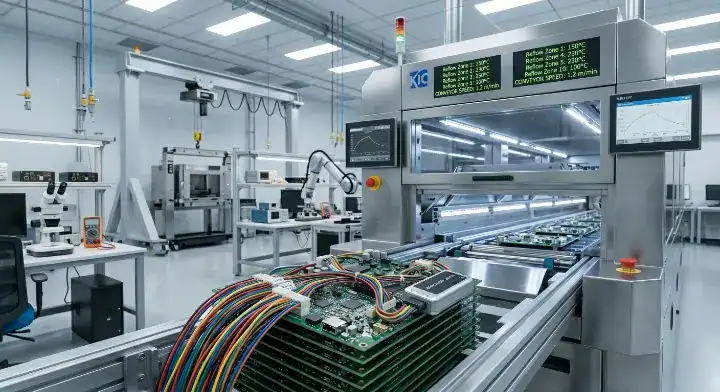
Quick Answer: A reflow soldering profile is the measured temperature-versus-time history of a PCB assembly. Develop the process window from the exact solder paste, alloy and component limits, then verify it with thermocouples on the assembly. A temperature that works for one build can leave another with incomplete wetting or excessive heat exposure; neither a fixed 245°C peak nor a universal 10°C board-temperature spread guarantees defect-free joints.
Key takeaways:
- Match the process window to the exact solder paste, alloy and component limits.
- Measure the assembly with thermocouples; oven setpoints alone cannot qualify it.
- Record peak, TAL threshold, slopes and the relevant temperature differences at identified locations.
- Verify joint quality after a controlled trial; no single temperature setting guarantees zero defects.
Table of Contents
- 1. What Is a Reflow Soldering Profile and Why Does It Matter?
- 2. What Are the Four Zones of a Reflow Profile?
- 3. How Do Lead-Free and Leaded Reflow Profiles Differ?
- 4. What Defects Does a Bad Reflow Profile Cause?
- 5. How Do You Set the Right Preheat Ramp Rate?
- 6. How Do Soak Time and Temperature Affect Tombstoning?
- 7. How Do You Optimize Peak Temperature and Time Above Liquidus?
- 8. How Should You Profile a Mixed-Component Board?
- 9. What Tools Do You Need for Thermal Profiling?
An oven display cannot tell you whether the coldest solder joint has reached its process window while the hottest component remains within its limit. This guide keeps those two checks separate, explains the four thermal phases and shows how to use profile records when investigating tombstoning, voids and poor wetting.
1. What Is a Reflow Soldering Profile and Why Does It Matter?
A reflow soldering profile plots the temperatures measured on an assembly as it heats, the solder melts and the joints cool. The production recipe consists of oven settings and conveyor speed; the profile is the evidence of what the board and components actually experienced. Record the paste product, alloy, assembly revision and measurement locations with the graph.
The useful temperature spread is ΔT: the difference between measurement locations at a defined time or process stage. Reduce that spread where needed, but qualify every monitored location against its own peak, time and ramp limits. A small ΔT alone cannot prove that the joints reflowed correctly.
- Preheat: warm the assembly and release flux volatiles within the selected processing window.
- Reflow: exceed the selected alloy threshold long enough to wet the surfaces without exceeding exposure limits.
- Cooling: solidify the solder within the paste and component limits.
2. What Are the Four Zones of a Reflow Profile?
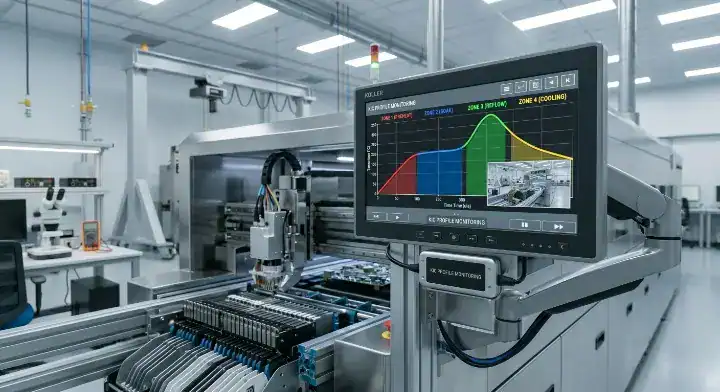
Preheat, pre-reflow or soak, reflow, and cooling describe thermal phases, not the number of physical oven heaters. Some pastes use a ramp-to-peak process; others benefit from a soak. The selected paste and assembly determine the shape and duration.
During preheat, the assembly warms and flux volatiles are released. Before reflow, the flux activates and temperatures may equalize. Above the alloy liquidus, solder can wet the mating surfaces and form joints. Cooling then solidifies those joints. The table describes what to check at each phase; numerical limits belong to the approved process window.
| Phase | What happens | Set the window from | What to verify |
|---|---|---|---|
| Preheat | Assembly warms; volatiles are released | Paste guidance and component restrictions | Measured rising slope at the relevant locations |
| Pre-reflow / optional soak | Flux activation and thermal equalization | Paste chemistry and measured board response | Time/temperature interval and local thermal imbalance |
| Reflow | Solder wets the mating surfaces | Alloy threshold and paste process window | Peak and TAL at cold and heat-sensitive locations |
| Cooling | Joints solidify | Paste and component limits | Measured falling slope and joint condition |
A four-phase thermal curve does not require a four-zone oven, and more heater zones do not by themselves qualify a process. What matters is whether the measured assembly profile meets the agreed limits at the intended production loading.
3. How Do Lead-Free and Leaded Reflow Profiles Differ?
SAC alloys generally melt at higher temperatures than eutectic tin-lead solder. Kester’s lead-free FAQ describes a 217–221°C melting range for tin-silver-copper alloys and identifies Sn63Pb37 as eutectic. Select the TAL threshold from the paste documentation rather than silently treating the start of a melting range as the fully liquid point.
For a named example, Kester NP560, TDS issued 20 October 2021, page 3 gives 235–255°C as its SAC-alloy peak guideline, a 0.7–2.0°C/s ramp and 3–6°C/s cooling. Its preheat guideline is 130–180°C for 30–90 seconds, with a 70-second target. It calculates SAC305 TAL above 221°C and says the optimum profile depends on the assembly and equipment. These are product-specific starting values, not a recipe for every SAC305 paste.
| Feature | SAC305 build | Sn63Pb37 build | Engineering implication |
|---|---|---|---|
| Alloy melting behavior | Tin-silver-copper range about 217–221°C | Eutectic melting at 183°C | Name the alloy and record the TAL threshold |
| Peak guideline | NP560 SAC example: 235–255°C | Use the selected SnPb paste guideline | A paste-specific range is not a universal oven setting |
| TAL | Use the specified threshold and duration | Use the specified threshold and duration | Compare profiles using the same stated calculation method |
| Upper exposure limit | Check the actual component restrictions | Check the actual component restrictions | No universal 10–15°C or 40°C safety margin |
The Kester EP256 TDS, 20 April 2021, page 3 likewise treats its SnPb profile as a guideline and discusses some mixed-alloy applications. A board with SnPb paste and SAC BGA balls needs a separately reviewed process; comparing only the nominal paste melting points misses that requirement.
Keep component qualification limits separate from solder-joint process targets. IPC/JEDEC J-STD-020E (January 2015), Table 5-2 note 2 explicitly distinguishes classification/preconditioning profiles from board-assembly profiles. Use the limits applicable to the actual component, including its moisture handling and allowed reflow exposure.
4. What Defects Does a Bad Reflow Profile Cause?
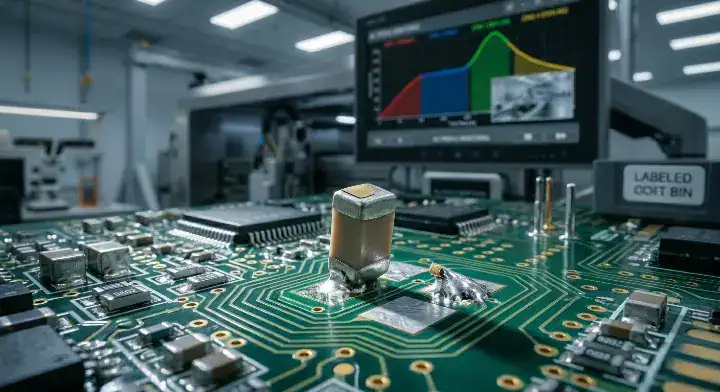
A poor thermal process can contribute to tombstoning, voiding and incomplete wetting, but a defect photograph does not establish the cause. Paste deposit, placement, land geometry, surface condition and the thermal history can interact.
For a quick-turn assembly run, retain the first-article profile and inspection results so that later recipe changes can be compared with a known build. Separate a repeatable defect at one location from a problem appearing throughout the assembly.
Tombstoning involves unequal wetting forces at the two terminations. AIM’s SMT Troubleshooting Guide, tombstoning section lists paste-volume or wetting imbalance, component misplacement and thermal imbalance as separate causes to investigate. Measure the relevant pad temperatures and check the print and placement before choosing a corrective action.
| Observed issue | Possible contributors | Check before changing the profile | Verify the trial |
|---|---|---|---|
| Tombstoning | Unequal wetting, paste volume, placement or thermal imbalance | Pad-level traces, print deposits and component position | Repeat the same location checks after a controlled change |
| Voiding | Paste chemistry, deposits, geometry and thermal history | X-ray result, process records and applicable criteria | Compare the same joint type and measurement method |
| Bridging | Excess paste, print/placement or process mismatch | Stencil deposits and placement before blaming cooling | Inspect bridges and any new open-joint problems |
| Poor wetting / incomplete joint | Surface condition, flux activity or inadequate local exposure | Solderability and the measured joint location | Confirm wetting and the agreed acceptance requirements |
A dull SAC solder joint is not automatically a cold joint: alloy appearance differs from SnPb. Confirm wetting and the applicable acceptance criteria instead of increasing temperature solely because the joint looks less shiny.
5. How Do You Set the Right Preheat Ramp Rate?
Set the preheat ramp from the selected paste’s processing guidance and the components’ limits. Define whether the specified ramp is an average over an interval or the maximum local rising slope; those measurements answer different questions.
An aggressive rise can contribute to rapid volatile release and solder spatter. If spatter appears, also check paste condition and storage, stencil deposits and the delay before reflow. Change the ramp within the qualified window and inspect the result rather than assuming a single rate explains every occurrence.
- Identify the paste product, alloy, board revision and the observed spatter locations.
- Verify the relevant rising slopes and sensor attachments on the measured profile.
- Trial one controlled adjustment, then compare profile and inspection records before release.
6. How Do Soak Time and Temperature Affect Tombstoning?
A soak can help a thermally uneven assembly, but its duration is a process variable. Indium’s Profiling Basics – Reflow Phases describes soak as an option when needed to reduce temperature differences and notes that its effect on voiding depends on solder chemistry. A soak is not a guarantee against tombstoning.
A small termination and a pad tied into substantial copper can heat differently. Check their measured traces through the wetting interval, along with paste volume, placement and solderability. Extending the soak is worth testing only when the paste supports it and the measurements identify a thermal imbalance.
A useful process-trial record separates the starting condition, the changed setting and the measured outcome:
- Baseline: retain the measured curve, print/placement checks and observed defect locations.
- Candidate: change a defined recipe variable while holding other relevant process inputs constant.
- Verification: remeasure the assembly and inspect the same joint locations against the agreed criteria.
7. How Do You Optimize Peak Temperature and Time Above Liquidus?
Select a peak and TAL window that meets the paste’s requirements without exceeding component exposure limits. For context, Indium’s process primer describes 30–90 seconds above liquidus as common; the actual acceptance window must come from the selected materials and process. State the calculation threshold: time above 217°C and time above 221°C are different measurements even on the same recorded curve.
Treat a voiding result as a measured joint condition, not proof that the peak or TAL must increase. Review paste chemistry, deposit, surface finish, package geometry and the thermal profile together. Agree the applicable IPC-A-610 class, package-specific criteria and customer requirements before accepting the build; do not apply one percentage to every joint type.
Compare the coldest relevant solder location against the lower process limits and the hottest sensitive component against its upper exposure limits. If the two requirements do not overlap, changing the recipe alone may be insufficient; the assembly, paste, fixture or heating arrangement needs review.
Confirm any adjustment with another measured profile and joint inspection. A particular peak such as 245°C can be a trial setting within an approved window, but it is not an automatic cure for voids, and 250°C is not a universal boundary at which every PCB permanently warps.
8. How Should You Profile a Mixed-Component Board?
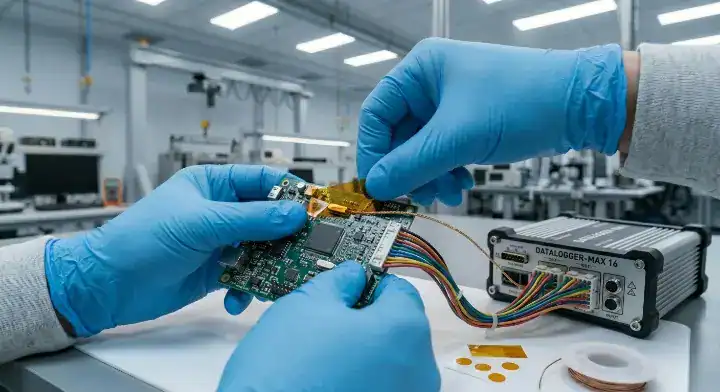
Mixed-component boards need measurements across the assembly’s thermal range. A large component or copper-rich area may heat more slowly than an exposed small part, so increasing peak heat can solve one location while pushing another beyond its limit.
Start with the cold location and the heat-sensitive location on the same run. Check local peak, TAL and the relevant slopes at both. Look at conveyor speed, top/bottom balance, loading and fixtures before deciding which setting to change.
A multi-zone oven offers adjustment options, but no fixed zone count proves that a board can or cannot be processed. Judge the actual equipment by the measured process window under representative loading.
- Map a high-mass location, a low-mass location and any heat-sensitive part before the run.
- Record each location’s peak, TAL and relevant ramp/cooling measurements.
- Review the local margin to its limits; repeat the measurement after a controlled adjustment.
Engineering check: if a cold joint misses the lower TAL limit while a nearby sensitive part is already near its upper limit, a blanket temperature increase is a poor first experiment. Compare the local heat transfer and loading, then trial a controlled change and verify both locations.
9. What Tools Do You Need for Thermal Profiling?
Use a profiler and thermocouples suited to the process temperature and the assembly. Choose the channel count from the locations that need verification: high thermal mass, low thermal mass, heat-sensitive parts and suspected defect sites.
The sensor attachment must measure the intended pad, joint or package location rather than oven air. KIC’s thermocouple-attachment application note recommends representative populated boards and sampling the hot and cold areas; it also explains how attachment failure can invalidate a trace. Record a location photograph or channel map with each run.
| Profile record | What to retain | Why it matters | Release check |
|---|---|---|---|
| Product and materials | Assembly revision; paste product/alloy; fixture/loading | Makes the record specific to the build | Matches the intended production setup |
| Measurement map | Channel names and physical attachment locations | Makes each trace interpretable | Covers critical thermal extremes |
| Measured values | Peak; TAL threshold/time; slopes; relevant temperature spread | Allows comparison with stated limits | Each monitored location meets its applicable window |
| Trial and inspection | Changed settings and joint-inspection results | Separates the intervention from its outcome | No unverified improvement or yield claim |
Save the raw traces as well as the software’s pass/fail report. A channel label such as “TC3” is useful only when another engineer can identify its physical location and the limit being checked.
The record below makes a profile repeatable without relying on equipment price as a proxy for capability.
How Can We Help with a Measured Reflow Profile?
A profile is ready for production when the measured locations meet the approved window under representative conditions and the inspected joints meet the agreed criteria. Keep the recipe, board revision, paste identification and inspection result together so the next build can be compared with the same baseline.
QueenEMS supports SMT assembly with 3D AOI and X-ray inspection. For a profiling discussion, provide the BOM and assembly files, the exact solder-paste product and alloy, component thermal restrictions and any existing measured traces. Those inputs allow the process and inspection requirements to be reviewed for the actual build.
Contact us with the assembly revision, target quantity and the defect locations you want investigated. Include profile files and inspection images when available so the review starts with the measured problem.
Written by the QueenEMS Engineering Team
FAQ
1. Does a lead-free profile take longer than a traditional leaded profile? Not necessarily. Cycle time depends on the paste, assembly and equipment. The higher processing temperature of many SAC builds does not establish a fixed extra number of seconds; compare qualified measured profiles for the actual products.
2. Can I use a generic oven profile if my board only has standard SMD components? Only as a starting recipe for verification. Copper distribution, component mass, paste and production loading still affect the temperatures at the joints. Verify representative locations before using that recipe for production.
3. Will adding nitrogen gas to the reflow oven fix a bad temperature profile? No. Atmosphere and the temperature-time curve are separate process variables. Nitrogen may affect wetting and oxidation for the selected paste, but the assembly still has to satisfy its measured thermal window.
Upload your files today · Free DFM check before production · Ship worldwide
Get your PCB prototypes in as fast as 24 hours. We handle FR4, Rogers, and hybrid boards up to 40 layers in volume production, with advanced builds subject to engineering review — free prototypes for 2–4 layer FR-4 boards, no minimum order.
Just upload your Gerber + BOM — we source every part, assemble, and inspect (AOI + X‑Ray) so you don't have to chase suppliers. Boards ship in as fast as 24 hours.