
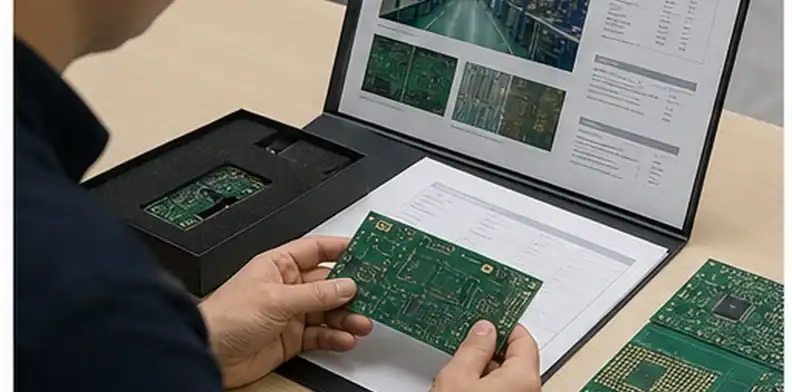
Quick Answer: PCB supplier evaluation for Mexico should score build fit, evidence, communication, delivery terms, and repeat-production control before price is compared. A supplier that can quote quickly is not automatically qualified for Mexico-bound industrial, automotive, energy, or electronics builds. The safer review asks what the supplier can prove before shipment and what assumptions would change landed cost or schedule.
Key takeaways – Evaluate the supplier, not only the quoted PCB price. – Keep capability, quality evidence, and Mexico delivery terms in separate score fields. – Ask for repeat-order controls before the first pilot is approved. – Reject vague answers that cannot be tied to files, reports, or Incoterms.
PCB supplier evaluation for Mexico is different from asking for a fast quote. A quote checks whether one board can be priced. Supplier evaluation checks whether the same partner can build the right revision, prove quality before export, communicate clearly across languages and time zones, and repeat the result after the pilot build.
This page is the supplier-selection companion to the Mexico RFQ page. For quote fields and file preparation, use QueenEMS’ PCB quote for Mexico buyers. Here, the focus is whether the supplier deserves the order.
Table of Contents
- What should Mexico buyers evaluate first?
- How do you score technical build fit?
- Which quality evidence matters before shipment?
- How should communication be tested?
- What delivery and Incoterm answers should be checked?
- How do you verify repeat-production control?
- When should a low quote be rejected?
- What scorecard should purchasing use?
What should Mexico buyers evaluate first?
Mexico buyers should evaluate whether the supplier can build the exact PCB requirement, not whether the supplier has a broad capability list. A factory may advertise multilayer boards, HDI, impedance, heavy copper, and special finishes, yet still be a poor fit for a specific stackup, material, tolerance, or evidence requirement.
Start with the product risk. A board for industrial controls, EV charging, medical equipment, or telecom hardware may need different inspection records and delivery planning than a simple prototype. Put the risk into the evaluation before looking at price.
The first supplier answer should name the files reviewed, the assumed revision, and the technical limits that need confirmation. A reply that only says “we can do it” is not enough for a Mexico-bound production order.
How do you score technical build fit?
Technical build fit should be scored against the actual board: layer count, material, finished thickness, copper weight, smallest drill, line/space, impedance, surface finish, solder mask clearance, slots, edge plating, via type, and panel needs. Each item should be marked as standard, review-required, or not recommended.
The useful question is not “Can you make PCBs?” It is “Can you build this revision under these drawing notes without changing the stackup, material, or acceptance rule?” If the supplier needs to change a requirement, the answer should return as a proposed deviation for engineering approval.
For high-speed or RF boards, include the stackup and controlled-net table. For power boards, include copper, thermal, and clearance requirements. For assembly-linked projects, confirm whether the bare-board supplier understands the later PCBA process.
Which quality evidence matters before shipment?
Quality evidence should match the board risk and the receiving process in Mexico. Common records include electrical test confirmation, final inspection report, impedance report, microsection when required, material certificate or laminate statement, solderability evidence, packing photos, and certificate of conformance.
A useful supplier can say which evidence is included, which evidence costs extra, and which evidence must be planned before fabrication. For example, impedance coupons and microsections may need panel planning. Asking for them after production can leave a documentation gap.
Do not require every possible report for every order. That creates cost without clarity. Instead, define the evidence that receiving, engineering, or the end customer will actually use to accept the lot.
How should communication be tested?
Communication should be tested before the purchase order by sending a real technical question and checking the answer quality. A strong supplier identifies the file, feature, risk, and proposed action. A weak supplier replies with general assurances.
For Mexico teams, bilingual handoff may matter even when the business language is English. The RFQ should use clean units, controlled file names, and short approval sentences. Avoid relying on voice calls for technical changes. Put accepted answers back into the drawing note, PO note, or revision folder.
Fast communication is useful only when it is precise. A same-day response that hides material substitution, delivery assumption, or geometry change is not a qualified response.
What delivery and Incoterm answers should be checked?
Delivery review should separate manufacturing lead time from export handling, freight, customs responsibility, and delivery to the Mexico destination. A supplier quoting EXW, FOB, DAP, or DDP may be describing very different buyer responsibilities.
Ask the supplier to state the destination city, Incoterm, freight method, shipment documents, packing method, and who is responsible for import clearance and tax handling. The buyer may not need the supplier to solve every customs question, but the quote should not hide the boundary.
For commercial comparison, use QueenEMS’ DDP vs DAP PCB shipping article after the technical evaluation has narrowed the supplier list.
How do you verify repeat-production control?
Repeat-production control verifies whether the supplier can build revision B the same way they built the approved pilot. This is especially important when the first lot required CAM adjustment, material approval, special packing, or customer inspection evidence.
Ask how the supplier records approved stackup, material, surface finish, impedance, panelization, test rules, and customer deviations. The next RFQ should not restart from memory or a sales email. It should reuse the controlled production baseline.
The buyer should also define what triggers reapproval. Material substitution, copper change, surface finish change, drill structure change, or supplier process change may require engineering review even if the board outline and BOM are unchanged.
When should a low quote be rejected?
A low quote should be rejected when it depends on unclear assumptions that affect quality, delivery, or repeatability. Common warning signs include missing stackup, no material rule, no statement about test evidence, unexplained delivery terms, silence on controlled impedance, or a refusal to document deviations.
Low price is useful only after scope is equal. A supplier that excludes reports, assumes alternate material, or leaves import terms open may not be cheaper after the order is released. The buyer should ask for the assumption list before treating the quote as comparable.
Rejecting a quote does not mean rejecting the supplier forever. It means the supplier has not yet provided enough evidence for this project stage.
What scorecard should purchasing use?
Use a simple scorecard that separates technical, quality, delivery, and communication risk. Do not collapse everything into price.
| Score field | What good looks like | Hold trigger |
|---|---|---|
| Build fit | Board-specific capability answer | Generic capability list only |
| Quality evidence | Included reports are named | Evidence discussed after shipment |
| Mexico delivery | Incoterm and destination stated | Freight boundary unclear |
| Communication | Technical answers cite files | Sales assurance without details |
| Repeat control | Approved build baseline retained | Reorders rely on email memory |
| Price | Scope and assumptions are visible | Low price with hidden exclusions |
For supplier evaluation, send QueenEMS the Gerber or ODB++, drawing, stackup, quantity, target destination in Mexico, required evidence, and supplier responses. We can help classify the supplier as quote-ready, review-required, or too risky for the current order.
FAQ
Is a capability list enough for Mexico PCB supplier evaluation?
No. A capability list is only a starting point. The supplier must connect capability to the actual board files, quality evidence, and Mexico delivery requirement.
Should Mexico buyers always choose the lowest PCB quote?
No. The lowest quote should win only when the scope, evidence, delivery terms, and repeat-control assumptions are comparable.
What is the most useful supplier test before a pilot order?
Send one real CAM or quality question and review whether the supplier answers with a file-based technical response rather than a generic promise.
Can QueenEMS help compare supplier responses?
Yes. Send the supplier replies, quote assumptions, board files, and required evidence so the evaluation can be scored against the actual project.
Written by the QueenEMS Engineering Team
Upload your files today · Free DFM check before production · Ship worldwide
Get your PCB prototypes in as fast as 24 hours. We handle FR4, Rogers, and Flex up to 60 layers — free prototypes for 2–4 layer boards, no minimum order.
Just upload your Gerber + BOM — we source every part, assemble, and inspect (AOI + X‑Ray) so you don't have to chase suppliers. Boards ship in as fast as 24 hours.