
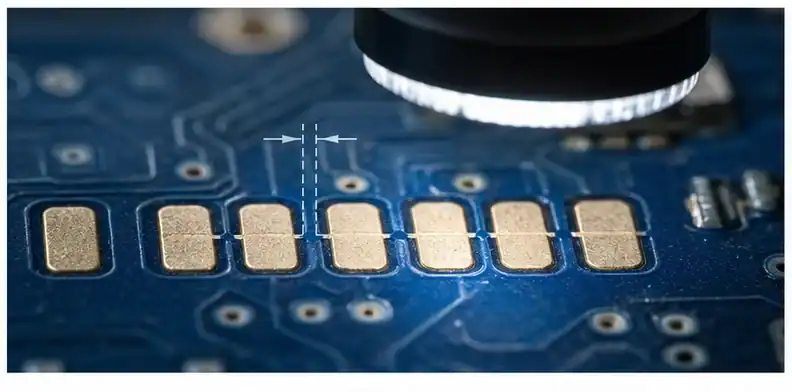
Quick Answer: Decision: minimum mask-web decision. Controlled object: a DFM map of adjacent apertures showing where a printable web remains and where openings must merge. Design-owned boundary: locations where a mask dam is functionally required, BGA and fine-pitch exceptions, mask color, and assembly-process constraints. Supplier discretion: merging selected same-footprint openings after engineering and assembly confirm that the web is not required. Stop rule: a required dam below the demonstrated process window, an unapproved gang opening, or mask color changing the available margin.
Mask bridge RFQ path
- When does a solder mask bridge need special review?
- What should the RFQ files show for mask bridges?
- How should buyers handle DFM warnings about mask webs?
- Which inspection evidence is worth requesting?
- How should buyers compare quotes with different mask assumptions?
- What should a clean solder mask bridge RFQ include?
When does a solder mask bridge need special review?
A solder mask bridge needs special review when the web between two exposed pads is narrow enough that registration, solder mask process limits, or assembly paste behavior could remove the barrier. The buyer should treat it as a manufacturability and assembly-risk item, not as a simple color or cosmetic preference.
SERP and AI-style answers often reduce this topic to a minimum solder mask web number such as 4-5 mil or about 0.1 mm. Use those numbers only as a review trigger, not as a universal purchase rule, because mask color, copper thickness, imaging process, registration tolerance, pad pitch, and assembly method can change what the supplier can hold. For RFQ work, the safer question is whether the supplier will keep a mask web, open the area as one gang opening, or ask the design owner to approve a land-pattern change.
- Fine-pitch ICs, dense connectors, and small passive arrays carry the highest risk.
- The useful question is whether a reliable mask web can remain after fabrication tolerance.
- Assembly risk rises when missing mask changes solder volume control between adjacent pads.
| Situation | Buyer decision |
|---|---|
| Fine-pitch pad rows | Ask whether mask-defined separation is manufacturable |
| Prototype only | Allow lighter evidence if assembly risk is accepted |
| Production PCBA | Confirm mask registration and assembly review together |
Bottom line: Review the bridge when its loss could change solder behavior, not only when the drawing looks crowded.
What should the RFQ files show for mask bridges?
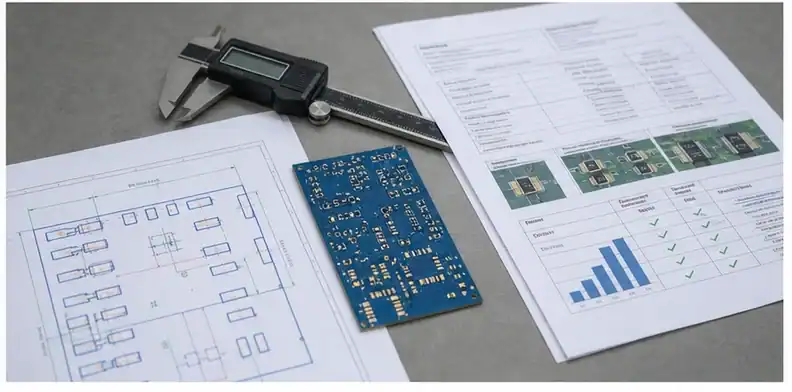
The RFQ should show solder mask openings, copper pads, minimum spacing, component pitch, finish, and the assembly process that will use the pads. A supplier can review the mask bridge only when the Gerber or ODB++ mask layer, copper layer, and assembly context are all visible.
- Send the mask layer as released data, not a screenshot.
- Flag critical components where solder bridging would create a real failure.
- Include paste and assembly assumptions when QueenEMS also reviews PCBA.
| RFQ input | Why it matters |
|---|---|
| Mask Gerber / ODB++ | Shows actual opening and web geometry |
| Copper layer | Shows whether the mask bridge has enough support |
| Assembly drawing | Shows which parts make the bridge critical |
Bottom line: A mask bridge review is only useful when PCB data and assembly intent are checked together.

How should buyers handle DFM warnings about mask webs?
A DFM warning about a mask web should be handled as a decision, not an automatic approval. The buyer should ask whether the issue affects solder bridging, cosmetic acceptance, solder mask slivers, registration yield, or only a conservative factory rule.
- A supplier may ask to remove the bridge, enlarge openings, or change pad definition.
- Engineering should approve changes that alter solder joint behavior.
- Purchasing should keep the approved assumption with the quote record.
| DFM warning | Action before approval |
|---|---|
| Mask web too narrow | Ask whether bridge can remain or should be removed |
| Opening expansion requested | Check solder volume and short risk |
| Different supplier rules | Compare assumptions before comparing price |
Bottom line: Do not approve a mask change until the assembly effect is clear.
Which inspection evidence is worth requesting?
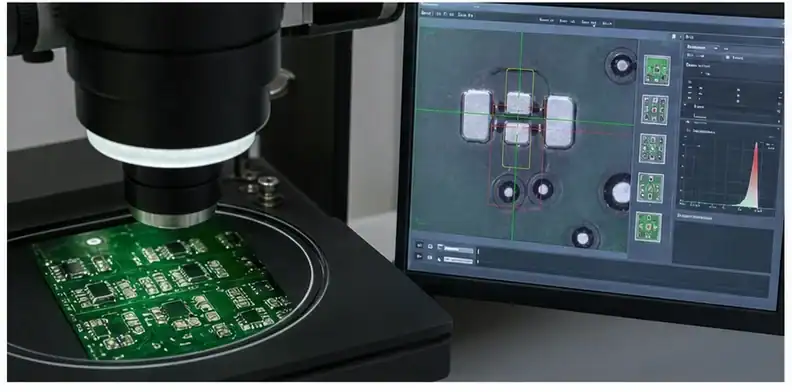
Evidence should match the risk level. A prototype may need a clear photo of the critical pad row, while production PCBA may need first-article review, AOI feedback, or a supplier note confirming how the mask bridge was treated.
- Ask for evidence around named critical components, not every pad on the board.
- Use photo evidence when the buyer needs a fast visual decision.
- Use assembly feedback when solder bridging is the real concern.
| Risk level | Useful evidence |
|---|---|
| Low-risk prototype | Photo of the critical region |
| Fine-pitch production | First-article mask and assembly review |
| Customer acceptance risk | Outgoing inspection note tied to the drawing |
Bottom line: The best evidence proves the bridge decision at the pads that can actually fail.
How should buyers compare quotes with different mask assumptions?
Quotes should be compared by the accepted mask-opening rule, critical component risk, evidence level, and whether PCBA support is included. A cheaper quote may simply assume bridge removal or looser mask control, which can move risk from fabrication into assembly.
- Ask each supplier to restate the mask assumption in writing.
- Separate price differences from evidence and review differences.
- Keep DFM decisions in the purchase record for reorder control.
| Quote difference | Buyer interpretation |
|---|---|
| Lower price, no evidence | May be fine for low-risk bare boards |
| Higher price with review | May protect fine-pitch assembly yield |
| Bridge removed silently | Needs engineering approval before release |
Bottom line: Compare the assumption, not just the line-item price.
What should a clean solder mask bridge RFQ include?
A clean RFQ includes controlled PCB data, critical component list, solder mask layer, copper layer, surface finish, assembly plan, acceptable DFM change path, and the evidence request. That package lets QueenEMS quote the real requirement instead of guessing how strict the buyer wants the mask web controlled.
- Mark the critical pads or components that need special attention.
- State who can approve mask-opening changes after DFM.
- Keep the final decision with the released fabrication files.
| RFQ item | Include it when |
|---|---|
| Critical component list | Fine pitch or high failure cost exists |
| PCBA files | Assembly behavior is part of the risk |
| Evidence request | Shipment acceptance depends on mask condition |
Bottom line: The RFQ should tell the supplier which mask bridges are product risks and who can approve a change.
What should the buyer record before release?
For solder mask bridge decisions, the record should identify the critical component rows or pad groups rather than applying one rule to the whole board. A supplier may be able to keep mask webbing in one region and remove it in another. Naming the critical areas prevents a broad CAM edit from changing solder behavior where the assembly team most needs control.
The buyer should also record whether the risk is fabrication appearance or PCBA yield. A missing mask bridge may be acceptable on a low-risk connector but unacceptable between fine-pitch pads where solder paste can join adjacent leads. That distinction helps QueenEMS decide whether bare-board evidence, assembly review, or both should be quoted.
Production record for the minimum mask-web decision
Controlled object
Controlled object: a DFM map of adjacent apertures showing where a printable web remains and where openings must merge.
Failure boundary
Failure boundary: missing mask dams, unstable slivers, solder bridging, distorted deposits, or a false promise that CAM cannot print repeatedly.
Design-owned conditions
Design-owned conditions: locations where a mask dam is functionally required, BGA and fine-pitch exceptions, mask color, and assembly-process constraints.
Supplier discretion
Supplier discretion: merging selected same-footprint openings after engineering and assembly confirm that the web is not required.
Required proof
Required proof: the final aperture map, identified merged openings, supplier web capability, and first-article inspection at the tightest pitch.
Production stop
Production stop: a required dam below the demonstrated process window, an unapproved gang opening, or mask color changing the available margin.
Repeat-order baseline
Repeat-order baseline: the approved merge map, ink system or color, tightest web locations, first-lot evidence, and stencil interaction notes.
RFQ inputs
RFQ inputs: mask and copper data, assembly drawings, critical footprints, stencil assumptions, selected color, quantity, and explicit merge authority.
FAQ
Can the supplier decide the minimum mask-web decision?
Discretion for minimum mask-web decision: merging selected same-footprint openings after engineering and assembly confirm that the web is not required. Engineering control for minimum mask-web decision: locations where a mask dam is functionally required, BGA and fine-pitch exceptions, mask color, and assembly-process constraints.
What stops this minimum mask-web decision?
Stop rule for minimum mask-web decision: a required dam below the demonstrated process window, an unapproved gang opening, or mask color changing the available margin. Disposition owner for minimum mask-web decision: the named engineering approver.
Which proof closes the minimum mask-web decision?
Evidence for minimum mask-web decision: the final aperture map, identified merged openings, supplier web capability, and first-article inspection at the tightest pitch. Revision link for minimum mask-web decision: the quoted dataset.
What survives into the next order?
Reorder baseline for minimum mask-web decision: the approved merge map, ink system or color, tightest web locations, first-lot evidence, and stencil interaction notes.
For a focused minimum mask-web decision, send QueenEMS mask and copper data, assembly drawings, critical footprints, stencil assumptions, selected color, quantity, and explicit merge authority. Redline request: minimum mask-web decision. Open assumptions: minimum mask-web decision. Approver: minimum mask-web decision owner.
Written by the QueenEMS Engineering Team
Sources
Upload your files today · Free DFM check before production · Ship worldwide
Get your PCB prototypes in as fast as 24 hours. We handle FR4, Rogers, and Flex up to 60 layers — free prototypes for 2–4 layer boards, no minimum order.
Just upload your Gerber + BOM — we source every part, assemble, and inspect (AOI + X‑Ray) so you don't have to chase suppliers. Boards ship in as fast as 24 hours.