
Quick Answer: Solder wick is flux-coated copper braid that removes molten solder by capillary action, but it only works safely when the braid width, flux chemistry, iron tip, heat time, and lift motion match the PCB pad. In production rework, a good solder wick process should protect pads, limit thermal exposure, verify cleaning needs, and leave inspection evidence before the board is released.
Key takeaways:
- Solder wick is best for flat pad cleanup, solder bridges, and controlled SMD rework, not for every component-removal problem.
- Pad lifting usually comes from too much force, too much dwell time, weak flux, oversized braid, or lifting the wick after the solder freezes.
- Lead-free joints and heavy copper areas need more thermal planning than simple hobby tutorials suggest.
- Buyers should ask for rework location, method, inspection evidence, and any cleaning or test records before accepting a repaired lot.
Solder wick looks simple, but a careless pull can turn a repairable PCB into scrap. The same copper braid that cleans a fine-pitch bridge can also lift pads, scratch solder mask, contaminate a no-clean process, or hide a weak rework record if the supplier treats it as a quick touch-up.
For engineering and purchasing teams, the real question is not only “how do I use solder wick?” It is “how do I know the rework was controlled well enough to ship?” This guide explains the technique, the limits, and the evidence QueenEMS buyers should request when solder wick is used during PCB assembly rework.
Table of Contents
- What Is Solder Wick Used For?
- How Do You Use Solder Wick Safely?
- Which Solder Wick Width Should You Choose?
- How Does Flux Type Change the Rework Risk?
- Why Does Solder Wick Fail to Absorb Solder?
- When Is a Desoldering Pump Better Than Wick?
- Can Solder Wick Be Used on SMD and BGA Pads?
- How Should Lead-Free Rework Be Controlled?
- What Inspection Should Follow Solder Wick Rework?
- What Should Buyers Ask QueenEMS to Review?
What Is Solder Wick Used For?
Solder wick is used to remove excess solder from a PCB pad, lead, bridge, or prepared land after the solder is melted. It is a braided copper strip, usually coated with flux, that pulls liquid solder into the braid through capillary action.
The best use cases are precise and local. Solder wick works well for clearing a solder bridge between fine-pitch leads, flattening SMD pads after component removal, removing excess solder from a reworked pad, and preparing a land pattern before a replacement part is installed. It is less suitable when a large plated through-hole barrel is full of solder or when a hidden package must be removed before the pads are accessible.
Buyers should care because wick use changes the condition of the pad surface. A board may look clean after rework, but too much heat, scraping, or incompatible residue can create reliability risk. That is why solder wick is a rework process, not just a hand tool.
| Use case | Wick fit | Main risk |
|---|---|---|
| Fine-pitch solder bridge | Strong | Bending leads or overheating nearby parts |
| Flat SMD pad cleanup | Strong | Pad lifting if the braid freezes to the pad |
| BGA pad leveling after removal | Conditional | Scratching pads or removing solder mask |
| Full through-hole barrel clearing | Limited | Barrel plating damage or incomplete solder removal |
| Large thermal plane solder removal | Limited | Excessive dwell time and board overheating |
If the issue is part of a wider defect trend, use solder wick records together with a broader PCBA rework cause review rather than treating each repair as an isolated event.
How Do You Use Solder Wick Safely?
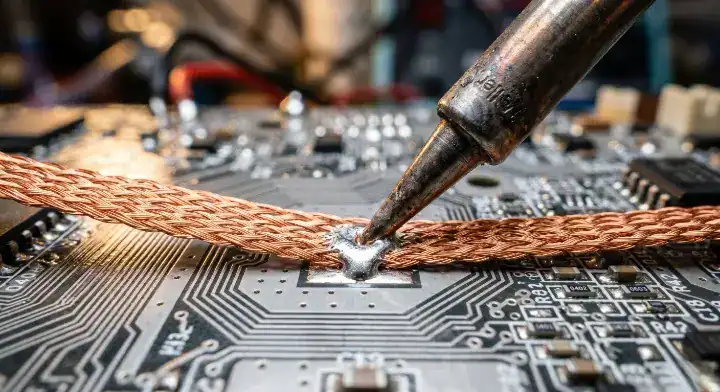
Use solder wick safely by placing the braid on the solder, placing a clean tinned iron tip on top of the braid, waiting only until solder visibly flows into the copper, and lifting the iron and braid together before the solder freezes. The motion matters as much as the temperature.
Do not drag dry braid across pads. Dragging can scratch solder mask, especially on OSP finishes or fine BGA land patterns. Do not press harder when the solder does not move. Pressure rarely solves a wetting or thermal-transfer problem; it usually increases pad damage risk.
A safer sequence is:
- Add flux if the joint is oxidized or slow to wet.
- Choose a braid width close to the pad or bridge width.
- Tin and clean the iron tip so heat transfers quickly.
- Place braid on the target solder, then the iron on the braid.
- Watch for solder flow into the braid.
- Lift the braid and iron together.
- Cut off the saturated braid before the next touch.
For production work, record which reference designators were reworked and how the result was verified. “Touched up by operator” is not enough for a buyer who needs release confidence.
Which Solder Wick Width Should You Choose?
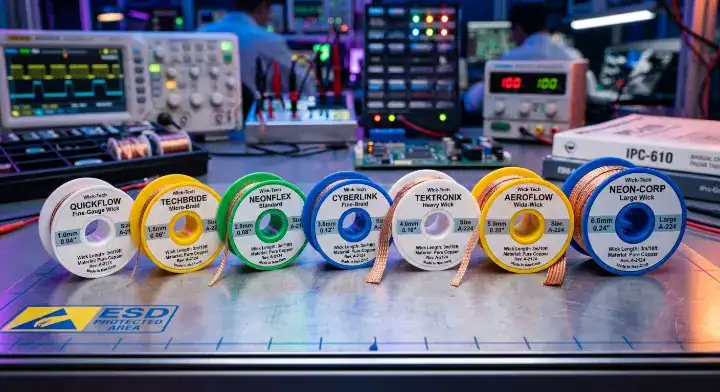
Choose a solder wick width that is close to the solder area you need to remove. A braid that is too narrow forces repeated passes and longer heat exposure. A braid that is too wide can pull heat away from the joint, contact neighboring features, or remove more solder than intended.
For fine-pitch IC leads and small chip components, narrow braid gives control. For large pads, shields, connectors, or BGA land cleanup after package removal, wider braid may be appropriate, but the technician needs a tip with enough thermal mass to heat the braid evenly. The pad, not the spool label, should drive the choice.
| Target area | Better braid choice | Why |
|---|---|---|
| 0402/0603 chip pads | Narrow | Limits heat and contact area |
| Fine-pitch IC bridge | Narrow, pointed end | Fits between leads without flooding adjacent pins |
| SOIC/QFP pad cleanup | Medium | Balances control and solder volume |
| Connector lug or large pad | Wider | Removes more solder per touch |
| BGA land leveling | Medium to wide with strong flux control | Levels pads after package removal, not before |
When a supplier cannot explain the width and tip choice, the repair may depend too much on operator habit. That creates inconsistent results across lots, shifts, and board revisions.
How Does Flux Type Change the Rework Risk?
Flux type changes how quickly solder wets the braid and what residue remains after rework. Rosin, no-clean, water-soluble, and unfluxed braid can all be useful, but they should match the assembly process and cleaning plan.
Rosin or activated flux can improve wicking on oxidized joints, but it may require cleaning. No-clean braid is convenient, but “no-clean” does not mean residue is always irrelevant; conformal coating, high-impedance circuits, RF areas, and customer cleanliness requirements may still require review. Unfluxed braid gives process engineers more control when a specific liquid flux is required.
For a full flux chemistry decision, use the QueenEMS guide to choosing flux in soldering. In this article, the main rule is simpler: do not mix flux families casually during repair.
| Wick flux type | Advantage | Buyer question |
|---|---|---|
| Rosin/RMA | Strong wetting on oxidized solder | Was residue cleaned and verified? |
| No-clean | Faster release for many assemblies | Is the residue acceptable for this product? |
| Water-soluble | Strong activity with planned wash | Was washing completed before release? |
| Unfluxed | Uses a controlled external flux | Which flux was applied and why? |
Why Does Solder Wick Fail to Absorb Solder?
Solder wick usually fails because heat, flux, or surface condition is wrong. The braid may be oxidized, the flux may be exhausted, the iron tip may be too small, the temperature may be too low for the alloy, or the PCB area may be connected to heavy copper that drains heat away.
The first fix is not more force. Add fresh flux, clean and tin the iron tip, cut off used braid, and check whether a wider tip is needed. For stubborn lead-free joints, adding a small amount of fresh solder can improve heat transfer and bring active flux to the joint, but the repaired area still needs inspection.
Common failure signals:
| Symptom | Likely cause | Safer correction |
|---|---|---|
| Braid darkens but solder stays put | Oxidized braid or weak flux | Cut used/old section; add compatible flux |
| Solder melts but does not climb | Poor thermal contact | Clean/tin tip; use better tip geometry |
| Pad lifts after removal | Solder froze to braid or dwell was too long | Lift iron and braid together; shorten heat time |
| Nearby parts shift | Braid too wide or heat spread too far | Use narrower braid and localized support |
| Ground pad will not clear | Heavy copper thermal mass | Preheat or use a different removal method |
If the same failure repeats on a lot, record it as process evidence. Repeated wick problems often point to thermal design, oxidized finish, paste/reflow history, or rework instruction gaps.
When Is a Desoldering Pump Better Than Wick?
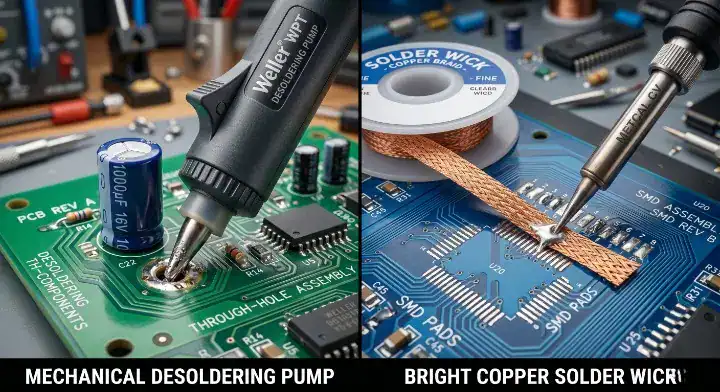
A desoldering pump is often better for removing a large volume of molten solder from a through-hole joint, while solder wick is better for flattening pads and removing small residual solder. The tools are complementary, not interchangeable.
For a plated through-hole connector, a pump can clear most solder from the barrel quickly after the joint is heated. Wick can then remove remaining surface solder if needed. For an SMD pad, a pump may be too aggressive or too imprecise, while wick can clean the land flat for replacement.
| Rework task | Preferred tool | Reason |
|---|---|---|
| Clear through-hole barrel | Pump or vacuum tool | Removes volume from inside the hole |
| Remove fine bridge | Solder wick | Precise local solder removal |
| Prepare SMD pad | Solder wick | Leaves a flatter land |
| Remove large connector | Pump plus heat control | Avoids excessive wick dwell |
| Level BGA lands after removal | Solder wick | Pads must be flat before replacement |
For high-reliability through-hole assemblies, avoid turning the wick into a scraping tool. If the barrel remains blocked, the process may need preheat, a vacuum desoldering station, or engineering review rather than repeated braid passes. The QueenEMS article on through-hole PCB assembly is a better support page for those reliability choices.
Can Solder Wick Be Used on SMD and BGA Pads?
Yes, solder wick can be used on exposed SMD pads and on BGA lands after the package has already been removed. It cannot remove solder hidden under an installed BGA because the braid cannot reach the joints.
For SMD bridges, use narrow braid, enough flux, and a light touch. For BGA land cleanup, use controlled heat and avoid dragging the braid across the pad field. BGA pads are small and easy to damage; a scratched mask or missing pad can turn a component replacement into a board-level repair.
The buyer should ask what was reworked and what the acceptance evidence shows. A BGA-related repair may need X-ray, microscope photos, or test coverage depending on the product. If the issue is BGA assembly strategy rather than post-removal pad cleanup, use QueenEMS BGA assembly support instead of expanding this article into a BGA process guide.
| Package or pad type | Wick role | Release evidence |
|---|---|---|
| Chip resistor/capacitor | Remove excess pad solder | AOI or microscope check |
| QFP/SOIC | Remove bridges or flatten pads | Visual/AOI plus functional test if needed |
| QFN/LGA | Clean exposed lands after removal | Microscope and package-specific inspection |
| BGA | Level land pattern after package removal | X-ray after replacement where required |
| High-density area | Local correction only | Rework record and adjacent-part inspection |
How Should Lead-Free Rework Be Controlled?
Lead-free rework needs more thermal control because common SAC alloys melt at higher temperatures than tin-lead solder and often need more energy to stay molten at the joint. That does not mean the technician should simply set the iron as high as possible.
The safer approach is to control the whole heat path: clean tip, suitable tip size, compatible flux, short contact time, preheat where appropriate, and immediate inspection after cleanup. Heavy copper planes, shields, connectors, and thick boards can make the local pad much colder than the iron setting suggests.
| Control item | Why it matters |
|---|---|
| Tip geometry | Transfers heat through the braid evenly |
| Flux compatibility | Restores wetting without contaminating the process |
| Contact time | Limits pad lifting and laminate stress |
| Preheat | Reduces thermal shock on heavy boards |
| Inspection | Confirms cleanup did not create a new defect |
The supplier should not claim a universal iron temperature for every board. A small consumer PCB, a thick industrial controller, and a high-copper power assembly may need different thermal tactics. The useful evidence is the controlled method and verified result, not a generic temperature number.

What Inspection Should Follow Solder Wick Rework?
Inspection after solder wick rework should verify that the pad is intact, the solder volume is suitable, nearby parts were not disturbed, flux residue is acceptable, and the electrical function still meets the test requirement. The needed evidence depends on the package and risk level.
For visible SMD pads, magnified inspection or AOI may be enough. For hidden joints after replacement, X-ray or functional test may be needed. For rework on high-reliability products, buyers may also request operator qualification, rework instruction, cleaning record, and final quality release.
| Inspection item | What it confirms |
|---|---|
| Pad adhesion and shape | No lifted pad, torn trace, or missing land |
| Solder volume | Not starved, bridged, or over-wicked |
| Residue condition | Flux residue fits cleaning/coating requirements |
| Adjacent components | No shifted, overheated, or bridged parts |
| Electrical test | Reworked circuit still performs as intended |
For broader inspection planning, compare AOI, X-ray, and ICT testing instead of relying on a single photo. A clean-looking pad is helpful, but it is not always sufficient release evidence.
What Should Buyers Ask QueenEMS to Review?
Buyers should ask QueenEMS to review the rework location, defect reason, chosen method, cleaning requirement, inspection result, and shipment-release evidence. The goal is not to ban solder wick; the goal is to make sure it was used only where it fits.
For a quote or rework review, send the PCB files, BOM, assembly drawing, component reference designators, photos of the problem, package type, acceptance class or reliability requirement, and any previous failure symptoms. If the board has heavy copper, fine-pitch packages, BGA components, conformal coating, or high-voltage/high-impedance circuits, say so before rework begins.
QueenEMS should separate three decisions:
| Decision | What to confirm |
|---|---|
| Should wick be used? | Pad geometry, solder volume, package access, thermal mass |
| How should it be controlled? | Braid width, flux type, tip size, cleaning plan |
| How should it be released? | Inspection photo, AOI/X-ray/test record, rework log |
When the issue is recurring, the best next step may be design feedback or process correction rather than more manual cleanup. For RFQ preparation, the PCB assembly RFQ checklist helps define the files and evidence needed before production starts.
Send the assembly files, photos, reference designators, and inspection requirement when requesting a QueenEMS review. That package lets the team decide whether solder wick cleanup is appropriate or whether the board needs a different rework method.
FAQ
Can solder wick damage PCB pads?
Yes. Solder wick can damage PCB pads if the braid is dragged, pressed too hard, overheated, or pulled after the solder freezes. Use compatible flux, controlled heat, and lift the braid and iron together.
Can I reuse a saturated section of solder wick?
No. Cut off the solder-filled section before the next touch because the braid will no longer pull solder effectively. Reusing saturated wick only adds heat and friction.
Is solder wick better than a solder sucker?
It depends on the joint. Solder wick is better for flat SMD pads and bridges, while a solder sucker or vacuum tool is usually better for clearing larger through-hole barrels.
Does no-clean solder wick always mean no cleaning?
No. No-clean residue may be acceptable for many assemblies, but coating, RF, high-impedance, or customer cleanliness requirements can still require cleaning review.
What should I ask a supplier after solder wick rework?
Ask which locations were reworked, why rework was needed, which flux and braid were used, how the area was inspected, and whether the board passed final test or release checks.
Sources
- DigiKey, How and When to Use Solder Wick: https://www.digikey.com/en/blog/how-and-when-to-use-solder-wick
- Chemtronics, Desoldering Braid and Solder Wick: https://www.chemtronics.com/desoldering-braid-wick
- Chemtronics, Remove Excess Solder from SMT Land with Wick: https://www.chemtronics.com/how-to-remove-excess-solder-from-smt-land-with-wick
- MG Chemicals, What is Solder Wick: https://mgchemicals.com/knowledgebase/what-is-solder-wick/
- IPC-7711/7721 table of contents reference: https://www.electronics.org/TOC/IPC-TOC-7711-21C.pdf
Written by the QueenEMS Engineering Team
Upload your files today · Free DFM check before production · Ship worldwide
Get your PCB prototypes in as fast as 24 hours. We handle FR4, Rogers, and hybrid boards up to 40 layers in volume production, with advanced builds subject to engineering review — free prototypes for 2–4 layer FR-4 boards, no minimum order.
Just upload your Gerber + BOM — we source every part, assemble, and inspect (AOI + X‑Ray) so you don't have to chase suppliers. Boards ship in as fast as 24 hours.