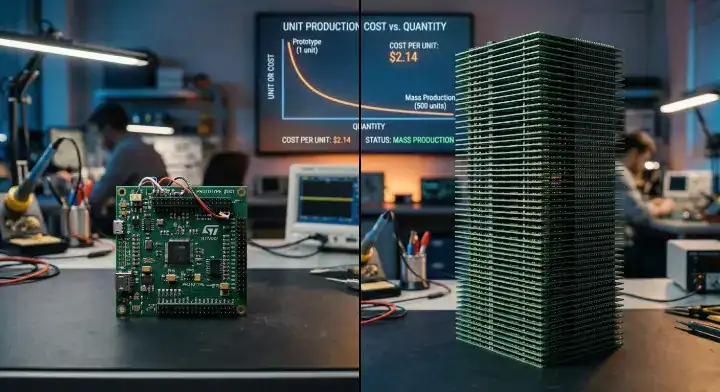
Quick Answer: The optimal PCB minimum order quantity depends entirely on how fixed setup costs (NRE) are distributed across your batch. For a standard 4-layer SMT board, ordering 5-10 prototypes costs $30 to $80 per board because NRE adds ~$40 to each unit. Scaling to 50-100 pieces drops that fixed burden below $4 per board, reducing unit prices to $20-$60. At 500+ pieces, the unit price drops to $3-$8. Key takeaways:
- 5-10 pcs (Prototype): $30 to $80 per board.
- 50-100 pcs (Small Batch): $20 to $60 per board (the 50-piece inflection point).
- 500+ pcs (Mass Production): $3 to $8 per board (NRE impact drops to $0.40/board).
- Re-ordering the exact same design saves you $100-$200 in repeated NRE and stencil fees.
Table of Contents
- Why Does Ordering 50 PCBs Cost Less Per Unit Than Ordering 5?
- What Is the Real Total Cost of a 5-Unit vs 50-Unit vs 500-Unit PCB Order?
- What Hidden Costs Will Your PCB Quote Leave Out?
- How Much Cheaper Is Your Second Order of the Same Design?
- How Does Panelization Reduce Your Per-Unit Cost?
- Should You Order 5 or 50 for Your First Batch?
- FAQ
You’ve sent your Gerber files to three assemblers and gotten three wildly different quotes. One says $800, another says $2,400, and the third hasn’t responded in a week. Sound familiar? After processing 2,400+ assembly orders last year, we’ve seen this confusion play out hundreds of times. Here’s what actually drives your pcb minimum order quantity pricing — and how to make sure you’re not overpaying.
Why Does Ordering 50 PCBs Cost Less Per Unit Than Ordering 5?
Ordering 50 PCBs costs significantly less per unit than 5 boards because fixed setup costs (NRE, stencils, machine programming) are diluted across a larger volume. If a factory charges $200 for setup, ordering 5 boards adds $40 to each board’s price, while ordering 50 boards only adds $4 per board.
To understand why a pcb minimum order quantity exists, you must understand Non-Recurring Engineering (NRE) and setup fees. Whether a factory runs one board or ten thousand boards through the SMT line, the initial preparation steps are identical. CAM engineers must process and verify your Gerber files. Photo-plotting and tooling must be prepared. SMT pick-and-place machines require programming, and reflow oven thermal profiles must be established. This entire process generates a fixed cost, typically ranging from $100 to $300.
But here’s what most guides won’t tell you… The price gap is driven by hard mathematical realities related to production setup, not factories trying to gouge you on prototypes. If you order 500 boards, that exact same $200 NRE is diluted to just $0.40 per board.
To learn more about how tooling costs are structured, you can read our guide on what NRE means and how to reduce setup costs.
What Is the Real Total Cost of a 5-Unit vs 50-Unit vs 500-Unit PCB Order?
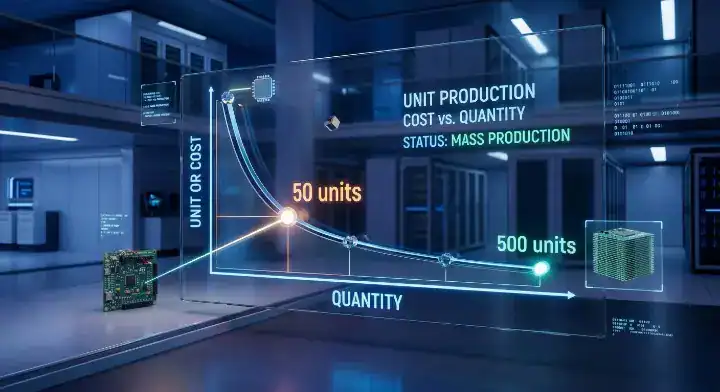
The real total cost difference between order volumes is dramatic: 5 prototype boards cost $71.00 each, a small batch of 50 boards costs $22.60 each, and a mass production run of 500 boards drops to just $4.46 each for a standard 4-layer FR4 board.
This table separates fixed setup costs from variable manufacturing costs to show exactly where your budget goes at different pcb order quantity cost breakdowns.
| Cost Component | 5 pcs (Prototype) | 50 pcs (Small Batch) | 500 pcs (Volume) |
|---|---|---|---|
| Fixed Setup Costs | |||
| NRE (Tooling & CAM) | $150.00 | $150.00 | $150.00 |
| SMT Stencil | $50.00 | $50.00 | $50.00 |
| E-Test Setup (Fixtures/Programming) | $30.00 | $30.00 | $30.00 |
| Total Fixed Costs | **$230.00** | $230.00 | $230.00 |
| Variable Costs (Per Board) | |||
| Bare Board Fab + Assembly Labor | $25.00 | $18.00 | $4.00 |
| The Final Math | |||
| Fixed Cost Distributed Per Board | **$46.00** | $4.60 | $0.46 |
| Final Unit Price | $71.00 | $22.60 | $4.46 |
Note: Component costs are excluded as they vary wildly by BOM.
Now, here’s the part that surprises most customers: 50 units represents the critical inflection point for nre cost pcb small batch production. Moving from 5 pieces to 50 pieces drops the fixed cost burden by 90%. Understanding this helps you predict your overall PCB assembly cost across your product’s lifecycle.
Need help calculating this for your specific BOM? Upload your files to our SMT assembly service page for a transparent quote within 24 hours.
What Hidden Costs Will Your PCB Quote Leave Out?
Your PCB quote might leave out hidden costs like SMT stencils ($30-$100), electrical testing fixture fees, quick-turn surcharges (+30% to 100%), and compliance reporting fees. These fixed fees heavily inflate the per-unit cost of small orders.
When calculating how many pcbs should I order, you must look beyond the per-square-inch material cost. Many engineers focus entirely on the bare board price and are shocked by the final invoice.
Here are the hidden elements factories factor into low-volume quotes:
| Hidden Fee | Typical Cost | Impact on 5 pcs | Impact on 500 pcs | Can it be avoided? |
|---|---|---|---|---|
| SMT Stencils | $30 – $100 | Adds $6 – $20/board | Adds $0.06 – $0.20/board | No, required for SMT |
| E-Test Fixtures | $50 – $200 | Adds $10 – $40/board | Adds $0.10 – $0.40/board | Use flying probe for prototypes |
| Quick-Turn Surcharge | +30% to 100% | Doubles total cost | Rarely applies to volume | Yes, plan 2-3 weeks ahead |
Here’s where it gets real: 80% of first-time customers submit BOMs without considering how these fixed fees destroy their prototype budget. We built our quoting system to separate fixed NRE from variable costs so you can clearly see the mathematical impact of your order volume.
How Much Cheaper Is Your Second Order of the Same Design?
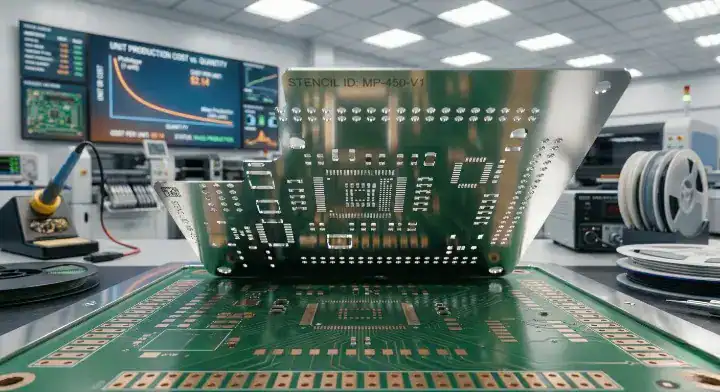
Your second order of the exact same PCB design will be significantly cheaper, often saving you $100 to $200 by eliminating repeat NRE fees and reusing your SMT stencil.
It is a common misconception that changing suppliers will automatically yield a better price. If you re-order the exact same design (no BOM or Gerber changes) from your initial manufacturer, the tooling is already paid for. Your unit price on a re-order of 5 boards will drop significantly because you are only paying the variable material and labor costs.
So what does this actually mean for your budget? Before you switch factories to save $10 on materials, remember that switching means paying those $200+ NRE fees all over again. When placing your first order, always ask your manufacturer: “Do you keep stencils and CAM programs on file, and will NRE be waived on exact re-orders?”
How Does Panelization Reduce Your Per-Unit Cost?
Panelization reduces your per-unit cost by combining multiple PCB designs onto a single manufacturing panel, allowing you to pay the $100-$300 NRE setup fee only once instead of multiple times for different projects.
If your team is working on two different sensor modules and you order 50 pieces of each separately, the factory will charge you two NRE fees (e.g., $200 x 2 = $400). By using strategic panelization, you can place both designs onto the same Gerber file. You pay the setup fee once, effectively saving $200 immediately.
The real question is: Is your factory helping you optimize your panel? At QueenEMS, we routinely combine customer sub-assemblies into single panels. You can dive deeper into this strategy in our guide on how to reduce PCB panel costs.
Should You Order 5 or 50 for Your First Batch?
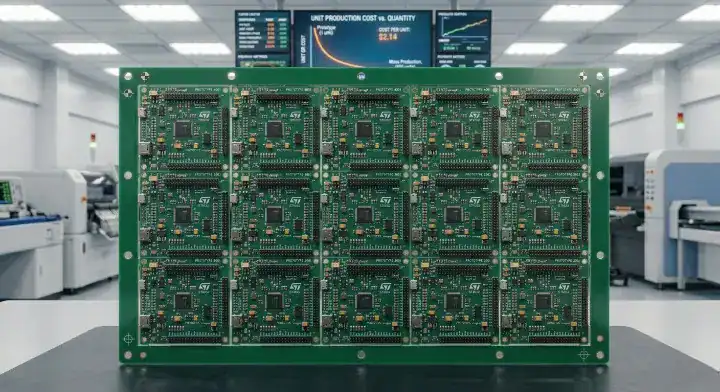
You should order 5 PCBs if you are strictly doing functional bench testing, but you should order 50 PCBs if you need to conduct EMC testing, send out sales samples, or distribute hardware to multiple software engineers.
Instead of guessing, you can use a simple formula to determine your optimal first order quantity: Optimal Quantity = (Total Fixed Costs) ÷ (Target Unit Cost Savings)
Imagine your factory quotes you $80 per board for 10 boards, and $30 per board for 50 boards. Your fixed NRE/Stencil costs are $250. If your goal is to push the fixed cost burden down to just $5 per board: *$250 ÷ $5 = 50 boards.*
| Strategy | Best For | Advantages | Risks |
|---|---|---|---|
| Order 5-10 pcs | Proof of Concept, pure functional verification. | Lowest total cash outlay. | High cost-per-board. Not enough units for full team testing. |
| Order 30-50 pcs | EVT, software dev kits, EMC lab testing, beta users. | Hits the critical cost inflection point. Cheaper per unit. | Higher upfront cost. Wasted money if a fatal flaw requires a respin. |
For most hardware startups, ordering 20-30 pieces hits the sweet spot. It provides enough boards for the development team without over-committing capital. If you need hardware fast, check out our PCB prototyping and quick-turn capabilities. We offer free 2-4 layer FR4 prototypes for new customers to eliminate early-stage barriers.
FAQ
Can I avoid the NRE fee on my first PCB order? No, NRE fees cover the necessary engineering time, CAM processing, and machine programming required to translate your digital files into physical production instructions. However, you can minimize its impact by ordering a slightly larger batch (e.g., 30-50 pieces) to dilute the cost per board. Upload your BOM today to get a transparent breakdown of your NRE vs. unit costs.
Why did my assembly cost jump when I requested a 24-hour turnaround? Fast turnarounds require factories to halt other production lines, pay overtime, and expedite component shipping. This quick-turn surcharge can add 30% to 100% to your bill. Choosing a standard 3-5 day lead time is the easiest way to cut your prototype costs. Contact us to compare pricing between standard and quick-turn lead times for your project.
Do I have to pay for a new SMT stencil if I only change one component? It depends. If the new component has the exact same footprint (e.g., swapping a 10k 0402 resistor for a 4.7k 0402 resistor), the old stencil can be reused. If the physical copper pads change, a new stencil must be laser-cut. Send our engineering team your revised Gerber files for a free DFM review to see if your tooling can be salvaged.
Written by the QueenEMS Engineering Team. Ready to build your next board? Contact us today at https://www.queenems.com/