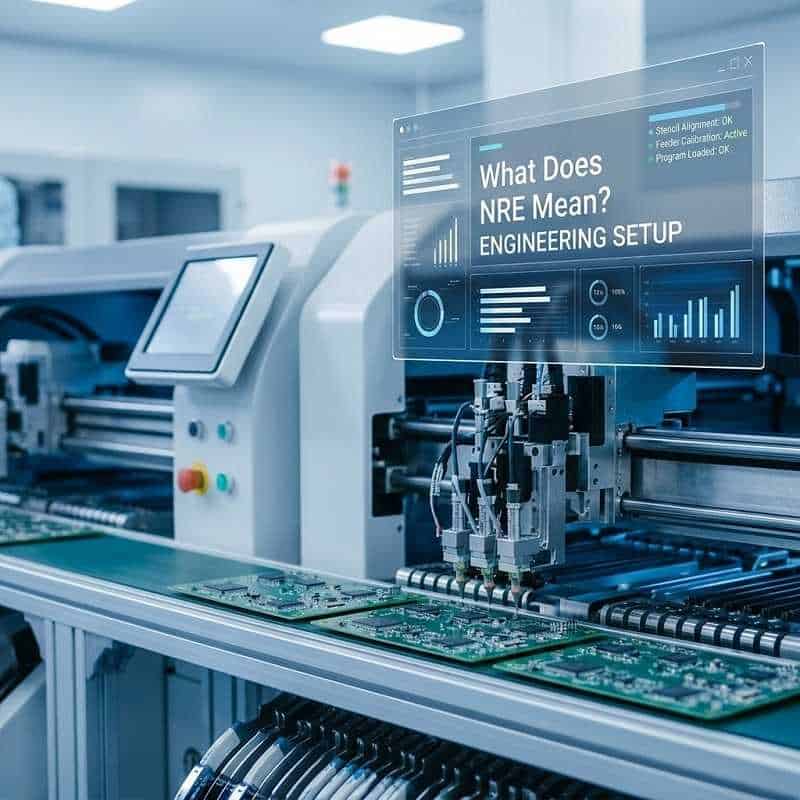
What does NRE mean is a primary question defining the initial financial hurdle in any professional electronics manufacturing project. This term refers specifically to the one-time engineering cost of setting up production lines for your unique board. These non-recurring engineering charges cover the complex transition from your digital design files to a physical, assembled circuit board. Here is the deal, understanding these fees upfront is the only way for you to avoid budget-shattering surprises during the procurement phase.
You’ve likely spent months perfecting your PCB layout, only to receive a manufacturing quote that seems significantly higher than the individual unit price you calculated. It is incredibly frustrating to see hundreds or even thousands of dollars added to a small prototype run without a clear technical explanation. This is where it gets interesting, because these fees aren’t just “extra profit” for the factory; they represent essential technical investments in your product’s quality. By mastering the components of NRE, you can optimize your designs to slash these costs and streamline your partnership with a professional pcb assembly partner.
Worried about high initial tooling costs? We waive the NRE fees for new clients.
Ready to Experience Zero-Risk Prototyping?
Claim your FREE 2-4 Layer FR4 Prototypes today!(Zero NRE Fee) Partner with QueenEMS for high-precision manufacturing and turnkey assembly services — from your first design to mass production.
1. What exactly does NRE mean in the world of PCB assembly?
What does NRE mean essentially refers to the one-time engineering labor and physical tooling required to prep a factory for your specific board design. When you ask what does NRE mean for your project, you are looking at the costs of translating Gerber data into machine instructions. Ready for the good part? Once these files and tools are created, they typically won’t be charged again for future production runs of the exact same design.
Does NRE apply to every single order?
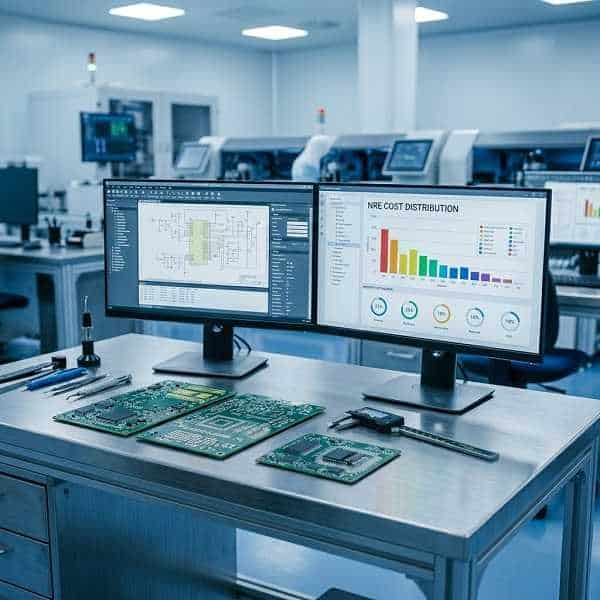
Well, it depends on whether the design has changed or if you are moving to a new manufacturer. The real story is that NRE is a “start-up” cost that ensures the high-speed robots know exactly where to place every tiny resistor. Without this engineering phase, the risk of mass-production defects would be astronomical.
- Stencil fabrication for solder paste application
- CNC programming for pick-and-place machinery
- Initial machine setup and calibration labor
- Component data verification and BOM scrubbing
Key Takeaway: NRE is an investment in manufacturing accuracy that occurs once per design revision to ensure repeatable quality.
2. Why is the SMT stencil the most common NRE charge?
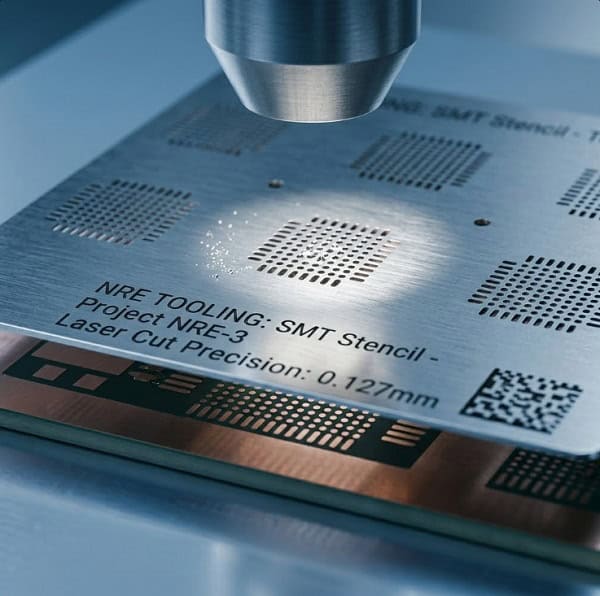
What does NRE mean when looking at a quote often starts with the laser-cut stainless steel foil known as a solder paste stencil. Understanding what does NRE mean in this context is vital because the stencil is the physical template for your entire assembly process. But here’s the kicker, even the smallest change to a single component pad requires a completely new stencil to be manufactured.
Can you use the same stencil for different boards?
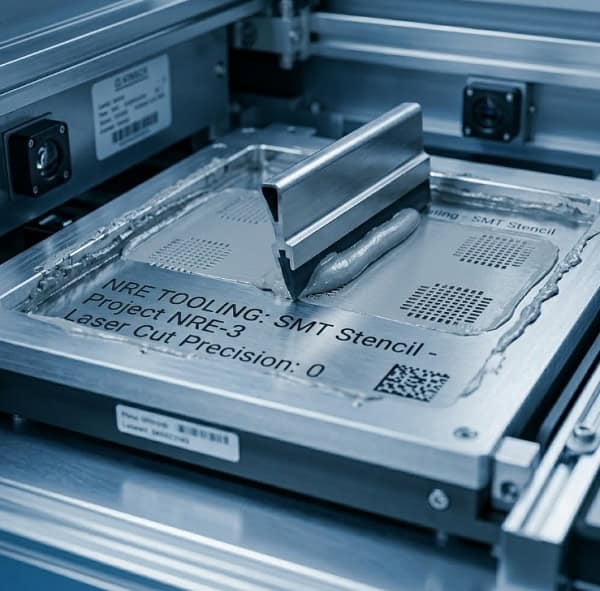
Typically no, because the stencil is a 1:1 map of your specific PCB’s top and bottom copper layers. You might be wondering if there are ways to save here, such as panelizing multiple designs onto one larger frame. This is a common strategy used in pcb prototyping and quick turn services to keep costs manageable for startups.
- Laser-cut precision for fine-pitch components
- Framed vs. frameless stencil options for different volumes
- Electropolishing treatments for better paste release
- Nano-coatings to reduce cleaning frequency
Key Takeaway: The stencil is a physical tool unique to your board; choosing frameless options for prototypes can reduce initial NRE.
3. How does machine programming factor into your NRE fees?
What does NRE mean in terms of labor usually boils down to the hours an engineer spends writing code for the assembly line. When analyzing what does NRE mean, you must account for the time needed to map your Bill of Materials (BOM) to the factory’s internal part numbers. Believe it or not, the complexity of your component list directly dictates how many hours of programming are required before the first board can be made.
Why is BGA assembly more expensive for NRE?
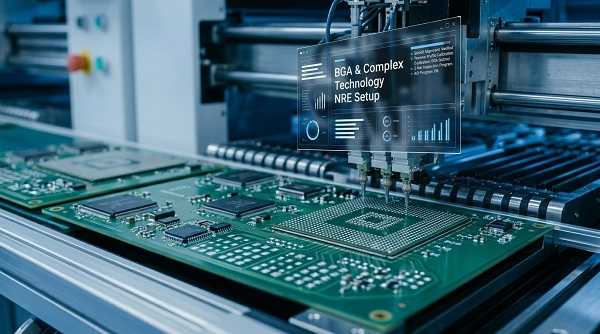
Advanced components like BGAs require additional X-ray inspection programming and much tighter thermal profiling. Here’s the deal, the more complex your parts, the more time a manufacturing engineer must spend ensuring the equipment is perfectly calibrated. This is especially true for BGA assembly where hidden solder joints are involved.
- Conversion of X-Y coordinate data for pick-and-place machines
- Setting up the Automated Optical Inspection (AOI) profiles
- Configuring thermal profiles for the reflow oven
- Generating specialized programs for BGA or 01005 components
Key Takeaway: Clean documentation and standard footprints help engineers program faster, which can lead to lower labor-based NRE charges.
4. What is the role of test fixtures in NRE costs?
What does NRE mean when you move from simple assembly to a fully tested product often involves the creation of a “bed of nails” or test jig. If you want to know what does NRE mean for high-reliability electronics, look at the custom hardware built just to verify your circuits. This is where it gets interesting, as these fixtures can sometimes cost more than the PCB tooling itself depending on the test coverage.
Is functional testing always worth the NRE?
For medical or industrial devices, the answer is a resounding yes. What’s the real story? While the upfront fixture cost is high, it prevents the massive cost of field failures by catching defects at the factory. We specialize in IC programming and testing to ensure every board leaving the line is 100% functional.
- Custom-drilled acrylic plates for pogo-pin alignment
- Wiring and integration with oscilloscope or multimeter tools
- Programming of functional test scripts
- ICT (In-Circuit Test) fixture fabrication
Key Takeaway: Functional test NRE is a safeguard for your brand reputation, though flying probe testing can be a lower-NRE alternative for small batches.
5. Why do different assembly methods change the NRE quote?
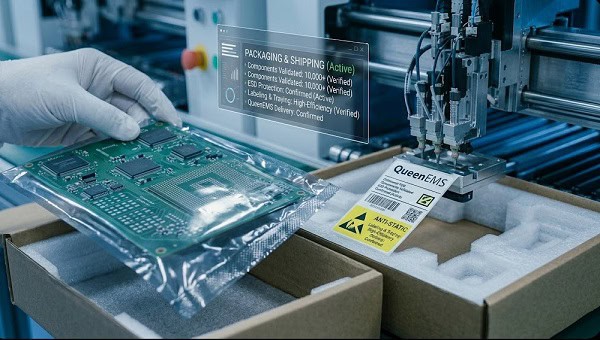
What does NRE mean changes significantly depending on whether your board is strictly surface-mount or includes older through-hole technology. In the context of what does NRE mean, a “mixed technology” board requires two different sets of engineering setups. Ready for the good part? You can often reduce NRE by eliminating manual through-hole components in favor of SMT equivalents.
Is through-hole assembly still relevant?
Yes, particularly for connectors or power-heavy components that need physical strength. But here’s the kicker, each manual step adds to the engineering overhead and NRE. If your project involves THT PCB assembly, expect slightly different NRE line items compared to a pure SMT board.
- Separate setups for SMT and THT lines
- Creation of custom solder pallets for wave soldering
- Additional hand-soldering instruction manuals for staff
- Double-sided SMT requires two stencils and two setups
Key Takeaway: Simplification of the assembly technology (sticking to SMT only) is a direct path to lowering your NRE bill.
6. How can panelization help you minimize NRE charges?
What does NRE mean in the context of panelization is the art of fitting as many boards as possible onto a single production sheet. When discussing what does NRE mean for cost efficiency, panelization reduces the number of times a machine has to “handshake” with a new board. This is where it gets interesting, because a well-designed panel can drastically cut down the labor portion of your NRE.
Should you design your own panels?
It is usually better to let the factory engineer the panel. The real story is that we understand our machine limitations and can design a panel that runs at maximum speed. This expertise in industrial automation allows us to optimize the layout for the best possible yield and lowest NRE.
- V-score vs. Tab-routing for board separation
- Adding fiducials to the panel waste area for machine alignment
- Reducing the number of stencils needed for small boards
- Improving material utilization to lower PCB costs
Key Takeaway: Consult with your manufacturer before finalizing your layout; a factory-optimized panel can save you significant NRE in the long run.
7. Does a repeat order eliminate the NRE fee?
What does NRE mean for your second and third orders is usually “zero,” provided no changes have been made to the design. When clarifying what does NRE mean, the “Non-Recurring” part is the most important promise a factory makes to a client. You might be wondering, however, if there are any exceptions, such as when a stencil wears out or a factory changes its machinery.
What happens if I change one resistor?
Even a small change can trigger a new NRE fee. Here’s the deal, changing a component footprint means the stencil no longer matches, and the pick-and-place program must be updated. This is why “Quick Turn” services often charge NRE for every revision during the pcb prototyping phase.
- Stored stencils remain ready for your next batch
- Programming files are archived in the factory database
- Setup time is reduced but machine labor still exists
- Test fixtures are maintained for long-term use
Key Takeaway: Lock in your design before moving to production to avoid paying the NRE “revision tax” multiple times.
8. Can high-volume orders lead to NRE waivers?
What does NRE mean for a large-scale B2B buyer is often a negotiable line item that can be absorbed by the factory. When negotiating what does NRE mean for a 10,000-unit contract, many manufacturers will waive the NRE to win the business. Believe it or not, the factory is more interested in the long-term production revenue than a one-time setup fee.
Is this common in the telecom sector?
Absolutely, especially for telecom infrastructure where production runs are large and predictable. The real story is that the more “predictable” your business is, the more leverage you have to ask for NRE waivers.
- Amortizing NRE into the unit price for high volumes
- Waiving tooling fees for long-term service agreements
- Free programming for established “Strategic Partners”
- Volume-based discounts on stencils and fixtures
Key Takeaway: Don’t be afraid to ask for NRE waivers if you are bringing significant production volume to the table.
9. How do you distinguish between PCB NRE and PCBA NRE?
What does NRE mean is often split into two different categories: the bare board fabrication and the actual assembly process. When analyzing what does NRE mean, you have to distinguish between the “photoplots” for the board and the “stencils” for the components. Ready for the good part? Using a turnkey provider helps consolidate these fees into a single, easier-to-manage quote.
Does “Mixed Assembly” increase both?
Yes, because you are dealing with multiple soldering technologies. But here’s the kicker, managing mixed assembly under one roof reduces the total engineering time spent communicating between different vendors.
- PCB NRE: Films, drill programs, and electrical test setup
- PCBA NRE: SMT stencils, feeder setup, and AOI programming
- Engineering NRE: DFM review and BOM verification labor
- Component NRE: Minimum order quantities or tape/reel fees
Key Takeaway: Understand that NRE is a multi-layered cost; turnkey services often offer the best value by bundling these engineering tasks.
10. How to audit your NRE quote for hidden costs?
What does NRE mean on a quote might sometimes hide “padding” if the breakdown isn’t transparent. To truly understand what does NRE mean, you should ask for a line-item breakdown of every engineering charge. This is where it gets interesting, because a reputable factory will be more than happy to show you exactly where your money is going.
Why transparency matters in manufacturing?
Our about page highlights our commitment to open communication and technical honesty. The real story is that a partner who hides their NRE logic is likely hiding other inefficiencies in their production process.
- Verify if “Engineering Fee” includes a full DFM report
- Check if stencil costs align with market rates
- Ask if the test fixture becomes your property after the project
- Ensure setup fees aren’t being double-charged on multi-board projects
Key Takeaway: Demand transparency in your NRE line items to ensure you are paying for engineering expertise, not just administrative overhead.
Conclusion
Navigating the complexities of what does NRE mean is a vital skill for any procurement professional or engineer looking to move a product into mass production. By recognizing that these are one-time investments in quality and precision—covering stencils, programming, and fixtures—you can better plan your project budgets and design for lower costs from day one. Here is the deal, NRE shouldn’t be a barrier to entry, but a roadmap to a stable and repeatable manufacturing process.
At QueenEMS, we are dedicated to helping B2B buyers demystify the assembly process and find the most cost-effective path to market. Whether you are scaling up a drone project or building industrial automation sensors, our team is here to provide the engineering support you need to succeed. Ready to take the next step? Contact us today to get a transparent, expert-led quote for your next PCBA project. We don’t just build boards; we build the future of reliable electronics through partnership and technical excellence.
Don’t let high setup costs hold back your innovation. Contact QueenEMS today and get your first prototype moving at zero cost
Comprehensive FAQ: Understanding PCB & PCBA NRE Cost
Section 1: The Basics of NRE
- Q: What exactly does the NRE fee cover?
- A: NRE (Non-Recurring Engineering) covers the one-time costs of preparing your project for production. This includes DFM (Design for Manufacturing) analysis, photoplotting for PCB layers, laser-cutting SMT stencils, and programming automated assembly and testing equipment.
- Q: Is the NRE fee a one-time charge?
- A: Yes. Once paid, the NRE covers that specific design for life. At QueenEMS, we archive your tooling data and fixtures. As long as the design remains identical, you will not be charged NRE fees for any future repeat orders.
- Q: Why do I need to pay for a “Stencil NRE” even for small-batch prototype runs?
- A: Precision laser-cut stencils are vital for accurate solder paste deposition. Even for a run of 5-10 pieces, using a professional stencil ensures high SMT yield and prevents defects like bridging, which are common with manual soldering.
- Q: Are testing fixtures (E-Test) always included in the NRE charge?
Section 2: Cost Optimization & Incentives
Ready to Experience Zero-Risk Prototyping?
Claim your FREE 2-4 Layer FR4 Prototypes today!(Zero NRE Fee) Partner with QueenEMS for high-precision manufacturing and turnkey assembly services — from your first design to mass production.
- Q: How can I offset the NRE costs during the early product R&D phase?
- Q: Can NRE fees be amortized into the unit price for long-term contracts?
- A: Yes. For high-volume projects, we can amortize the setup costs into the individual PCBA unit price to improve your cash flow and simplify initial procurement budgets.
- Q: Is the NRE fee refundable if the project moves to mass production?
- A: We offer NRE credit-back incentives. Once your cumulative production volume reaches a specific threshold (e.g., 5,000 units), the initial prototype NRE can be credited back to your mass production invoice.
Section 3: Technical & Design Considerations
- Q: Does a minor revision to the PCB layout trigger a full new NRE charge?
- A: Not necessarily. If a change only affects one layer (e.g., the silk screen), we may only charge a partial “Revision Fee” for the specific tooling required rather than a full new NRE.
- Q: If I have multiple designs, can I combine them to save on NRE?
- A: If multiple PCBs are of the same material and thickness, they can sometimes be panelized together to share a single NRE fee. Contact our engineering team to see if your designs are eligible for “Combo-NRE” savings.
- Q: If components are out of stock and the design must change, do I pay NRE twice?
- A: If the component footprint remains identical despite a part substitution, no new NRE is charged. A fee only applies if the physical board layout or drill files must be altered to fit new component packages.
Section 4: Timeline & Project Management
- Q: Can a “Rush Order” expedite the NRE engineering and tooling process?
- A: Yes. While standard NRE setup takes 24-48 hours, we offer “Priority NRE Processing” for urgent milestones, fast-tracking DFM analysis and tooling creation within 12 hours.
- Q: What happens to the NRE if I decide to pause the project?
- A: Your NRE investment is secure. We store your digital production files and physical stencils in a controlled environment, ready to resume production whenever your project is reactivated.