
QueenEMS Header
Mixed Technology PCB Assembly Services

Mixed Technology PCB Assembly Services

SMT + Through-Hole Assembly for Complex & Industrial Boards

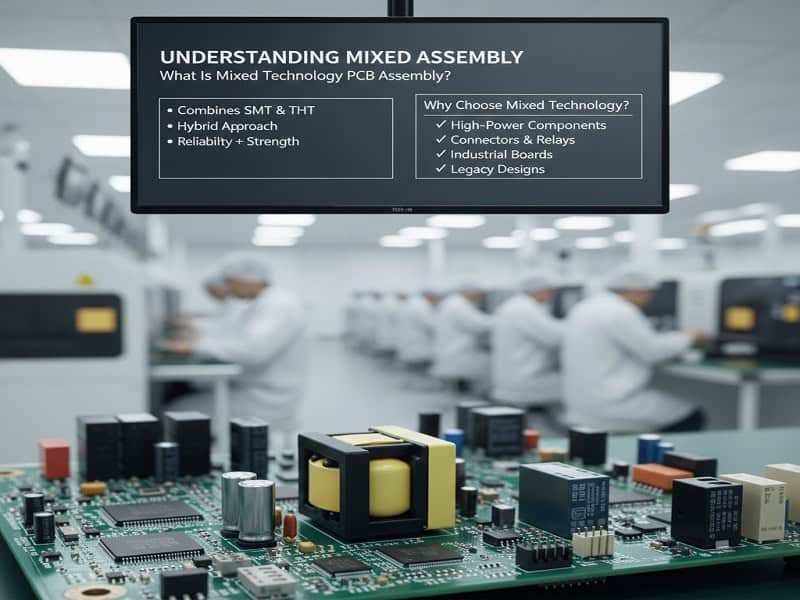
UNDERSTANDING MIXED ASSEMBLY

What Is Mixed Technology PCB Assembly

Mixed technology assembly combines surface mount (SMT) and through-hole (THT) components on the same board. This hybrid approach delivers the precision of SMT with the mechanical strength and reliability of through-hole connections—essential for industrial, power, and high-performance applications.

Mixed-Assembly

Why Choose Mixed Technology?

Modern electronics demand both miniaturization and durability. Pure SMT excels at component density, while pure through-hole provides strength. Mixed assembly gives you both—compact layouts where needed, rugged connections where they matter.

  • High-power components requiring heat dissipation and mechanical stability
  • Connectors, transformers, and relays that need physical anchoring
  • Industrial boards subject to vibration, thermal cycling, and harsh environments
  • Legacy designs requiring both modern ICs and traditional components

Pure SMT

Maximum density and speed, but limited mechanical strength. Best for consumer electronics and compact designs.

Mixed Technology

Combines density with durability. Optimized component placement for both performance and reliability in demanding conditions.

Pure Through-Hole

Robust and repairable, but bulky and slow to assemble. Reserved for legacy systems or extremely harsh environments.

Ready to explore if mixed assembly is right for your design?

Get Engineering Review
IDENTIFY YOUR NEEDS

When Do You Need Mixed Assembly?

Not every board requires mixed technology. But when your design combines high-power components, complex connectivity, or harsh operating conditions with modern IC requirements, mixed assembly becomes essential for reliability and performance.

High Current Power Board
POWER ELECTRONICS

High Current + Precision Control

Power supplies, motor controllers, and industrial drives need through-hole components for high-current handling and heat dissipation, while control circuitry requires compact SMT ICs for precision.

Mixed assembly handles thermal stress and current demands
Industrial Control Board
CONNECTIVITY

Connectors + Dense Circuitry

Industrial automation, telecommunications, and test equipment require robust connectors, transformers, and relays alongside advanced microprocessors and communication ICs.

Mechanical anchoring prevents field failures
vibration-and-thermal-cycling
INDUSTRIAL RELIABILITY

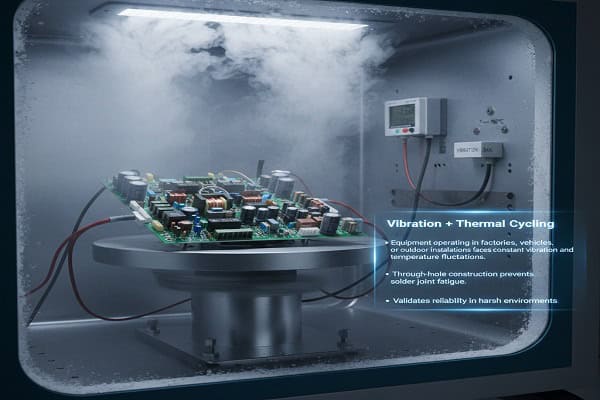
Vibration + Thermal Cycling

Equipment operating in factories, vehicles, or outdoor installations faces constant vibration and temperature fluctuations. Through-hole construction prevents solder joint fatigue.

Enhanced structural integrity for extended field life

Mixed Assembly Checklist: Do You Need It?

1
High-Current Components: Does your board include components carrying >2A, requiring substantial heat dissipation or mechanical anchoring?
2
Physical Connectors: Do you have heavy connectors, large transformers, or electromechanical relays that create mechanical stress?
3
Harsh Environment: Will the board operate in conditions with vibration, shock, temperature extremes (-40°C to +85°C or beyond)?
4
Long Field Life: Is your product expected to operate continuously for 10+ years without service access?
5
Legacy + Modern Mix: Are you updating an existing design that must retain some through-hole parts while adding new SMT features?
6
Regulatory Standards: Do certifications (UL, CE, IEC) require specific component mounting methods for safety or EMC compliance?

Checked 2+ boxes? Mixed assembly is likely critical for your success.

Discuss Your Requirements
OUR EXPERTISE

Our Mixed Technology Capabilities

We've invested in dedicated mixed-technology production lines with specialized equipment and trained technicians. This isn't an afterthought—it's a core competency built over years of industrial electronics manufacturing.

SMT + THT Combined Process

Seamlessly integrate SMT reflow and through-hole soldering in a controlled sequence. We optimize the order to prevent thermal damage and ensure consistent quality across all components.

  • Automated SMT placement + reflow
  • Selective wave soldering for THT
  • Mixed process coordination

Single & Double-Sided Boards

Handle complex layouts with components on both sides. Our process flow ensures proper support during reflow and prevents component damage during through-hole insertion and soldering.

  • Top & bottom SMT placement
  • Controlled THT insertion sequence
  • Multi-layer board support

Flexible Volume Production

From prototype runs to mid-volume production, our setup adapts to your needs. Quick changeover and modular tooling mean we're efficient whether you need 10 boards or 10,000.

  • Prototype & NPI support
  • Small batch production (50-500)
  • Medium runs (500-5000+)

Production Volume Flexibility

Prototype / NPI
5-50 boards for validation & testing
Small Batch
50-500 units for pilot production
Mid-Volume
500-5,000+ for sustained production

Let's match our capabilities to your exact requirements.

Request Capability Review
PROCESS BREAKDOWN

SMT Assembly Stage

In mixed assembly, SMT comes first for a reason. Surface mount components are smaller, heat-sensitive, and require precise reflow profiling. By completing SMT before through-hole, we prevent thermal stress and mechanical interference, ensuring optimal solder joints for every component type.

SMT Process Flow

1
Solder Paste Stenciling

Precision paste application to SMT pads using laser-cut stencils matched to your design

2
Component Placement

Automated pick-and-place with vision alignment for components down to 0201 package size

3
Reflow Soldering

Controlled thermal profile in multi-zone ovens ensures proper solder joint formation without damage

4
AOI Inspection

Automated optical inspection catches defects immediately—before through-hole processing begins

high-density-placement-accuracy
PRECISION

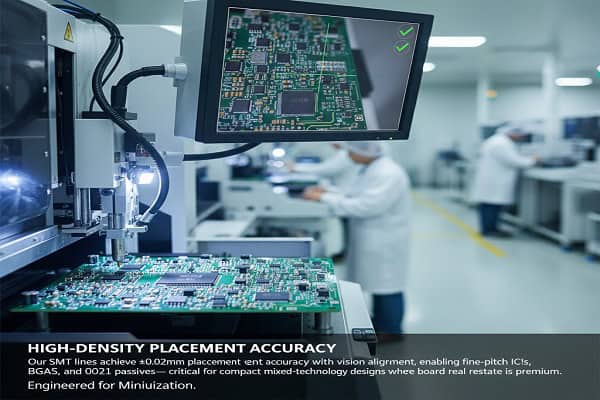
High-Density Placement Accuracy

Our SMT lines achieve ±0.02mm placement accuracy with vision alignment, enabling fine-pitch ICs, BGAs, and 0201 passives—critical for compact mixed-technology designs where board real estate is premium.

immediate-detection
QUALITY

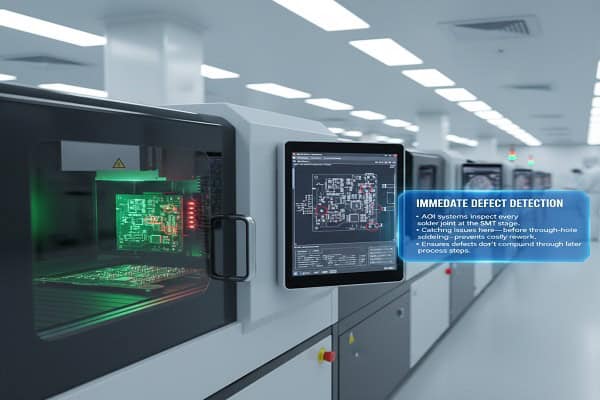
Immediate Defect Detection

AOI systems inspect every solder joint at the SMT stage. Catching issues here—before through-hole soldering—prevents costly rework and ensures defects don't compound through later process steps.

why-smt-come-first
STRATEGY

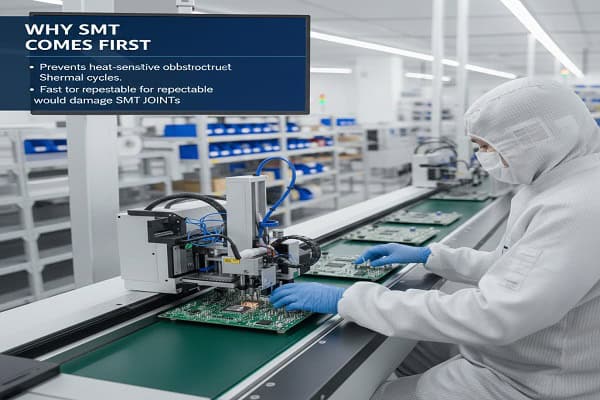
Why SMT Comes First

Completing SMT before THT prevents heat-sensitive components from experiencing multiple thermal cycles. Through-hole pins can obstruct SMT pads if inserted first, and wave soldering temperatures would damage SMT joints.

SMT Technical Specifications

Component Size
Down to 0201 (0.6×0.3mm)
Placement Accuracy
±0.02mm with vision alignment
Fine Pitch
QFP/BGA down to 0.4mm pitch
Reflow Profile
Lead-free (SAC305) & leaded support
AOI Coverage
100% inspection post-reflow
Handling
ESD-protected environment (IEC 61340)

Need to discuss SMT requirements for your mixed assembly project?

Connect With Our Engineers
Module 6 - Through-Hole Assembly Stage
THROUGH-HOLE PROCESS

Through-Hole Assembly Stage

After SMT reflow, through-hole components are inserted and soldered. This stage requires careful method selection—wave soldering, selective soldering, or hand soldering—based on board complexity, component sensitivity, and production volume. Our expertise ensures strong mechanical connections without thermal damage to nearby SMT parts.

hand-solder
PRECISION METHOD

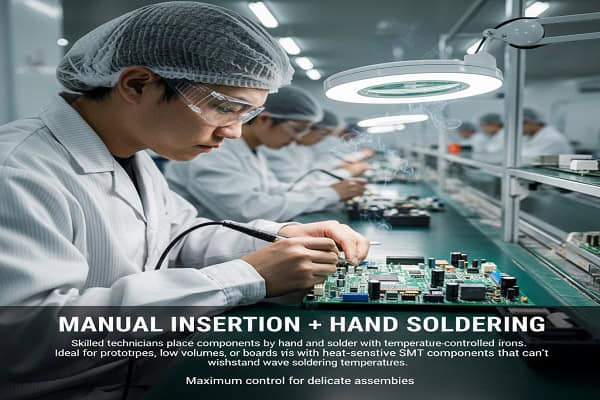
Manual Insertion + Hand Soldering

Skilled technicians place components by hand and solder with temperature-controlled irons. Ideal for prototypes, low volumes, or boards with heat-sensitive SMT components that can't withstand wave soldering temperatures.

Maximum control for delicate assemblies
TARGETED APPROACH

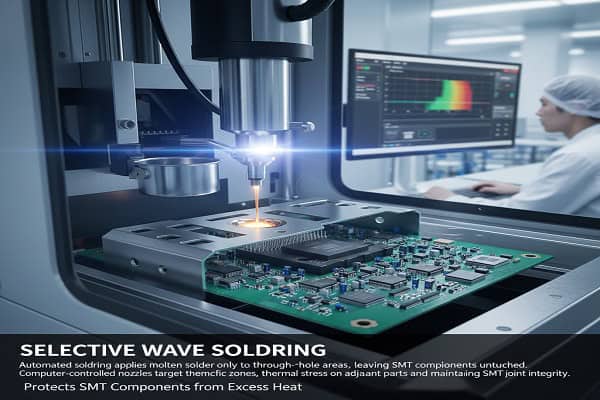
Selective Wave Soldering

Automated soldering applies molten solder only to through-hole areas, leaving SMT components untouched. Computer-controlled nozzles target specific zones, preventing thermal stress on adjacent parts and maintaining SMT joint integrity.

Protects SMT components from excess heat
full-wave-solderring
HIGH VOLUME

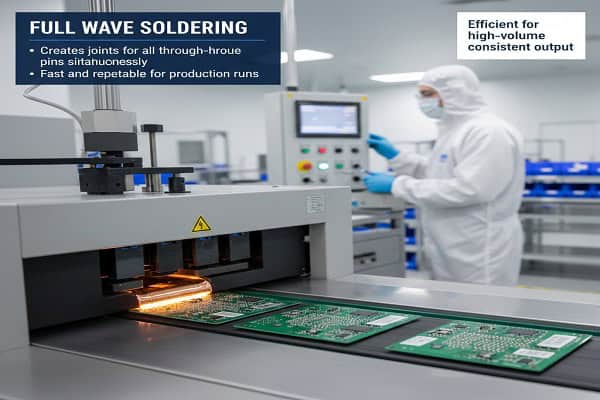
Full Wave Soldering

The board passes over a wave of molten solder, creating joints for all through-hole pins simultaneously. Used when SMT components can tolerate brief exposure or when masking protects critical areas. Fast and repeatable for production runs.

Efficient for high-volume consistent output

Through-Hole Quality Control Points

Component Orientation

Polarity-sensitive parts (diodes, capacitors) must be inserted correctly. Our visual and electrical checks prevent costly rework.

Solder Joint Quality

Inspectors verify proper wetting, fillet shape, and hole fill per IPC-A-610 standards for reliable electrical and mechanical connections.

Lead Trimming & Spacing

Component leads are trimmed to spec without damaging pads. Proper spacing prevents shorts and ensures clearances for conformal coating.

Typical Through-Hole Components in Mixed Assembly

Heavy Connectors
Power Transformers
Electromechanical Relays
Large Capacitors (>1000µF)
High-Power Resistors
Terminal Blocks & Fuses

Questions about through-hole methods for your specific components?

Discuss THT Requirements
Modules 7-10 - Mixed Technology PCB Assembly
CRITICAL WORKFLOW

SMT + THT Process Sequence

The order of operations in mixed assembly isn't arbitrary—it's engineering. Getting the sequence wrong leads to rework, thermal damage, or board scrapping. Our proven workflow minimizes stress on components, prevents defects, and ensures every board meets spec the first time.

Want to review your design's process flow before production?

Request Process Review
DESIGN FOR MANUFACTURING

DFM & Engineering Review

Mixed technology boards are complex by nature. What looks perfect in CAD can be a nightmare in production if component placement, pad geometry, or thermal profiles aren't optimized for the hybrid process. Our DFM review catches issues before they become expensive production delays.

Start with a free DFM review before committing to production.

Upload Files for DFM Check
QUALITY ASSURANCE

Quality Control for Mixed Pcb Technology Pcb Assembly Services

Mixed assembly demands rigorous inspection at every stage. SMT and through-hole defects have different signatures, failure modes, and acceptance criteria. Our multi-layered QC approach combines automated inspection, skilled visual checks, and functional testing.

Quality questions? Let's discuss inspection and testing protocols for your boards.

Review Quality Requirements
SUPPLY CHAIN MANAGEMENT

Component Sourcing & BOM Control

Mixed assembly BOMs are inherently complex—SMT reels, THT tape, cut strips, and bulk parts all require different handling. Component availability varies wildly between SMT and through-hole, and substitutions can wreck manufacturability. Our procurement process ensures you get the right parts, on time, without surprises.

Ready to review your BOM and identify potential sourcing challenges?

Submit BOM for Analysis
Mixed Technology PCB Assembly - Modules 11-15
INDUSTRIES WE SERVE

Industries Using Mixed Technology

Mixed assembly isn't for every application—but for industries where reliability, power handling, and mechanical robustness matter, it's essential. These sectors depend on the unique combination of SMT precision and through-hole strength that mixed technology provides.

industrial-control-systems
INDUSTRIAL

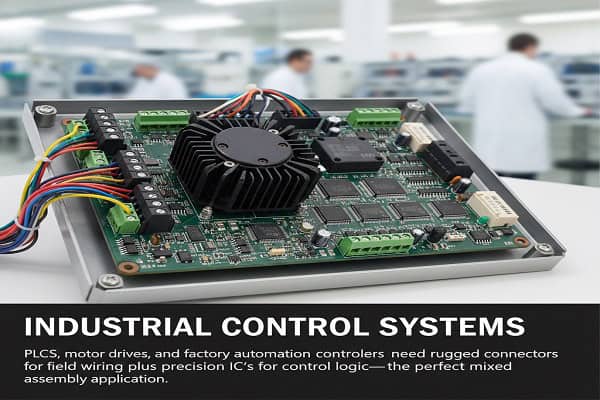
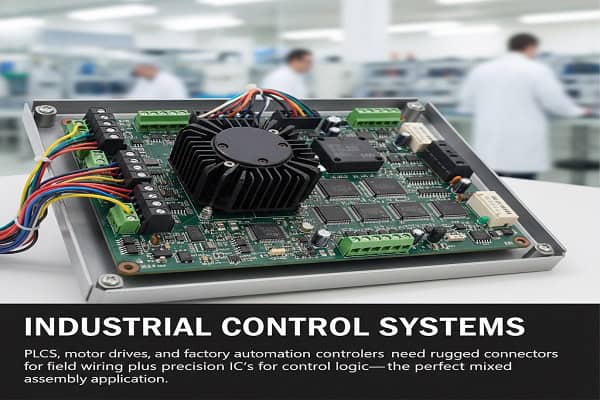
Industrial Control Systems

PLCs, motor drives, and factory automation controllers need rugged connectors for field wiring plus precision ICs for control logic—the perfect mixed assembly application.

Power Electronics
POWER

Power & Energy Systems

Inverters, UPS systems, and battery management require through-hole power components alongside SMT control circuitry for efficient energy conversion and monitoring.

Communications
TELECOM

Communications & Networking

Base stations, routers, and industrial ethernet equipment combine high-speed digital processing with robust I/O connectors for harsh deployment environments.

medical-and-lab-equipment
MEDICAL

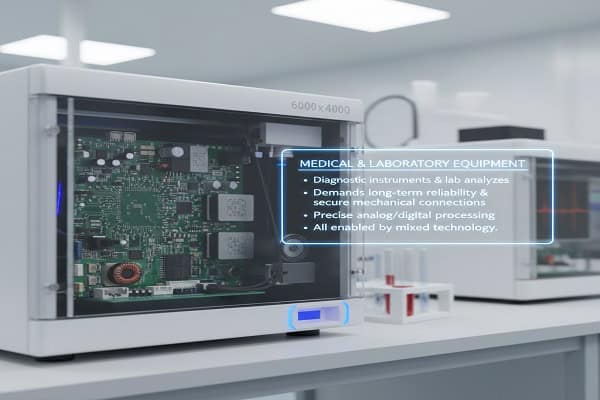
Medical & Laboratory Equipment

Diagnostic instruments and lab analyzers demand long-term reliability, secure mechanical connections, and precise analog/digital processing—all enabled by mixed technology.

Serving a different industry? Let's discuss if mixed assembly fits your needs.

Explore Your Industry Application
OUR DIFFERENCE

Why Choose Us for Mixed Assembly

Mixed technology assembly is a specialized skill—not every manufacturer has the process knowledge, equipment, or experience to do it right. We've built our capabilities specifically around hybrid assembly, making us the reliable partner for industrial and complex electronics.

Factory Direct Connection

Work directly with the production team—no middlemen, no markups. Questions get answered in hours, not days, because engineers are on-site.

Mixed Process Expertise

We've run thousands of mixed boards across industries. Our team knows how to sequence operations, prevent thermal issues, and optimize yield.

Fast Engineering Response

DFM reviews typically complete within 24-48 hours. Process questions get real-time answers from people who actually build your boards.

Small Batch Friendly

No 1,000-piece minimums. We handle prototypes, NPI runs, and pilot production with the same attention as high-volume orders.

By The Numbers

10+
Years Mixed Assembly Experience
500+
Mixed Technology Projects Delivered
98%
First-Pass Yield Rate
24-48h
Typical DFM Review Turnaround

Ready to partner with a team that truly understands mixed assembly?

Start Your Project
PROVEN RESULTS

Project Snapshots

Real projects from real clients. These examples show the kinds of challenges we solve daily—process complexity, component constraints, and tight timelines. Each one required the specialized mixed assembly expertise we've built our reputation on.

INDUSTRIAL

Industrial Motor Controller

Challenge: High-current power stage + precision control ICs on same board

Client needed through-hole MOSFETs and transformers for 10A+ current handling, plus fine-pitch SMT microcontroller and CAN transceivers. Standard process would have damaged SMT during wave soldering.

Selective wave solder protected SMT, 100% yield on 200-unit pilot
Battery Management System
POWER

EV Battery Management System

Challenge: Automotive-grade reliability with obsolete through-hole components

Legacy design used discontinued through-hole current sensors. We sourced alternates, validated them against automotive standards, and coordinated dual-source SMT and THT BOM delivery to meet production schedule.

Zero escapes through 1,000+ units, automotive qualification passed
5g-base-station-interface-card
TELECOM

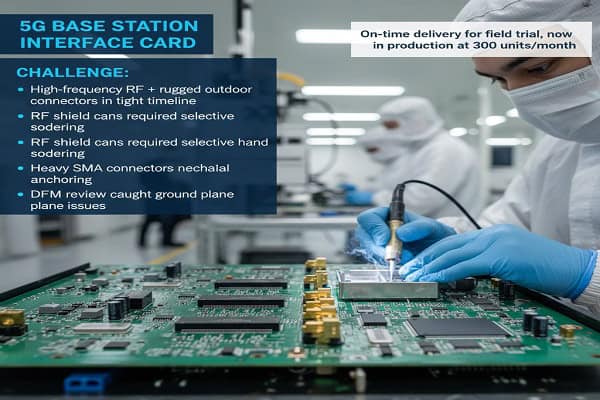
5G Base Station Interface Card

Challenge: High-frequency RF + rugged outdoor connectors in tight timeline

RF shield cans required selective hand soldering after SMT reflow. Heavy SMA connectors needed mechanical anchoring. DFM review caught ground plane issues before tooling, saving 2 weeks.

On-time delivery for field trial, now in production at 300 units/month

Have a complex project? Let's discuss how we can help.

Share Your Challenge
FREQUENTLY ASKED QUESTIONS

Mixed Assembly FAQ

Common questions about mixed technology assembly—answered clearly and directly based on years of customer conversations.

What's the minimum order quantity for mixed assembly?

We don't enforce strict MOQs. Prototypes start at 5-10 boards. For pilot production, we typically recommend 50+ units to optimize setup costs, but we'll work with your needs. The real question is value—mixed assembly makes sense when board complexity justifies the hybrid process.

How do you price SMT + THT assembly?

Pricing considers both processes. SMT is charged per placement (component count × complexity). Through-hole adds per-pin labor or machine time depending on method (hand solder vs. selective wave). Volume matters—unit cost drops significantly from 50 to 500 boards. We provide detailed breakdowns so you see where costs come from.

Which components shouldn't go on mixed assembly boards?

Heat-sensitive SMT parts (certain sensors, electrolytic caps, plastic-package ICs) can't withstand wave solder temperatures. If your design has these near THT areas, we'll use selective wave or hand soldering to protect them. DFM review catches these issues early so we can plan the right process sequence.

Do you support small-batch trial production?

Yes. Many clients start with 50-200 unit pilot runs to validate design and process before committing to volume. We treat pilot builds with the same process rigor as production—full DFM, IPC inspection, and documentation—so results are predictive of larger runs.

What lead time should I expect for mixed assembly?

After components arrive: 7-10 days for prototypes (5-50 boards), 10-15 days for pilot runs (50-500 units). If parts are on long lead times, that's your constraint—not our process. We'll flag component availability during quoting so you have realistic timelines from the start.

Can you handle consigned components?

Absolutely. If you're providing components (either you've already purchased them or they're strategic/proprietary), we'll coordinate incoming inspection, kitting, and traceability. We just need clear labeling, advance notice on delivery, and any handling requirements for sensitive parts.

Still have questions? Let's talk through your specific situation.

Ask Your Question
READY TO START?

Get Your Mixed Assembly Quote

We don't quote blindly. Upload your PCB files and BOM, and our engineering team will review your design for manufacturability, identify potential issues, and provide an accurate quote with clear lead times. No surprises, no hidden fees—just transparent pricing backed by process expertise.

Free DFM review with every quote request
24-48 hour quote turnaround on standard builds
Direct engineer contact throughout your project
Upload PCB & BOM for Review

🔒 Your files are confidential and will not be shared with third parties

Tell Us About Your PCBA Project

Get a customized quote within 24 hours. Our team is ready to help you find the perfect solution for your needs

Email Us

[email protected]
Response within 12 hours

Call / WhatsApp

+86-0755-363091328
Mon - Sat, 9AM-6PM CST

Visit Our Factory

1-4/F Property Office Building, ZhengFeng North Road, Shenzhen, China. 518103

Visit Our Office

(Head Office)1/27, Soi Border 5, Bang Bon Tai,Bang Bon, Bangkok 10150,Thailand

📥 Download Full Catalog (PDF)