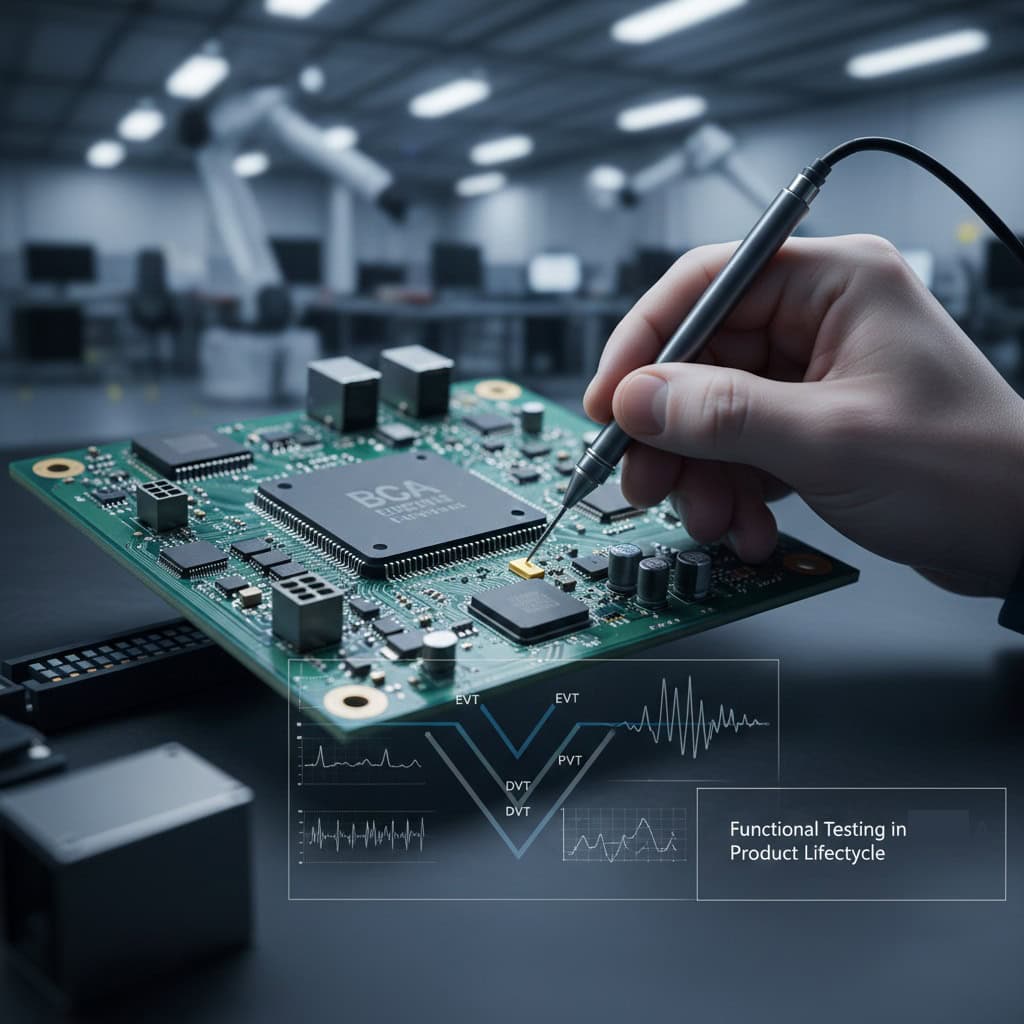
Quick answer: Functional testing in PCBA product lifecycle verifies that a board performs its intended electrical, firmware, communication, sensor, power, and user-interface functions before the product moves from engineering prototypes to production. EVT proves the design can work, DVT proves the design meets requirements under realistic conditions, and PVT proves the released design can be assembled and tested repeatedly with production tooling.
Key takeaways:
- EVT functional testing is for bring-up, debugging, and proving core design feasibility.
- DVT functional testing is for requirements coverage, environmental margin, firmware behavior, and reliability evidence.
- PVT functional testing is for production repeatability, fixture stability, operator workflow, yield data, and shipment readiness.
- The test plan should be designed before layout release, because missing test points and unclear firmware steps become expensive later.
A PCBA can pass visual inspection and still fail in the product. Functional testing closes that gap by asking a practical question: does this assembled board perform the functions the customer will actually depend on? For buyers, founders, and hardware engineers, the goal is not simply to add more tests. The goal is to place the right test at the right lifecycle stage so failures are found while they are still cheap to fix.
What functional testing checks in the PCBA lifecycle
Functional testing checks the operation of the assembled board after manufacturing steps such as solder paste printing, SMT placement, reflow, inspection, programming, and rework. It may verify power rails, current draw, boot behavior, firmware loading, I/O, communication buses, LEDs, displays, relays, motors, sensors, RF modules, charging circuits, and safety interlocks.
It is different from inspection. AOI and X-ray can find solder and assembly defects, while in-circuit testing can check connectivity and component-level conditions. Functional testing verifies that the board behaves as a working product or subsystem.
| Test type | What it answers | Typical timing |
|---|---|---|
| AOI / visual inspection | Are components placed and soldered correctly? | After assembly |
| X-ray | Are hidden joints such as BGA solder joints acceptable? | After assembly for selected packages |
| ICT or flying probe | Are nets, values, opens, and shorts likely correct? | Prototype or production test |
| Functional test | Does the PCBA perform its intended functions? | EVT, DVT, PVT, and production |
| Burn-in or stress test | Does the product survive defined operating stress? | DVT, PVT, or reliability screening |
EVT: prove the board can work
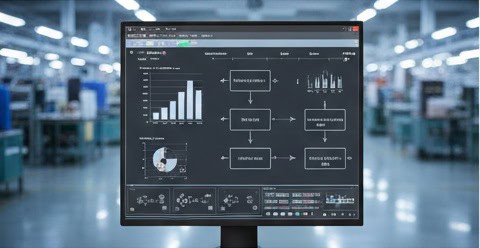
EVT, or engineering validation testing, is the first stage where the engineering team proves that the design can operate. The test setup may still be manual. Fixtures may be temporary. The firmware may be a debug build. That is acceptable because the purpose is learning, not production speed.
- Bring up power rails in a controlled sequence.
- Measure current draw in sleep, idle, and active modes.
- Load firmware and confirm boot behavior.
- Verify critical interfaces such as USB, CAN, Ethernet, UART, SPI, I2C, RF, sensors, or motor drivers.
- Record design issues that require schematic, layout, BOM, or firmware changes.
EVT exit evidence should include a known-good test procedure, measured results, failure list, engineering change notes, and a clear decision about whether the next board spin is required.
DVT: prove the design meets requirements
DVT, or design validation testing, verifies that the near-final design meets the product requirements under defined conditions. Functional testing becomes more formal at this stage. The team should cover nominal operation, edge cases, firmware update behavior, communication reliability, thermal behavior, enclosure interactions, and defined environmental conditions.
DVT is also where test coverage becomes a business decision. If a requirement is important enough to promise to customers, it should have a test method, limit, sample plan, and pass/fail record. If the PCBA will need certifications, DVT should identify the test evidence and design margins required before submission.
| DVT area | Functional test focus | Evidence to keep |
|---|---|---|
| Power system | Startup, load change, protection, charging, sleep current | Measured limits and waveforms |
| Firmware | Boot, update, rollback, error states, calibration | Version-controlled test logs |
| Communication | Protocol stability and error handling | Pass/fail data and boundary cases |
| Environmental margin | Operation across defined temperature or humidity conditions | Condition, duration, and result record |
| User/product behavior | Buttons, displays, LEDs, sensors, actuators, alarms | Requirement-to-test traceability |
PVT: prove the factory can repeat the test
PVT, or production validation testing, checks whether the released design can be built and tested repeatedly using production-intent tooling, operators, fixtures, software, and documentation. A PVT test that only works when the design engineer is present is not ready for production.
The PVT goal is repeatability. The fixture should contact the board consistently. The software should identify the product revision and firmware version. Operators should have clear instructions. The test log should capture serial number, date, station, result, failure code, and any measured values needed for traceability.
- Confirm the production fixture does not create false failures.
- Measure test cycle time and bottlenecks.
- Check operator workflow and safety steps.
- Verify fixture maintenance and calibration requirements.
- Review first-pass yield and failure Pareto before ramp.
What to define before layout release
Functional testing becomes much easier when design-for-test decisions are made before PCB layout release. Missing access points, ambiguous boot modes, and undocumented calibration steps can force manual probing or expensive fixture redesign later.
| DFT decision | Why it matters | Common mistake |
|---|---|---|
| Test points | Enable repeatable probing and fixture contact. | Placing points where the fixture cannot reach them. |
| Programming access | Supports firmware loading and version control. | Relying on engineering-only cables or hidden pads. |
| Serial number strategy | Connects test result to each unit. | No link between board ID and test log. |
| Power limits | Detects shorts, wrong parts, or abnormal load. | No defined current limits for each mode. |
| Failure codes | Turns test data into process improvement. | Only recording pass/fail without root-cause categories. |
What to send your PCBA partner for functional testing
A contract manufacturer cannot build a reliable functional test from a BOM alone. Send a test package that explains what the board should do, how to power it, how to program it, what to measure, and what limits define a pass.
- Product requirement or test requirement document.
- Firmware image, programming method, and version-control rule.
- Golden sample or known-good reference unit when available.
- Power input range, current limits, and safety notes.
- Connector pinout, cable requirements, and fixture constraints.
- Expected outputs, tolerances, timing windows, and communication commands.
- Failure-code list and retest/rework rules.
- Required test log fields for traceability.
If the test is not defined yet, start with a pilot procedure in EVT and improve it through DVT. By PVT, the procedure should be stable enough for production operators and repeatable enough for yield tracking.
How QueenEMS supports PCBA functional testing
QueenEMS can support functional testing by reviewing the assembly files, programming requirements, fixture access, and production test flow before the build starts. The most useful handoff includes Gerbers, BOM, pick-and-place files, firmware, test procedure, pass/fail limits, and any known failure history from earlier prototype runs.
For turnkey PCBA projects, the practical advantage is feedback speed. When assembly, programming, inspection, and functional testing are coordinated through one workflow, failures can be traced back to soldering, component selection, firmware, fixture contact, or design assumptions faster than when each step is handled by a separate vendor.
FAQ about functional testing in PCBA product lifecycle
Can functional testing replace AOI or X-ray?
No. Functional testing verifies product behavior, while AOI and X-ray inspect assembly quality. A strong PCBA quality plan uses inspection and functional testing together.
Can I skip EVT or DVT to save time?
Skipping validation stages can make the schedule look shorter, but it increases the chance of discovering design or test problems during production. If the schedule is tight, reduce scope carefully; do not remove the stage-gate decision entirely.
What is the difference between DVT and PVT testing?
DVT proves the design meets requirements. PVT proves the released design can be manufactured and tested repeatedly with production tooling, operators, documentation, and traceability.
What makes a good PCBA functional test fixture?
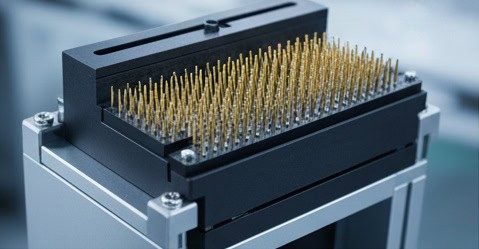
A good fixture provides repeatable contact, protects the board from stress, identifies the correct revision, supports safe power application, records useful data, and minimizes false failures.
What should I prepare before asking QueenEMS for testing support?
Prepare the BOM, Gerbers, pick-and-place file, firmware, test procedure, pass/fail limits, power requirements, connector details, and any known failure history. If the procedure is not finished, send the intended product functions and QueenEMS can help review the test approach.
Written by the QueenEMS Engineering Team
Upload your files today · Free DFM check before production · Ship worldwide
Get your PCB prototypes in as fast as 24 hours. We handle FR4, Rogers, and Flex up to 60 layers — free prototypes for 2–4 layer boards, no minimum order.
Just upload your Gerber + BOM — we source every part, assemble, and inspect (AOI + X‑Ray) so you don't have to chase suppliers. Boards ship in as fast as 24 hours.