Quick Answer: The primary PCB warping causes include uneven copper distribution, reflow temperatures exceeding the material’s Tg, and core thicknesses under 1.0mm. Proper copper pour balancing can slash warpage rates from a disastrous 3% down to an IPC-compliant 0.25%, saving you $500 to $2,000 in average assembly rework fees. Key takeaways:
- IPC standards dictate a maximum warping tolerance of 0.75% for surface-mount boards.
- Lightly warped bare boards (<0.75%) can be fixed by baking at 105°C for 2-4 hours followed by cold pressing.
- Using stable prepreg materials like 2113 or 2116 minimizes structural stress during lamination.
- Attempting to flatten an already-assembled warped board will fracture solder joints and ruin the entire PCBA.
- What are the main PCB warping causes?
- How much warping is acceptable by IPC standards?
- How can you prevent warping in your PCB design?
- What should your manufacturer do to prevent warping?
- Can you fix a warped PCB?
- A quick warping risk checklist for your next design
- FAQ
You unpack a fresh batch of circuit boards, set one on your workbench, and notice it wobbles like a bad diner table. If you send that bowed board through the SMT line, your pick-and-place machine will misalign parts and the reflow oven will create dozens of cold solder joints. After analyzing thousands of rejected boards last year, we know exactly what drives these structural failures. Here are the real PCB warping causes, the actual costs of fixing them, and how to design your next stackup so it stays perfectly flat.
What are the main PCB warping causes?
The most common PCB warping causes are asymmetrical copper distribution across layers, using core thicknesses under 1.0mm, and exposing the board to reflow temperatures that exceed its Glass Transition Temperature (Tg). When copper-heavy layers expand faster than copper-light layers during the 260°C lead-free soldering process, the board bows or twists to release the thermal stress.
Here’s what most guides won’t tell you… the severe warping usually doesn’t happen during bare board fabrication. It strikes the second your board hits the reflow oven. Standard FR4 has a Tg around 130°C. When your oven hits 260°C, the resin softens dramatically. If your stackup is unbalanced or if you scored deep V-cuts that weaken the mechanical structure, the board permanently bends as it cools down.
Also, moisture is a silent killer in the fabrication shop. If a factory stores boards in a humid environment, the FR4 material absorbs moisture rapidly.
Common triggers for stackup failures:
- Routing 80% copper on the top layer and only 20% on the bottom layer.
- Heating boards with high moisture content causing trapped water vapor to expand.
- Using extremely thin 2-layer vs 4-layer PCB designs for large panel sizes.
How much warping is acceptable by IPC standards?
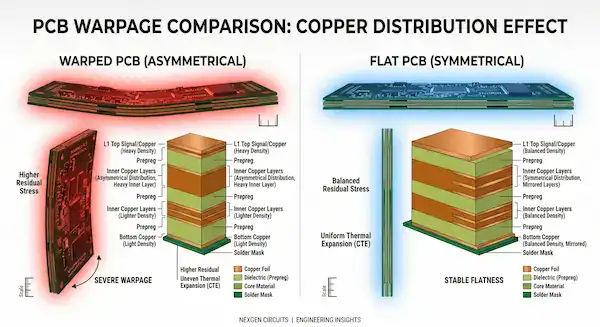
According to the IPC-A-600 standard, the maximum acceptable bowing and twisting for surface-mount technology (SMT) printed circuit boards is 0.75%. For through-hole only boards, the tolerance is slightly more relaxed at 1.5%, but exceeding these specific numbers practically guarantees assembly defects.
So what does this actually mean for your budget? If your board warps beyond 0.75%, your stencil printer will leave uneven solder paste deposits across the pads. A warped board adds an average of $500 to $2,000 in rework fees because of lifted BGA chips and misaligned fine-pitch components. Selecting the right stackup is 10 times cheaper than paying for PCB fabrication cost overages due to high scrap rates.
| Warpage Level | IPC Status | Impact on Assembly Process |
|---|---|---|
| < 0.25% | Ideal | Flawless SMT processing. |
| 0.25% – 0.75% | Acceptable (IPC standard) | Safe for most components; monitor BGAs closely. |
| 0.76% – 1.5% | Fail (for SMT) | Solder paste smearing, tombstoning, and open joints. |
| > 1.5% | Critical Failure | Will jam pick-and-place machines; scrap immediately. |
How can you prevent warping in your PCB design?
You can prevent warping in your design by balancing your copper area so layer coverage varies by less than 15%, maintaining a symmetrical layer stackup, and filling large empty spaces with solid copper pours. Proper copper balancing alone can reduce a board’s warp rate from 3% down to a highly safe 0.25%.
Now, here’s the part that surprises most customers… choosing a thicker board is the absolute easiest fix. A standard 1.6mm board is structurally stable, while anything under 1.0mm is highly susceptible to thermal bowing. If your enclosure requires a very thin board, you must use high-Tg materials to survive reflow unharmed. Read our guide on FR4 material and Tg grades to match your laminate to your thermal profile.
Your design prevention checklist:
- Keep copper thickness and distribution symmetrical around the center core.
- Use copper pours (thieving) in large blank areas to match the density of adjacent layers.
- Upgrade to Tg170 material instead of standard Tg130 if you have a dense lead-free component layout.
What should your manufacturer do to prevent warping?
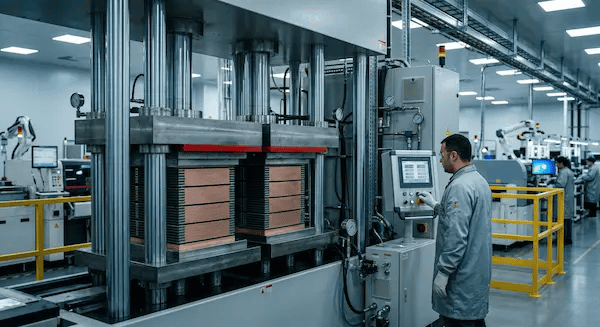
Your manufacturer should prevent warping by selecting stable prepreg styles like 2113 and 2116, running a proper pre-bake cycle to remove moisture before lamination, and avoiding asymmetrical pressing profiles. A dedicated multilayer PCB manufacturer tightly controls the cooling rate during pressing so internal stresses resolve evenly.
Here’s where it gets real… 80% of budget factories rush the cooling cycle after lamination to increase their daily output volume. We recently took over a project where the previous supplier’s boards warped by 2.2% simply because operators pulled them from the press while still hot. At QueenEMS, we enforce a strict 2-hour controlled cooling phase under high pressure, which virtually eliminates process-induced bowing.
You should ask your manufacturer to run a DFM PCB design check on your copper distribution before they cut a single piece of FR4. We flag unbalanced designs within 2 hours of upload so you can fix them before paying for custom tooling.
Can you fix a warped PCB?
You can fix a bare PCB with light warping (under 0.75%) by baking it at 105°C for 2 to 4 hours and letting it cool flat under a heavy cold press. However, if a bare board exceeds 1.5% warpage or if the board is already populated with components, you must scrap it entirely.
Want the honest answer? Attempting to flatten a populated PCBA will immediately fracture the internal copper traces and tear the BGA solder joints right off the pads. There is no reliable physical fix for an assembled warped board.
Our factory rules for warped boards:
- Light Warp (<0.75%): Bake and cold press (bare boards only).
- Heavy Warp (>1.5%): Scrap and contact your fabricator for fresh replacements.
- Assembled Boards: Do not touch. Scrap immediately to avoid expensive field failures later.
A quick warping risk checklist for your next design
Before you send your Gerber files to production, run them through this 4-point warping risk checklist to catch asymmetrical flaws early. If you answer “yes” to three or more of these questions, your design has a very high probability of bowing during assembly.
| Risk Factor | Question | High Risk Answer |
|---|---|---|
| Thickness | Is your overall board thickness less than 1.0mm? | Yes |
| Copper Balance | Is the copper weight heavily skewed to one side of the stackup? | Yes |
| Empty Space | Does your routing leave large areas without copper pours? | Yes |
| Material | Are you using standard Tg130 FR4 for a dense lead-free assembly? | Yes |
If your design fails this test, do not risk your production budget. Upload your BOM and Gerbers to QueenEMS for a free DFM engineering review. Our team will show you exactly where to add copper pours to stabilize the structure.
FAQ
Does surface finish affect PCB warping? No, the surface finish itself does not cause warping. High temperatures involved in applying finishes like HASL can trigger stress release in an already unbalanced board. ENIG or OSP are applied at lower temperatures and pose less thermal risk to thin boards.
Why does my 2-layer board warp more than my 4-layer board? It usually depends on thickness and copper ratio. If you use a very thin 2-layer board with heavy copper routing on one side and nothing on the back, it bends much faster than a symmetrically stacked 4-layer board.
Will adding a frame or tooling rails stop V-cut warping? Yes, adding solid breakaway rails (at least 5mm wide) helps maintain mechanical rigidity during the SMT process. If you use V-cuts, make sure they do not exceed 1/3 of the board’s total thickness to maintain structural integrity. Upload your panel design to QueenEMS, and we will verify your rail strength for free.
Written by the QueenEMS Engineering Team