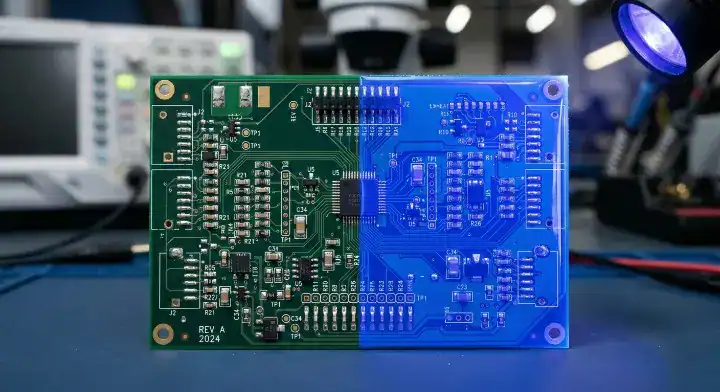
Quick Answer: PCB conformal coating is a thin protective polymer film applied to assembled boards to guard against moisture, corrosion, and chemical contamination. The right type is determined by your operating environment, not your preference: acrylic (AR) is the cheapest and easiest to rework ($2–$5 per board) and handles humidity well but dissolves in solvents; silicone (SR) handles extreme temperatures (-65°C to 200°C) and vibration at $8–$15 per board; polyurethane (UR) adds chemical resistance at moderate cost; epoxy (ER) is permanent and cannot be removed for rework. Many boards inside sealed enclosures (IP54+) do not need conformal coating at all — adding it unnecessarily costs $2–$20 per board with no reliability benefit.
Key takeaways:
- Acrylic is the default for most applications: cheap, easy to rework, good moisture protection.
- Silicone is for extreme temperature range (-65°C to 200°C) and vibration environments — not for rework-friendly designs.
- Polyurethane adds chemical resistance over acrylic; choose it when solvent exposure is a real risk.
- Epoxy and Parylene are permanent — never use them if field repair is expected.
- Boards in sealed IP54+ enclosures typically do not need conformal coating at all.
- Conformal coating adds thermal resistance — evaluate this on high-power designs before committing.
Table of Contents
- What Does PCB Conformal Coating Actually Do — and What Can It Not Do?
- When Does Your Board Actually NOT Need Conformal Coating?
- Acrylic vs Silicone vs Polyurethane: Which Coating Is Forced on You by Your Environment?
- When Should You Never Use Epoxy or Parylene — and When Are They the Only Option?
- Will Conformal Coating Hurt My Thermal Performance?
- The 60-Second Decision Checklist: Which Conformal Coating Does Your Application Require?
You review your quote and see an extra line item adding $12 per board for silicone protection, pushing your hardware startup over budget. You selected it because “aerospace-grade” sounds highly reliable. After processing thousands of PCBA orders last year, we see two massive mistakes repeatedly: clients overpaying for silicone on indoor consumer devices, and outdoor sensor companies using cheap acrylic that dissolves completely within six months due to solvent exposure. Choosing the right pcb conformal coating is a strict mathematical function of your operating temperature, chemical exposure, and rework requirements. Here is how to select the exact chemistry your board demands without wasting a single dollar.
What Does PCB Conformal Coating Actually Do — and What Can It Not Do?
PCB conformal coating acts as a 25 to 130-micron breathable polymer shield that protects your components from humidity, dust, and mild chemical exposure, but it will never make your board fully waterproof. Based on typical failure analysis reports, a properly applied coating prevents dendritic growth and corrosion across closely spaced component pads.
Many hardware designers treat coating like a magic waterproofing spray. The practical reality is… conformal coating breathes. Moisture vapor can pass through most coatings over time. Its primary job is preventing condensation droplets from bridging active electrical traces and shorting out the circuit. If your product is going to be submerged in water, you do not need conformal coating—you need potting compound or a hermetically sealed enclosure.
We constantly remind clients that applying an insulating layer over your entire board means you are locking in whatever is underneath it. If the factory fails to clean the board properly before application, the coating will trap flux residues against the copper. This trapped residue eventually eats through the traces, causing the exact failures the coating was meant to stop. We heavily rely on advanced PCBA testing to prevent costly field failures before applying any chemical layer to the finished board.
When Does Your Board Actually NOT Need Conformal Coating?
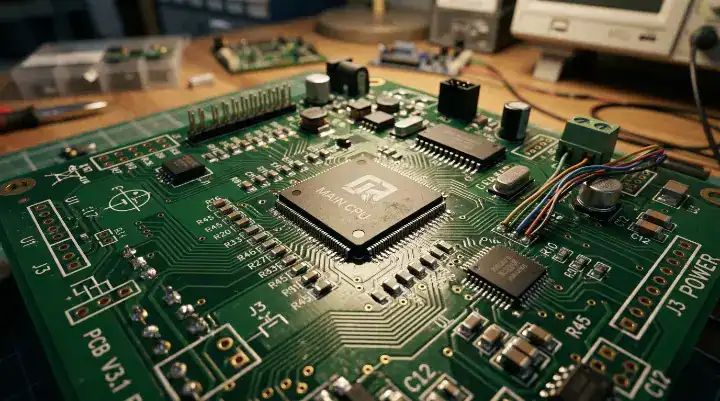
You absolutely do not need conformal coating if your PCB sits inside an IP54-rated sealed enclosure or operates in a climate-controlled indoor environment, saving you $2 to $20 per board and up to two days of production time. Most guides skip this fact to sell more manufacturing services.
We see this question constantly on engineering forums: “Do I really need conformal coating for my consumer IoT device that goes inside a sealed plastic enclosure?” No, you do not. If your outer casing blocks dust and splashing water (IP54 or better), the internal board is already safe from standard environmental threats. Short-lifespan consumer electronics under two years of expected use almost never justify the extra expense.
Pull back the curtain on this… Every time you add a manual or automated spray process, you drastically increase your PCB assembly cost. Our automated coating lines add between 0.5 to 2 days to standard production schedules. You should only trigger this process if your hardware faces direct exposure to outdoor air, aggressive temperature swings causing internal condensation, or potential splashing from industrial chemicals. For a standard smart home thermostat mounted on a living room wall, skipping the coating is the smartest engineering decision you can make.
Acrylic vs Silicone vs Polyurethane: Which Coating Is Forced on You by Your Environment?
Your operating environment dictates your coating material: use acrylic for basic humidity ($2–$5), upgrade to polyurethane for chemical solvent exposure ($5–$12), and specify silicone only for extreme temperature swings from -65°C to 200°C ($8–$15). It is not a matter of preference.
A common scenario pops up during the design phase: “I need conformal coating for a board that will be in a humid outdoor environment. Acrylic is cheapest — is it sufficient, or do I need silicone?” Yes, a high-quality acrylic (AR) coating is completely sufficient for high humidity. It offers excellent moisture protection and is incredibly easy to rework using basic isopropyl alcohol. However, acrylic fails immediately if exposed to fuel vapors, industrial solvents, or harsh cleaning agents.
If your hardware sits near a factory floor where technicians use solvent sprays, acrylic will melt right off the board. In that specific scenario, you must upgrade to Polyurethane (UR). Polyurethane resists intense chemical attacks and physical abrasion. If your board sits near an engine block hitting 150°C, both acrylic and polyurethane will burn. That specific high-heat environment forces you to buy Silicone (SR).
| Coating Type | Cost per Board | Temperature Range | Chemical Resistance | Rework Difficulty | Best Application |
|---|---|---|---|---|---|
| Acrylic (AR) | $2–$5 | -40°C to 125°C | Weak (Dissolves) | Very Easy (IPA) | Indoor/light outdoor, prototypes needing rework |
| Silicone (SR) | $8–$15 | -65°C to 200°C | Moderate | Hard (Specialty solvent) | High-temperature zones, vibration environments |
| Polyurethane (UR) | $5–$12 | -40°C to 125°C | Strong (Anti-solvent) | Hard (Specialty solvent) | Industrial chemical exposure, automotive chassis |
| Epoxy (ER) | $10–$20 | -55°C to 150°C | Extreme | Permanent (Cannot remove) | Harsh environments, zero-repair disposable boards |
| Parylene | $30–$80+ | -200°C to 150°C | Extreme | Permanent (Laser/Grinding) | Medical implants, aerospace reliability |
When selecting any of these materials, require your assembler to provide documentation showing the material meets IPC standards for PCB reliability, specifically IPC-CC-830B.
When Should You Never Use Epoxy or Parylene — and When Are They the Only Option?
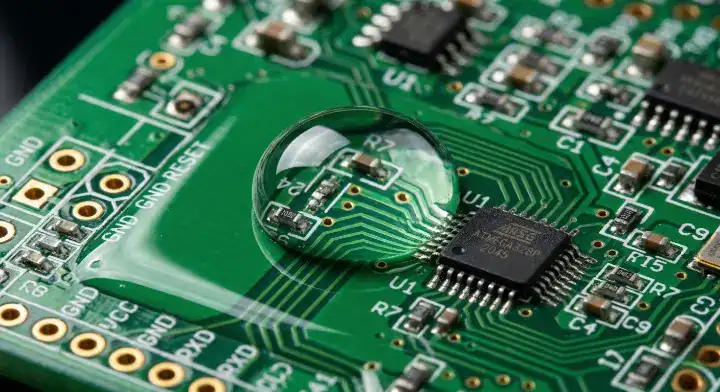
You should never apply epoxy or parylene if your product requires future field repairs, because these permanent coatings force you to destroy the board to replace a failing component. Epoxy costs $10–$20 and creates a rock-hard shell, while parylene requires a $30–$80 vacuum deposition process for ultimate, impenetrable protection.
Epoxy (ER) offers the absolute highest physical abrasion and chemical resistance. However, it cures into a solid plastic-like state that shrinks slightly. You cannot dissolve it with chemicals. If a $2 capacitor fails under an epoxy coating, you have to throw away the entire $500 PCBA.
So what does this mean for your design? You only use epoxy for products deployed into deep-sea environments or underground mining equipment where repair is impossible anyway. Parylene represents an entirely different class of protection. Unlike spray coatings, parylene is applied as a gas in a vacuum chamber. It coats every microscopic crevice evenly, leaving zero pinholes. Because it is highly biocompatible and creates a perfect moisture barrier, it is the mandatory standard for medical PCB assembly, such as pacemakers or internal diagnostic devices.
Will Conformal Coating Hurt My Thermal Performance?
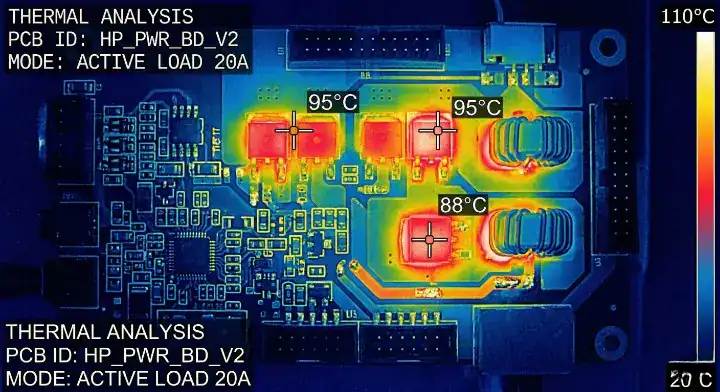
Yes, pcb conformal coating increases thermal resistance, and thick layers of silicone can trap heat under high-power components, potentially raising junction temperatures by 5°C to 15°C depending on your power density. Many designers ignore this thermal blanket effect until their prototypes overheat on the test bench.
A frequent concern arises for power electronics: “My power supply board runs hot. Will conformal coating trap heat and cause thermal problems?” Absolutely. Thin acrylic layers (25–50µm) have a negligible impact on heat dissipation. Silicone, however, is applied much thicker (50–130µm) and acts as a thermal insulator. If you cover a power MOSFET or a large inductor with silicone, the component loses its ability to radiate heat effectively into the surrounding air.
That said… you have engineering workarounds. We highly recommend selective coating for high-power boards. Instead of dipping or spraying the entire board, we use automated selective coating machines to trace paths around your hot components and heat sinks, leaving them bare while protecting the sensitive digital logic nearby. Before moving into mass production, run a thermal imaging test on a bare board, apply the coating, and test it again to verify your critical components stay within safe operating margins.
The 60-Second Decision Checklist: Which Conformal Coating Does Your Application Require?
Choosing the right coating takes less than a minute when you match your exact operating conditions to our factory capability matrix, eliminating guesswork and preventing costly over-specification. Review the checklist below before submitting your BOM for full SMT assembly.
| Your Application Scenario | Recommended Coating | Factory Reasoning |
|---|---|---|
| PCB inside sealed IP54+ enclosure | None | Enclosure handles the protection; coating is wasted money. |
| Indoor consumer tech, light humidity | Acrylic | Basic protection, lowest cost, easy rework. |
| Outdoor IoT, high humidity, no chemicals | Acrylic | Excellent moisture barrier; chemical resistance unnecessary. |
| Industrial controls, solvent/cleaner contact | Polyurethane | Chemical resistance is the mandatory upgrade here. |
| Engine bays, fuel or oil exposure | Polyurethane or Epoxy | Vapors and road salt demand aggressive chemical shielding. |
| High heat (>125°C), heavy vibration | Silicone | The only chemistry surviving the temperature and flexing. |
| Medical implants, bodily fluid isolation | Parylene | Unmatched uniformity and strict biocompatibility. |
| Prototypes requiring frequent debugging | Acrylic (Only) | Anything else makes rework financially unviable. |
| High power density boards | Evaluate first | Run thermal tests; use selective coating to save heat paths. |
Not sure whether your application actually needs conformal coating — or which type? Upload your BOM and tell us your operating environment, and our engineering team will recommend the most cost-effective protection strategy. We offer Free DFM/DFA engineering review on every order to catch these issues early.
Frequently Asked Questions
Can I use conformal coating over connectors and test points? No, you must keep coating out of connectors and off test points. Conformal coating is an electrical insulator. If it gets inside a connector, it will block the electrical signal. Factories either apply masking tape over these areas before spraying or use selective coating machines to program exact paths around them.
How do you remove conformal coating for component rework? It depends entirely on the chemistry. Acrylic dissolves easily with standard isopropyl alcohol or a spot-cleaning pen. Polyurethane and silicone require highly aggressive, toxic specialty strippers and mechanical scraping. Epoxy and parylene are effectively permanent; attempting to remove them usually destroys the copper traces underneath.
Does conformal coating prevent tin whiskers? Yes, applying a layer of polyurethane or acrylic significantly suppresses the growth of tin whiskers from lead-free solder joints. The polymer layer creates a physical barrier that prevents whiskers from bridging across adjacent pads, heavily increasing the long-term reliability of densely packed component layouts.
Written by the QueenEMS Engineering Team. Ready to build your next board with a 99.7% first-pass yield rate? Contact us today to get your free quote.