
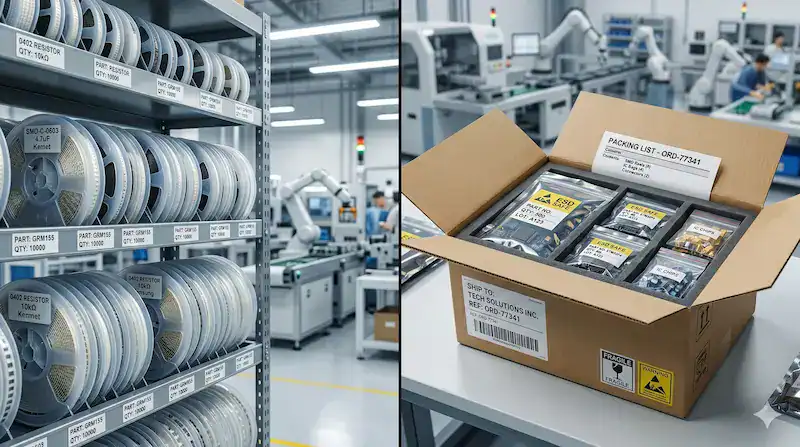
Quick Answer: Turnkey PCB assembly costs 8-15% more in component markup but eliminates your procurement labor and inventory risks, making it cheaper for runs under 500 boards. Consigned assembly saves 10-25% on raw component costs but only becomes profitable for production runs over 1,000 units where your supply chain is already established. Key takeaways:
- Turnkey component markup typically ranges from 8% to 15%.
- Consigned assembly requires you to supply 15-25% extra components for attrition.
- Missing parts in consigned orders cause an average 3-7 day production delay.
- Partial turnkey offers a middle ground where you supply core ICs and the factory handles common passives.
Table of Contents
- Understanding turnkey vs consigned PCB assembly: What’s the real difference?
- How much does each model actually cost?
- Which model gets boards to you faster?
- What are the hidden risks most guides won’t mention?
- When should you choose partial turnkey instead?
- How do you decide? A 5-question checklist
You’ve sent your BOM to two assemblers. One quotes $3,920 fully loaded. The other says $3,300 — but wants you to buy and ship every component yourself. Sounds like an easy $620 savings, right? Not so fast. After processing 2,400+ orders last year, we’ve watched that “$620 savings” evaporate into $1,500 of delay costs more times than we can count. If you are comparing turnkey vs consigned pcb assembly, here is how to avoid that trap.
Understanding turnkey vs consigned PCB assembly: What’s the real difference?
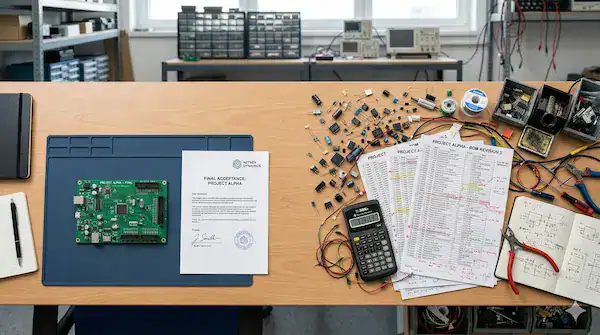
Turnkey assembly means the factory buys all components, manufactures the bare boards, and handles the entire soldering process. Consigned assembly requires you to purchase all parts, manage the inventory, and ship a complete physical kit to the factory for production.
Here’s the thing: Most engineers think they only have two choices. They completely ignore the hybrid approach.
- Full Turnkey: Factory handles 100% of sourcing and assembly.
- Consigned (Kitted): You handle 100% of sourcing, factory only solders.
- Partial Turnkey: You supply specific high-value parts, factory buys the rest.
| Comparison Item | Turnkey Assembly | Consigned Assembly | Partial Turnkey |
|---|---|---|---|
| Component Sourcing | Factory | Customer | Split |
| Shortage Risk | Factory bears risk | Customer bears risk | Split |
| Cost Structure | Higher BOM markup | Lower raw part cost | Medium |
| Best Suited For | Prototypes, Startups | Volume Production | Custom IC designs |
How much does each model actually cost?
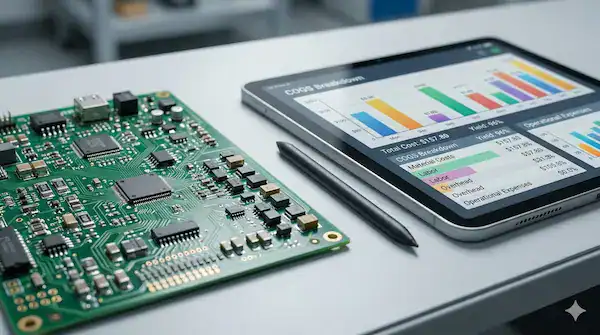
For a 100-board prototype run, turnkey usually costs $200-$400 less in total ownership because you avoid internal procurement labor and separate shipping fees. At 1,000 boards, a consigned model can save you 10-25% on component costs if you hold direct manufacturer pricing agreements.
So what does this actually mean for your budget? Let’s look at a standard 4-layer board with 150 SMT components.
| Cost Breakdown | Turnkey (100 pcs) | Consigned (100 pcs) | Turnkey (1,000 pcs) | Consigned (1,000 pcs) |
|---|---|---|---|---|
| Raw Component Cost | $450 | $400 | $3,500 | $3,000 |
| BOM Markup (8-15%) | $54 | $0 | $420 | $0 |
| Your Labor/Shipping | $0 | $250 | $0 | $300 |
| Total Estimated Cost | $504 | $650 | $3,920 | $3,300 |
Turnkey markup covers procurement labor, inventory storage, incoming quality inspection, and risk premium. Consigned quotes look cheaper on paper until you calculate your hidden costs. You spend hours negotiating with vendors, paying multiple shipping charges, and handling customs clearance.
80% of first-time customers submit BOMs with at least one error that would halt production. Last year, 35% of the consigned orders we processed arrived with at least one missing or incorrect BOM item. We had to pause production for these clients, causing an average 5-day delay. That single delay often costs hardware startups significantly more than our standard turnkey markup.
Not sure which model fits your budget? Upload your BOM to our engineering team — we provide a transparent, itemized quote that breaks down every cost.
Which model gets boards to you faster?
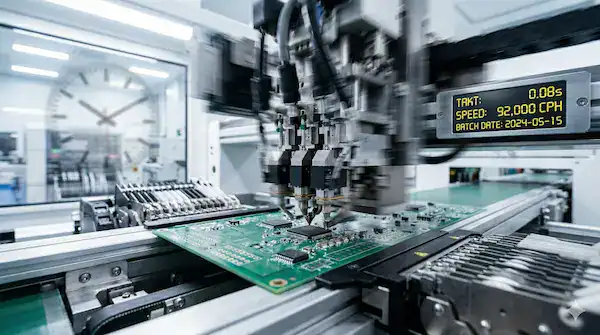
Turnkey assembly typically delivers finished boards in 2-3 weeks since the factory sources components simultaneously while fabricating the bare PCBs. Consigned assembly can theoretically finish the assembly phase in 1-2 weeks, but only if you deliver a 100% complete, error-free component kit on day one.
But here’s what most guides won’t tell you… Your component delivery timing dictates the entire schedule.
- Turnkey uses parallel processing: PCB fabrication and part sourcing happen simultaneously.
- Consigned uses sequential processing: We cannot schedule the SMT line until your final reel arrives.
- Component delays hit consigned orders harder: One missing $0.05 resistor stops the entire build.
Our data shows consigned customers wait an extra 3-7 days on average because their internal procurement teams face unexpected backorders. To make this concrete, here is what a standard production schedule looks like:
Turnkey Timeline:
- Day 1-3: BOM Review + Component Sourcing Started
- Day 1-5: PCB Fabrication (parallel)
- Day 5-10: Components Arrive
- Day 10-15: SMT Assembly + Testing
- → Total: ~15 working days (or 3-5 days if you utilize quick-turn PCB assembly services)
Consigned Timeline:
- Day 1-?: Waiting for your complete physical kit
- Day ?+1~3: Kit inspection and inventory counting
- Day ?+3~8: SMT Assembly + Testing
- → Total: Depends entirely on your kit readiness
What are the hidden risks most guides won’t mention?
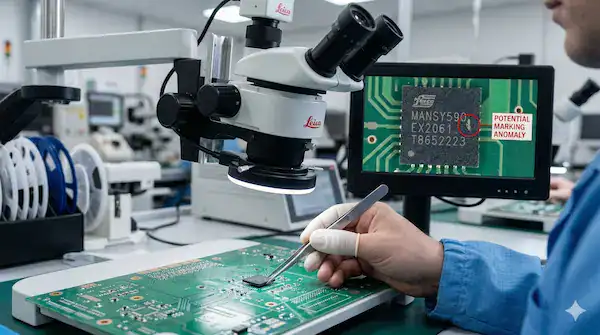
The biggest risk in turnkey is factory-substituted parts without your approval, while consigned assembly exposes you to counterfeit components and high attrition losses. You must send 15-25% extra passive components for consigned runs to cover machine loading waste and feeder threading.
Want the honest answer? Sourcing parts from unauthorized brokers to save money usually ends in disaster.
- Turnkey Risk: Low-tier factories might swap standard capacitors for cheaper brands.
- Consigned Risk: Fake ICs from grey market suppliers.
- Consigned Overage: You buy 100 boards, but you must supply enough 0402 resistors to build 125.
We recently received a batch of customer-supplied MCUs that looked physically perfect on the outside. Our pre-production 3D AOI and X-Ray inspection revealed the internal die did not match the original manufacturer—they were refurbished fakes. Catching that defect early saved the entire 500-board batch from the scrap bin. We run free DFM/DFA engineering reviews on every order to catch these precise issues.
When should you choose partial turnkey instead?
Partial turnkey works best when you need to supply proprietary ICs or hard-to-find sensors, but want the factory to source the hundreds of standard resistors and capacitors. You retain control over critical parts while offloading 80% of the BOM line items.
Now, here’s the part that surprises most customers… You do not have to pick extremes. Most companies transition to this hybrid model by their third or fourth manufacturing run.
Let’s say you are building an IoT gateway. You hold a direct pricing agreement for the main processor, but your BOM contains 120 lines of generic 0402 capacitors, standard LEDs, and USB headers. Sourcing those 120 lines yourself means managing dozens of reels, tracking multiple shipments from different distributors, and handling the attrition math for every single passive component.
By utilizing a partial turnkey approach:
- You supply the main MCU, custom RF modules, or pre-programmed chips.
- We buy the standard FR4 boards, generic connectors, and passive components.
- You completely skip managing reels of 10k resistors.
This hybrid approach gives you maximum flexibility. It keeps your intellectual property secure while heavily reducing your logistics workload.
Get a transparent quote within 24 hours. Just mark which items you will supply on your BOM, and we handle the rest.
How do you decide? A 5-question checklist
You can decide your assembly model in under five minutes by answering five simple questions about your order volume, supplier relationships, and inventory capabilities. If you lack established component suppliers, turnkey remains the safer bet.
The real question is… How much time can your engineering team dedicate to logistics?
- Do you have established relationships with component distributors?
- No → Turnkey
- Is your order volume exceeding 1,000 boards?
- No → Turnkey saves money
- Does your BOM include proprietary or branded core ICs?
- Yes → Partial Turnkey
- Can your team manage inventory, attrition margins, and separate shipping?
- No → Turnkey
- Has your product reached mass production with a completely stable BOM?
- Yes → Consigned begins to show ROI
We are completely straightforward about our capabilities: for stable, high-volume production runs above 5,000 boards where your supply chain is locked in, a dedicated consigned assembly house — or even an in-house line — may outperform our turnkey service on per-unit cost. However, if your batches are smaller or your engineering team is currently overwhelmed with supply chain tasks, turnkey provides an immediate return on investment.
FAQ
Can I switch from turnkey to consigned mid-project? Yes, you can transition models between batches. You must verify that your newly self-sourced components match the exact manufacturer part numbers (MPN) from the original turnkey run to prevent footprint mismatches. Upload your updated BOM to confirm compatibility.
Does turnkey assembly cost more than consigned? The raw component BOM price costs more due to the factory’s 8-15% markup. Your total cost often ends up lower for small runs because you eliminate internal labor, separate shipping fees, and inventory storage expenses. Get a free quote to compare the exact difference.
What files do I need for a turnkey quote vs. consigned quote? Turnkey quotes require your Gerber files, a complete BOM, and CPL (Centroid) data. Consigned quotes need the exact same files, plus a detailed packing list of the physical parts you plan to ship to our facility. Upload your files today for a free DFM check.
How much extra components should I send for consigned assembly? You must provide a 15-25% overage for passive components like resistors and capacitors to account for SMT machine feeder threading. High-value ICs typically require a 2-5% overage depending on the package type. Contact us to get exact attrition requirements for your specific build.
What happens if a component is out of stock in turnkey mode? Our purchasing team immediately flags the shortage and proposes form-fit-function alternative parts for your engineering team to approve. We never substitute parts without your explicit written permission. Reach out to our engineers to see how we handle your specific BOM.
Ready to manufacture? Upload your BOM and get a free quote within 24 hours.
Written by the QueenEMS Engineering Team