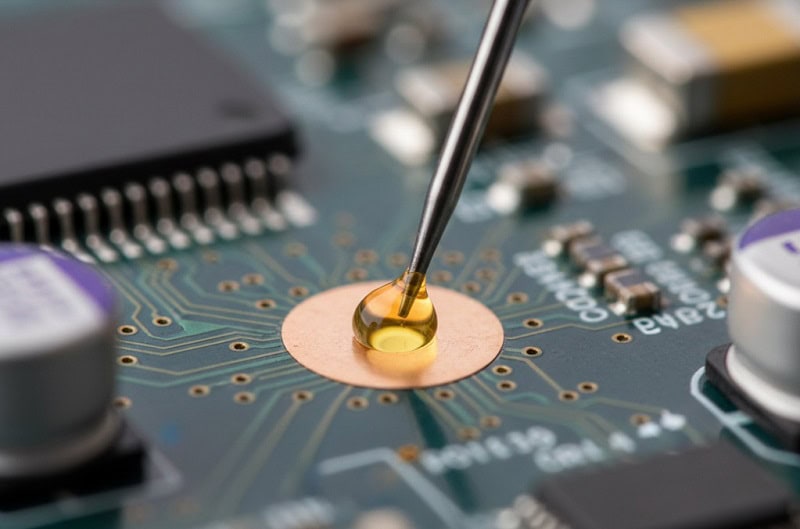
Flux in soldering is a chemical cleaning agent used before and during soldering to remove oxides from the surfaces of metals, ensuring a high-quality metallurgical bond between the solder and the components. Imagine you are overseeing a high-stakes production run for medical devices, only to find that your first batch has a 20% failure rate due to cold solder joints and intermittent connectivity. This frustrating scenario often stems from surface oxidation that prevents molten solder from wetting properly, leading to expensive rework and delayed shipments. Here is the deal: flux in soldering is the secret ingredient that solves these adhesion issues by chemically prepping the metal surfaces. At Queen EMS, we understand that selecting the right chemical profile is critical for long-term reliability. By mastering flux application, you can eliminate oxide-related defects and ensure your assemblies withstand the test of time.
1. What is the primary role of flux in soldering?
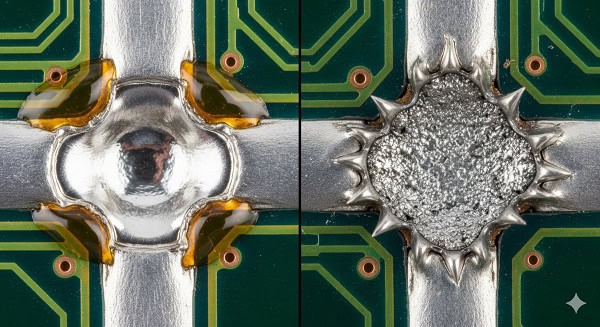
Flux in soldering acts as a powerful cleaning agent that removes oxidized layers from metal surfaces to facilitate the flow of molten solder. Without this chemical action, the solder would simply “bead up” on the surface rather than forming a reliable connection. You might be wondering how a liquid or paste can impact the structural integrity of your electronics.
- It chemically reduces oxides on the copper pads and component leads.
- It prevents further oxidation during the high-heat reflow or wave soldering process.
- It lowers surface tension to improve the “wetting” or spreading of the solder.
How does it prevent surface re-oxidation?
The flux forms a temporary protective barrier over the clean metal while the board is exposed to high temperatures. This barrier prevents oxygen in the air from reacting with the heated metal before the solder can seal the joint. Ready for the good part?
- Organic acids in the flux activate at specific temperatures to strip away contaminants.
- The resulting surface is “metallurgically clean,” allowing for a perfect atomic bond.
| Flux Function | Impact on PCB Assembly | Benefit |
| Oxide Removal | Cleaner bond surfaces | Reliable electrical paths |
| Wetting Agent | Even solder spread | Stronger mechanical joints |
| Thermal Barrier | Prevents re-oxidation | Consistent joint quality |
Mastering the oxide removal process is the first step toward achieving a zero-defect assembly line.
2. Why are there different flux in soldering types?
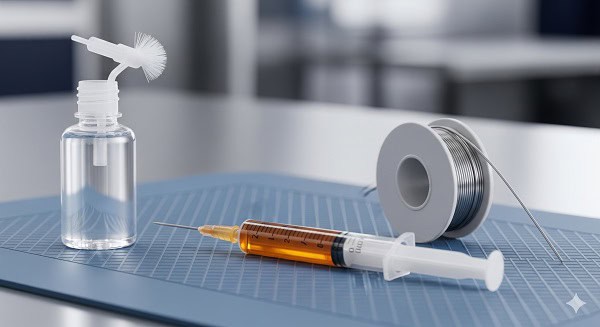
Flux in soldering types are categorized based on their chemical activity and the residues they leave behind, which directly influences the cleaning process required after assembly. Selecting the wrong type can lead to board corrosion or electrical leakage over time. Believe it or not, the chemistry used in flux in soldering can make or break your product’s lifespan.
- Rosin-based fluxes provide excellent protection but often require solvent cleaning.
- No-clean fluxes are designed to leave minimal, non-conductive residue.
- Water-soluble fluxes offer high activity for difficult-to-solder metals.
Which chemistry fits your application best?
High-reliability sectors like aerospace often prefer high-activity fluxes followed by rigorous cleaning to ensure absolute purity. Conversely, consumer electronics frequently utilize no-clean options to streamline production and reduce costs. What’s the real story?
- Rosin (R, RMA, RA) classifications indicate the level of activation.
- Synthetic fluxes are increasingly popular for lead-free soldering processes.
| Flux Category | Activation Level | Post-Soldering Cleaning |
| Rosin (R/RMA) | Low to Medium | Solvent Recommended |
| Water-Soluble | High | Mandatory Water Wash |
| No-Clean | Low | Not Required |
Understanding these chemical differences allows you to choose a process that balances cost with performance.
3. How does rosin flux in soldering work?
Flux in soldering using rosin-based formulas relies on natural resin extracted from pine trees, which becomes acidic when heated to strip away oxides. At room temperature, rosin is inert and non-conductive, making it a safe choice for delicate electronics. This is where it gets interesting for engineers focusing on longevity.
- RMA (Rosin Mildly Activated) is the gold standard for many military applications.
- It provides a protective coating that encapsulates any remaining ions after soldering.
- RA (Rosin Activated) contains stronger additives for faster oxide removal.
Is rosin still relevant in the lead-free era?
Modern rosin formulations have been adapted to handle the higher temperatures required for lead-free alloys. They remain a favorite for PCBA testing prototypes where rework and hand-soldering are common. But wait, there’s more.
- Rosin is highly effective at preventing solder bridges in fine-pitch components.
- The residue is typically non-corrosive unless specific activators are added in high concentrations.
[Image showing the pine resin extraction process transitioning into a high-purity rosin flux used in electronics manufacturing]
| Rosin Type | Activity Level | Typical Use Case |
| R (Pure Rosin) | Very Low | Gold or pre-cleaned surfaces |
| RMA | Moderate | Standard high-reliability boards |
| RA | High | Heavily oxidized or legacy parts |
Rosin remains a pillar of the industry due to its unique ability to be safe when cold and effective when hot.
4. Why use water-soluble flux in soldering?
Flux in soldering with water-soluble components offers the highest level of chemical activity, which is essential for soldering to oxidized or non-precious metals. These fluxes are highly acidic and must be washed off completely with deionized water to prevent long-term corrosion. You might be wondering why anyone would choose a flux that requires such intensive cleaning.
- It ensures 100% wetting even on difficult-to-solder surfaces.
- Water is an environmentally friendly and low-cost cleaning solvent.
- The high activity level makes it ideal for large-scale wave soldering.
Does the cleaning process affect your yield?
An automated aqueous cleaning system is mandatory when using these fluxes to ensure no ionic contamination remains. Failure to clean properly can lead to “dendritic growth,” causing short circuits in humid environments. Ready for the good part?
- Boards come off the line looking pristine and “shiny.”
- It is the preferred method for boards with very dense component layouts.
| Factor | Water-Soluble Flux | No-Clean Flux |
| Oxide Removal | Superior | Moderate |
| Cleaning Cost | Higher (Equipment) | Zero |
| Visual Appeal | Excellent (Pristine) | Matte/Waxy Residue |
Key Takeaway: Water-soluble flux is perfect for high-density boards where total surface cleanliness is a priority.
5. What makes no-clean flux in soldering unique?
Flux in soldering known as “no-clean” is formulated with low levels of solids so that the remaining residue is non-conductive and does not need to be removed. This technology revolutionized mass production by eliminating the washing stage, which significantly reduces production time. Here is the deal: flux in soldering with no-clean chemistry is now the most common choice for general consumer electronics.
- Residues are designed to be waxy and inert after the reflow cycle.
- It significantly reduces water usage and waste treatment costs in the factory.
- It is compatible with most in-circuit testing (ICT) probes.
Are there downsides to leaving residue behind?
While the residue is safe, it can sometimes interfere with conformal coating adhesion or purely aesthetic requirements. If your board requires a high-gloss finish, you might still need a brief cleaning cycle. But here is the kicker.
- The waxy coating can actually protect the joint from environmental moisture.
- Modern no-clean fluxes are virtually invisible to the naked eye.
| Advantage | Benefit to Manufacturer | Benefit to End-User |
| No Wash Stage | Faster turnaround times | Lower product price |
| Inert Residue | Safe electrical performance | Long-term reliability |
| Environmental | Reduced chemical waste | Greener manufacturing |
Key Takeaway: No-clean flux is the most cost-effective path for the majority of modern PCB assembly projects.
6. How does flux in soldering affect solder joint reliability?
Flux in soldering directly impacts the metallurgical bond, as any trapped flux or unremoved oxides can create “voids” or weak spots in the joint. Reliable joints depend on the flux completing its job and then either being removed or becoming inert. You might be wondering how microscopic residues can lead to massive mechanical failure.
- Incomplete oxide removal leads to “cold joints” that snap under vibration.
- Trapped gas from flux outgassing can create large voids inside the solder ball.
- Proper activation ensures the solder “intermetallic layer” forms correctly.
Can flux activity cause long-term corrosion?
If a high-activity flux in soldering is not deactivated by heat or removed by washing, it will continue to eat away at the copper traces. This is particularly dangerous for products used in high-humidity or tropical climates. What’s the real story?
- Ionic contamination is the leading cause of field failures in industrial electronics.
- Correct reflow profiles are essential to ensure the flux is fully “spent.”
| Joint Issue | Cause | Prevention |
| Cold Joint | Insufficient flux activity | Use stronger flux or clean surface |
| Voiding | Excessive flux outgassing | Optimize reflow ramp rate |
| Corrosion | Uncleaned acidic residue | Mandatory aqueous washing |
Key Takeaway: The chemistry of the flux and the precision of the reflow oven are equally responsible for joint strength.
Experiencing field failures due to poor soldering profiles? Our Quick-Turn PCBA process guarantees optimized thermal profiling and zero-defect soldering.
7. Why is the reflow profile critical for flux in soldering?
Flux in soldering requires a specific temperature ramp to activate its cleaning agents and a “soak” period to remove all oxides before the solder melts. If the temperature rises too fast, the flux may boil away, leaving the surfaces unprotected. This is where it gets interesting for production managers.
- The “pre-heat” phase evaporates solvents to prevent solder spattering.
- The “soak” phase allows the flux to chemically strip the oxides.
- The “reflow” phase is where the solder and clean metal finally bond.
What happens if the flux burns off too early?
If the flux is exhausted before the solder reaches its liquidus temperature, the metal will re-oxidize, resulting in grainy or dull solder joints. This is a common issue in quality control when moving between leaded and lead-free processes. Ready for the good part?
- Modern reflow ovens use multiple zones to fine-tune the flux activation time.
- Profile sensors track the exact board temperature to ensure the flux is active at the right moment.
| Reflow Zone | Flux Behavior | Result |
| Pre-heat | Solvent evaporation | Stable flux layer |
| Soak | Chemical activation | Oxide-free metal |
| Reflow | Outgassing/Exhaust | Strong metallurgical bond |
Key Takeaway: A perfectly tuned reflow profile ensures the flux does its job without leaving harmful, active chemicals behind.
8. How does flux in soldering impact fine-pitch SMT?
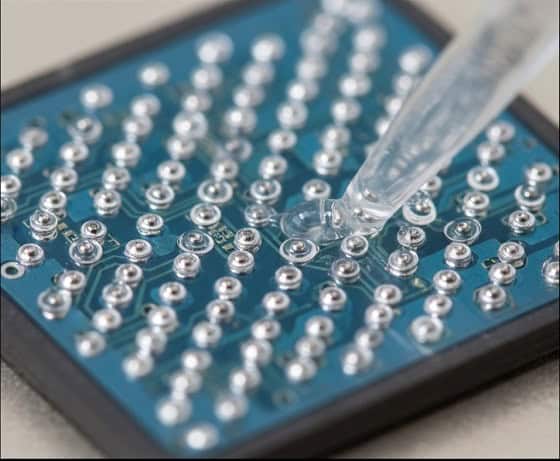
Flux in soldering for fine-pitch components requires high-viscosity “tacky flux” to hold tiny parts in place during placement and prevent solder bridging between close pins. As components shrink, the volume of flux becomes critical—too much causes bridges, too little causes opens. Here is the deal.
- Tacky flux acts as a temporary adhesive during the “pick and place” process.
- It ensures that the tiny volume of solder paste in a 0201 component wets the entire pad.
- Proper flux selection reduces the “balling” effect where tiny solder spheres scatter across the board.
Is flux more important for BGA and CSP?
In Ball Grid Array (BGA) assembly, the flux must travel under the chip and activate all the balls simultaneously. We often use flux in soldering in paste form specifically for these high-density interconnects. But wait, there’s more.
- The flux helps “self-align” the chip as the solder melts and surface tension takes over.
- No-clean tacky fluxes are standard for BGA rework to avoid cleaning under the package.
| Component Type | Flux Requirement | Goal |
| 0201 Passive | Low residue / Tacky | Prevent tombstoning |
| BGA | High activity / Tacky | Self-alignment and wetting |
| QFP | High wetting spread | Prevent pin bridging |
Key Takeaway: For advanced SMT, the physical properties of the flux are as important as its chemical properties.
9. Why is cleaning essential after using flux in soldering?
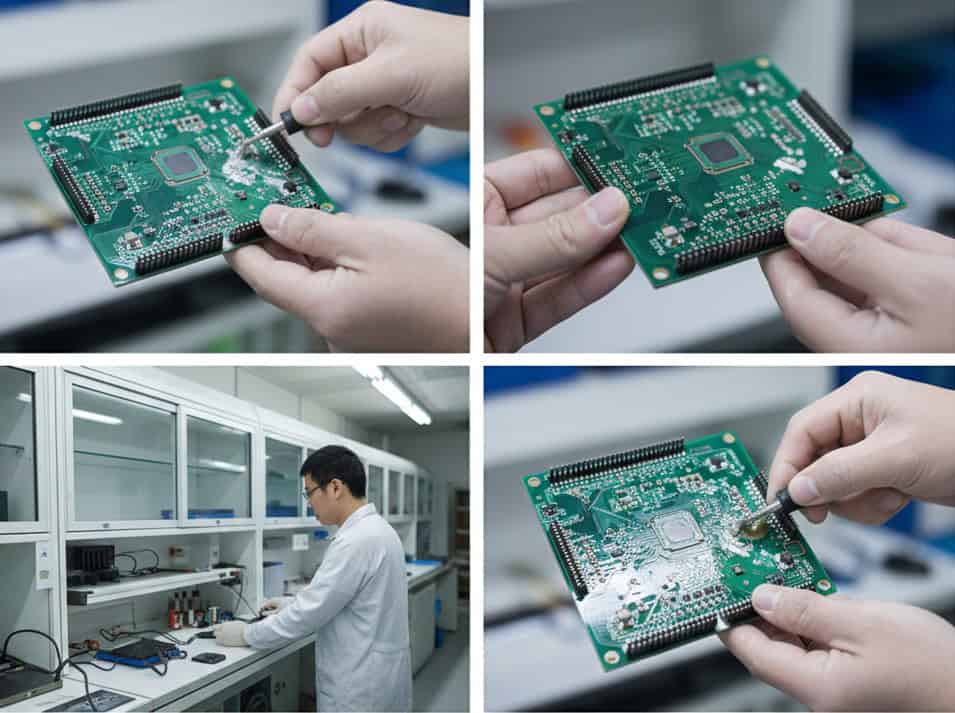
Flux in soldering residues, if left unmanaged, can attract moisture and lead to electrochemical migration, where metal “whiskers” grow between pads and cause shorts. While no-clean flux exists, many mission-critical boards are still cleaned to ensure zero ionic contamination. You might be wondering if your product needs this extra step.
- Medical and military boards almost always require a full aqueous wash.
- Cleaning improves the adhesion of conformal coatings used for weatherproofing.
- It allows for a more accurate visual and PCBA testing inspection.
What are the modern cleaning techniques?
Today, we use high-pressure spray-in-air systems and ultrasonic cleaners to reach the tight spaces under tiny components. These systems use environmentally friendly chemistry to neutralize the flux acids. What’s the real story?
- Ionic contamination testers can measure the board’s cleanliness down to the microgram.
- Proper cleaning ensures that “no-clean” residues don’t interfere with high-frequency signals.
| Cleaning Method | Best For | Benefit |
| Aqueous Wash | High-volume production | Environmentally safe |
| Ultrasonic | Dense component clusters | Deep under-chip cleaning |
| Manual Solvent | Rework and Repair | Fast and localized |
Key Takeaway: Post-solder cleaning is the final guarantee of a high-reliability hardware product.
10. How to choose a partner for flux in soldering control?
Flux in soldering management requires a manufacturing partner with advanced process control and a deep understanding of material science to avoid long-term reliability issues. You need a factory that monitors flux density and reflow profiles in real-time. Here is the deal: the difference between a cheap board and a premium one is often found in the quality control of the soldering chemistry.
- Verify if the factory uses automated flux dispensers for consistency.
- Check their capability for ionic contamination testing.
- Ensure they can provide thermal profile reports for your specific board design.
Does your partner understand your industry standards?
A professional factory will recommend specific flux chemistries based on whether your product is for consumer, industrial, or life-support applications. At Queen EMS, we treat every joint as a critical connection. Ready for the good part?
- We provide transparent documentation of our chemical and cleaning processes.
- Our engineering team helps you optimize your BOM for the best soldering results.
| Partner Metric | Low-Cost Shop | Professional Partner |
| Flux Control | Manual/Inconsistent | Automated/Logged |
| Testing | Visual Only | ICT/X-Ray/Ionic |
| Cleanliness | “Looks Good” | Measured & Certified |
Key Takeaway: Your assembly partner’s expertise in flux management is the ultimate safeguard for your brand’s reputation.
Conclusion
In summary, we have explored how flux in soldering serves as the vital link between raw metal and a reliable solder joint by removing oxides, preventing re-oxidation, and improving wetting. From the inert safety of rosin to the high-power cleaning of water-soluble formulas, selecting the right chemistry is essential for your product’s specific environment and performance needs. You should know that the best solder joints are a result of a content loop: high-quality materials, precise thermal profiling, and rigorous testing. At Queen EMS, our vision is to provide the transparent engineering expertise you need to ensure every PCBA we deliver is built to last. If you are ready to eliminate soldering failures and boost your production yield, please contact us today to discuss your next project. Let’s build a future of reliable connections, together.
FAQ
Q1: Can I use “no-clean” flux for medical devices? Generally, no. Most medical standards require a clean board to ensure no ionic residues can interfere with sensitive readings or cause long-term corrosion.
Q2: What’s the best way to remove old rosin flux residue? Isopropyl alcohol (IPA) and a specialized ESD-safe brush are the most effective tools for manual cleaning, though automated aqueous systems are better for mass production.
Q3: How do I know if my flux has “expired”? Flux contains solvents that evaporate over time. If your flux becomes thick, crusty, or fails to spread easily, it should be replaced to avoid poor wetting.
Q4: Is liquid flux better than flux paste? It depends on the application. Liquid flux is ideal for wave soldering and large areas, while flux paste (tacky flux) is better for high-precision SMT placement and BGA rework.
Q5: Does lead-free soldering require more flux? Not necessarily more flux, but usually a “stronger” or more thermally stable flux, as lead-free alloys have higher melting points and are more prone to oxidation.