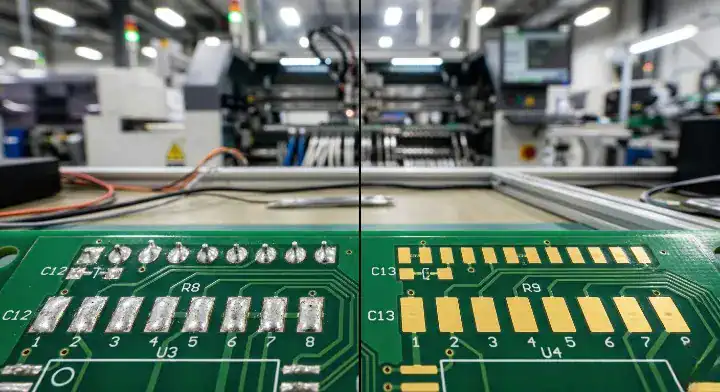
Quick Answer: Choosing between hasl vs enig pcb surface finishes comes down to your component list, not your budget. Lead-free HASL costs $0.10–$0.30 per square inch and works for boards with through-hole components and pads above 0.8mm pitch. ENIG costs $0.30–$0.60 per square inch but is mandatory the moment your BOM includes any BGA, QFN, or components with pitch below 0.5mm — skipping it risks tombstoning and cold joints that cost far more to rework than the finish upgrade itself.
Key takeaways:
- ENIG adds roughly $0.20–$0.30/sq in over HASL — on a 100×100mm board, that’s about $2–$3 extra per board.
- Any BGA or QFN on your BOM is an automatic ENIG trigger, regardless of pitch.
- HASL’s uneven surface increases tombstoning rates on 0402 and smaller components by 3–5x compared to ENIG.
- Black pad in ENIG is not an inherent defect — it’s a process control failure; IPC-4552 compliance eliminates the risk.
- Prototypes: HASL is fine for hand-soldering iterations. SMT production runs: reassess before committing.
Table of Contents
- What Is the Real Cost Difference Between HASL and ENIG?
- Which Components Force You to Choose ENIG?
- What Happens to Your Assembly Yield When You Pick the Wrong Finish?
- When Is HASL Still the Right Call?
- Is ENIG Black Pad Risk Real, or Is It Overblown?
- Lead-Free HASL vs ENIG: Does RoHS Compliance Change Your Decision?
- Frequently Asked Questions About PCB Surface Finishes
- The One-Minute Decision Checklist: HASL or ENIG?
You’ve sent your Gerber files out for quoting and stared at the hasl vs enig pcb surface finish options, wondering if the price jump is justified. Pick the wrong one, and you either overpay on fabrication or face a 20% scrap rate at the assembly line because the solder paste didn’t print flat. After processing 2,400+ assembly orders last year, we’ve seen this exact confusion ruin production runs. Let’s look at what actually drives this decision based on factory floor realities, so you can stop guessing and start building.
What Is the Real Cost Difference Between HASL and ENIG?
HASL typically costs $0.10 to $0.30 per square inch, while ENIG ranges from $0.30 to $0.60 per square inch. For a standard 100x100mm board, upgrading to ENIG adds roughly $2 to $3 to your total PCB fabrication cost breakdown.
You pay more for ENIG because it requires a complex electroless chemical process depositing nickel and immersion gold, whereas HASL is literally dipping the board in molten solder and blowing off the excess with hot air. The cost gap becomes negligible at high volumes, but for small runs, that base chemical setup fee impacts your per-board price. Your choice of solder mask specification also plays a role in total costs, but the finish dictates your assembly success.
So what does this mean in practice? * Small prototypes: The ENIG upgrade might add $30-$50 to your total cart.
- Medium runs (1,000 pcs): You are looking at a $2,000 to $3,000 difference.
- Hidden savings: ENIG prevents costly hand-rework on SMT lines, often paying for itself if your board has complex ICs.
Which Components Force You to Choose ENIG?
You must switch to ENIG if your BOM includes any BGA, QFN, components with a pitch below 0.5mm, or chip sizes 0402 and smaller. While collective wisdom sometimes suggests 0.5mm is the HASL cutoff, 0.8mm pitch is the actual safety boundary for high-yield production.
Engineers frequently ask on forums if the 0.8mm rule holds true. Yes, it does. At 0.5mm on HASL, you are relying entirely on the solder paste stencil to compensate for the board’s uneven dome-shaped pads. Sometimes you get lucky. Usually, you get bridges. Furthermore, BGAs are absolute ENIG triggers. Any BGA requires perfectly coplanar pads so all solder balls collapse evenly during reflow. If you are working with HDI PCB manufacturing, ENIG is non-negotiable.
The factory floor reality is… you should let your BOM make the decision.
| Component Type / Condition | Recommended Finish | Reason |
|---|---|---|
| Through-hole only, pitch >1.0mm | HASL (Lead-Free) | Planarity is not required; HASL is fully adequate. |
| SMD, pitch >0.8mm, no BGA/QFN | HASL (Lead-Free) or ENIG | HASL for budget-sensitive; ENIG for stable yield. |
| Any BGA (regardless of pitch) | ENIG — Mandatory | BGAs require perfectly flat pads for uniform solder ball contact. |
| QFN (with exposed thermal pad) | ENIG — Mandatory | Thermal pad solder voids are uncontrollable on uneven HASL surfaces. |
| Any IC with pitch ≤ 0.5mm | ENIG — Mandatory | HASL unevenness exceeds pad tolerance, causing cold solder joints. |
| 0402 and smaller chip components | ENIG — Highly Recommended | Tombstoning rate is 3–5x higher on HASL. |
| RF / High-frequency modules (>3GHz) | ENIG — Mandatory | HASL’s skin effect causes signal loss at high frequencies. |
| Hand-soldered prototypes (testing only) | HASL — Acceptable | Hand soldering tolerates unevenness; sensible for saving prototype costs. |
Upload your BOM for a free DFM check — we’ll flag any finish-sensitive components before you commit to a surface finish.
What Happens to Your Assembly Yield When You Pick the Wrong Finish?
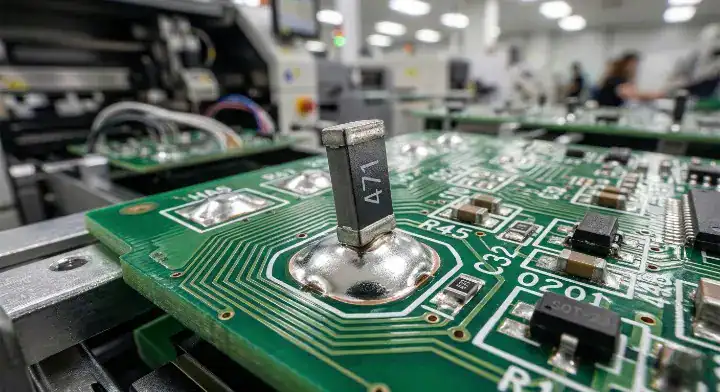
Assembling fine-pitch components on HASL boards increases tombstoning and cold solder joint rates by 3 to 5 times compared to ENIG. You might save $200 on a prototype batch, but you will lose thousands in manual rework and scrapped boards on the SMT assembly process line.
We see this specific scenario weekly: A customer asks, “I usually prototype in HASL because revisions are easier to hand solder. But for production with QFNs and fine pitch, should I switch to ENIG?” The answer is a hard yes. Hand soldering tolerates the uneven topography of HASL because the iron melts the existing solder. An SMT stencil printer cannot adapt. The squeegee scrapes across the uneven HASL domes, depositing inconsistent paste volumes. For a QFN, this means the large exposed thermal pad sits high on a solder dome, lifting the perimeter pins off the board and creating massive voids.
Pull back the curtain on this… * Tombstoning: 0402 and 0201 passives slide off the uneven HASL slopes during reflow.
- Coplanarity failures: Fine-pitch ICs fail to make contact on one side.
- The rule: Prototypes for bench testing can use HASL. Production runs with QFNs/BGAs must transition to ENIG.
When Is HASL Still the Right Call?
Lead-free HASL remains the best choice for through-hole dominant boards, designs with component pitches larger than 0.8mm, and simple functional prototypes. It provides excellent solderability and forms very strong mechanical joints for legacy or power-heavy applications.
Do not pay for ENIG if you don’t need it. If you are building a simple power supply board, a basic motor controller with large discrete components, or a test jig, HASL is perfectly fine. The solder-on-solder bond formed during assembly is incredibly strong. It is also highly resilient to multiple handling cycles before assembly, unlike bare copper finishes.
Let’s look at the numbers.
- Cost savings: 15% to 25% cheaper overall fabrication costs on large panels.
- Solderability: Solder wets to HASL better than almost any other finish.
- Durability: Takes physical scratching and handling better than thin immersion gold.
Is ENIG Black Pad Risk Real, or Is It Overblown?
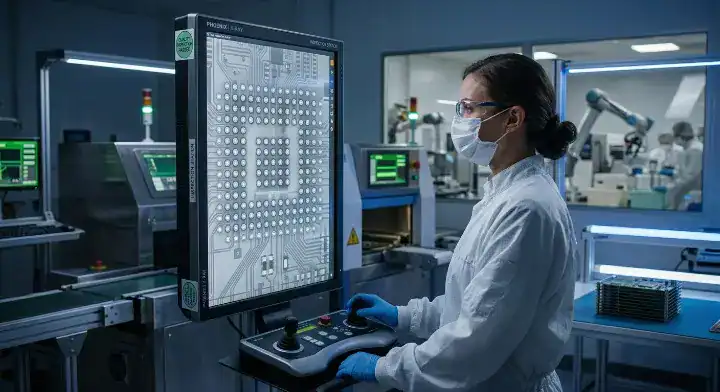
ENIG black pad syndrome occurs in less than 0.1% of boards from high-quality manufacturers, making it a highly overblown risk today. It happens due to poor nickel bath control causing hyper-corrosion, not an inherent flaw in the ENIG surface finish itself.
Engineers constantly worry about this based on horror stories from fifteen years ago. “I keep hearing about black pad syndrome with ENIG. How big of a risk is it actually, and can I avoid it?” The risk drops to near zero if you use a reputable board house. Black pad happens when an overly aggressive gold bath corrodes the underlying nickel layer. The terrifying part is that X-ray inspection won’t catch it — you only find out when the component falls off. You avoid it by demanding your supplier follows strict Statistical Process Control (SPC).
It comes down to this.
- Root cause: Exhausted chemical baths and incorrect phosphorus levels.
- Prevention: Require IPC-4552 compliance from your fabricator.
- Verification: Ask if their gold thickness strictly stays between 2 and 4 µin.
Not sure which finish your design needs? Send us your Gerbers and we’ll review it for free.
Lead-Free HASL vs ENIG: Does RoHS Compliance Change Your Decision?
Both lead-free HASL and ENIG are fully RoHS compliant, but lead-free HASL requires higher reflow temperatures (around 260°C) and produces an even rougher surface than traditional leaded HASL. If you need RoHS compliance and have any fine-pitch SMD components, ENIG is the only safe engineering choice.
Leaded HASL is practically dead outside of military and aerospace exemptions. When the industry shifted to RoHS, the lead-free alloys used in modern HASL became less fluid. They do not blow off the pads as smoothly during the air-knife process, making the coplanarity problem worse. Furthermore, lead-free assemblies often require multiple thermal cycles (top side, bottom side, selective wave). ENIG withstands these multiple reflow profiles without oxidizing, while HASL degrades faster after the first pass.
The bottom line is clear.
- Shelf life: ENIG comfortably lasts 12+ months in storage. HASL starts degrading between 6 to 12 months.
- Thermal cycles: ENIG survives double-sided SMT plus wave soldering effortlessly.
- Skin effect: At high frequencies (>3GHz), HASL’s uneven surface causes signal loss. ENIG provides a more predictable transmission line.
Frequently Asked Questions About PCB Surface Finishes
Can I use HASL for boards with 0.5mm pitch components? No, it is highly risky for your production yield. While it is technically possible to print solder paste on a 0.5mm HASL pad, the uneven domed surface guarantees a high rate of solder bridges and cold joints on the assembly line. Upload your BOM to QueenEMS for a free DFM check, and we will quickly verify if your components require a finish upgrade.
How much more expensive is ENIG compared to HASL? ENIG typically costs $0.20 to $0.30 more per square inch than lead-free HASL. For a standard 100x100mm circuit board, this adds approximately $2 to $3 to the total fabrication cost, but it easily pays for itself by eliminating SMT rework on fine-pitch components. Get a transparent quote within 24 hours at QueenEMS to see the exact price difference for your specific design.
How do I know if my PCB has ENIG black pad syndrome? You cannot detect black pad with standard visual checks or X-ray inspection. It requires destructive cross-section analysis to see the corroded nickel layer beneath the gold, which is exactly why choosing a factory with strict chemical controls is critical. Request a free first-article inspection on your first order with us to ensure perfect ENIG plating quality.
The One-Minute Decision Checklist: HASL or ENIG?
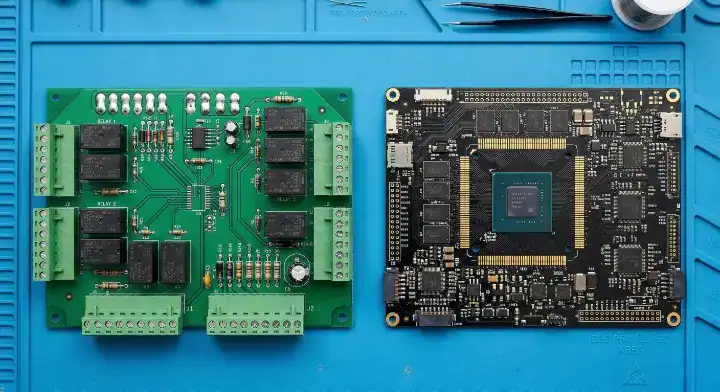
Choose HASL for simple through-hole boards or prototypes to save money, but switch to ENIG the moment your design requires flat pads, long shelf life, or high-density component placement. Use the scenario matrix below to make your final choice in five seconds.
Stop debating the pennies on fabrication and look at your assembly risks. We offer free DFM/DFA engineering review on every order to catch these exact mismatches before they hit the floor. If you guess wrong, you pay for it in rework stations and angry customers.
Think about it this way.
| Your Board Scenario | Finish Decision | Reasoning |
|---|---|---|
| Pure THT board, large pitch connectors | HASL | Saves money, no difference in performance. |
| SMDs present but min pitch is 0.8mm+, no BGA | HASL or ENIG | Depends on your budget and shelf-life requirements. |
| Any BGA or QFN in the BOM | ENIG, no exceptions | HASL cannot meet the extreme planarity requirements of BGAs/QFNs. |
| RoHS compliance required + fine-pitch SMDs | ENIG | Lead-free HASL has poor planarity; ENIG is the correct choice. |
| Industrial / Medical, shelf life >12 months | ENIG | HASL oxidation risk increases after long-term storage. |
| Rapid prototype, <10 pcs, hand-soldered testing | HASL | Best cost-efficiency; finish can be switched for mass production. |
Written by the QueenEMS Engineering Team. Ready to build your next board? Contact us today at https://www.queenems.com/