Quick Answer: First article inspection (FAI) in PCB assembly verifies the initial machine setup to prevent batch-wide defects, while Automated Optical Inspection (AOI) scans individual boards during production for visible surface errors. You need FAI for any new design, BOM change, or batch over 50 units because AOI alone will pass 100% of boards that have systematic setup errors, like consistently reversed polarized components. Key takeaways:
- FAI catches systematic errors (wrong MPN, layout spacing risks) that AOI completely misses.
- Full-batch AOI only catches optical surface defects like missing parts or solder bridges.
- A 50-piece prototype run with BGA components requires FAI because a wrong setup means 50 scrapped boards.
- FAI typically costs $50–$200 per setup, but premium EMS providers include it for free.
Table of Contents
- What Is the Difference Between First Article Inspection and AOI in PCB Assembly?
- What Can AOI Actually Catch — and What Does It Miss?
- When Is First Article Inspection Required vs Optional?
- Do You Need FAI for a Prototype Order or Only for Production?
- How Do You Require FAI in Your Purchase Order?
- What Does a Complete FAI Report Include?
- How Much Does First Article Inspection Cost?
- FAQ
You sent your files to the factory, paid the invoice, and waited three weeks. When the 500 boards arrived, the inspection report showed they passed Automated Optical Inspection (AOI) with flying colors. But when you powered them up in the lab, every single unit failed because the factory loaded a batch of polarized capacitors backwards. After processing 2,400+ assembly orders last year, we see this exact nightmare happen to hardware teams who assume AOI means 100% protection. Here is the blunt truth about what AOI actually catches, what it misses, and why a proper first article inspection is your only real safety net against batch-wide disasters.
What Is the Difference Between First Article Inspection and AOI in PCB Assembly?
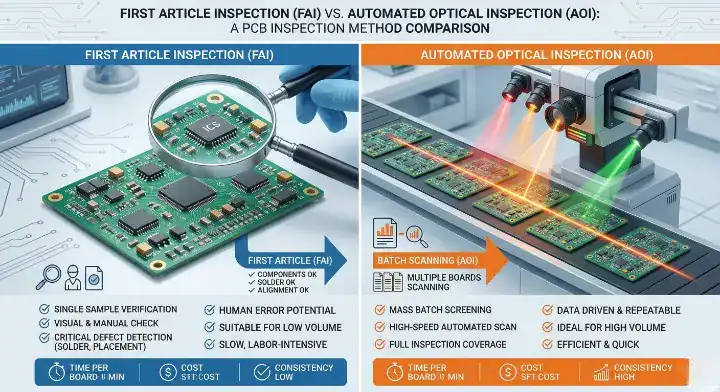
First article inspection (FAI) is a comprehensive verification of the very first fully assembled board to prove the production line is set up correctly, while AOI is an automated camera system that checks every subsequent board for random visible defects. You run an FAI once per batch to prevent systematic errors, and you run AOI continuously to catch isolated soldering mistakes.
The most dangerous assumption procurement managers make is treating these two methods as interchangeable. They serve completely different functions in the SMT assembly process.
Here is where the confusion starts:
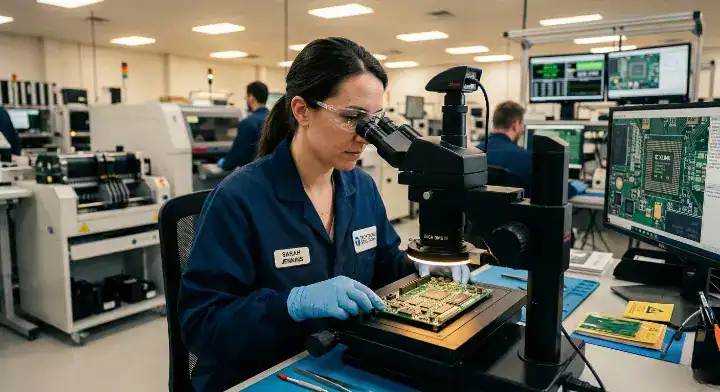
- FAI (The Setup Validator): A human engineer, often using specialized digital microscopes and LCR meters, verifies that the bare board, the solder paste, the component reel loading, and the pick-and-place programming are 100% accurate according to your BOM and Gerbers.
- AOI (The Production Monitor): A machine takes high-speed photos of the finished boards and compares them to a reference image. If the reference image (the first board) is wrong, the AOI will happily approve thousands of defective boards.
Inspection Methods Comparison
| Inspection Type | Timing | Target | What It Catches | What It Misses | Cost Impact |
|---|---|---|---|---|---|
| FAI | Before mass production starts | Setup accuracy & BOM match | Wrong MPNs, orientation, spacing risks | Hidden inner-layer defects | $50–$200 (or free with some EMS) |
| AOI | During/after reflow soldering | Individual board surface | Missing parts, solder bridges, shifts | BGA voids, wrong part with same package | Included in assembly per-board price |
| X-Ray | After reflow | Hidden solder joints | BGA/QFN voids, hidden shorts | Surface anomalies, wrong MPNs | High machine time cost |
| ICT | After assembly | Electrical functionality | Opens, shorts, wrong values | Long-term reliability issues | High NRE for custom test fixtures |
This breakdown shows why relying on a single method leaves you vulnerable. You use FAI to get the baseline right, and AOI to keep the machines honest during the run.
Bottom line: FAI protects your entire batch from a $10,000 setup mistake, while AOI protects individual boards from a 10-cent machine hiccup. You need both.
What Can AOI Actually Catch — and What Does It Miss?
AOI systems capture 95% of visible surface defects like missing components, solder bridges, and misalignments, but they completely miss internal BGA voids, incorrect part numbers that share the same package, and mechanical spacing risks. If the factory loads the wrong 0402 resistor reel, the AOI sees a perfect 0402 package and passes the board.
Hardware engineers often complain on forums that their factory “did AOI” but still shipped a bad batch. This happens because optical systems lack context. They do not read part numbers, and they do not evaluate design intent. Without proper PCBA testing protocols starting at board one, you are flying blind.
What AOI explicitly catches:
- Missing components
- Solder bridges between visible pins
- Components shifted outside acceptable IPC tolerances
- Insufficient or excessive solder volume
What AOI completely misses:
- Wrong MPN: A 10k resistor looks identical to a 100k resistor to a camera.
- Internal voids: BGA, LGA, and QFN connections are hidden under the chip.
- Systematic orientation errors: If the machine was programmed backwards from the start, the AOI reference is backwards.
Let’s get specific: We recently had a client who almost authorized a 500-piece run at another facility. The previous factory’s AOI passed 100% of the boards. The problem? A specific IC was placed with the polarity reversed across the entire batch. AOI simply matched the production boards to the incorrect first board. An FAI would have caught this before board number two ever hit the soldering paste printer.
Factory Veteran Insight: 60% of the field failures we analyze from other manufacturers passed AOI without a single flag. The most common culprit is alternative components. A buyer swaps a hard-to-find chip for a cheaper alternative that looks identical on the outside but has a different internal pinout. We implemented a mandatory BOM-to-reel physical verification during our FAI process, cutting these specific systematic errors down to absolute zero.
AOI Capabilities Checklist
| Defect Type | Can AOI Catch It? | What Additional Method Do You Need? |
|---|---|---|
| Solder Bridges (Visible) | Yes | None |
| BGA Joint Voids | No | 3D X-Ray Inspection |
| Wrong Component Value | No | FAI BOM Verification / LCR Measurement |
| Polarity/Orientation | Yes (if reference is correct) | FAI to establish correct reference |
| Component Spacing Risk | No | FAI manual engineering review |
If your manufacturer relies purely on optical matching without a human engineer validating the first board’s bill of materials, you are taking a massive gamble.
Bottom line: AOI is a fast, dumb camera that confirms consistency; it requires human intelligence during FAI to confirm accuracy.
When Is First Article Inspection Required vs Optional?
You must require a first article inspection for any order exceeding 50 pieces, any board containing BGA/QFN packages, or any project where you have changed the BOM or the manufacturing supplier. FAI is only optional for simple, 2-layer prototype runs of under 10 boards where you plan to test and debug the hardware manually yourself.
Making the call between requiring FAI or skipping it comes down to risk management. If you are building a consumer gadget where a failure means a bad review, that is one thing. If you are building an industrial controller that needs to meet IPC Class 3 standards, a bad setup is catastrophic.
You absolutely need FAI when:
- New design, first production run: Even if prototypes worked, mass production uses different machines.
- Any BOM change: Swapping an MCU or even a passive component brand requires a setup check.
- Changing suppliers: Never trust a new factory’s internal processes on the first run.
- Complex packages: BGA assembly demands FAI paired with 3D X-ray because you cannot rework 500 boards cheaply.
- Medical/Automotive applications: IPC Class 3 compliance strictly requires documented setup verification.
FAI Decision Matrix
| Project Scenario | Order Volume | BOM Changes? | IPC Requirement | Conclusion |
|---|---|---|---|---|
| Simple breakout board | < 10 pcs | No | Class 1 | AOI is enough |
| New IoT device v1.0 | 50+ pcs | No | Class 2 | Must do FAI |
| Existing product, new factory | 1,000 pcs | No | Class 2 | Must do FAI |
| Industrial sensor update | 500 pcs | Yes (Alternative IC) | Class 3 | Must do FAI + X-Ray |
If you are on the fence, ask yourself what it would cost to scrap the entire order.
Bottom line: If a setup error on the pick-and-place machine will cost you more than $500 in scrapped boards, FAI is a mandatory requirement.
Do You Need FAI for a Prototype Order or Only for Production?
You need FAI even for prototype orders of 50 pieces because prototyping verifies your design, whereas FAI verifies the factory’s automated production equipment setup. If you run 50 complex boards without FAI, a single misplaced reel in the machine will instantly hand you 50 expensive, unusable coasters.
Engineers frequently ask on StackExchange if they can skip FAI because “it is just a prototype.” This stems from a misunderstanding of what a prototype run actually is in a modern EMS facility.
The reality of modern prototyping: Your early desk-built prototypes verified your schematic. But when you order 50 boards from a factory, they are not hand-soldering them. They load your design into an automated SMT line.
- The Setup Cost: Setting up a pick-and-place machine for 50 boards takes the exact same amount of time as setting it up for 5,000 boards.
- The Risk: If the operator assigns the 3.3V regulator to the 5V regulator footprint, the machine will build all 50 boards flawlessly wrong in about four minutes.
Here is the catch: If your prototype run is just 5 pieces built in a highly manual NPI (New Product Introduction) cell, an informal check might suffice. But the moment your boards touch an automated line, you need that first unit verified.
Bottom line: Never confuse design prototyping with manufacturing verification; require FAI on any automated run, even if the volume is only 50 units.
How Do You Require FAI in Your Purchase Order?
You require FAI by explicitly stating “First Article Inspection (FAI) required per IPC-A-610 before full production run” in your Assembly Notes or PO remarks, and demanding a hold on production until you approve the high-definition photos. Never rely on verbal agreements or assume the factory will perform one just because the order is large.
Buyers frequently vent on EEVBlog that factories ignored their request for an FAI. When we look at their paperwork, the request was buried in an email thread three weeks prior to the PO. Factories run on documentation. If it is not on the PO, it does not exist.
The exact template you should use in your PO:
“First Article Inspection (FAI) required per IPC-A-610 Class [2/3] before full production run. FAI report including HD photos of all critical components must be provided for customer approval before remaining units are assembled.”
But wait, there’s more: You also need to clarify how AOI is handled. Many low-cost factories only perform sample AOI (e.g., checking 1 in 10 boards) unless you specifically demand full-batch AOI.
Factory Veteran Insight: We see buyers get burned when they assume “AOI included” means every board. A client came to us after receiving a batch where 15% of the boards had solder bridges. The previous factory admitted they only ran AOI on 20% of the batch to save time. We immediately changed our policy: QueenEMS runs 100% Full-Batch AOI and provides a free FAI report for client approval before the main run starts.
Bottom line: Put your FAI requirement in writing on the official PO and explicitly state that full production cannot commence without your written approval of the first board.
What Does a Complete FAI Report Include?
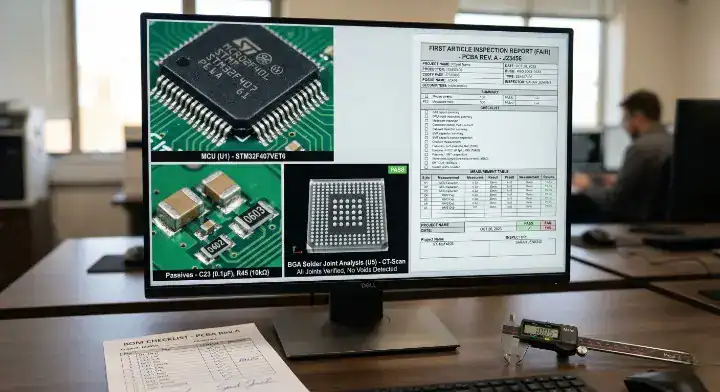
A complete FAI report includes high-definition macro photos of all critical components, a verified BOM checklist proving physical part numbers match the paperwork, X-ray scans for any bottom-terminated components, and LCR measurement records for unmarked passives. It is not just a checkbox saying “board looks good.”
When the factory sends you the report, you are looking for hard evidence that your BOM was executed perfectly.
What you should demand in the report:
- Top and bottom HD photos (minimum 4K resolution)
- Close-ups of IC orientations and pin 1 indicators
- 3D X-Ray images of BGA/QFN packages
- Notes on any footprint-to-pad mismatch or solder paste spread
The 3 Ways FAI is Executed
| Execution Method | Reliability | Cost/Time Impact | Best Used For | QueenEMS Approach |
|---|---|---|---|---|
| On-Site Client Audit | Highest | Expensive travel, delays line | Defense, Aerospace | Welcome anytime |
| Live Video / HD Photo | High | 12-24 hour production pause | Standard Commercial, IoT | Standard (Free for clients) |
| Factory Self-Check | Lowest | Fast, but high trust required | Cheap consumer goods | Never recommended alone |
If a factory refuses to send HD photos and says “trust our internal QC,” that is a massive red flag. They are prioritizing line speed over your yield rate.
Bottom line: Treat the FAI report as a legal sign-off; if it lacks HD photos of your critical ICs and a verified BOM checklist, reject the report and halt production.
How Much Does First Article Inspection Cost?
First article inspection typically costs between $50 and $200 per setup depending on board complexity and component count, though premium EMS providers build this into their standard service fee at no extra charge. If your board requires custom testing fixtures alongside the visual FAI, costs can scale upward of $500.
You are not just paying for the engineer’s time to look at the board. You are paying for the “downtime” of the SMT line. While you review the HD photos in your office, the factory’s $500,000 pick-and-place machine is sitting idle, waiting for your green light.
What drives the cost:
- Component count: Verifying 50 unique line items takes 20 minutes; verifying 400 takes hours.
- X-Ray needs: Scanning BGAs adds machine time.
- Business model: Budget prototype houses charge FAI as a strict line-item add-on.
Here is the reality: At QueenEMS, we include FAI and a free DFM/DFA engineering review on every order. We absorb the cost of pausing the line because catching a polarity error on board https://www.google.com/search?q=%231 saves us the nightmare of dealing with 500 RMAs next month. It protects our 99.7% first-pass yield rate just as much as it protects your budget.
Bottom line: Expect to see a $50-$200 NRE fee for FAI on standard quotes, but prioritize manufacturing partners who include it transparently as part of a high-yield process.
FAQ
Does AOI check the bottom side of the PCB? Yes, but only if the factory runs the board through the AOI machine a second time or uses a dual-sided inline AOI system. Always confirm with your manufacturer that their process includes double-sided optical inspection for complex boards. Upload your BOM for a free DFM check and process review today.
Can FAI detect counterfeit components? It depends. FAI engineers checking the physical reel against your BOM can spot glaring packaging anomalies or wrong manufacturer logos. However, sophisticated counterfeits that look identical require dedicated electrical or decapsulation testing. Get a transparent quote within 24 hours to secure reliable component sourcing.
If I change one resistor value, do I need a new FAI? Yes. A BOM change means a new reel is loaded into the machine. If the operator loads the wrong reel, the machine will place it flawlessly on every board. A partial FAI (Delta FAI) focused purely on the changed component is the safest route. Request a free first-article inspection on your first order with us.
Conclusion
Assuming an automated optical inspection is enough to protect your PCB batch is a costly mistake. You came here wondering what the actual difference is, and the numbers speak for themselves: AOI is your shield against random machine errors, but FAI is your foundation. Without it, you risk mass-producing systemic flaws that optical cameras are entirely blind to.
At QueenEMS, we do not believe in charging you extra to prove we set our machines up correctly. We provide a comprehensive FAI process, complete with HD photos and 3D X-Ray inspection on every BGA joint, before we run your full batch. Combined with our free DFM engineering review, we ensure your design moves from Gerber to finished product with a 99.7% first-pass yield rate.
Stop gambling your budget on blind production runs. Contact us today to get a transparent quote that includes proper manufacturing verification from board number one.
Written by the QueenEMS Engineering Team