Are you struggling to determine the correct HS code for PCB and PCBA products while facing potential customs delays or unexpected tariff costs? Identifying the precise classification for your electronics is the most reliable way to ensure smooth international trade compliance and optimize your bottom line. At queenems, we leverage our extensive manufacturing expertise to help partners navigate these complex regulatory requirements with total confidence.
Imagine this scenario: you have a critical shipment of custom-assembled controllers sitting at the border, but the customs officer flags your paperwork because the code you used applies only to bare boards. This simple mistake can lead to heavy fines, shipment seizures, and weeks of lost production time. But here’s the kicker… most of these headaches are completely avoidable if you understand the fundamental differences in how global authorities view bare boards versus populated assemblies. Ready for the good part? This guide provides the exact roadmap you need to classify your electronics correctly every single time, saving you money and stress.
1. What is the fundamental difference between HS code for PCB and PCBA classifications?
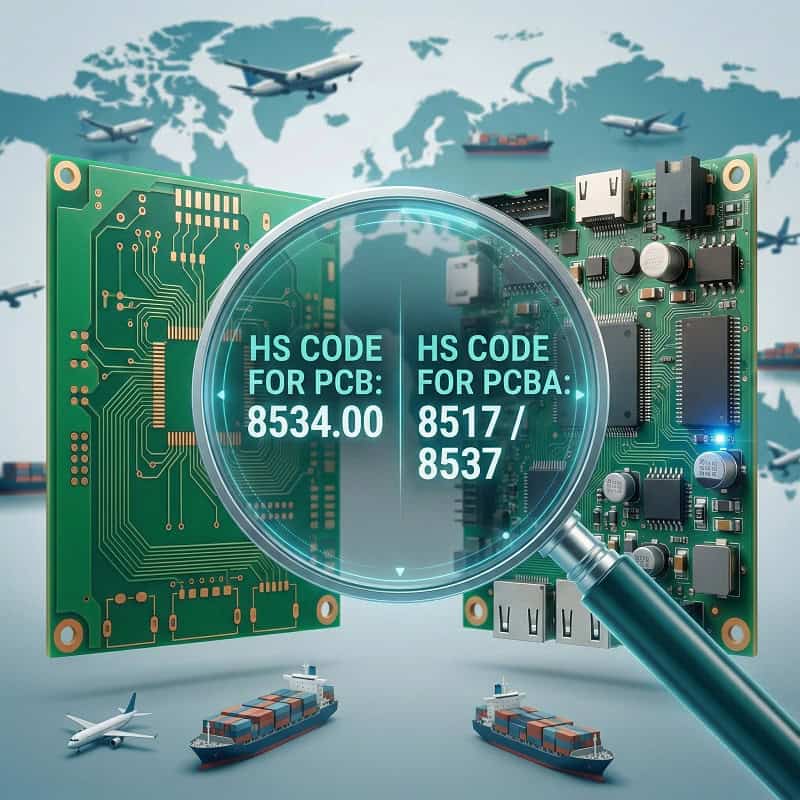
The primary distinction lies in whether the board is a raw substrate or a functional electronic assembly with mounted components. For a standard HS code for PCB and PCBA, the classification changes entirely once soldering occurs because the product evolves from a “part” into an “assembly”.
Does the presence of components change everything?
Yes, the addition of even a single active or passive component shifts the product from a raw printed circuit into a populated assembly. What’s the real story? While a bare board is essentially a piece of plastic and copper, a PCBA possesses specific electrical logic or power distribution capabilities that customs agencies track under different categories.
- Bare boards fall under heading 8534.
- Populated boards often move to 8517, 8537, or 8543.
- Customs duty rates typically differ between these categories.
Key Takeaway: Always verify if your board has components attached before selecting a code, as misclassifying a populated board as a bare one is a leading cause of customs audits.
| Board Type | Components Attached | Common HS Heading | Primary Use |
| Bare PCB | None | 8534 | Structural Base |
| PCBA | Yes | 8517 / 8537 | Functional Logic |
The data above clarifies how the physical state of the board dictates its legal classification at the border.
2. Which HS code for PCB and PCBA applies to bare printed circuit boards?
Bare printed circuit boards without any electronic elements are strictly classified under HS code 8534.00, which covers circuits made by printing or plating conductive patterns on an insulating base. You might be wondering if this applies to multilayer or flexible boards as well. The answer is simple: as long as the board remains unpopulated, 8534 remains the global standard regardless of layer count or material.
Is material type a factor for 8534?
Standard FR-4, high-frequency laminates, and even ceramic substrates generally fall under this code if they are purely conductive paths. This is where it gets interesting… some specific regions might have sub-classifications for flexible versus rigid boards, so checking local tariff schedules is always a smart move.
- Rigid FR-4 boards.
- Flexible printed circuits (FPC).
- Multilayer high-frequency boards.
Key Takeaway: Use code 8534.00 for all bare board imports to ensure you are not overpaying for duties intended for finished electronic goods.
| Category | HS Code | Description | Duty Implication |
| Bare Rigid PCB | 8534.00 | Printed circuits without components | Usually low or zero |
| Bare Flexible PCB | 8534.00 | Flexible circuits without components | Category-dependent |
These codes represent the global baseline for any raw substrate before it reaches the assembly line.
3. How do you find the right HS code for PCB and PCBA when components are added?
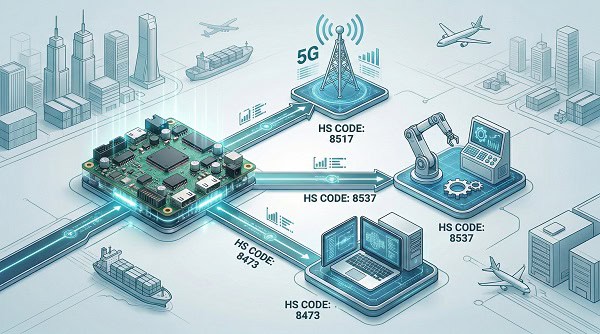
Once components are soldered, the assembly is no longer just a “printed circuit” and must be classified according to its specific function or the device it powers. For example, a HS code for PCB and PCBA used in a router might fall under telecommunications equipment rather than general electronics. It’s a big deal because the “essential character” of the product has now changed from a part to a functional system.
Should you classify by the board or the final device?
General customs rules suggest that if a PCBA has a clearly defined independent function, it should be classified under the heading for that function. Wait, there’s more: if the board is designed solely for use in a specific machine, it may be classified as a “part” of that machine under categories like 8473 (computers) or 8529 (TVs).
- Motherboards for computers.
- Control boards for industrial machinery.
- Signal processors for telecommunications.
Key Takeaway: To avoid errors, identify the primary machine or system your PCBA will inhabit before attempting to assign an HS code.
| Function | Targeted HS Code | Sector |
| Data Processing | 8473.30 | IT / Computing |
| Telecommunication | 8517.79 | Networking |
| Control Systems | 8537.10 | Industrial Automation |
Reviewing these functional categories helps narrow down the search for the most compliant classification for your specific assembly.
4. Why is HS code 8517 common for modern HS code for PCB and PCBA?
In our digital-first economy, a vast majority of electronic assemblies include networking or communication features, leading them to be classified under heading 8517. This category covers apparatus for the transmission or reception of voice, images, or other data. Let’s dive deeper. If your HS code for PCB and PCBA contains a Wi-Fi module, Bluetooth chip, or ethernet port, it very likely belongs here.
Does a Wi-Fi chip change the code?
Most customs authorities prioritize communication capability over other secondary functions when determining a code. Think about it: a control board that also sends data to the cloud is often viewed primarily as a communication device in the eyes of the law.
- Wireless communication modules.
- Network switch mainboards.
- Internet of Things (IoT) controllers.
Key Takeaway: If your PCBA communicates over a network, start your HS code search within the 8517 subheadings to match current trade trends.
| Component Type | Feature | HS Heading |
| GSM/5G Module | Cellular Connectivity | 8517 |
| Ethernet Port | Wired Data | 8517 |
| Bluetooth LE | Short-range Wireless | 8517 |
Selecting the correct communication-based code ensures you are aligned with how most modern electronic imports are scrutinized.
5. When should you use HS code 8537 for your HS code for PCB and PCBA?
If your assembly is designed for the distribution of electricity or the control of power, heading 8537 is usually the correct choice. This covers boards equipped with two or more apparatuses of heading 8535 or 8536, such as switches, fuses, and relays. But here’s the kicker… this is one of the most common codes for HS code for PCB and PCBA used in household appliances and factory machinery.
Is voltage a factor for this code?
Heading 8537 is specifically split between boards for voltage not exceeding 1,000V and those that handle higher power. The best part is that most consumer and light industrial PCBAs fall safely into the 8537.10 sub-category for low-voltage applications.
- Power supply control boards.
- Appliance control panels.
- Motor driver assemblies.
Key Takeaway: Use 8537 for “dumb” power control boards that manage electricity flow rather than processing complex data or signals.
| Application | Voltage Range | Typical Code |
| Home Appliance | < 1000V | 8537.10 |
| Industrial Switchgear | > 1000V | 8537.20 |
| PLC Modules | Control Logic | 8537.10 |
Differentiating between data processing and power control is essential for choosing between 8517 and 8537 categories.
6. Does the HS code for PCB and PCBA affect the duty rate you pay?
Absolutely, as the HS code is the direct link to the tariff schedule which determines the percentage of tax applied to your shipment’s value. Using a HS code for PCB and PCBA with a 0% duty rate versus one with a 5% rate can make a massive difference in high-volume production. What’s the real story? Many countries offer duty-free status for IT products under the Information Technology Agreement (ITA), but industrial control boards may not qualify.
Can a wrong code lead to overpayment?
Many importers accidentally use a generic “parts” code that carries a higher duty than a specific functional code. It gets better: some specialized PCBAs for medical or aerospace applications may qualify for specific exemptions if classified under their respective niche headings.
- Check for Free Trade Agreements (FTA).
- Verify ITA eligibility for your code.
- Compare “Part” vs. “Assembly” duty rates.
Key Takeaway: Proactively researching the duty rates associated with different potential HS codes can save your company thousands in annual import costs.
| HS Heading | General Duty Range | ITA Covered |
| 8473 (IT Parts) | 0% – 2% | Yes |
| 8517 (Telecom) | 0% – 3% | Yes |
| 8537 (Control) | 2% – 5% | Partially |
This table illustrates why the strategic selection of a code is just as much a financial decision as it is a legal one.
7. How can you avoid common classification errors for HS code for PCB and PCBA?
The most frequent mistake is providing an incomplete description to your freight forwarder, which forces them to guess the code. When shipping a HS code for PCB and PCBA, you must provide the “End-Use” and “Function” clearly on the commercial invoice. Ready for the good part? Clear communication ensures that the customs agent sees the same product you do.
Is the BOM list enough for customs?
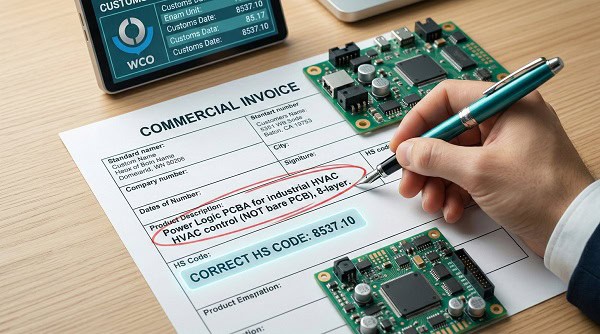
While a Bill of Materials helps, customs agents rarely have the technical background to determine a code from a list of resistors. This is where it gets interesting… providing a “Functional Description” (e.g., “Main Controller Board for Industrial HVAC System”) is far more effective than just saying “PCBA”.
- Always specify “Populated” or “Bare”.
- Describe the final machine the board serves.
- Mention any communication protocols (e.g., Bluetooth).
Key Takeaway: Write your shipping descriptions for a non-technical audience to ensure the customs officer can easily match your board to the right HS code.
| Bad Description | Good Description | Why it Works |
| PCBA Board | Control PCBA for 5G Router | Defines function and device |
| Electronic Part | Bare PCB for Medical Device | Specifies state and application |
| Controller | Power Logic PCBA for HVAC | Clarifies power vs data |
Clearer descriptions lead to faster clearance and fewer requests for additional documentation from border authorities.
8. What role does the “Principal Function” play in HS code for PCB and PCBA?
Customs authorities use the “General Rules of Interpretation” (GRI) to determine which function is the most significant when a board does multiple things. For a complex HS code for PCB and PCBA, if it controls a motor but also communicates via Wi-Fi, the communication part often takes legal precedence. You might be wondering how to argue your case if you disagree with a customs ruling.
How do you determine the primary function?
The primary function is usually the one that defines the product’s purpose; a board in a washing machine is a “controller,” regardless of its small status LED. But here’s the kicker… if two functions are equally important, customs typically chooses the code that appears last in numerical order in the tariff schedule.
- Identify the most expensive component.
- Determine the board’s core purpose.
- Consult the GRI rules for tie-breakers.
Key Takeaway: Focus your classification on what the board actually does for the end-user, rather than every minor feature it possesses.
| Multi-Function Board | Function A | Function B | Likely Classification |
| Smart Light Switch | Power Switch | Wi-Fi Connectivity | 8517 (Comm.) |
| Robot Controller | Motor Drive | Sensor Logic | 8537 (Control) |
Understanding function hierarchy is the secret to defending your classification choices during a customs audit.
9. Where can you find global HS code databases and resources?
Finding the right code often requires cross-referencing multiple international databases to ensure your HS code for PCB and PCBA is valid in both the exporting and importing countries. You might be wondering which websites are the most authoritative for this task. Here is the deal: using official government portals is the only way to guarantee the accuracy of your trade data.
Which international databases are most reliable?
Searching the databases below can help you identify the right HS codes for your PCB products with precision. This is where it gets interesting… each country has its own specific tariff tool that accounts for local trade agreements and specialized subheadings.
- World Customs Organization HS Classification Database: https://www.wcoomd.org/en/topics/nomenclature/instrument-and-tools/hs-nomenclature-2017-edition/hs-nomenclature-2017-edition.aspx
- US Customs and Border Protection HTS Search: https://hts.usitc.gov/
- Indian Customs HS Code Finder: https://www.cybex.in/hs-code-finder.aspx
- UK Trade Tariff Tool: https://www.gov.uk/trade-tariff
- EU Export Helpdesk for Exporters: https://trade.ec.europa.eu/access-to-markets/en/home
- Chinese Customs HS Code Search (Chinese site): https://www.hsbianma.com/
- HKTDC HS Code Search: https://www.censtatd.gov.hk/en/index_hs_code.html
- Australia DFAT Free Trade Agreement Portal: https://ftaportal.dfat.gov.au/
- Japan HS code: https://www.customs.go.jp/tariff/index.htm
- Canadian customs tariff Code: https://www.cbsa-asfc.gc.ca/trade-commerce/tariff-tarif/menu-eng.html
Key Takeaway: Always verify your HS code on the official portal of the destination country to account for regional variations in tariff subheadings.
| Country/Region | Official Database | Best For |
| Global | WCO Database | General 6-digit codes |
| USA | HTS Search | Specific US import duties |
| China | HS Bianma | Export classification |
| EU | Access2Markets | European trade rules |
Utilizing these official resources minimizes the risk of using outdated codes that could lead to shipment delays.
10. How will future tech changes impact the HS code for PCB and PCBA?

The World Customs Organization (WCO) updates the HS system every five years to keep pace with technological advancements like AI and advanced sensors. Staying ahead of these shifts for your HS code for PCB and PCBA ensures you aren’t using an obsolete code that triggers a red flag. What’s the real story? The next update will likely focus more on “smart” features and integrated modules that blur the lines between categories.
Will AI chips get their own codes?
As dedicated AI hardware becomes standard on boards, we may see new subheadings specifically for high-performance computing at the edge. This is where it gets interesting… staying informed about these updates allows you to adjust your supply chain and pricing before the laws even change.
- Monitor WCO update previews.
- Watch for new “Smart” categories.
- Update your internal ERP systems regularly.
Key Takeaway: Compliance is a moving target; review your product database every year to ensure your HS codes still reflect the latest global trade standards.
| Era | Focus | Key Category Change |
| 2010s | Telecom Expansion | Massive shift to 8517 |
| 2020s | IoT & Automation | Refined 8537 and 8542 |
| Future | AI & Edge Computing | Likely new 84xx/85xx splits |
Being proactive about upcoming changes prevents “compliance debt” and keeps your international shipping moving at peak efficiency.
Conclusion
Successfully navigating the HS code for PCB and PCBA landscape is the difference between a seamless global supply chain and a logistical nightmare. By accurately distinguishing between bare boards and populated assemblies, and by classifying based on the principal function of the device, you protect your business from unnecessary costs and delays. But here’s the kicker… most companies leave this to chance, while leaders treat it as a strategic advantage.
At queenems, we don’t just assemble boards; we partner with you to ensure every aspect of your production, from engineering to international delivery, is handled with professional precision. If you are ready to streamline your electronics sourcing and ensure total trade compliance, contact us today for a consultation. Our mission is to transform your complex PCBA requirements into a scalable, worry-free advantage for your business.
FAQ
Q1: Can I use the same HS code for both PCB and PCBA? No, you generally cannot. Bare boards without components are classified under 8534.00, whereas assemblies with components (PCBA) are classified according to their specific function, often under 8517 or 8537.
Q2: What is the best way to determine the HS code for a custom IoT board? The best approach is to identify the primary communication method. Because most IoT boards are designed for data transmission, they usually fall under heading 8517, specifically subheadings for wireless communication.
Q3: How do I know if my PCBA qualifies for duty-free status? You should check if your specific HS code is covered under the Information Technology Agreement (ITA). Most telecommunications and data processing assemblies are duty-free in member countries, but you must verify the specific code first.
Q4: Can a mistake in the HS code lead to my shipment being seized? Yes, it can. While most errors result in fines or delays, consistent misclassification or “tariff jumping” (intentionally using a lower-duty code) can lead to shipment seizure and a permanent black mark on your import record.
Q5: What’s the most important document for customs classification? The commercial invoice is the most critical. It should include a detailed, non-technical functional description and the proposed 6-digit HS code to help customs officers verify your classification quickly.