
Professional Through-hole PCB Assembly Service for High-Reliability Applications
Industrial-grade through-hole assembly services combining precision manual insertion, advanced wave soldering, and rigorous quality control for projects that demand superior mechanical strength and long-term reliability.
Request THT Assembly QuoteWhat Is Through-hole PCB Assembly?
Through-hole technology (THT) assembly service involves inserting component leads through drilled holes in the PCB and soldering them to pads on the opposite side, creating robust mechanical bonds that outperform surface mount technology in strength, current handling, and reliability under stress.
Core Technology
Through-hole assembly creates permanent mechanical and electrical connections by inserting component leads through plated holes that traverse the entire board thickness. The leads are clinched on the solder side and secured with high-temperature solder joints, resulting in connections that withstand mechanical stress, thermal cycling, and vibration far better than surface-mounted alternatives.
THT vs SMT: Key Differences

Need help determining if through-hole assembly is right for your project?
Consult Our Engineering TeamWhen to Use Through-hole Assembly
Through-hole assembly excels in applications where mechanical durability, high current handling, and long-term reliability outweigh size and weight constraints. These scenarios typically involve harsh operating environments or critical functionality requirements.
High Current Applications
Power supplies, motor drives, and energy systems requiring robust current paths and heat dissipation that SMT connections cannot reliably support.
Mechanical Stress Environments
Industrial control systems, transportation electronics, and equipment subjected to continuous vibration, shock, or mechanical strain where solder joint integrity is paramount.
Harsh Environmental Conditions
Equipment operating in extreme temperatures, high humidity, or corrosive atmospheres where THT's superior solder joint penetration provides enhanced environmental sealing and longevity.
Match your project requirements with our THT assembly capabilities
Explore Our THT ServicesComprehensive Through-hole Assembly Services
Our factory-direct THT assembly combines precision manual insertion, automated wave soldering, and selective soldering capabilities with comprehensive engineering support to deliver reliable, cost-effective through-hole assembly for projects of any complexity.
Wave Soldering
Full-spectrum wave soldering for high-volume production with precise temperature profiling, nitrogen atmosphere control, and flux management ensuring consistent, void-free joints across entire board populations.
Selective Soldering
Precision point-to-point soldering for mixed-technology boards, enabling THT component integration on predominantly SMT assemblies without exposing sensitive components to full-wave heat exposure.
Manual Insertion
Skilled technician-led component placement using custom fixtures and work instructions, delivering the precision and quality control essential for specialty components, prototypes, and low-volume production runs.
Ready to leverage our full-service THT assembly capabilities?
Get Your THT Assembly QuoteManual Through-hole Assembly Excellence
Our manual insertion process combines experienced technicians, standardized procedures, and rigorous quality controls to deliver consistent, high-quality through-hole assembly for prototypes, low-volume production, and specialty components that require human judgment and precision handling.
When Manual Insertion Is Essential
Large or oddly-shaped components, mixed-orientation parts on the same board, ultra-low volume production where automated setup costs exceed labor savings, and prototype builds requiring rapid design iteration without tooling investments.
IPC-Trained Technicians
All manual assembly operators hold IPC-A-610 certification and undergo continuous training in component handling, ESD protection, and workmanship standards. Average technician experience exceeds 5 years in through-hole assembly work.
Custom Fixtures & Work Instructions
Project-specific assembly jigs ensure consistent component positioning and orientation. Detailed visual work instructions with photos and dimensional callouts eliminate ambiguity and reduce assembly errors to near-zero rates.
In-Process Inspection
Operators perform self-inspection after component placement and before soldering. Supervisors conduct random in-process audits, verifying component orientation, lead clinching, and board cleanliness before boards proceed to soldering operations.
Documented Procedures
Every project receives a formal assembly procedure document with component placement sequences, orientation diagrams, and quality checkpoints. Revision control ensures operators always work from current documentation, preventing outdated assembly methods.
Traceability & Control
Batch-level tracking links each assembled board to operator ID, component lot numbers, and inspection records. This complete traceability enables rapid root cause analysis if field issues arise and provides the documentation required for regulated industries.
Trust our manual assembly expertise for your precision THT projects
Discuss Your Manual Assembly NeedsWave & Selective Soldering Expertise
Our advanced soldering capabilities combine traditional wave soldering for high-volume efficiency with precision selective soldering for mixed-technology boards, delivering defect-free joints that meet the most demanding reliability standards.
Wave Soldering
High-volume production method where entire boards pass over molten solder waves, simultaneously soldering all through-hole joints on the bottom side in a single pass.
Single-sided THT boards, high-volume production runs (500+ units), boards with minimal SMT components, standardized component libraries.
Selective Soldering
Programmable point-to-point soldering targeting specific through-hole locations, enabling THT integration on mixed-technology boards without heat exposure to sensitive SMT components.
Mixed SMT/THT assemblies, low-to-medium volume production, boards with heat-sensitive components, prototypes and NPI builds.
Defect Prevention & Joint Quality Assurance
Optimized flux chemistry and temperature profiling eliminate solder voids and gas entrapment, ensuring maximum electrical and thermal conductivity.
Controlled solder wave dynamics and precise board angles prevent solder bridging between adjacent pins, even on fine-pitch connectors.
Multi-zone preheating gradually raises board temperature, preventing component thermal shock damage and substrate delamination.
Optimize your THT soldering process with our advanced capabilities
Request Process Engineering ReviewSMT + Through-hole Mixed Assembly
Modern electronics increasingly combine SMT and THT technologies on the same board. Our integrated manufacturing process handles mixed-technology assemblies seamlessly, coordinating reflow and wave soldering operations to deliver defect-free boards efficiently.
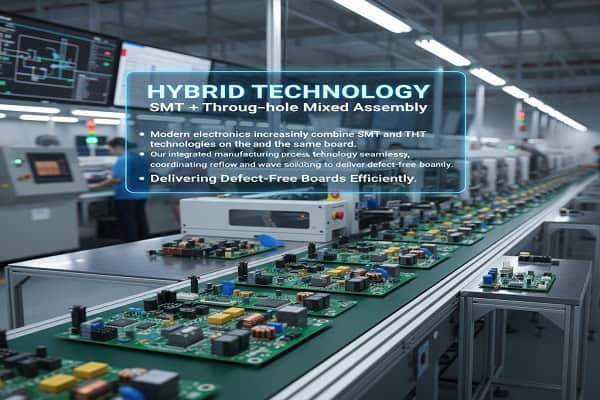
SMT Components First
Surface-mount components are placed and reflow soldered first. Automated pick-and-place machines handle high-density SMT populations, followed by reflow oven processing to create permanent solder joints before through-hole insertion begins.
Through-hole Insertion
After SMT reflow, through-hole components are manually or mechanically inserted. Strategic component sequencing and custom fixtures ensure SMT components aren't damaged during THT insertion operations and maintain proper board orientation throughout.
Selective Soldering
Programmable selective soldering targets only THT joints, leaving SMT components untouched. Localized heating prevents reflowing previously soldered SMT joints while creating robust through-hole connections that meet IPC Class 2/3 standards.
Final Inspection & Test
Comprehensive AOI scans verify both SMT and THT joint quality. Functional testing validates electrical performance, ensuring mixed-technology integration hasn't introduced connectivity issues or component interaction problems before shipment.
Why Choose Mixed Assembly Over Single Technology
Optimized Design Flexibility
Use SMT for compact, high-density circuitry while reserving THT for connectors, high-current paths, and mechanically stressed components. Combine the strengths of both technologies in a single design.
Cost-Effective Solutions
Reduce board size and layer count with dense SMT routing, while avoiding expensive SMT replacements for standard through-hole connectors and power components. Balance cost with functionality effectively.
Enhanced Reliability
Critical mechanical interfaces benefit from THT's superior pull strength and vibration resistance, while signal processing circuitry leverages SMT's short trace lengths and high-frequency performance advantages.
Leverage both SMT and THT advantages in your next design
Get Mixed Assembly QuoteDFM & Engineering Review for Through-hole Assembly
Our engineering team reviews every design before production, identifying potential manufacturability issues and recommending optimizations that reduce costs, improve yields, and accelerate time-to-market without compromising functionality.
Hole & Pad Design
We verify that plated hole diameters accommodate component lead tolerances with proper clearance while ensuring annular ring dimensions meet IPC standards for reliable solder joint formation.
Component Spacing
Adequate clearance between through-hole components prevents assembly conflicts, facilitates manual insertion tooling, and ensures wave solder flow reaches all joints without shadowing.
Component Availability
Before production starts, we verify all specified components are available or identify acceptable alternatives, preventing costly delays from obsolete or long-lead-time parts.
Our DFM Review Process
Submit Gerbers, BOM, and assembly drawings via our secure portal
Software checks flag common DFM issues within 2 hours
Human verification catches nuanced manufacturability concerns
Detailed findings with recommendations delivered in 24-48 hours
Catch manufacturability issues before they become production problems
Request Free DFM ReviewQuality Control for Through-hole Assembly
Multi-layered inspection processes verify every aspect of through-hole assembly quality, from component placement accuracy to solder joint integrity, ensuring your boards meet specifications and function reliably in demanding applications.
Industry Standards Compliance
All assemblies meet IPC workmanship standards for solder joint formation, component placement, and cleanliness. Class 3 available for high-reliability applications.
Quality management system certification ensures consistent processes, documented procedures, and continuous improvement practices across all operations.
Full compliance with environmental regulations. Material declarations and test reports available for all assemblies upon request.
Automated Optical Inspection
High-resolution AOI systems scan every board post-soldering, detecting solder bridges, insufficient solder, component orientation errors, and missing parts. Defect libraries adapted specifically for through-hole assembly characteristics.
Manual Visual Inspection
Trained inspectors perform 100% visual verification under magnification, checking solder fillet formation, lead clinching quality, component seating, and board cleanliness. Critical for catching nuanced defects automated systems miss.
Functional Testing
In-circuit and functional test fixtures verify electrical connectivity and circuit operation. Flying probe testing available for prototypes and low-volume runs. Custom test procedures developed per customer specifications and acceptance criteria.
Experience the difference rigorous quality control makes
View Our Quality CertificationsComponent Sourcing & BOM Control
Through-hole components often present unique sourcing challenges due to longer lead times and ongoing obsolescence pressures. Our procurement expertise and supplier networks ensure your projects avoid delays and unauthorized substitutions.
Extended Lead Times
Many through-hole components have 12-16 week lead times from manufacturers. We forecast demand, maintain strategic inventory, and leverage distributor relationships to compress procurement timelines and prevent production delays.
Obsolescence Pressure
THT components face ongoing obsolescence as manufacturers transition to SMT. We proactively monitor end-of-life notices, recommend modern equivalents, and help you design future-proof solutions before parts become unavailable.
Quality Verification
Counterfeit and grey-market THT components pose significant risks. We source exclusively from authorized distributors and implement incoming inspection protocols that verify authenticity, date codes, and electrical specifications.
Transparent Approval Process
No component substitutions without your explicit approval. When alternatives are necessary, we provide detailed comparison data on electrical characteristics, form factors, and cost impacts before proceeding.
Full Traceability
Every component tracked from distributor to finished assembly. Date codes, lot numbers, and supplier information recorded for each batch, enabling rapid root cause analysis if field issues arise.
Consignment Options
For proprietary or hard-to-source components, we accommodate customer-supplied materials with secure receiving, storage, and kitting processes. Inventory tracking provided in real-time through our portal.
BOM Management Capabilities
Live component pricing checks during quoting eliminate surprises. Market fluctuations flagged proactively with alternatives suggested.
Automated alerts when BOM components reach end-of-life. Proactive recommendations for drop-in replacements prevent redesigns.
Unused components stored up to 12 months at no charge. Applied to future builds or returned upon request with full documentation.
Eliminate sourcing headaches and keep your projects on schedule
Upload BOM for Sourcing AnalysisIndustries Relying on Through-hole Assembly
Through-hole assembly serves critical applications across industries where mechanical reliability, current handling capacity, and long-term durability are non-negotiable requirements for product success and customer safety.
Industrial Control
Heavy-duty control systems for manufacturing automation, process control, and facility management requiring robust connectivity and vibration resistance.
Power Electronics
High-current power conversion, distribution, and management systems where through-hole components handle amperage levels impossible for SMT alternatives.
Communications Equipment
Telecommunications infrastructure and networking hardware requiring field-serviceable connectors and long operational lifespans in demanding environments.
Automation Systems
Factory automation, robotics, and intelligent machinery where boards endure constant vibration and require decades-long reliability without field failures.
Find solutions tailored to your industry's unique requirements
Discuss Your Industry ApplicationWhy Choose Us for Through-hole Assembly
Combining factory-direct efficiency with experienced engineering support, we deliver through-hole assembly that balances quality, cost, and speed—without the communication barriers and hidden costs of traditional offshore manufacturing.
Factory-Direct Access
No trading companies or middlemen. You work directly with our engineering and production teams, ensuring clear communication and eliminating markup layers.
15+ Years THT Experience
Dedicated through-hole assembly expertise since 2009. Our technicians have soldered millions of joints and understand nuances that newer facilities miss.
Rapid Engineering Response
Technical questions answered within 4 business hours. DFM reviews completed in 24-48 hours. No waiting days for answers from distant time zones.
Low-Volume Friendly
No unrealistic MOQs forcing you to order more than needed. We efficiently handle runs from 10 to 10,000 units with competitive per-unit economics.
We switched to this factory after three years of frustration with our previous CM. Their through-hole soldering quality is exceptional, and their willingness to work with our 200-piece NPI builds without penalty pricing made all the difference for our product development cycle.
Experience the difference of working with a dedicated THT assembly partner
Start Your First ProjectThrough-hole Assembly Project Snapshots
Real projects demonstrating how our through-hole assembly expertise solves complex manufacturing challenges across diverse applications and production volumes.
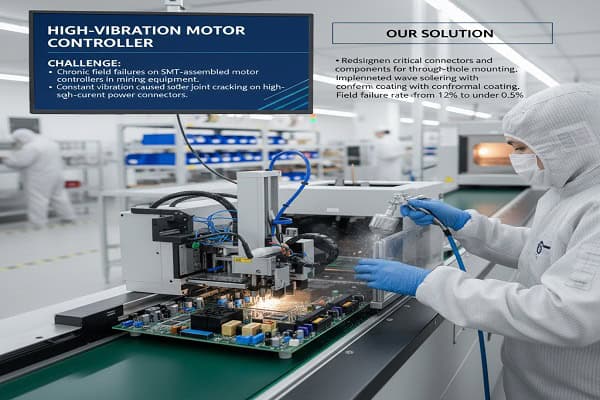
High-Vibration Motor Controller
Customer experienced chronic field failures on SMT-assembled motor controllers in mining equipment. Constant vibration caused solder joint cracking on high-current power connectors, resulting in intermittent failures and costly field service calls.
Redesigned critical connectors and power components for through-hole mounting. Implemented wave soldering with conformal coating for enhanced environmental protection. Field failure rate dropped from 12% to under 0.5% over 18-month deployment.
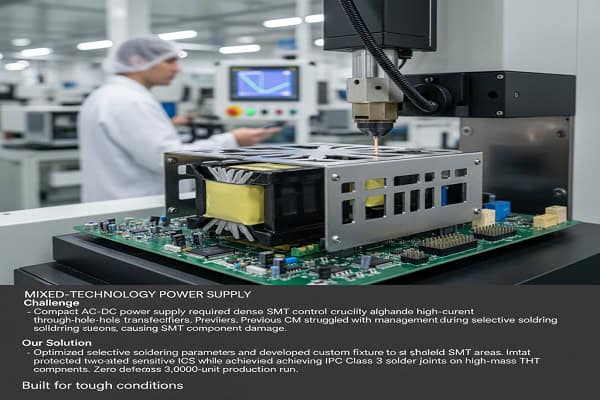
Mixed-Technology Power Supply
Compact AC-DC power supply required dense SMT control circuitry alongside high-current through-hole transformers and rectifiers. Previous CM struggled with thermal management during selective soldering, causing SMT component damage.
Optimized selective soldering parameters and developed custom fixture to shield SMT areas. Implemented two-stage temperature profiling that protected sensitive ICs while achieving IPC Class 3 solder joints on high-mass THT components. Zero defects across 3,000-unit production run.

Legacy Product Sustainment
Medical device manufacturer needed ongoing production support for 15-year-old design containing multiple obsolete through-hole ICs. Original CM refused small runs, demanding redesign or 5,000-piece MOQ the customer couldn't justify.
Sourced obsolete components through authorized distributors and established buffer stock. Accommodated 50-100 unit quarterly production runs without penalty pricing. Customer maintains product availability for installed base while planning next-generation replacement on their timeline.
Let us solve your unique through-hole assembly challenges
Share Your Project RequirementsThrough-hole Assembly Questions
Clear answers to common questions about our through-hole assembly capabilities, processes, and business terms.
Choose through-hole when mechanical strength matters more than size—applications involving high current (>3A), frequent connector mating cycles, extreme vibration, or harsh environmental conditions. THT also makes sense for prototypes requiring easy component swapping and legacy designs with obsolete SMT equivalents unavailable.
We provide unified quotes covering both technologies. Pricing considers SMT setup, placement, reflow, followed by THT insertion and selective/wave soldering. Upload your complete Gerbers and BOM—our system automatically identifies which components are SMT vs THT and calculates optimal process routing and combined pricing.
No hard MOQ. We regularly handle runs as small as 10-25 units for prototypes and NPI. Per-unit costs decrease with volume, but we won't force you to order 1,000 pieces when you need 50. Quote requests are evaluated individually—send us your quantity and we'll provide honest pricing without artificial minimums.
Yes, both processes available. Lead-free (SAC305 alloy) is our standard for RoHS compliance. We maintain separate wave solder machines for leaded (Sn63/Pb37) when required for aerospace, military, or legacy product compatibility. Specify your requirement during quoting—there's no premium for either process.
Consigned components accepted for unique, proprietary, or customer-stocked parts. We require advance shipment with clear labeling and kitting instructions. Our receiving team inspects for damage and verifies quantities before production. For common components, we recommend our turnkey sourcing to leverage our distributor pricing and eliminate your procurement overhead.
Standard lead time is 10-15 business days from component availability. Prototypes and NPI can be expedited to 5-7 days with premium pricing. Most delays stem from component procurement—providing accurate BOMs early and flagging long-lead items lets us order parts proactively and maintain schedule predictability.
Have a question not covered here?
Ask Our Engineering TeamGet Your Through-hole Assembly Quote Today
Upload your design files and receive a detailed quote within 24 hours. Our engineering team will review your design for manufacturability and provide transparent pricing with no hidden fees or unexpected surprises.
Tell Us About Your PCBA Project
Get a customized quote within 24 hours. Our team is ready to help you find the perfect solution for your needs
Email Us
[email protected]
Response within 12 hours
Call / WhatsApp
+86-0755-363091328
Mon - Sat, 9AM-6PM CST
Visit Our Factory
1-4/F Property Office Building, ZhengFeng North Road, Shenzhen, China. 518103
Visit Our Office
(Head Office)1/27, Soi Border 5, Bang Bon Tai,Bang Bon, Bangkok 10150,Thailand