
Robotics PCB Assembly for Continuous Operation and Long-Term Reliability
Hidden PCB assembly issues lead to downtime, instability, and costly system failures in robotics applications.
Your robotic systems demand long-term reliability, consistent performance, and zero-defect tolerance — not just initial functionality.
The 5 Critical Challenges in Robotics PCBA Manufacturing
These aren't theoretical problems — they're the specific failure modes that cause system downtime, field failures, and costly retrofits.
Continuous Operation Stress
Robots run 24/7 in industrial environments. Solder joints and components experience cumulative thermal cycling and mechanical stress that consumer electronics never encounter.
Multi-Board System Complexity
Control boards, motor drivers, power distribution, and sensor interfaces must work together seamlessly. Any inconsistency creates system-level integration nightmares.
Vibration & Thermal Cycling
Robotic motion and motor operation create constant vibration. Combined with thermal cycling from power electronics, this accelerates solder joint fatigue and component failures.
Small-Batch Consistency Challenges
Robotics rarely hits consumer-volume scale. Maintaining process consistency across small batches and multiple robot models requires disciplined process control.
High Rework Cost
Robotics projects have long integration and commissioning cycles. PCBA defects discovered during system testing create expensive delays and field retrofits.
Sound familiar? Let's discuss how to systematically address these challenges.
Explore Solutions for Your Robotics ElectronicsWhy Robotics PCBA ≠ Consumer Electronics PCBA
The requirements are fundamentally different. Assembly processes optimized for consumer electronics fail catastrophically in continuous-operation industrial environments.
Intermittent Use Model
- Operates in brief sessions with extended idle periods for thermal recovery
- Minimal mechanical stress — stationary operation in controlled environments
- Failures inconvenient but rarely create operational or safety consequences
- Short product lifecycles mean issues often outlived by replacement cycles
- Field service involves replacement rather than repair and retrofit
Continuous Operation Reality
- 24/7 operation with no thermal recovery periods — stress accumulates continuously
- Constant vibration from motors and actuators accelerates solder joint fatigue
- Failures cause production downtime, missed deliveries, and safety incidents
- 10+ year operational life requires zero degradation in critical systems
- Field failures trigger expensive site visits, system downtime, and retrofit costs
Your assembly partner must understand these operational realities, not just electrical specifications.
See Our Robotics-Specific ApproachCommon PCBA Failure Patterns in Robotics Projects
These scenarios repeat across the industry — preventable issues that escaped quality control and manifested during operation or system integration.
Motor Driver Solder Fatigue
High-current motor driver boards passed initial testing but developed solder joint cracks under thermal cycling and vibration stress during continuous operation.
Result: Intermittent motion control failures appeared after 2-3 months of deployment. Entire robot fleet required board replacement and system recalibration.
Batch Variation Integration Failure
Control boards from different production batches had slight parameter variations that weren't caught. Robots assembled with mixed batches exhibited unpredictable behavior.
Result: Field commissioning took 3x longer than planned. Engineering team spent weeks troubleshooting "software issues" that were actually hardware inconsistencies.
Unevaluated Component Substitution
Factory substituted "equivalent" voltage regulators during component shortage without notification. Substitutes had different EMC characteristics affecting sensor accuracy.
Result: Position accuracy degraded in production environment. Root cause took weeks to identify, requiring board redesign and fleet retrofit.
These failures share common root cause: inadequate process discipline for long-life, continuous-operation systems.
Learn Our Prevention MethodologyWhat Robotics Customers Really Need from PCBA Partners
These aren't generic quality requirements — they're the specific factors that determine whether your robots operate reliably or create ongoing support burdens.
Batch Consistency
Every production run must perform identically. Parameter drift between batches creates system integration problems that surface during commissioning, not testing.
Engineering Expertise
Direct access to engineers who understand motor control, power distribution, and EMC challenges — not sales representatives who defer technical questions.
Comprehensive Testing
Beyond AOI and basic functionality — thermal cycling, vibration stress, and load testing that replicates years of continuous operation before shipment.
Continuous Operation Understanding
Process controls designed for 24/7 operation reality, not intermittent consumer use. Assembly partner must understand cumulative stress failure modes.
Zero Unauthorized Changes
Complete BOM control with documented approval process. Component substitutions must never happen without engineering review and system-level impact assessment.
Ready to work with a partner who understands continuous-operation requirements?
Start the ConversationHow We Systematically Address Robotics PCBA Risks
These aren't reactive quality measures — they're proactive process controls designed to prevent the specific failure modes that cause robotics system downtime.
Engineering Precheck
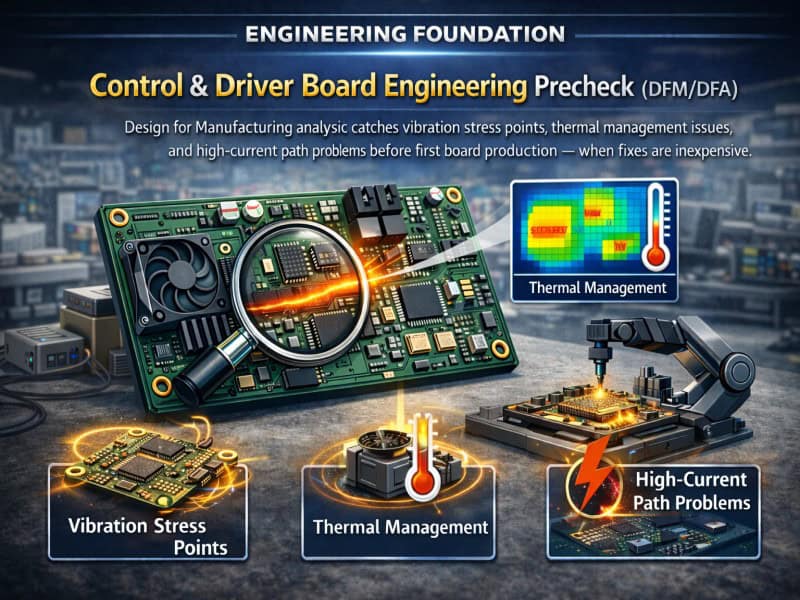
DFM analysis identifies vibration stress points, thermal management issues, and high-current path problems before production begins — when design changes are still economical.
Process Stability
Statistical process control monitors critical parameters across production runs. Batch-to-batch consistency maintained through documented procedures, not operator discretion.
Testing Rigor
Multi-layer verification beyond standard AOI — X-ray for power joints, functional testing under load, and thermal cycling that simulates years of continuous operation.
Production Consistency
Small-batch production managed with same controls as high-volume runs. Component sourcing locked with full traceability and zero unauthorized substitutions.
Each control point addresses a documented robotics failure mode, not generic quality metrics.
Review Our Robotics ProcessControl & Driver Board Engineering Precheck (DFM/DFA)
Design for Manufacturing analysis catches vibration stress points, thermal management issues, and high-current path problems before first board production — when fixes are inexpensive.
High-Density Control Board Manufacturability
Complex multi-layer control boards require careful via placement and component density analysis. We verify manufacturability against continuous-operation thermal requirements, not just assembly feasibility.
Motor Driver High-Current Path Analysis
Driver boards handling motor currents require verified trace widths, copper weights, and thermal relief strategies. Standard consumer electronics pad designs fail under continuous high-current operation.
Vibration Stress Point Identification
Motor and actuator vibration concentrates stress at specific board locations. We identify high-risk areas and recommend mounting strategies or design modifications before production.
Multi-Board System Integration Review
Robotics systems use multiple interconnected boards. We review connector specifications, signal integrity between boards, and power distribution architecture for system-level compatibility.
Engineering review prevents the costly mistakes that only surface during system integration or field deployment.
Submit Your Robot Control DesignMulti-Board & Mixed Technology Assembly Control
Robotics systems require control boards, power distribution, motor drivers, and sensor interfaces working together. Consistency across board types and assembly technologies is non-negotiable.
SMT + THT Mixed Assembly
Robot boards combine surface-mount control circuitry with through-hole power connectors and mechanical mounting points. Dual-process thermal management prevents damage to sensitive components.
Multi-Board Type Parallel Production
Complete robot systems require multiple board types assembled simultaneously. Process parameters and quality controls maintained consistent across control, driver, and power boards.
High-Current Joint Verification
Motor driver and power distribution boards require X-ray inspection on high-current joints. Visual inspection alone cannot detect voids or incomplete solder wetting that cause field failures.
Assembly complexity requires process discipline that goes beyond standard SMT factory capabilities.
Review Our Mixed Technology ExpertiseComponent Sourcing & Substitution Management for Robotics
Unauthorized component changes create system-level integration failures and performance drift that only appear during commissioning — after expensive system assembly is complete.
Zero Unauthorized Substitutions
No component changes without written engineering approval. Not "equivalent specifications," not "better performance" — your approved BOM is what gets assembled in your robot electronics.
Documented Change Process
Supply chain disruptions requiring alternatives trigger formal documentation with full technical comparison, EMC impact assessment, and system-level compatibility verification.
Long-Life Component Planning
Robotics systems operate for 10+ years. Component sourcing considers long-term availability, obsolescence risk, and batch consistency for future production runs and field service requirements.
Component integrity isn't negotiable when system integration and long-term operation depend on it.
Review Our Component ManagementRobotics Electronics Testing & Validation Strategy
Standard assembly testing catches manufacturing defects. Robotics-specific testing catches the failures that only manifest under continuous operation, thermal cycling, and vibration stress.
AOI Inspection
Automated Optical Inspection verifies component placement, orientation, and solder appearance on every board. Immediate feedback prevents process drift across production runs.
X-ray Analysis
X-ray inspection on BGA packages, power devices, and high-current joints reveals voids and cracks that visual inspection misses — critical for continuous-operation reliability.
Functional Testing
Custom test fixtures verify control logic, motor driver operation, and sensor interfaces function correctly under electrical load that simulates actual robot operation.
Environmental Stress Testing
Thermal cycling and vibration testing on sample boards from each batch simulates months of continuous operation, revealing latent defects before system integration.
Testing strategy determines whether problems surface during assembly or during robot commissioning.
Design Your Testing ProtocolProduction Models for Robotics Projects
Whether you're prototyping new robot designs or scaling to multi-model production, our approach maintains consistency without requiring high-volume commitments.
Project-Type Robots
Custom and specialized robots require iterative development with production-grade assembly discipline. We provide the process control and documentation needed for reliable system integration.
- DFM review on initial designs prevents integration issues during system assembly
- Quick-turn prototyping with same quality controls as production runs
- Engineering documentation supports transition to volume production
- Component sourcing strategy established during development phase
- Testing protocols developed alongside robot commissioning
Multi-Model Equipment
Industrial and service robots rarely achieve consumer-volume scale. Our process controls maintain consistency across small batches and multiple robot configurations without volume penalties.
- Statistical process control maintains consistency across production batches
- Scalable from tens to hundreds of units per robot model
- Full traceability supports field service and long-term fleet management
- Flexible scheduling accommodates project-based demand patterns
- Component inventory management ensures availability for multiple robot models
Your robot requirements determine our approach, not inflexible minimum order quantities.
Discuss Your Production RequirementsWhy Robotics Companies Choose China PCBA—And How to Control the Risks
The manufacturing ecosystem advantages are real for robotics electronics. So are the quality risks. Understanding both enables you to capture benefits while preventing failures that cause downtime.
The Advantages
Established supply chain for motor drivers, control processors, and power electronics. Cost structure competitive for small to mid-volume robotics production. Flexible manufacturing capacity accommodates project-based demand cycles and multiple robot configurations.
The Real Risks
Inadequate understanding of continuous-operation requirements for industrial robots. Component substitutions during shortages without system-level impact assessment. Testing protocols insufficient to catch failures that emerge during extended operation or commissioning.
Risk Mitigation Strategy
Engineering protocols designed for continuous-operation systems prevent ad-hoc solutions. Controlled sourcing with full traceability eliminates unauthorized changes. Robotics-relevant testing catches problems during assembly, not during expensive commissioning or field deployment.
Geographic location matters less than process discipline and robotics-specific expertise.
Evaluate Our Robotics CapabilitiesOur Role in Robotics Projects: Manufacturing Partner, Not Just Supplier
The distinction determines outcomes. Suppliers execute purchase orders. Manufacturing partners collaborate to prevent problems before they impact system integration.
Order Execution Focus
- Sales team handles all communication, filters technical questions to protect production
- Engineering involvement only after problems emerge in the field
- DFM review treated as formality without genuine risk assessment
- Component substitutions decided internally based on availability and cost
- Testing limited to what's explicitly specified in purchase order
- Issues discovered during commissioning become "your problem to solve"
Collaborative Engagement
- Direct engineering communication from project initiation through production
- Proactive DFM analysis identifies system integration risks before first build
- Collaborative problem-solving when design or supply chain challenges emerge
- Transparent component sourcing with documented approval for all changes
- Testing strategy developed based on robot operational requirements
- Continuous feedback from production to design supports system optimization
Your robot's success is our success — not just fulfilling purchase orders on schedule.
Experience the Partnership DifferenceRobotics Applications We Support
Each robot type creates specific requirements for control precision, power management, and environmental resilience. Our process adapts to your operational demands.
Robot Control Units
Main control boards integrating processors, motion controllers, and communication interfaces requiring precise coordination for multi-axis systems and real-time operation.
Motor Driver Boards
High-current driver electronics for servo motors and actuators handling continuous operation with precise torque control and thermal management for industrial duty cycles.
Power Distribution Boards
Multi-voltage power management systems distributing power to control, drive, and accessory subsystems with protection circuits and monitoring for continuous operation.
Sensor Interface Modules
Multi-channel sensor acquisition and processing electronics integrating vision, force, position, and proximity sensors for coordinated system operation and safety monitoring.
If your application involves continuous-operation robotics, we understand the specific reliability requirements.
Discuss Your Robot ApplicationLet's Review Your Robotics PCBA Risks Before Production
Robotics systems are built to run continuously, not to fail fast and iterate. If your project requires long-term reliability and engineering support, we should talk before production begins.
This isn't a sales pitch — it's an engineering assessment of whether our robotics-specific capabilities match your requirements.
Direct engineering contact within 24 hours. No sales filtering, no generic quotes.
Tell Us About Your PCBA Project
Get a customized quote within 24 hours. Our team is ready to help you find the perfect solution for your needs
Email Us
[email protected]
Response within 12 hours
Call / WhatsApp
+86-0755-363091328
Mon - Sat, 9AM-6PM CST
Visit Our Factory
1-4/F Property Office Building, ZhengFeng North Road, Shenzhen, China. 518103