
Common Challenges in Medical PCB Assembly
Even experienced contract manufacturers struggle to consistently meet medical-grade requirements. These four failure modes account for the majority of costly redesigns, regulatory delays, and field failures in medical electronics.
Batch Consistency Failures
Many suppliers deliver an acceptable first run, then quietly shift components or profiles on subsequent batches. For medical OEMs, unexpected variation between production lots triggers re-validation cycles that consume months and budget. Consistency isn't a bonus — it's a baseline requirement.
Inadequate Traceability Records
Regulatory audits and field incident investigations demand full-chain traceability — from incoming component lot numbers to final test records. Suppliers without structured documentation systems leave medical manufacturers exposed when regulators come calling or when a device recall requires precise scope identification.
Unstable Solder Joint Quality
Medical devices operate under repeated thermal cycling, mechanical stress, and long deployment periods. Poor reflow profile management, inadequate flux activity, or inconsistent paste printing create micro-voids and cold joints that survive initial inspection — only to fail months into clinical use.
Missing Compliance Documentation
CE marking, FDA 510(k) submissions, and ISO audits all require manufacturing records that most contract assemblers simply don't produce by default. When documentation gaps emerge at the submission stage, projects face costly delays. The right CM provides audit-ready records from the very first production run.
Unauthorized Component Substitutions
Component shortages pressure assemblers into substituting parts without notifying customers. In medical applications, even a pin-compatible alternative can alter electrical characteristics in ways that invalidate clinical performance. Transparent sourcing with customer approval on any BOM change is non-negotiable.
No Pilot Run Validation
Jumping straight from engineering samples to production quantities is a high-risk shortcut. Without a structured pilot run that validates process parameters under real production conditions, hidden defect modes emerge at scale — when they are most expensive and disruptive to address.
Familiar with any of these challenges? Let's talk about how we prevent them.
Discuss Your Medical PCB Requirements
Why Standard PCB Assembly Is Not Enough for Medical Devices
Consumer electronics tolerate a 0.5% field failure rate as an acceptable cost of doing business. Medical devices don't. A diagnostic monitor that drifts out of calibration or a monitoring device that reboots unexpectedly isn't a warranty claim — it's a serious adverse event. The gap between "consumer-grade acceptable" and "medical-grade required" is wider than most engineers anticipate.
| Requirement | Medical-Grade Standard |
|---|---|
| Operating environment | High-humidity, sterilization cycles, continuous duty |
| Thermal cycling endurance | Validated across full deployment lifetime |
| Component qualification | Manufacturer-approved, full lot traceability |
| Defect tolerance | Near-zero — field failure = patient risk |
| Documentation depth | Audit-ready records for every production unit |
Long-term solder joint integrity under thermal stress, consistent performance across switching cycles measured in the millions, and immunity to electromagnetic interference from clinical environments — these are design requirements, not aspirational targets. Meeting them demands a manufacturing process engineered specifically around them.
Ready to upgrade from standard to medical-grade assembly?
Get a Medical PCB Assembly AssessmentThe Risk of Incomplete Traceability in Medical PCB Manufacturing
Traceability in medical electronics is more than a documentation exercise. It is the mechanism that defines the scope of a recall, satisfies a regulatory audit, and protects your company when a field incident triggers an investigation.
When a device fails in the field, the first question investigators ask is: which other units were assembled with components from the same batch? This isn't hypothetical. Last year we caught a batch of MLCCs with capacitance outside ±10% tolerance — while the supplier's COC still showed conforming. Because every lot is tracked against board serial numbers, we isolated the affected boards in under 2 hours. Without that traceability, the customer faced a recall scope 10× larger than necessary.
BOM change management is equally critical. Each approved deviation from the original bill of materials must be documented, reviewed, and linked to the affected production units. An undocumented substitution, even one made with good intentions during a shortage, can invalidate your design history file and trigger a full re-submission.
Production records — soldering parameters, inspection results, test outcomes, operator IDs, and timestamps — must be retained and indexed in a way that supports both routine audits and reactive investigations. A spreadsheet stored on a local drive is not a traceability system.
- Inability to define a precise recall scope — costs inflate dramatically
- Regulatory agencies treat undocumented changes as willful non-compliance
- Design history file gaps delay or block 510(k) and CE submissions
- Field incident investigations stall without production audit trails
- Customer audits expose gaps that damage supplier qualification status
- Liability exposure widens when records cannot confirm conformance
Component Lot Tracking
Every component entering production is logged against its manufacturer lot code and linked to the specific boards it was assembled into. When a component batch is later identified as suspect, the impact scope is immediately and precisely defined — not estimated.
BOM Change Management
No component is substituted without explicit customer approval and documented deviation records. Each approved change is linked to the affected production lots and retained within the project documentation package, preserving the integrity of your design history file.
Production Record Retention
Reflow profiles, AOI and X-ray results, functional test outcomes, and inspection sign-offs are recorded per batch and retained for the full required retention period. Records are structured to support regulatory submissions and rapid-response audits without requiring manual reconstruction.
Want to see how our traceability system works in practice?
Request a Traceability OverviewEngineering-Led DFM for Medical PCB Assembly
Most PCB assemblers review Gerber files for obvious errors and call it DFM. We take a fundamentally different approach: a structured, pre-production engineering review that identifies manufacturability risks before a single component is placed or a single weld is made.
For medical-grade assemblies, this isn't optional. A footprint that creates tombstoning risk under high-humidity reflow, a thermal relief design that produces cold joints during wave soldering, or a high-frequency layout with impedance discontinuities — these issues are exponentially cheaper to resolve at the DFM stage than during clinical validation or, worse, after a field incident.
Our engineering team examines your layout and BOM against the specific demands of your target operating environment. Every identified risk is documented, a recommended resolution is proposed, and production doesn't begin until alignment is confirmed. That's what engineering-led DFM actually means.

Pre-Production Risk Identification
Before production launches, your layout and BOM are reviewed against your specific assembly process parameters. Risks tied to fine-pitch tolerances, connector orientation, and solder mask design are flagged and resolved in advance — eliminating the most common causes of first-article failures in medical assemblies.
Footprint & Pad Design Optimisation
Pad geometry directly determines solder joint quality and long-term mechanical strength. Our engineers verify that land patterns match the component's lead geometry and solderability characteristics, reducing the statistical probability of marginal joints that pass initial AQL inspection but degrade under operational stress.
Thermal Management Verification
Power-dense medical assemblies — patient monitoring units, portable diagnostic devices, imaging electronics — generate concentrated heat loads that copper pours and thermal vias must effectively dissipate. Our thermal review identifies heat path weaknesses before they become field failure modes or cause component derating violations.
High-Frequency Signal Integrity
Medical imaging, wireless patient monitoring, and high-speed diagnostic platforms all contain RF or high-speed digital circuits where controlled impedance is clinically significant. Our engineers review stack-up, trace geometries, and reference plane continuity to ensure signal integrity specs are achievable under production tolerances.
BOM Risk Assessment
Component availability, end-of-life status, and sourcing risk are evaluated before production begins. Where a specified part carries supply chain risk, alternative components are identified, reviewed, and approved before they are needed — preventing emergency substitutions that bypass qualification and compromise your design history.
DFM Report & Resolution Tracking
Every identified risk is documented in a structured DFM report with clear severity classification and recommended resolution. Open items are tracked to closure and the completed report becomes part of your project documentation package — providing an auditable record that the manufacturing process was validated before production began.
Engineering-led DFM is included as standard on every medical PCB project we take on.
Start Your Medical PCB DFM ReviewProcess Control for Stable Medical PCB Production
Stable medical-grade output is not the result of tighter inspection at the end of the line. It is the result of controlled process inputs at every step of production. Our approach embeds verification into the manufacturing sequence itself, so defects are prevented rather than discovered.
Incoming Material Verification
Every incoming component lot is verified against specifications and purchase records before entering the stockroom. Suspect components are quarantined and never used in production without resolution.
SMT Precision Control
Solder paste printing is validated at the start of each production run using SPI — 3D solder paste inspection. Placement accuracy is verified against component-specific tolerances before the board enters the reflow oven.
Reflow Profile Management
Each product family has an optimised, documented reflow profile validated against its solder paste specification and component thermal tolerances. Profiles are locked, version-controlled, and cannot be modified without an engineering change order.
Post-Process Verification
AOI and X-ray inspection are performed after soldering on every production batch. Findings are logged, reviewed against statistical control limits, and fed back into process parameters to prevent recurrence rather than simply catching the next batch.
- 3D SPI after every paste print — volume, height, area verified
- Pick-and-place accuracy to ±0.025 mm for fine-pitch components
- 0201 and 01005 passive component capability
- Stencil aperture and thickness optimised per BOM
- Nitrogen atmosphere reflow available for oxidation-sensitive devices
- 5DX automated optical inspection — top and bottom side
- X-ray inspection for BGA, QFN, and hidden-joint components
- IPC-A-610 Class 3 acceptance criteria for medical assemblies
- All inspection data retained and linked to production lot records
- First-article inspection documented before full-run approval
- Version-controlled process parameter records per product
- Engineering change order required for any process modification
- SPC monitoring on key process variables across production runs
- Non-conformance reports generated and root-cause closed
- Full production record package available to customer on request
Want to understand our full process control framework before committing to production?
Request a Process Control OverviewOur Structured Medical PCB Assembly Workflow
Reliable medical assembly outcomes are not accidental. They are the product of a deliberately sequenced process that treats each phase as a risk-reduction gate before the next begins. Every project follows the same four-phase methodology — regardless of volume or complexity.
DFM Engineering Review
Before any material is ordered, your design files and BOM are reviewed by our engineering team against the specific demands of your medical application. Risks are identified, documented, and resolved in writing. Production cannot advance until all DFM open items are closed.
- Layout review against IPC-2221 and IPC-7711 standards
- Thermal, impedance, and component placement analysis
- BOM feasibility and sourcing risk assessment
- Formal DFM report issued to customer for review and sign-off
BOM Verification & Risk Check
Every line item in your BOM is verified for availability, authenticity, and compliance before procurement begins. End-of-life components are flagged, alternative sources are qualified, and counterfeit-risk categories are sourced exclusively from authorised distribution channels.
- All components sourced from authorised distributors or direct from manufacturer
- Incoming inspection against manufacturer datasheets and COCs
- Lot traceability established at point of receipt
- Customer notified and approval obtained for any sourcing deviation
Pilot Run Validation
The first production batch is treated as a process validation event, not a delivery commitment. Process parameters are confirmed against actual boards, first-article inspection results are reviewed, and any process adjustments are documented before the pilot run is accepted and full production approved.
- First-article inspection with full photographic documentation
- AOI and X-ray performed on every pilot unit
- Functional test executed against customer-defined test plan
- Customer approval of pilot before mass production release
Controlled Mass Production
Mass production runs under the same locked process parameters validated in the pilot phase. Any deviation — whether in material, process, or personnel — triggers an engineering review before production continues. Batch records are maintained for every production run with complete traceability to the previous phases.
- Locked, version-controlled process parameters applied to every batch
- In-process SPC monitoring on key quality variables
- Batch-level production records linked to DFM and BOM documentation
- Final QC report and packing list provided with every shipment
This is how we build consistency into every medical assembly project from the very first conversation.
Start Your Medical PCB ProjectLow-to-Mid Volume Medical PCB Assembly Support
The majority of medical devices never reach mass-production volumes. Diagnostic platforms, clinical monitoring equipment, and specialised laboratory instruments typically require small, tightly controlled batches — and they demand the same engineering rigour at 50 units as at 5,000.
Many contract manufacturers reserve their best processes, most experienced engineers, and tightest inspection regimes for high-volume accounts. Lower-volume medical projects are often routed to less controlled workflows — a mismatch that produces exactly the kind of batch-to-batch variation that medical OEMs cannot afford.
Our production model is built around the reality that medical devices don't scale the same way consumer products do. A clinical trial batch of 30 units carries the same regulatory obligations as a production run of 3,000. We apply the same DFM review, the same BOM verification, the same pilot run protocol, and the same traceability standards regardless of quantity.
For teams moving from engineering prototype to pre-clinical validation batch to controlled market release, we provide a consistent manufacturing partner across every phase — so the assembly quality your clinical data was built on is exactly the quality in the hands of clinicians.

Engineering Prototype & Pre-Clinical
Ideal for design validation, regulatory submission samples, and pre-clinical trial units where design iterations may still occur.
- Full DFM review included as standard
- Flexible BOM with approved alternatives pre-qualified
- 100% unit inspection and test by default
- Rapid turnaround for design iterations
Clinical Validation & Controlled Release
The most common range for medical device clinical trials, limited market release, and CE/FDA submission production batches.
- Pilot run validation with full process lock documentation
- Batch-level traceability records for regulatory submissions
- IPC-A-610 Class 3 acceptance criteria applied
- Customer-defined functional test integration
Stable Commercial Production
Ongoing commercial supply for approved medical devices where batch-to-batch consistency and supply reliability are critical to clinical operations.
- Locked process parameters maintained across all batches
- SPC monitoring and yield trend reporting
- Proactive component lifecycle management
- Scheduled production planning with confirmed lead times
Whatever your current stage, we have a production model designed to match it.
Tell Us About Your Volume RequirementsHigh Reliability SMT & THT for Medical Devices
Medical assembly capability is measured not just by what a line can place, but by whether it can place it reliably enough, repeatedly enough, and with sufficient process control to satisfy regulatory scrutiny. Our SMT and THT capabilities are configured specifically around the requirements of high-reliability medical electronics.
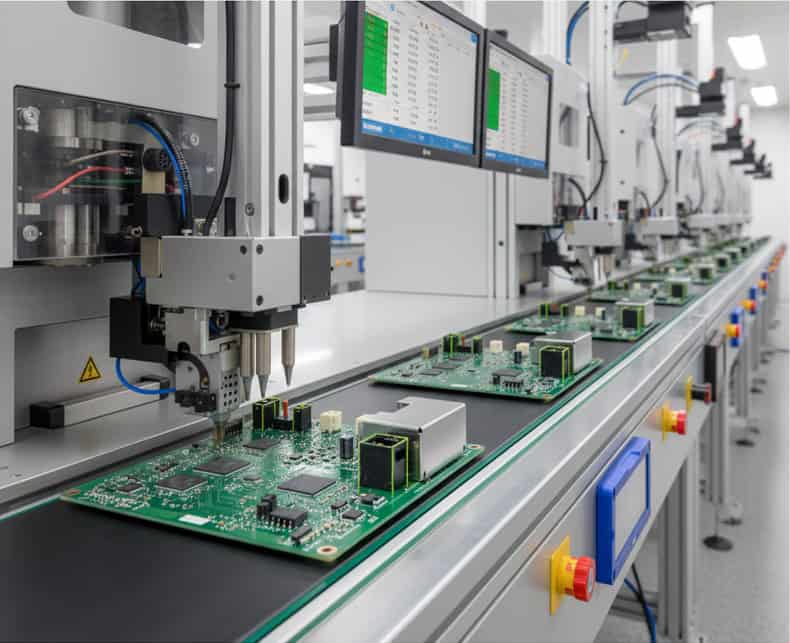
Surface mount technology for medical applications demands more than speed and component count. Fine-pitch BGAs with 0.4 mm ball pitch, micro-QFNs with exposed thermal pads, and 01005 passives all require verified process capability — not estimated or assumed. Our placement equipment is qualified and monitored against the specific tolerance windows required by medical-grade assemblies.
Through-hole technology in medical devices isn't legacy — it's deliberate. Power connectors, high-current terminals, and mechanically stressed interfaces in patient-contact equipment are specifically designed for THT because solder joint pull-out strength and vibration resistance are clinically significant. Our selective and wave soldering processes are validated to IPC-A-610 Class 3 for all through-hole joints.
Mixed-technology boards — SMT on one side, THT on the other, with embedded shielding cans or press-fit connectors — are common in medical platforms. Our production line is configured to handle the sequencing, masking, and thermal management that mixed-technology assembly demands without compromising either side's soldering quality.
Fine-Pitch SMT Assembly
High-density medical PCBs increasingly rely on fine-pitch ICs and passives that challenge placement and soldering process windows. Our line is qualified for 0201 and 01005 components, 0.4 mm pitch BGAs, and 0.3 mm pitch QFPs — with SPI and AOI validation after each step.
BGA & Underfill Capability
BGA components in medical electronics serve as primary processing, memory, and communication interfaces. Our BGA assembly process includes paste volume verification, X-ray inspection of every joint layer, rework capability, and underfill dispensing where mechanical reinforcement is specified for vibration or shock environments.
Through-Hole (THT) Assembly
Medical-grade THT soldering is held to IPC-A-610 Class 3 — the highest published standard for solder joint quality. Selective soldering is available for mixed boards where wave soldering would expose SMT components to thermal risk. All wave and selective solder profiles are documented and version-controlled.
Mixed-Technology Boards
Most real-world medical PCBs combine SMT and THT in a single assembly, often with additional processes — press-fit connectors, RF shielding cans, conformal coating, or potting. Our production sequence is configured to handle multi-step mixed assemblies without compromising soldering quality or component integrity across any process stage.
Conformal Coating & Potting
Medical devices deployed in clinical environments face humidity, cleaning agents, and condensation that bare PCBs cannot survive long-term. We apply conformal coatings — acrylic, silicone, and polyurethane — with controlled film thickness, coverage verification, and documentation of masked exclusion zones for connectors and test points.
Cleaning & Ionic Contamination Testing
Flux residue on medical PCBs can cause dendritic growth and electrochemical migration — failure mechanisms that develop slowly and are extremely difficult to diagnose in the field. We offer precision aqueous cleaning validated to IPC-TM-650 ionic contamination limits, with test reports included in the production documentation package.
Tell us what your medical device demands — we'll confirm whether our line is the right match.
Review Your Assembly Requirements With UsFunctional Testing & Inspection for Medical Electronics
Inspection tells you whether an assembly was built correctly. Functional testing tells you whether it works. For medical electronics, both are required — and neither is sufficient on its own. Our testing and inspection framework is designed to catch every failure mode before it reaches the field.
Automated Optical Inspection (AOI)
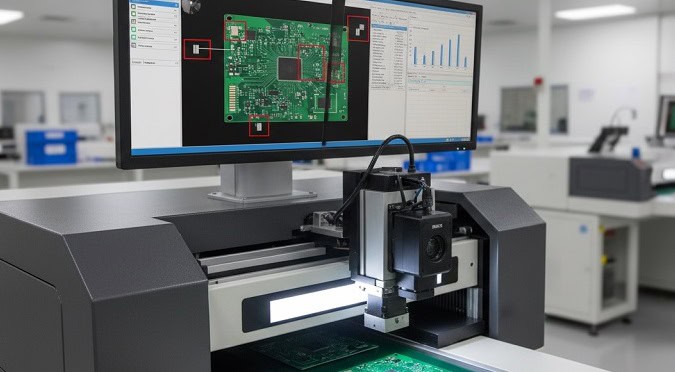
AOI provides 100% coverage of every solder joint and component placement on every board. For medical assemblies, this isn't a cost trade-off against AQL sampling — it's a baseline requirement. AOI catches opens, shorts, missing components, tombstoning, and polarity errors at a speed and consistency that manual inspection cannot match.
- 5-axis AOI performed after reflow on all SMT boards
- Both top and bottom side inspection coverage
- Defect images stored and linked to production lot records
- Statistical defect trending used to drive process improvement
- IPC-A-610 Class 3 acceptance criteria applied for medical assemblies
X-Ray Inspection
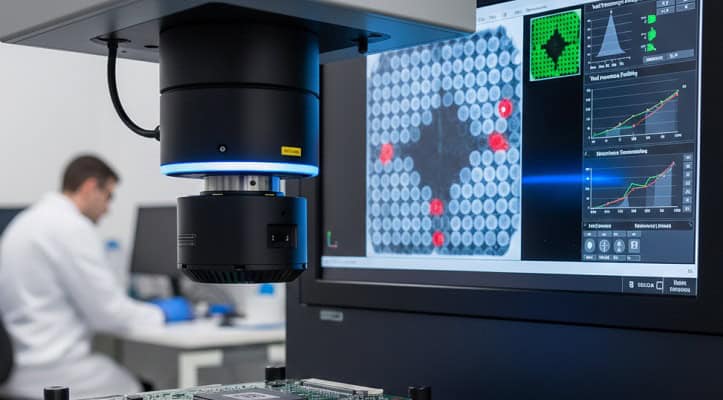
BGA joints, QFN thermal pads, and press-fit contacts are completely invisible to optical inspection. X-ray is the only method that can verify solder fill, detect voids, confirm ball formation, and identify bridging under these components. On medical boards, X-ray is applied to all BGA and hidden-joint components as a standard process step — not an optional add-on.
- 2D and 3D X-ray capability for void analysis and joint profiling
- Void percentage measured against IPC-7095 acceptance limits
- Applied to 100% of units containing BGA, QFN, or LGA packages
- X-ray images archived and linked to board serial numbers
- BGA rework-and-reinspect workflow available for field returns
Customised Functional Testing
We integrate customer-provided functional test plans or develop test fixtures in-house that exercise your board's actual clinical performance parameters — power-on sequencing, signal accuracy, communication protocol verification, and alarm output validation. Functional test data is logged and included in the shipment documentation package as evidence of conformance, not just as a pass/fail stamp.
Burn-In & Accelerated Ageing
Infant mortality failures — components that pass initial test but fail within the first hours of operation — are a real risk for medical devices where early field failure has clinical consequences. Burn-in testing at elevated temperature and voltage screens out these latent defects before shipment, delivering a product population with a substantially more predictable field reliability profile. Test duration and conditions are defined per product based on component criticality.
Test Documentation & Traceability
Every test outcome — pass or fail — is recorded against the board's serial number and linked to its production lot record and component traceability data. Test reports are structured to support inclusion in your design history file and are available for regulatory review at any point during the product's lifetime. A failed unit is never re-labeled as passed; the complete disposition record is retained and accessible.
Ready to define a testing programme that gives your regulatory team the evidence they need?
Discuss Your Medical PCB Testing RequirementsComponent Sourcing with Full Transparency
In medical electronics, the component is not just a part — it is a clinical variable. A capacitor that performs to specification in a diagnostic device isn't interchangeable with a visually identical part from an unauthorised source. Counterfeit components, grey-market stock, and undocumented substitutions have all triggered medical device field failures and regulatory actions.
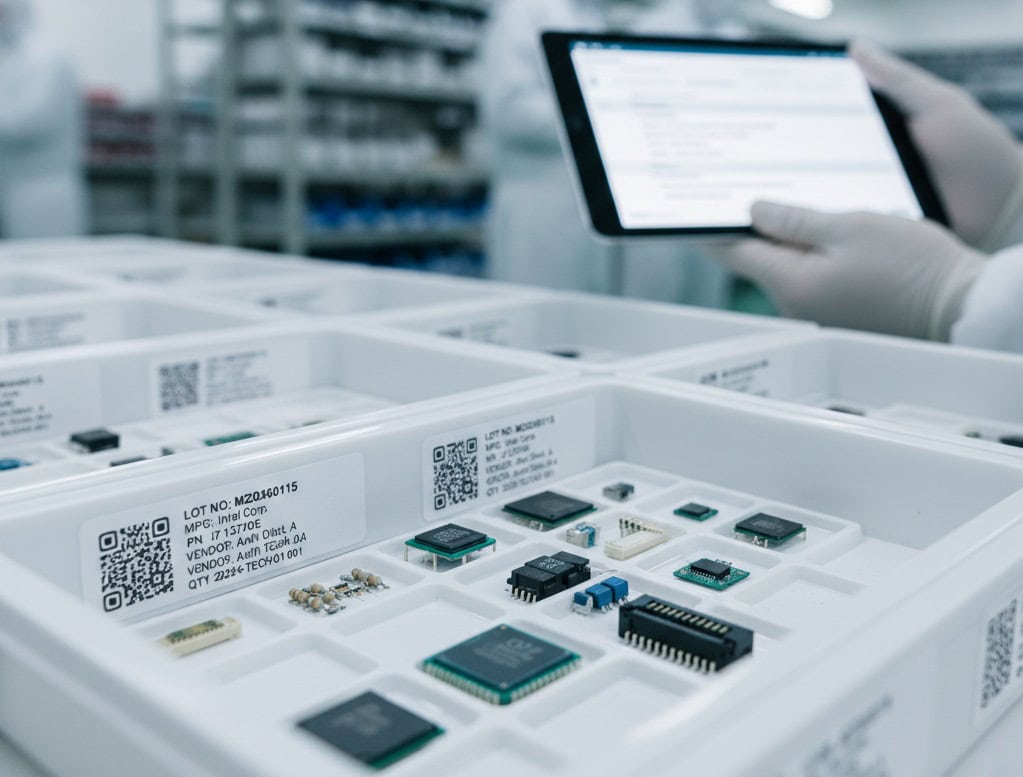
Our sourcing policy is unconditional: every component is procured from the original manufacturer or an authorised franchised distributor, accompanied by a certificate of conformance and full lot traceability. We do not source from open-market brokers, spot-market aggregators, or any channel where provenance cannot be independently verified.
When a specified component is unavailable or approaching end-of-life, we identify alternatives and bring them to you for approval — with supporting technical documentation — before any substitution is made. Your BOM is your specification. We treat it that way.
Authorised Distribution Only
Every component in your BOM is sourced from the original manufacturer or a franchised authorised distributor. Certificates of conformance accompany every shipment. We maintain supplier qualification records and conduct periodic audits of our supply chain partners to verify continued authorisation status and quality system integrity.
Customer Approval on All Deviations
If a specified component becomes unavailable, we bring the situation to you with documented alternatives and technical justification — and we wait for your written approval before proceeding. No substitution is ever made unilaterally. The approved deviation is recorded and linked to the affected production lots in your project documentation, preserving the integrity of your design history file.
End-of-Life & Lifecycle Monitoring
Medical devices often remain in production for five to fifteen years — far longer than most component lifecycles. We proactively monitor EOL and PCN notifications for every part in your active BOMs. When a component approaches end-of-life, we alert you with lead time to source a last-time-buy quantity or complete a controlled re-qualification before availability is lost.
Want to verify our sourcing policy against your supply chain compliance requirements?
Request Our Sourcing Policy DocumentationChina-Based Medical PCB Assembly
with Global Export Experience
China-based manufacturing carries a cost and lead-time advantage that is difficult to replicate elsewhere. What separates reliable China-based medical assembly from the rest is not geography — it is whether the quality system, documentation practices, and export processes meet the standards of the markets the devices are sold into.
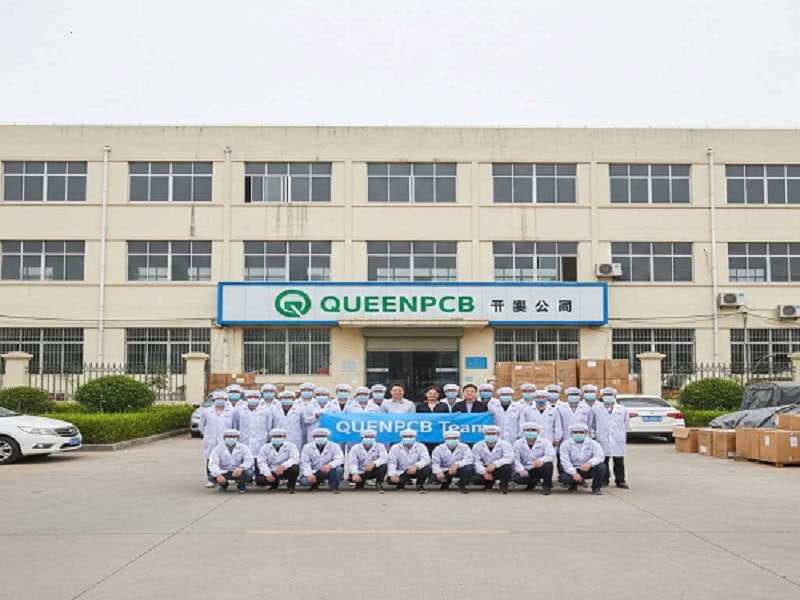
Our facility is a direct-supply manufacturer — not a trading company, not a sourcing agent, and not a brand layered over a subcontracted production floor. When you place an order, it is built here, under our process control, by our engineering and production team. The facility you audit before the project starts is the facility that builds every batch.
We have been exporting medical and industrial electronics to customers in North America, Western Europe, and the Asia-Pacific region for over a decade. That means our documentation is structured to support FDA 21 CFR Part 820 requirements, CE technical files, and MDR compliance reviews — not translated ad hoc when a regulatory submission is due, but built into our standard production record package.
Export logistics, customs documentation, ECCN classification, and DDP delivery options are handled in-house. Our customers receive complete shipment documentation suitable for import clearance without needing to manage a parallel logistics relationship.
Direct Factory — No Subcontracting
Production never leaves our facility without your knowledge. We do not subcontract assemblies to secondary factories. Every board you order is built on our line, under our process control, with our operators. Your audit of our facility is valid for every batch we ship to you.
Regulatory Documentation Aligned to Export Markets
Our production record package is structured to support regulatory submissions in the US, EU, and other regulated markets. DHF-compatible documentation, material declarations, and test reports are produced as standard outputs — not as after-the-fact reconstructions.
Stable Quality System Across Seasons
Supply chains that depend on a single Chinese factory sometimes experience seasonal disruptions around Chinese New Year and Golden Week. We manage these windows proactively — scheduling production, pre-building safety stock where appropriate, and communicating lead time impacts at least 60 days in advance.
Considering a China-based medical PCB partner? Let's discuss what your quality and compliance requirements actually need.
Start the ConversationSuitable for Long-Term OEM Medical Partnerships
The most reliable medical device supply chains are built on manufacturing partnerships, not transactional vendor relationships. When your contract assembler knows your product, your regulatory obligations, and your clinical market as well as you do, production problems are solved before they become supply problems.
Long-term OEM relationships in medical manufacturing create compounding quality advantages. The more production cycles your assembler has completed on your product, the better-characterised the process becomes, the lower the defect rate trends, and the more predictable the output quality. Switching manufacturers resets this curve entirely — and in regulated medical manufacturing, process changes require documented validation, not just a new purchase order.
We invest in understanding the clinical application and operational context of every product we manufacture long-term. That understanding informs component lifecycle decisions, process parameter reviews, and engineering change assessments in ways that a transactional relationship simply cannot replicate. When your product is approaching a design refresh or a new market certification, we are already part of the conversation — not being briefed from scratch.
Our long-term OEM model includes dedicated account management, structured quarterly business reviews, advance capacity planning, and agreed minimum batch inventory levels where appropriate to protect clinical supply continuity. We don't just build your boards — we help you manage your production programme.

Dedicated Account Management
Every long-term OEM account is assigned a dedicated technical account manager who owns the relationship across production, engineering, and logistics. Your contact knows your product, understands your regulatory context, and has the authority to resolve issues without escalation delays. No account management by ticket queue.
Batch-to-Batch Consistency Guarantee
Locked process parameters, version-controlled documentation, and SPC trending across production batches mean the 500th batch performs to the same specification as the 5th. Yield and quality metrics are reviewed quarterly against baseline targets, and any deviation triggers a formal corrective action — not an informal conversation.
Proactive Supply Planning
Clinical supply continuity depends on visibility well ahead of demand. We operate on rolling 12-month forecasts with our long-term OEM partners, pre-qualifying component alternatives before they are needed, managing long-lead-time component buffers, and communicating supply risk with enough lead time for you to take action — not the week a shipment is due.
Engineering Change Support
Medical device design changes — whether driven by component EOL, performance improvements, or regulatory updates — require controlled implementation at the manufacturing level. We manage ECO implementation with documented process parameter updates, first-article re-inspection under the new configuration, and clear linkage between the change record and the production batches it affects.
Stable Pricing & Lead Times
Long-term OEM partners receive agreed pricing frameworks with defined review cycles — not spot pricing that varies with market conditions on every order. Capacity is reserved against your rolling forecast, meaning your production slot is secured in advance, not competed for on the open scheduling board. Predictable cost and lead time are part of the partnership value, not negotiating points on each PO.
Quarterly Business Reviews
Every long-term OEM account participates in a structured quarterly business review covering quality metrics, yield trends, supply chain status, upcoming programme changes, and any open corrective actions. These reviews are documented, action items are tracked to closure, and the record is retained as part of your supplier qualification file. Transparency is a built-in feature of the partnership, not an optional extra.
Looking for a manufacturing partner you can grow a medical device programme with?
Let's Talk Long-Term PartnershipWho We Are Best Suited For
Not every medical electronics project is right for every contract assembler. We'd rather be transparent about where we excel and where we're not the optimal fit than overpromise and under-deliver on a device that matters clinically.
- Diagnostic equipment — patient monitors, vital signs devices, analysers, and point-of-care diagnostic platforms where accuracy, consistency, and long-term reliability are the primary engineering objectives
- Clinical monitoring devices — continuous monitoring electronics, wearable clinical devices, and telemetry systems where batch-to-batch consistency directly affects clinical data integrity
- Industrial and laboratory medical equipment — benchtop analysers, laboratory automation electronics, and imaging system boards where complex mixed-technology assemblies demand rigorous process control
- Rehabilitation and therapeutic devices — electrotherapy, physiotherapy, and assistive technology electronics where operational longevity and regulatory compliance in non-implantable Class II categories are required
- Low-to-mid volume regulated programmes — projects running 10 to 5,000 units per batch that require full medical-grade documentation and cannot compromise process rigour for throughput economics
- Teams transitioning from prototype to clinical production — engineering teams that need a manufacturing partner capable of supporting design validation through to commercial launch without changing suppliers mid-programme
- Active implantable devices — pacemakers, neurostimulators, cochlear implants, and other active implantables operating under the most stringent regulatory frameworks typically require ISO 13485-certified manufacturing with implant-specific process validations that go beyond our current scope
- Class III high-risk PMA devices — devices subject to Pre-Market Approval requiring manufacturing under full FDA QSR with periodic FDA facility inspections are better served by facilities with active FDA registration and inspection history specific to that device category
- Ultra-high-volume commodity medical consumables — projects running hundreds of thousands of units per month where cost-per-unit optimisation takes precedence over the engineering-intensive process model we operate are not an economic match for our production structure
A note on honesty: We've written this section because we believe that knowing where a supplier genuinely adds value — and where they don't — is the most useful thing a medical device team can know during supplier selection. If your project falls outside the "where we excel" category above, we'll tell you directly and, where we can, recommend a more appropriate resource. If it falls squarely within it, we're confident we can build your device to the standard it demands.
Not sure whether your project is the right fit? Send us your requirements and we'll give you a direct assessment.
Submit Your Project for a Fit AssessmentRequest a Medical PCB Assembly Quote
If your medical device programme requires stable batch consistency, engineering-level DFM review, transparent component sourcing, and audit-ready production documentation — let's discuss what we can build together.
- Engineering DFM review included on every project
- Authorised-channel component sourcing only
- Full lot traceability from receipt to shipment
- IPC-A-610 Class 3 inspection standard
- Pilot run validation before mass production
- Audit-ready documentation package included
- AOI + X-ray inspection as standard process
- Responsive support from your first enquiry
To receive an accurate quotation, please share your Gerber files, BOM, assembly quantity, and any relevant IPC class or testing requirements.
All files and project information are treated as strictly confidential. NDAs available upon request.
Medical PCB Assembly FAQ
Answers to the questions medical device teams ask most before choosing an assembly partner.
What FDA device classifications can your medical PCB assembly support?
You don't have ISO 13485 — can you still build medical-grade PCBs?
What documentation do you provide for regulatory submissions?
How do you prevent component substitution on medical BOMs?
What's the real cost difference between IPC Class 2 and Class 3 medical assembly?
Still have questions about medical PCB assembly requirements? Let's discuss your specific project.
Upload Your Medical PCB FilesTell Us About Your Medical PCBA Project
Get a customized quote within 24 hours. Our team is ready to help you find the perfect solution for your needs
Email Us
[email protected]
Response within 12 hours
Call / WhatsApp
+86-0755-363091328
Mon - Sat, 9AM-6PM CST
Visit Our Factory
1-4/F Property Office Building, ZhengFeng North Road, Shenzhen, China. 518103