
Why Low Volume PCB Assembly Projects
Fail at Production Stage
Low volume PCB assembly for hardware startups is far more complex than simply building a working prototype. A prototype that works on the bench is only half the story. The gap between validation and scalable production is where most startup teams encounter costly delays and redesign cycles.
Sample Runs ≠ Production Ready
Your prototype passed bench testing — but it was assembled by hand, with hand-picked components, and zero tolerance for variation. The moment you move to SMT lines, every unresolved design decision becomes a defect rate. Without DFM validation, most designs require at least one costly revision round.
An Unstable BOM Is a Ticking Clock
Prototype BOMs are built for speed, not supply chain resilience. When lead times shift or a component goes EOL, a supplier that simply "builds what you send" will either stop production or swap parts without telling you. Either outcome delays your launch and risks your product's performance in the field.
Suppliers That Only "Follow Orders" Can't Save You
Most contract manufacturers take your files, load the line, and ship — full stop. They have no incentive to flag thermal issues, pad geometry mismatches, or paste-stencil risks before the batch runs. When things go wrong, you absorb 100% of the rework cost and schedule impact.
Ready to bridge the gap between prototype and production without the painful surprises?
Request a Free Prototype ReviewThe Hidden Risks in Low Volume PCB Assembly for Hardware Startups
In low volume PCB assembly for hardware startups, the lowest quote rarely reflects the true cost. Weak engineering oversight and unstable supply chains quickly compound into delays, redesign cycles, and missed launch windows.
Slow Communication Destroys Momentum
Every 24-hour email lag during a production issue is a day you can't recover. Hardware startups live and die by their launch window — a partner that goes quiet during problems doesn't just frustrate you, they quietly burn your runway. Responsive engineering support isn't a nice-to-have; it's a business critical capability.
Weak Engineering Capability Transfers Risk to You
A sales-focused factory treats your design as fixed — they won't flag a thermal dissipation problem, a pad spacing concern, or a silkscreen overlap that'll jam their AOI machine. Without in-house engineering review, every unresolved risk in your Gerbers becomes your problem to solve after the damage is done.
Silent Component Substitutions Are a Trap
When a BOM item goes out of stock, some suppliers substitute silently — sourcing a "functionally equivalent" part without approval. That part may pass basic checks but fail in your specific circuit conditions. By the time field failures surface, your customer relationship and warranty budget take the hit, not your manufacturer.
Inconsistent Batch Quality Erodes Your Reputation
Quality that passes inspection on batch one and fails on batch three is worse than a consistent defect rate — because it's unpredictable. For startups building their early customer base, one bad shipment can end repeat business before your product has a chance to prove itself in the market.
Delayed Launch
Weeks become months when defects surface post-production
Missed Funding Milestone
Investors expect delivery; broken promises cost you credibility
Batch-Wide Rework
Mass rework eats 30–60% of production cost with nothing to show
Customer Trust Lost
First-unit failures are hard to recover from in competitive markets
Don't let the wrong manufacturing decision become your biggest setback.
Talk to a Manufacturing EngineerWhat Really Happens Between
Prototype and Mass Production
The journey from a validated prototype to a reliable, scalable product involves a series of engineering decisions most factories skip. Understanding this process is the difference between a smooth product launch and a costly recall.
The Gaps That Cause Production Failures
Moving from prototype to production isn't a file transfer — it's a structured engineering validation process. When manufacturers skip these steps, startups pay the price in rework, delays, and damaged product reputation.
- Process Validation — confirming your design is achievable with repeatable SMT processes, not just hand-assembly techniques
- Solder Joint Consistency — ensuring paste volume, reflow profile, and pad geometry produce uniform, inspection-grade joints at volume
- Thermal Management Review — checking that power dissipation, component placement, and PCB copper pours hold up under real operating conditions
- Test Strategy Planning — defining ICT, functional, and final inspection protocols before production begins, not as an afterthought
- Pilot Run Execution — running a controlled small batch to catch real-world issues before committing to full production volume
Step 01
DFM Analysis
Engineers review your Gerbers, BOM, and assembly drawings to catch manufacturability issues before a single board is built
Step 02
Process Engineering
Stencil design, paste selection, reflow profile tuning, and component placement programs are all configured for your specific design
Step 03
Pilot Run
A controlled small-batch run with full AOI and functional inspection validates the entire production process before committing to volume
Step 04
Scale-Up Production
Once the pilot passes all quality gates, production scales with locked-in processes, approved components, and consistent inspection protocols
Want to see exactly what our prototype-to-production transition process looks like for your project?
Start Your Transition AssessmentOur Scalable Low Volume
PCB Assembly Model
Most factories are optimized for volume — the higher the batch, the lower the unit cost, and the higher their interest in your project. We built our production model differently: designed from the ground up to serve hardware teams that need quality at 10 units and the same process when they need 10,000.
Engineering DFM Review
Every project begins with a thorough Design for Manufacturability review. Our engineers assess your Gerbers, schematic intent, BOM, and assembly notes — surfacing issues that would cause yield loss before a stencil is cut or a component ordered. You get a written DFM report, not a verbal assurance.
BOM Risk Control
Before purchasing a single component, we cross-reference your BOM against real-time availability, lead time risk, and EOL status. Where shortages or obsolescence are flagged, we propose approved alternates — with your sign-off required before any substitution is made. No silent swaps, ever.
Pilot Run Validation
We run a controlled pilot batch — the same SMT line, same reflow profile, same inspection protocol as full production — before scaling up. Every board in the pilot goes through AOI, X-ray on BGA/QFN, and functional testing. Pilot approval is the green light for volume; there are no surprises at scale.
Scalable Production
Once the pilot passes all quality gates, we lock in every process parameter — paste volume, pick-and-place offsets, inspection thresholds — and carry them forward into every subsequent batch. Whether you're ordering 50 or 5,000 units, you get the same documented, controlled process.
Ready to run your first low-volume production batch with full engineering support?
Request a Low Volume PCB QuoteEngineering-Driven DFM
Before Every Production Run
Most manufacturers treat DFM as optional — something to do if a client requests it. We treat it as the foundation of every order. No stencil gets cut, no components get ordered, and no SMT program runs until our engineers have reviewed your design and confirmed it's production-ready.
Gerber & Layout Analysis
Our engineers review your Gerber files layer by layer — checking trace clearance, copper pour integrity, soldermask slivers, pad-to-hole ratios, and via-in-pad risks that CAM systems miss. Issues caught at Gerber review cost nothing to fix. Issues caught after soldering cost everything.
Assembly & Stencil Readiness
We evaluate your component placement for pick-and-place accessibility, solder paste aperture feasibility, component tombstoning risk, and fiducial marker placement. A design that's hard to assemble consistently is a design that will produce variable yield — regardless of how well the factory is run.
BOM & Component Validation
Every BOM line is cross-checked for part number accuracy, package footprint match, supply chain availability, and polarity markings. We flag ambiguous or potentially substituted parts before they reach the line — not after they're soldered onto 200 boards.
Submit your design files today and receive a full DFM report within 72 hours — at no obligation.
Request Your Free DFM ReviewFlexible Small Batch PCB Assembly
Without Excess Inventory
Tying up capital in component stock you haven't assembled yet is a startup tax most teams can't afford. Our small batch model is built around exactly what you need — assembled, inspected, and shipped — with the flexibility to scale the moment your order volume grows.
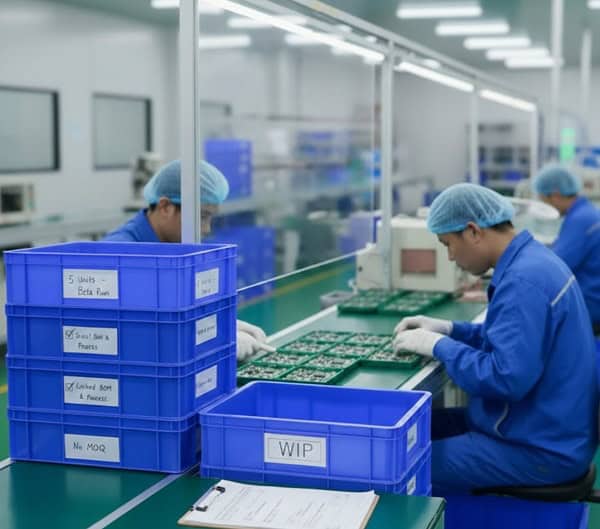 Small Batch · Low MOQ
Built for Teams That Can't Afford to Over-Order
Traditional EMS factories require minimum order quantities that force startups to commit to inventory before the design is fully validated in the field. Our small batch production model removes that constraint — letting you order the exact quantity you need for your next stage, whether that's a field trial, a beta program, or an early customer delivery.
- Minimum order from 5 units — no artificial volume thresholds
- Kitted or turnkey sourcing — we buy components or you supply them
- Same production line and inspection protocol regardless of batch size
- Reorder with locked BOM and process — no re-qualification overhead
- Incremental scaling: 5 → 50 → 500 → 5,000 with zero process change
- Surplus component storage available between production runs
5+
Minimum Order Quantity
No artificial volume floors — order what your project actually needs
0.2mm
Minimum Component Pitch
Full capability for fine-pitch ICs, BGAs, and micro-BGAs at any volume
48 hrs
DFM + Quote Turnaround
From file upload to confirmed quote and DFM feedback — no waiting weeks
10,000+
Max Monthly Capacity
Scale from pilot to full production without switching suppliers or re-qualifying
Planning a field trial, beta shipment, or early production run? Let's talk through your exact quantity needs.
Get a Small Batch PCB QuoteTurnkey PCB Assembly Services
for Lean Startup Teams
Managing a multi-supplier chain while simultaneously developing your product, pitching investors, and supporting customers is an unsustainable workload for a small team. Our turnkey service consolidates everything into a single managed workflow — so you ship finished boards, not spreadsheets.
Full Component Sourcing & Procurement
Submit your BOM and we handle everything from procurement to incoming inspection. We source from authorized distributors and tier-1 supply chain partners — verifying date codes, lot traceability, and authenticity. You receive a component traceability report with every shipment, not just an invoice.
SMT, THT & Mixed Assembly
From surface mount to through-hole to mixed-technology boards, every assembly process runs on our in-house SMT lines with automated optical inspection integrated at each production stage. No subcontracting, no handoffs — your board stays in one facility from bare PCB to finished assembly.
Testing, Packaging & Direct Shipment
After inspection, boards go through your specified functional test protocol, ESD-safe packaging, and direct shipment to your address — or drop-shipped to your customers if needed. A single PO, a single point of contact, and one consistent quality standard from order confirmation to delivery.
Incoming QC Inspection
SMT & THT Lines
Functional Testing
ESD-Safe Packaging
Global Direct Shipment
Full Traceability Report
Ready to hand off the entire production process and focus on what matters most — your product?
Explore Turnkey Assembly OptionsHigh Reliability PCB Assembly
with Full Inspection
Reliability isn't a product feature you add at the end — it's engineered into every step of production. Our inspection protocol doesn't exist to catch defects after the fact; it exists to confirm that each process step produced the result it was designed to produce, every time, on every board.
AOI
Automated Optical Inspection
Every board passes through our 3D AOI system immediately after reflow soldering. The system captures and analyzes every component: presence, orientation, polarity, solder joint height, and bridging. AOI catches the defects that visual inspection misses — and it does it faster and more consistently than any human quality check.
X-Ray
X-Ray Inspection
BGA, QFN, and other hidden-solder-joint packages require inspection methods that optical systems physically cannot perform. Our X-ray system images solder ball formation, voiding percentage, joint collapse, and bridging beneath packages — giving you quantified, documented evidence that every hidden joint meets specification before the board ships.
FCT
Functional Testing
Optical and X-ray inspection confirm the assembly was built correctly — functional testing confirms it actually works. Using your test specification or one we develop together, we power up each board, apply stimulus, and measure output against defined pass/fail parameters. Every board ships with a functional test record, not just a visual inspection stamp.
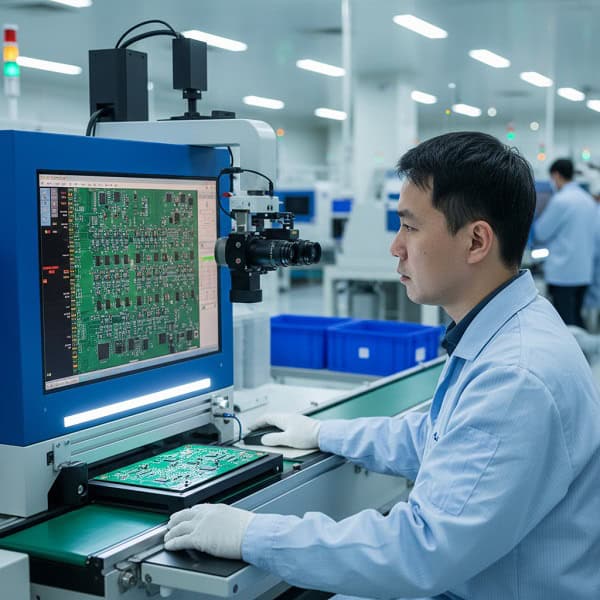 3D AOI — Post-Reflow
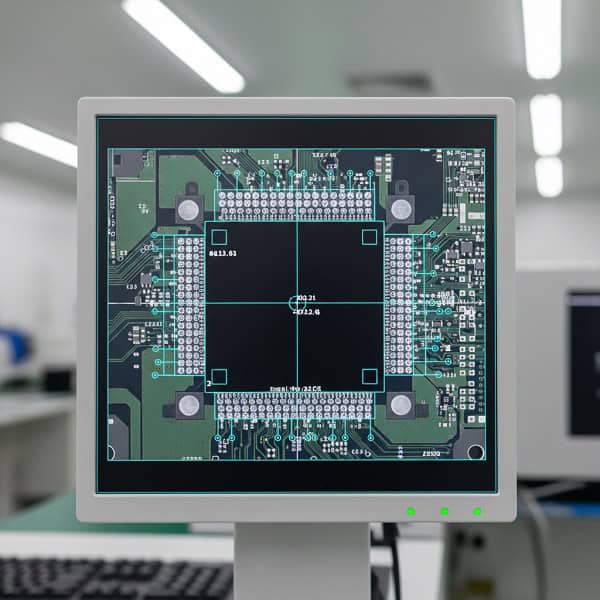 X-Ray — BGA Void Analysis
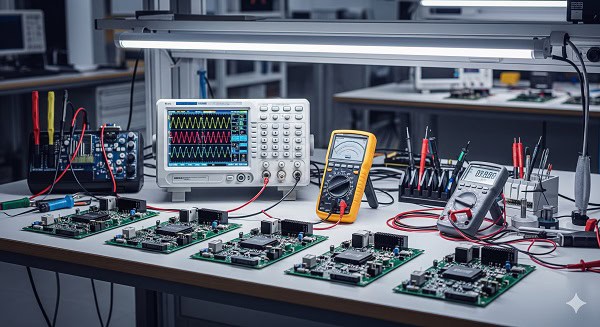 Functional Test — Power-On Verification
Want to know exactly which inspection steps apply to your specific design? Our engineers can walk you through a tailored quality plan.
Request a Quality Plan ReviewReliable PCB Assembly Delivery
for Product Launch Deadlines
A board that arrives two weeks after your trade show, investor demo, or launch date isn't a quality product — it's a missed opportunity. We treat your delivery date as a hard engineering constraint, not a soft target, and we build our production schedule around it from day one.
Day 1–2
Order Confirmation & DFM Review
Files received, DFM analysis completed, BOM cross-referenced, and production plan locked. You receive written confirmation of your delivery window before we touch a component.
Day 3–5
Component Procurement & Incoming QC
All components sourced, inspected on arrival, and logged with date codes and supplier traceability. No production starts until every part on the BOM is verified and ready.
Day 6–10
SMT Assembly & In-Line Inspection
Boards run through SMT, reflow, and 3D AOI in a single continuous flow. Any AOI failure triggers an immediate hold — no bad boards continue down the line while issues are investigated.
Day 11–12
Functional Test & Final QC
Each board powered on, tested against your spec, and signed off by our QC team. X-ray for BGA/QFN packages. Full test records generated per serial number.
Day 12–14
Packaging, Documentation & Dispatch
ESD-safe packaging, shipping mark per your requirements, and a complete delivery package including test records, traceability report, and packing list — dispatched with tracking to your door.
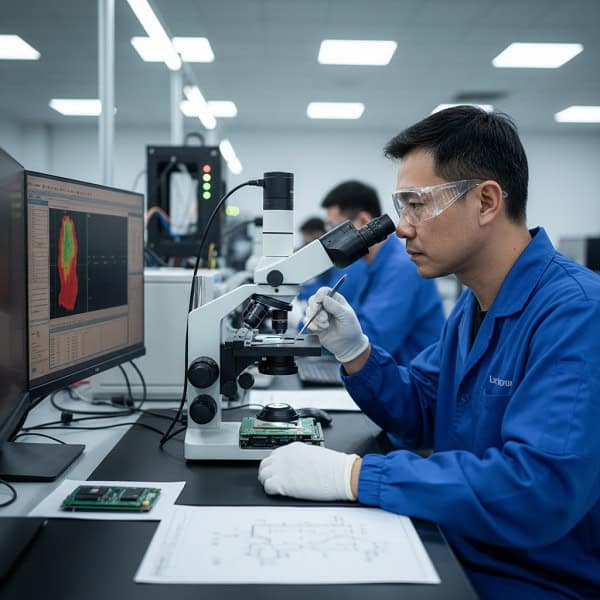 Standard Lead: 10–14 Days
Confirmed Delivery Windows
Every order ships with a confirmed delivery date issued at order acceptance — not an estimate that shifts each time you ask for an update. If your window changes, we tell you proactively, not after you chase us.
Express Production Available
When your timeline is compressed, express production scheduling reduces our standard lead time to as low as 5–7 working days for standard complexity boards. Rush capability exists because launch deadlines don't negotiate.
Global Logistics Support
We handle export documentation, customs declarations, and international shipping coordination for deliveries to the US, EU, UK, and beyond. You receive a single tracking number and a full set of export records — no logistics headache on your side.
Real-Time Order Visibility
Production status updates at each stage — procurement complete, SMT running, inspection passed, dispatched. You always know exactly where your order stands, without sending a single "what's the update?" email.
Have a product launch, investor demo, or trade show deadline? Tell us your date — and we'll build a production plan around it.
Lock In Your Delivery TimelineChina PCB Assembly Manufacturer
with Global Export Experience
Factory-direct pricing, engineering depth, and a decade of documented export experience to the US, EU, UK, and beyond. We're not a trading company placing your order with an unknown facility — we are the facility, and you always know exactly who is building your boards.
Factory Direct — No Middlemen
When you place an order, it goes directly onto our SMT lines — not to a broker who subcontracts to an unknown factory three tiers deep. You visit, audit, and communicate with the team that actually builds your boards. That transparency is a feature, not an accident.
10+ Years Exporting to Western Markets
We have been exporting assembled PCBs to North America and Europe since 2013. We understand IPC standards, UL compliance requirements, CE declaration processes, and the export documentation that clears customs without delays. We've solved every international logistics problem so you don't have to.
Transparent Process, Documented at Every Step
Every production stage generates a document trail: DFM report, BOM approval, component traceability, AOI results, functional test records, and a final outgoing inspection report. You receive a complete production dossier with every shipment — not just a packing list and an invoice.
 Our Factory · Direct Access
What "Working with a Chinese Manufacturer" Should Actually Look Like
The concerns most hardware startups have about overseas manufacturing — hidden substitutions, communication gaps, quality inconsistency — are factory selection problems, not country-of-origin problems. When you partner with us, you get direct access to the engineers who run your production, the inspectors who check your boards, and the account manager who owns your project from quote to delivery.
- English-speaking engineering team available during your business hours
- Video call factory access for clients who want to see their line before committing
- Dedicated project manager — one contact, not a rotating support queue
- IPC-A-610 Class II inspection standard as baseline, Class III available
- Export documentation: commercial invoice, packing list, COC, and test reports included
Quality Management
Certified manufacturing processes
Acceptability of Assemblies
Class II standard, Class III available
Lead-Free Compliance
Full EU RoHS documentation supplied
UL-Listed Materials
PCB laminates and solder materials
Want to verify our factory before placing your first order? Request a virtual facility walkthrough — no commitment required.
Request a Factory IntroductionStartup Electronics Manufacturing
Case Scenarios
Every hardware startup arrives at manufacturing from a slightly different direction. Here are three production scenarios we navigate regularly — and how our model delivers results at each stage of the journey.
IoT Sensor Team Transitioning from Hand-Built Prototypes
A five-person IoT startup had a working sensor node built by their hardware engineer on a prototype PCB. The design passed bench testing but had never run through SMT production. They needed 50 assembled units for a field trial without committing to a 500-unit MOQ that exceeded their current runway.
How We Helped
We ran a full DFM review and identified three pad geometry issues and a missing fiducial that would have caused AOI failures. After approval, we assembled 50 units with 100% AOI and functional test, delivering in 12 working days. The field trial succeeded, and the team reordered 300 units six weeks later using the same locked production process — no re-qualification needed.
Industrial Control Board Team with a Fixed Demo Deadline
A hardware team building industrial motor control boards had a trade show demo in six weeks and needed 20 functional units that could survive a live demonstration environment. Their previous manufacturer had quoted 8 weeks and required a 200-unit minimum. The board included a BGA processor and several high-current power MOSFETs requiring thermal validation.
How We Helped
We confirmed a 5-week lead time and assembled 20 units with full X-ray on the BGA package, 3D AOI post-reflow, and functional testing per a test spec we developed together with their engineering team. All 20 boards passed. The demo was delivered on time, and the team used the same production data to negotiate their Series A term sheet the following month.
Power Electronics Startup Moving from 100 to 2,000 Units
A power management hardware company had been assembling 50–100 units per batch with a local assembler. As their customer base grew, they needed to scale to 2,000 units per quarter — but their existing supplier couldn't guarantee consistent quality at volume and didn't have X-ray capability for their GaN-based power stage design.
How We Helped
We onboarded their design with a formal process qualification run of 100 units, documenting reflow profile, paste volume, and X-ray void acceptance criteria for their GaN package. The qualification passed first time. We now produce 500 units per month on a rolling schedule, with a confirmed 4-week lead time and full traceability records delivered with each batch.
Your scenario will be different — but the manufacturing challenges are familiar. Let's talk through where you are and what you need.
Discuss Your Production ScenarioIs Your Startup Ready
for Production?
Not every design is production-ready — and forcing an unvalidated design into manufacturing is how most hardware teams turn a solvable problem into a costly setback. Understanding which stage you're actually at helps us build the right production plan for where you are, not where you think you should be.
Stage One
Validation Stage
Your design is functional on the bench but hasn't been validated in a production environment. You need a small assembled run — typically 5–20 units — to confirm the design performs as expected when built by machines rather than hand. The goal is to find and fix problems before they become expensive.
You're here if:
- Your schematic is finalized but your Gerbers haven't been through DFM
- You've assembled prototypes by hand or with a rework station
- You need units for engineering evaluation or field testing
- You expect one more design revision before committing to production
Stage Two
Pilot Stage
Your design is validated and locked. You're preparing for your first real customer deliveries, a beta program, or a product launch. You need 20–200 units assembled to a repeatable production standard — with full inspection, documented processes, and confidence that what ships to customers represents your actual product quality.
You're here if:
- Design is frozen — no further revisions planned before this batch
- Units will go to real customers, beta users, or a launch event
- You need functional test records and traceability per serial number
- You want a production process you can reuse without re-qualifying
Stage Three
Scaling Stage
You've proven market demand and are ramping production to match. You need a manufacturing partner who can grow with you — from 200 to 2,000 units per quarter — without sacrificing the quality consistency you established in the pilot phase and without requiring you to re-qualify every time you increase volume.
You're here if:
- You have repeating orders but your current supplier struggles at volume
- Quality consistency is deteriorating as batch sizes increase
- You need forecast-based scheduling and locked lead times
- Supply chain stability and component traceability are now business-critical
Not Sure Which Stage You're At?
That's more common than you'd think. Most hardware teams are somewhere between stages — or have assumptions about their readiness that a quick engineering conversation can clarify. Share your files, tell us your timeline, and we'll tell you exactly what we'd recommend and why. No jargon. No upselling. Just a straight answer from engineers who've seen this problem hundreds of times.
- Have your Gerber files and BOM been through a DFM review yet?
- Is your design frozen, or are changes still expected before production?
- Do you have a functional test specification written, or is testing still ad hoc?
- What is your target volume for the next 6 months, and do you have a delivery date?
Tell us your stage, your volume, and your timeline — and we'll build a production plan that fits.
Assess My Production ReadinessWho We Are Best Suited For
We are good at a specific type of manufacturing challenge. Not every project is the right fit — and being clear about that upfront saves everyone time. Here's who we consistently deliver the most value for.
IoT & Connected Devices
Wireless modules, sensor nodes, edge computing hardware, and connected product platforms. We regularly assemble boards with BLE, WiFi, LoRa, and cellular modules — and understand the RF sensitivity and antenna clearance requirements that affect production yield for connected designs.
Industrial & Automation Hardware
Motor drives, PLC I/O modules, sensor interfaces, and industrial communication boards. Our IPC-A-610 Class II inspection baseline and X-ray capability for power packages make us well-suited for designs where field reliability is non-negotiable and a board failure has operational consequences.
Power Electronics & Energy Hardware
Battery management systems, DC-DC converters, GaN-based power stages, and energy monitoring hardware. We have specific process experience with high-current PCB layouts, thermal management validation, and X-ray inspection of power packages where hidden solder joint quality directly impacts safety and longevity.
Early-Stage Hardware Teams
Pre-Series A or Series A hardware startups who need a manufacturing partner that communicates like a collaborator — not a vendor who disappears between orders. We're built for teams that are making important production decisions for the first time and need engineering guidance, not just a factory floor.
Where we're not the right choice: If you need ultra-high-volume commodity assembly (50,000+ units per run with minimal engineering involvement), there are factories optimized purely for throughput that will serve you better on unit cost. We're also not the right fit for designs that require medical device manufacturing certification (ISO 13485) at this time. We'll always tell you honestly if we're not the best match — and point you toward a better option.
Engineering Is in the Room
Our account managers are engineers. When you send a question about your design, you get a technical answer from someone who understands your schematic — not a sales response that routes through three departments.
Your Process Is Yours
Once we qualify your production process, it's locked and documented. Every subsequent batch runs on the same parameters. You're not re-explaining your design to a new operator every time you reorder.
Scale Doesn't Disrupt Quality
We've deliberately built our production model so that scaling from 50 to 5,000 units doesn't require a new DFM review, a new supplier relationship, or a new inspection protocol. The process you validated at pilot is the process you ship at scale.
Think your project might be a good fit? Share your design and let's find out together — no obligation.
Check If We're the Right FitIf You Are Planning Any of These,
It's Time to Start the Conversation
You don't need to have everything figured out before reaching out. Most of our best client relationships started with a conversation, not a perfect set of files.
Scenario One
Running a Pilot Production Batch
You need 10–200 boards built to a real production standard — with DFM review, full AOI, and a locked process you can reuse. We run pilots with the same line settings and inspection protocol as every subsequent volume order.
Scenario Two
Preparing for a Product Launch
Your launch date is real and your design is frozen. You need a manufacturer who can confirm a delivery window and stick to it — with the quality documentation that backs up your product's reliability claims to customers and investors alike.
Scenario Three
Scaling from Prototype to Production
Your prototype works. Now you need a manufacturing partner who can take that design through DFM, run a clean pilot, and set up a repeatable production process that scales without quality degradation as your order volumes grow quarter over quarter.
Request Your Quote &
Free DFM Review Today
Send us your Gerber files, BOM, and assembly notes — and we'll come back with a detailed quote, a written DFM report, and a confirmed lead time within 48 hours. No volume minimums. No vague estimates. Just a straight answer from engineers who will actually build your boards.
Tell Us About Your PCBA Project
Get a customized quote within 24 hours. Our team is ready to help you find the perfect solution for your needs
Email Us
[email protected]
Response within 12 hours
Call / WhatsApp
+86-0755-363091328
Mon - Sat, 9AM-6PM CST
Visit Our Factory
1-4/F Property Office Building, ZhengFeng North Road, Shenzhen, China. 518103
Visit Our Office
(Head Office)1/27, Soi Border 5, Bang Bon Tai,Bang Bon, Bangkok 10150,Thailand