

Drone PCB Assembly for UAV Systems
Drone Electronics Are Unforgiving
A minor PCBA defect can lead to flight instability, mission failure, or complete loss of aircraft.
Your UAV systems demand precision assembly, consistent quality, and zero-defect tolerance — not just competitive pricing.
The 5 Critical Pain Points in Drone PCBA Manufacturing
These aren't abstract concerns — they're the specific failure modes that separate reliable drone electronics from grounded fleets.
Flight Controller Sensitivity
Flight control boards require absolute soldering consistency. Microscopic cold joints or flux residue create signal interference that manifests as flight instability.
Power & ESC Thermal Stress
Electronic Speed Controllers handle high burst currents during flight maneuvers. Inadequate solder joints or thermal management cause in-flight power failures.
Weight & Size Constraints
Every gram matters for flight time and payload capacity. Oversized components or excessive solder reduce performance, but cutting corners creates reliability issues.
Batch-to-Batch Variation
Drones require identical performance across production runs. Process drift between batches creates flight characteristic changes that operators notice immediately.
Prototype to Production Gap
Hand-assembled prototypes fly perfectly, but volume production introduces process variations that weren't tested. The transition kills many drone programs.
Recognize these challenges? Let's discuss how to address them systematically.
Explore Solutions for Your Drone ElectronicsWhy Drone PCBA Is More Demanding Than Consumer Electronics
The operating environment and consequences of failure create requirements that standard consumer electronics assembly processes cannot meet.
Failure = Replacement
- Operates in controlled environments with minimal vibration or shock
- Temperature ranges stay within comfortable human operating zones
- Power demands remain stable without sudden current spikes
- Failures cause inconvenience but no safety or asset loss risks
- Visual inspection and basic functional testing adequate for quality control
Failure = Aircraft Loss
- Constant vibration from motors stresses solder joints throughout flight operations
- Temperature cycling from ground to altitude and component heat dissipation
- Instantaneous current surges during aggressive maneuvers and emergency responses
- Mid-flight failures result in aircraft loss, payload damage, or safety incidents
- Requires thermal cycling, vibration testing, and load simulation beyond standard protocols
Your assembly partner must understand these distinctions at the process level, not just conceptually.
See Our Drone-Specific ApproachCommon Drone PCBA Failure Scenarios
These patterns emerge repeatedly across the industry — preventable issues that escaped quality control and manifested during flight operations.
Cold Solder Joints on Flight Controllers
Flight control boards passed visual inspection and ground testing, but cold solder joints on IMU sensors created intermittent connections under vibration.
Result: Erratic flight behavior during missions, multiple aircraft losses before root cause identified. Entire batch recalled for rework.
ESC Power Stage Thermal Failure
Electronic speed controller power MOSFETs assembled with standard reflow profile developed micro-cracks under thermal stress from high-current operation.
Result: In-flight power loss during aggressive maneuvers. Field failures appeared 20-30 flight hours into operation, well past acceptance testing.
Unauthorized Component Substitution
Factory substituted consumer-grade capacitors for automotive-grade parts without notification due to supply chain shortage.
Result: Premature component failures under temperature cycling. Performance degradation discovered during customer flight testing, delaying production launch.
These failures share a common thread: inadequate process control that testing alone cannot catch.
Learn Our Prevention StrategyWhat Drone Customers Really Care About When Choosing PCBA Partners
These aren't feature lists — they're the critical factors that determine whether your drones fly reliably or become liabilities.
Flight Stability
Every board must perform identically in flight. Assembly variations that affect sensor calibration, power delivery, or signal integrity ground entire fleets.
Batch Consistency
Production run 1 and production run 100 must exhibit identical flight characteristics. Process drift creates support nightmares and certification issues.
Engineering Communication
Direct access to engineers who understand IMU placement, power distribution, and EMI mitigation — not sales filters who defer technical questions.
Testing Coverage
Beyond AOI and basic continuity — thermal cycling, vibration simulation, and load testing that replicates actual flight conditions before delivery.
Full Traceability
Complete documentation of component batches, process parameters, and test results for failure analysis and certification compliance.
Ready to work with a partner who prioritizes flight reliability over order volume?
Start the ConversationDrone-Specific PCBA Risk Management Strategy
These aren't generic quality statements — they're engineered workflows designed to prevent the specific failure modes that ground drones.
Engineering Precheck
Flight controller layouts reviewed for IMU placement, signal integrity, and vibration isolation before production. Power distribution analyzed for current handling and thermal management.
Process Control
Thermal profiles validated specifically for high-current drone components. Statistical process control monitors consistency across batches to prevent flight characteristic drift.
Testing Rigor
Beyond standard AOI and X-ray — vibration testing, thermal cycling, and electrical load simulation replicate actual flight stress conditions before delivery.
Production Stability
Prototype-to-production transition managed to maintain identical assembly parameters. Component sourcing locked with full traceability and zero unauthorized substitutions.
Each control point addresses a specific drone failure mode documented in the field.
Review Our Drone PCBA ProcessFlight Controller & Core Board DFM Analysis
Design for Manufacturing review identifies vibration stress points, sensor placement issues, and assembly risks before the first board is built — when fixes are still inexpensive.
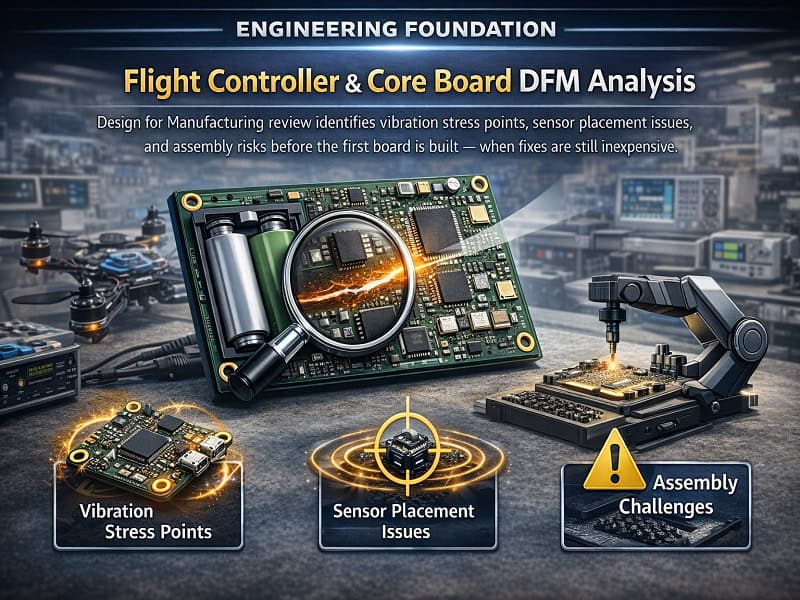
Critical IC Placement & Orientation
IMU sensors and flight processors require specific mounting orientations and isolation from vibration sources. We verify placement against flight dynamics requirements, not just electrical routing convenience.
BGA & Fine-Pitch Risk Assessment
High-density packages on flight controllers create voiding risks under vibration. We analyze pad design, thermal relief, and reflow profiles to prevent hidden joint failures.
Vibration & Thermal Stress Analysis
Motor vibration propagates through the frame to electronics. Component placement and mechanical mounting reviewed to minimize resonance and thermal cycling stress on solder joints.
Power Distribution Verification
Trace widths verified against burst current requirements during aggressive maneuvers. Voltage drop calculations prevent brown-out conditions that cause flight controller resets.
Engineering review prevents the expensive mistakes that only appear during flight testing.
Submit Your Flight Controller DesignPower Distribution & ESC Board Soldering Control
High-current drone power electronics require specialized assembly processes that consumer electronics manufacturers don't typically maintain.
High-Current Joint Consistency
ESC power MOSFETs and battery connectors handle instantaneous current surges during flight. Thermal profiling ensures complete intermetallic formation without creating stress that leads to cracking.
Mixed Technology Assembly
Drone power boards combine SMT control circuitry with through-hole high-current connectors. Dual-process assembly managed to protect sensitive ICs while ensuring robust mechanical connections.
AOI + X-ray for Power Stages
Automated Optical Inspection catches surface issues. X-ray inspection reveals voids and incomplete solder wetting in power device joints that visual inspection cannot detect.
Power stage failures during flight aren't recoverable — prevention is the only option.
Review Our Power Electronics ProcessWeight & Dimensional Control for Drone PCBA
Every gram affects flight time and payload capacity. But weight reduction that compromises reliability creates more expensive problems than it solves.
Board Design Optimization
- PCB thickness selection balances weight against mechanical rigidity for vibration resistance
- Component placement optimization minimizes board area without creating thermal hotspots
- Copper weight specified for current requirements — not over-engineered for margin
- Connector selection considers both weight and vibration-rated retention force
Assembly Process Control
- Solder paste volume controlled to prevent excess weight while ensuring joint strength
- Conformal coating applied only where environmental protection is necessary
- Mechanical fasteners specified for minimum weight with required vibration resistance
- Post-assembly weight verification catches process deviations before flight testing
Weight optimization without reliability compromise requires engineering discipline, not just lighter components.
Discuss Weight-Critical DesignsComponent Sourcing & Substitution Management for Drones
Unauthorized component changes create flight characteristic variations that operators notice immediately. Our BOM management eliminates substitution risks.
Zero Unauthorized Changes
No component substitutions without written engineering approval. Not "equivalent" parts, not "better specifications" — your approved BOM is what gets assembled on your drone boards.
Documented Approval Process
Supply chain issues requiring alternatives trigger formal notification with full technical documentation, performance comparison data, and flight impact assessment before any change.
Batch-Level Traceability
Every component batch logged with date codes, lot numbers, and supplier data. If a drone exhibits unexpected behavior, you can trace back to the exact parts used in that aircraft.
Component integrity isn't negotiable when aircraft safety depends on it.
Review Our Component ManagementGet a Free Drone PCBA Engineering Audit
Get a customized quote within 24 hours. Our team is ready to help you find the perfect solution for your needs
Email Us
[email protected]
Response within 12 hours
Call / WhatsApp
+86-0755-363091328
Mon - Sat, 9AM-6PM CST
Visit Our Factory
1-4/F Property Office Building, ZhengFeng North Road, Shenzhen, China. 518103