
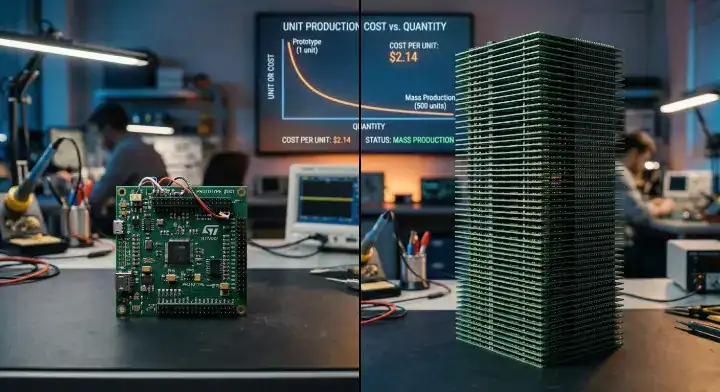
Quick Answer: PCB minimum order quantity cost is mostly the cost of making the order possible, not only the price of laminate and copper. CAM review, tooling, panel setup, material purchase, testing, packing, and administration can be almost the same whether you buy 5 boards or 500. A good quantity decision separates prototype learning, pilot validation, and production economics before the purchase order is released.
Key takeaways – The lowest unit price is not always the lowest project cost. – Bare PCB MOQ and PCBA MOQ are different decisions. – Quantity breaks help only when the extra boards will be used before the design changes. – Ask suppliers to separate setup, recurring unit price, material minimums, and evidence costs.
PCB minimum order quantity cost becomes confusing when buyers compare only the final unit price. A prototype quote may look expensive because fixed work is spread across a small lot. A larger quote may look attractive but can trap cash in boards that are still likely to change.
This page focuses on the buyer decision behind MOQ. For broader quote comparison, use QueenEMS’ PCB quote comparison process after you understand which costs are fixed and which costs repeat with each board.
Table of Contents
- What does PCB minimum order quantity cost include?
- Why do five-board orders look expensive?
- How should prototype, pilot, and production quantities differ?
- When does a larger quantity save money?
- How does PCBA change MOQ math?
- What quote fields should separate setup from unit cost?
- Which MOQ risks should stop a purchase order?
- What should you send for a quantity review?
What does PCB minimum order quantity cost include?
PCB minimum order quantity cost includes fixed order work plus variable board cost. Fixed work often covers CAM review, tooling or fixture preparation, panel planning, engineering questions, purchasing setup, traveler creation, inspection setup, packing labels, and invoice handling. Those activities do not shrink just because the quantity is small.
Variable cost changes with the number of boards, panel yield, laminate consumption, copper weight, surface finish, test time, and scrap allowance. This is why a quote can drop sharply from 5 to 20 pieces, then flatten after the fixed work is already absorbed.
| Cost item | Why it appears in MOQ math | Buyer action |
|---|---|---|
| CAM and DFM review | File cleanup and manufacturability checks happen before production | Confirm whether the charge repeats on unchanged reorders |
| Tooling or fixture setup | Drill, rout, stencil, test, or assembly preparation may be needed | Ask if it is one-time, revised-design, or per-lot |
| Panel utilization | Small board geometry may waste panel area at low quantity | Ask whether nesting or panel size changes the next price break |
| Material commitment | Special laminate or copper may require a purchasable sheet quantity | Separate material minimum from finished-board quantity |
| Test and documentation | Extra evidence can require planning and labor | Put report needs in the RFQ before comparing suppliers |
A quote that hides all of these inside one unit price is hard to compare. A quote that separates them lets engineering and purchasing decide whether to buy fewer boards, more boards, or a cleaner pilot quantity.
Why do five-board orders look expensive?
Very small PCB orders look expensive because the supplier still has to open a real manufacturing job. The CAM engineer reviews Gerber or ODB++ data, drill files, stackup notes, solder mask clearances, and fabrication drawing requirements before the shop can release the job.
Five pieces may also occupy the same planning lane as a larger order. The board still needs panelization, traveler instructions, material staging, drilling, plating, imaging, solder mask, finish, routing, electrical test, final inspection, and packing. The labor path is not one-tenth of a fifty-board lot.
Small orders are valuable when the goal is learning. They are poor value when the design is already frozen and the team simply wants a low cash outlay. In that case, the buyer may pay the setup burden repeatedly across several tiny lots.
How should prototype, pilot, and production quantities differ?
Prototype, pilot, and production quantities should answer different questions. A prototype quantity checks whether the design files build and whether the board supports engineering test. A pilot quantity checks whether the same design can move through assembly, inspection, packaging, and customer approval. A production quantity buys expected demand after the build rules are stable.
For a bare PCB prototype, 5 to 20 boards may be enough when engineers only need electrical and mechanical samples. For an assembled prototype, the quantity may need to cover firmware work, destructive inspection, compliance samples, customer demos, and rework learning.
A pilot run should be larger than the engineering sample because it tests repeatability. If the board has controlled impedance, unusual material, heavy copper, via-in-pad, tight registration, or a new assembly process, the pilot should include the evidence you expect to use later.
When does a larger quantity save money?
A larger PCB quantity saves money when the added boards use the same revision, same material, same process route, and same quality evidence before the design changes. It does not save money when the extra boards become obsolete, require rework, or sit beyond their practical storage window.
Ask for at least three price breaks: the minimum practical quantity, the pilot quantity, and the first production quantity. A useful quote might show 10, 50, and 200 pieces for bare boards, or 5, 25, and 100 assemblies for a PCBA project. The exact numbers should match the product stage.
The price-break discussion should include lead time. Some suppliers can add quantity with little schedule change because the panel and material are already planned. Other projects need more material, more test time, or longer assembly staging.
How does PCBA change MOQ math?
PCBA changes MOQ because components, stencil setup, programming, inspection, and test fixtures can create their own minimums. A bare PCB supplier may quote a low finished-board quantity, while an assembly supplier may need reels, trays, cut-tape handling, feeder setup, or fixture time that changes the economics.
Component sourcing is often the hidden issue. Some parts have minimum purchase quantities, multiple packaging options, or non-cancelable/non-returnable terms. A ten-piece PCBA job may require buying one hundred parts for a single line item. That remaining stock becomes inventory that must be controlled or written off.
For assembly-specific planning, the related PCBA manufacturing process article explains which process checkpoints need evidence before release.
What quote fields should separate setup from unit cost?
The RFQ should ask the supplier to separate setup costs, recurring unit cost, material minimums, test or report costs, and quote validity. Without that split, a buyer cannot see whether a higher quote is actually more expensive or simply more honest about the work required.
| Quote field | What to request | Why it matters |
|---|---|---|
| Minimum practical quantity | Lowest quantity the supplier recommends | Prevents unrealistic tiny orders |
| Price breaks | At least two larger quantities | Shows where fixed cost is absorbed |
| One-time charges | Tooling, stencil, fixture, CAM, NRE | Helps compare reorder economics |
| Recurring unit price | Board or assembly price at each quantity | Supports landed-cost comparison |
| Material minimum | Special laminate, copper, or component buy | Reveals inventory exposure |
| Evidence package | Test, inspection, report, packing records | Makes quality requirements visible |
| Validity period | Date and assumptions behind the quote | Protects purchasing from stale prices |
This table also helps when two suppliers quote different MOQs. One supplier may include a stencil and test report in the minimum order, while another supplier leaves those items as later charges.
Which MOQ risks should stop a purchase order?
A purchase order should stop when quantity is being used to hide an unresolved engineering question. Common examples include unapproved material substitution, a stackup that differs from the drawing, an unfinished BOM, missing centroid data, unclear surface finish, or a customer requirement that has not been transferred to the fabrication drawing.
Inventory risk is just as real. Buying 500 boards to lower unit price can be a poor decision if firmware, enclosure, thermal test, or customer approval may change the design. Purchasing should ask engineering whether the revision is frozen enough for that quantity.
For broader production release discipline, connect the quantity decision to the PCB production release package before moving from pilot to volume.
What should you send for a quantity review?
Send QueenEMS the Gerber or ODB++ files, drill data, fabrication drawing, stackup, surface finish, copper weight, board size, panel preference, expected order stage, target quantities, and any required test or inspection evidence. For PCBA, add the BOM, AVL, centroid file, assembly drawing, programming needs, and test requirements.
The review should answer four questions: what quantity is technically safe, what quantity is commercially efficient, which fixed charges are real, and what could make the extra boards unusable. That gives purchasing a better decision than accepting the first MOQ shown in a quote form.
For a quote-ready handoff, send the target quantity range and the reason behind it through the QueenEMS contact page. We can review whether a small prototype, a pilot lot, or a staged production release fits the current design risk.
FAQ
Is there a normal PCB minimum order quantity?
No single number applies to every PCB. A simple bare board may be quoted in very small quantities, while special laminate, heavy copper, controlled impedance, or assembly work can create a higher practical minimum.
Why is my prototype unit price higher than production price?
Prototype unit price is higher because fixed work is spread across fewer boards. CAM review, setup, inspection, packing, and administration do not fall in proportion to quantity.
Should I order extra boards to lower unit cost?
Order extra boards only when the revision is stable and the boards will be used. Extra quantity is waste when the design, material, BOM, or customer requirement may still change.
Does assembly always increase MOQ?
Not always, but assembly often adds component minimums, stencil setup, programming, inspection, and fixture considerations. The PCBA MOQ decision should be reviewed separately from the bare PCB quantity.
Written by the QueenEMS Engineering Team
Upload your files today · Free DFM check before production · Ship worldwide
Get your PCB prototypes in as fast as 24 hours. We handle FR4, Rogers, and Flex up to 60 layers — free prototypes for 2–4 layer boards, no minimum order.
Just upload your Gerber + BOM — we source every part, assemble, and inspect (AOI + X‑Ray) so you don't have to chase suppliers. Boards ship in as fast as 24 hours.