Choosing the right integration solution depends on your product’s environmental exposure, mobility requirements, and internal space constraints. Imagine you are finally moving your industrial controller from a prototype to a full production run. You have a high-quality PCBA, but now you face a chaotic mess of loose wires that won’t fit into the custom enclosure, leading to pinched cables and intermittent signal failures during final assembly. Here is the deal: this lack of integration planning results in skyrocketing labor costs and a high defect rate that stalls your time to market. By understanding the critical differences in cable assembly vs wire harness and enclosure integration, you can streamline your supply chain and ensure product reliability. At Queen EMS, we provide professional electromechanical solutions that turn individual components into finished, market-ready products.
1. What is the fundamental role of a PCBA box build?
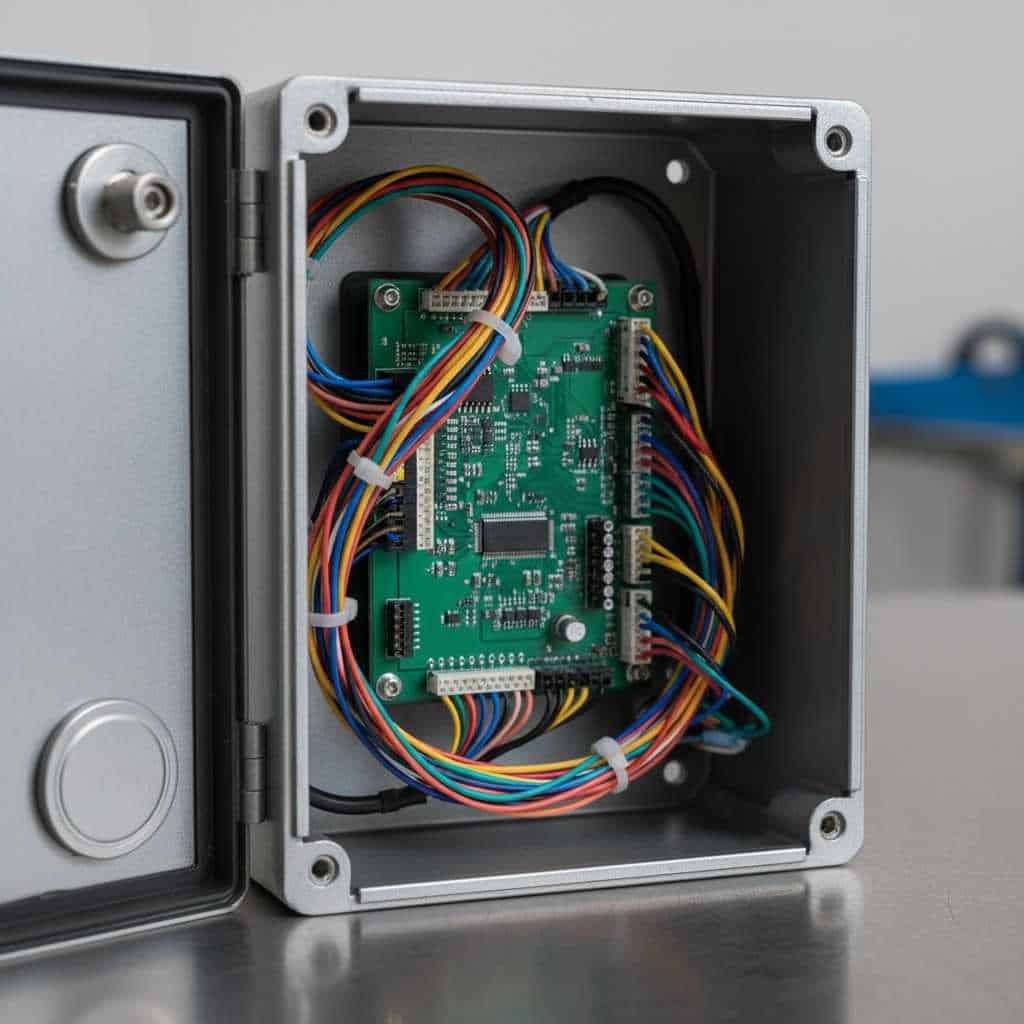
A PCBA box build involves the complete electromechanical assembly of a product, including the installation of boards into enclosures and the integration of internal wiring. This high-level assembly service ensures that all sub-components function as a single unit before leaving the factory. Ready for the good part?
- Integration of PCBAs into custom plastic or metal housings.
- Installation of sub-assemblies, sensors, and power supplies.
- Final testing to ensure full system functionality.
Is a turnkey box build right for you?
Choosing a turnkey provider allows you to consolidate your supply chain and reduce logistical headaches. You can move from individual Turnkey PCB Assembly to a finished product through one streamlined process.
- Simplifies inventory management for small to medium B2B firms.
- Ensures a single point of accountability for final quality.
Key Takeaway: A box build integration moves your project beyond the circuit board into a complete, integrated system ready for the end-user.
| Integration Feature | Component Level | System Level (Box Build) |
| Focus | Electrical Logic | Mechanical & Functional Logic |
| Testing | PCBA/ICT | Final Functional Testing |
| Logistics | Part Sourcing | Full Product Delivery |
By focusing on system-level integration, you ensure that mechanical tolerances and electrical connections align perfectly.
2. Why distinguish between cable assembly vs wire harness?
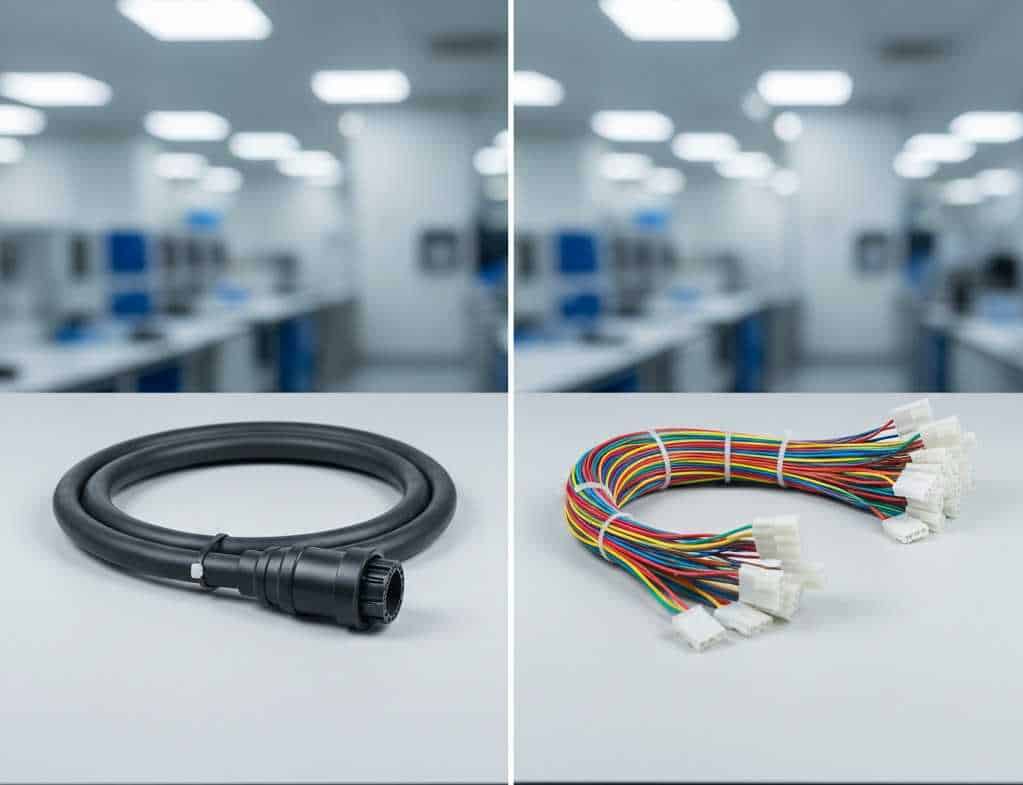
Understanding the difference in cable assembly vs wire harness is essential because they serve very different environmental and mechanical roles in your electronic product. While they both transmit power and data, their construction determines how well they survive in the field. But wait, there’s more.
- Cable assemblies feature a heavy-duty outer sheath for protection.
- Wire harnesses are simpler bundles used for internal space management.
- Choice impacts both the cost and the ruggedness of your final build.
How do they impact system reliability?
A well-designed cable assembly vs wire harness strategy prevents signal interference and mechanical wear. You must consider if your wires will be exposed to chemicals, moisture, or constant movement.
- Use cable assemblies for external connections or harsh environments.
- Use wire harnesses for internal, protected routing within the box.
Key Takeaway: Selecting the right interconnection method ensures that signals remain clear and connections stay physically secure throughout the product’s life.
| Feature | Wire Harness | Cable Assembly |
| Protection | Minimal (Tape/Ties) | Maximum (Extruded Jacket) |
| Environment | Internal/Protected | External/Harsh |
| Flexibility | Very High | Variable |
Properly identifying these needs during the design phase saves significant costs in future maintenance and returns.
3. How to optimize PCBA box build for cable assembly vs wire harness?
Optimizing your box build requires a clear plan for how internal wiring interacts with the mechanical enclosure and the PCBA itself. You need to ensure that the cable assembly vs wire harness choice fits the physical clearances of the housing. This is where it gets interesting.
- Design for easy routing to prevent wire pinching during enclosure sealing.
- Use standardized connectors to speed up the assembly process.
- Map out thermal zones to keep wires away from high-heat components.
Does internal layout affect assembly speed?
A clean internal layout drastically reduces the “touch time” per unit on the production line. By applying DFM (Design for Manufacturing) principles to your wiring, you improve consistency and lower labor costs.
- Prevents “rat’s nests” that make troubleshooting impossible.
- Simplifies the path for final functional testing probes.
Key Takeaway: Integrating wiring design with enclosure planning ensures a smooth assembly process and higher production yield.
| Optimization Factor | Benefit | Cost Impact |
| standardized Connectors | Faster Assembly | Lower Labor Cost |
| Routing Channels | Fewer Pinched Wires | Lower Defect Rate |
| Modular Wiring | Easier Repairs | Lower Lifecycle Cost |
Reducing the complexity of internal interconnections is a proven way to increase your overall assembly efficiency.
4. What are the manufacturing steps for cable assembly vs wire harness?
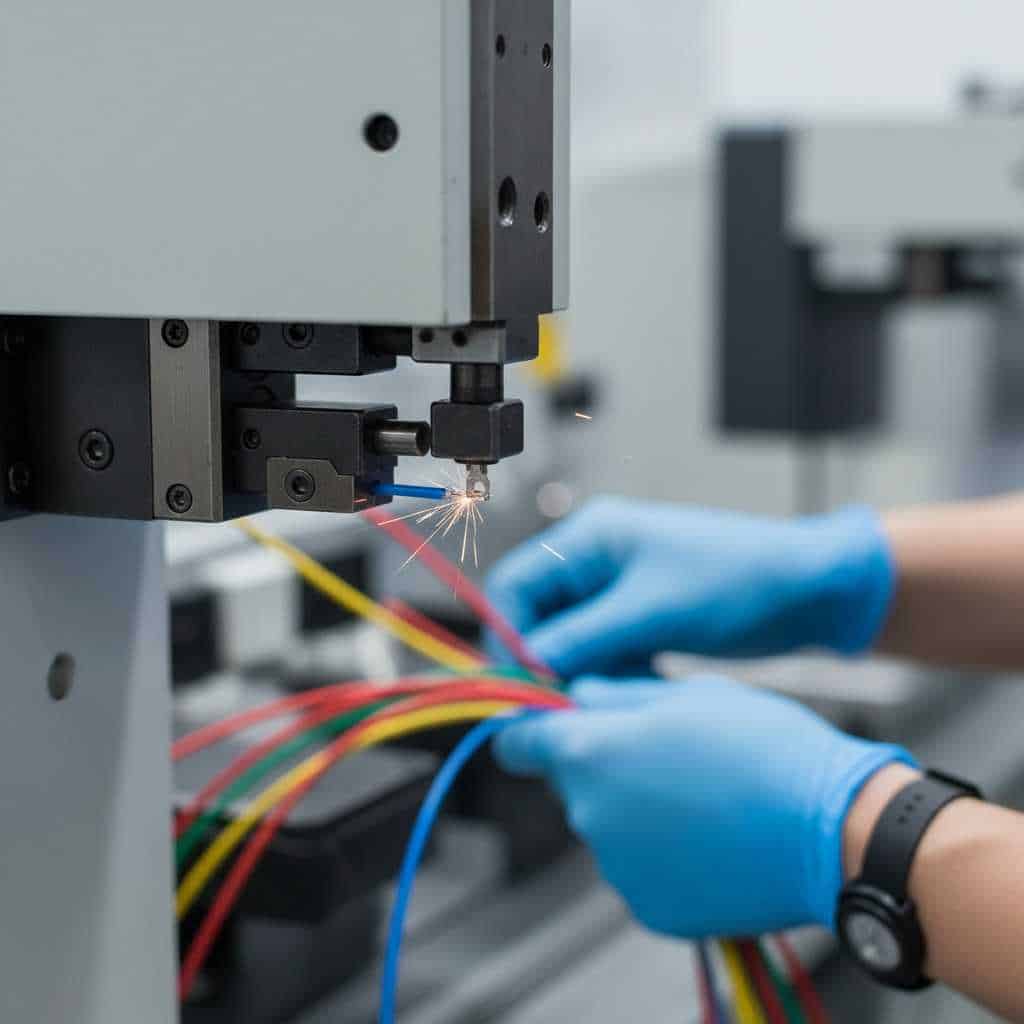
The manufacturing of a cable assembly vs wire harness involves different levels of labor and machinery, ranging from automated stripping to manual loom building. Each step is critical to ensuring the electrical integrity of the connection points. Ready for the good part?
- Automated cutting and stripping ensure consistent length.
- Precision crimping is vital for high-reliability connectors.
- Jacket extrusion provides the final protective layer for cables.
Why is crimp quality so critical?
A poor crimp can lead to high resistance or intermittent signal loss under vibration. We use specialized pull-force testing to ensure every terminal remains securely attached.
- Ensures gas-tight connections that resist oxidation.
- Prevents wire pull-out in high-vibration industrial settings.
Key Takeaway: Professional manufacturing of interconnections guarantees that your system’s “veins” won’t fail during critical operations.
| Process Step | Wire Harness | Cable Assembly |
| Terminal Crimping | Manual or Semi-Auto | High-Speed Automated |
| Bundling | Zip-ties/Spiral Wrap | Braiding or Extrusion |
| Testing | Continuity Check | Signal Integrity/IP Rating |
Consistent manufacturing processes translate to a product that performs exactly as intended in every environment.
5. When is a wire harness the better choice in cable assembly vs wire harness?
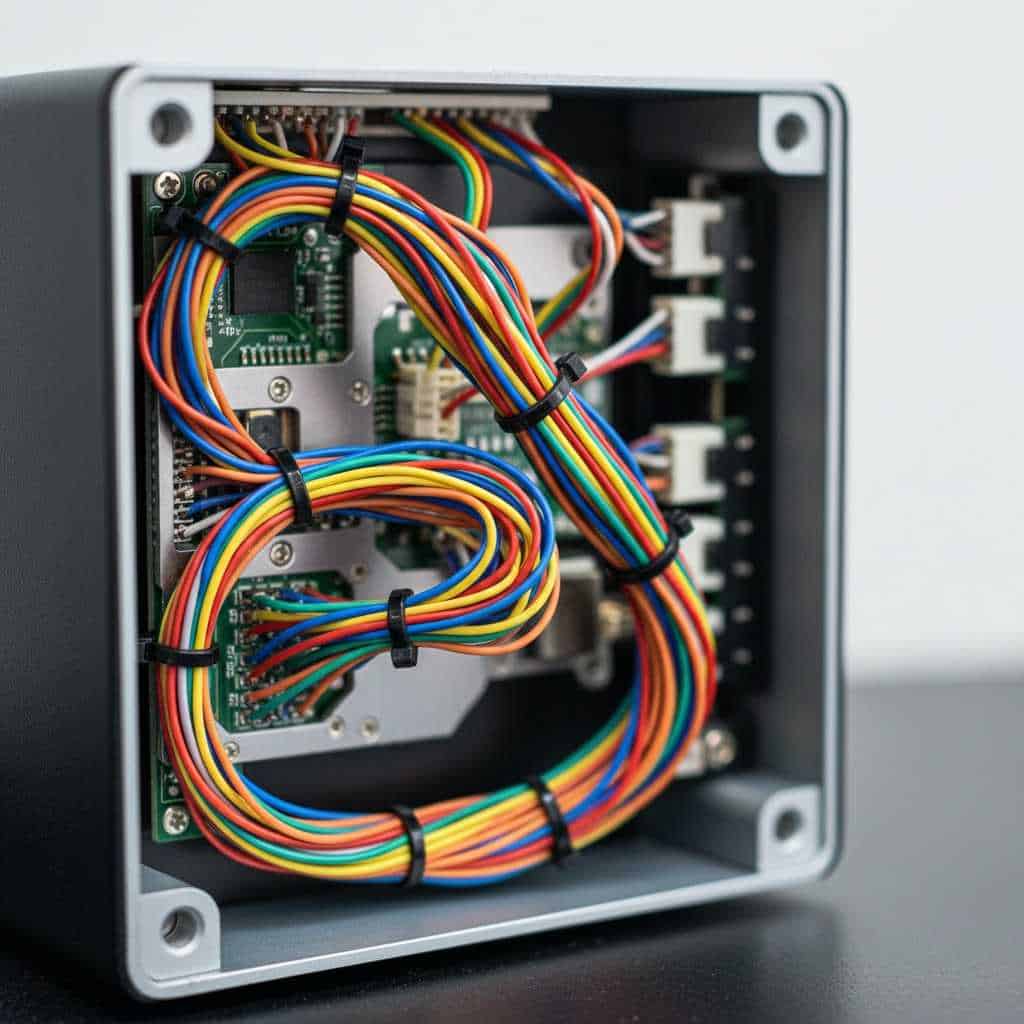
A wire harness is the better choice when internal space is limited and the wires are protected from external abrasion within a Box Build Assembly Service housing. Harnesses are significantly lighter and more flexible than full cable assemblies. Believe it or not, sometimes less is more when it comes to protection.
- Ideal for high-density electronic enclosures.
- Lower material cost compared to extruded cable jackets.
- Faster to install in tight, complex mechanical spaces.
Does flexibility matter for your layout?
Wire harnesses allow for tight bends and branching that full cables cannot handle. If you have multiple boards in a small chassis, a harness is your only viable path.
- Facilitates modular design where one harness connects multiple PCBAs.
- Reduces the overall weight of portable or aerospace electronics.
Key Takeaway: Use wire harnesses to optimize internal weight and space without paying for unnecessary environmental protection.
| Application | Best Solution | Why? |
| Internal PCBA Interconnect | Wire Harness | Space & Weight |
| Portable Devices | Wire Harness | Flexibility |
| Static Enclosures | Wire Harness | Cost Efficiency |
Selecting a harness for protected environments keeps your bill of materials lean while maintaining functional performance.
6. How to ruggedize the cable assembly vs wire harness?
Ruggedization involves adding shielding, strain relief, and specialized jacketing to the cable assembly vs wire harness to withstand extreme conditions. This is where your interconnection strategy meets the reality of the field environment. Wait, there’s more.
- Foil or braided shielding prevents electromagnetic interference (EMI).
- Overmolded strain reliefs protect connectors from physical pulling.
- Teflon or silicone jackets handle extreme temperature fluctuations.
Why is EMI shielding so important?
In industrial settings, external noise can corrupt sensitive data signals moving between your PCBA and the outside world. Rugged cable assemblies ensure your data remains clean.
- Essential for medical and high-speed data applications.
- Protects low-voltage signals from power line interference.
Key Takeaway: Investing in ruggedized interconnections prevents premature field failures and protects your brand’s reputation for quality.
| Ruggedization Type | Purpose | Environment |
| Overmolding | Strain Relief | High-Movement |
| Metal Braiding | EMI/RFI Shielding | Electrically Noisy |
| Heat Shrink | Moisture Seal | Outdoor/Wet |
Analysis of environmental stressors during the design phase ensures your interconnections don’t become the “weakest link.”
7. What testing is required for cable assembly vs wire harness?
Final validation for any cable assembly vs wire harness includes continuity, insulation resistance, and sometimes high-pot testing. These steps ensure that there are no hidden shorts or manufacturing defects before integration. Here is the deal.
- Continuity testing checks for correct pin-to-pin mapping.
- Insulation resistance ensures no leakage between wires.
- Hi-Pot testing validates the assembly’s safety at high voltages.
Is automated testing more reliable?
Using a “Cirris” or similar automated tester removes human error from the verification process. You get a digital “pass” record for every harnessintegrated into your box build.
- Catches intermittent connections caused by poor crimps.
- Validates complex branching logic in large harnesses.
Key Takeaway: Rigorous testing of interconnections is the only way to prevent “dead on arrival” units at the box build stage.
| Test Type | Failure Detected | Critical For |
| Continuity | Mis-wiring/Open Circuit | All Assemblies |
| Pull Test | Poor Crimp/Weak Joint | High-Vibration |
| Hi-Pot | Insulation Breakdown | Power Electronics |
Consistent testing protocols ensure that your interconnections are ready for years of trouble-free operation.
8. How does box build integration speed up time to market?
By consolidating PCBA, enclosure, and cable assembly vs wire harness sourcing into one factory, you eliminate multiple shipping legs and vendor coordination delays. This integrated approach allows for parallel processing of mechanical and electrical components. Ready for the good part?
- Final assembly happens immediately after the PCBA is tested.
- Mechanical issues are resolved in-house by the assembly team.
- Packaging and drop-shipping can be handled directly from the factory.
Can turnkey integration save you overhead?
Outsourcing the full integration allows your engineers to focus on next-generation designs rather than managing part numbers. You get a finished product in a box, ready for your customers.
- Reduces the need for an internal warehouse and assembly staff.
- Lowers total cost of ownership by optimizing the assembly workflow.
Key Takeaway: High-level integration services provide a “fast track” for B2B firms looking to scale production rapidly.
| Model | Coordination Effort | Time to Market |
| Fragmented (Multiple Vendors) | High | Slower |
| Turnkey Box Build | Low | Highly Optimized |
A unified assembly partner turns months of logistical coordination into a simple, recurring production schedule.
9. What are the common pitfalls in cable assembly vs wire harness design?
Common pitfalls include improper strain relief, mismatched wire gauges, and ignoring the “bend radius” of a cable assembly vs wire harness. These mistakes often go unnoticed until the product is in the field, leading to high warranty costs. The plot thickens.
- Undersized wire gauges can lead to overheating and fire risks.
- Lack of strain relief causes terminals to snap off under tension.
- Too many wires in a small bundle prevents proper heat dissipation.
How do you avoid “wire fatigue”?
Wires that undergo repeated bending will eventually work-harden and break if the material isn’t matched to the movement. You must choose high-flex stranded wire for any moving parts.
- Uses specialized “torsion-rated” cables for robotic applications.
- Implements protective sleeving to prevent abrasion against sharp edges.
Key Takeaway: Avoiding common wiring mistakes during the design phase prevents catastrophic field failures and costly redesigns.
| Design Mistake | Result | Solution |
| Sharp Bends | Wire Fatigue/Breakage | Follow Bend Radius Specs |
| No Labeling | Assembly Confusion | Color-Coding/Heat Shrink Labels |
| Poor Shielding | Signal Corruption | Proper EMI Grounding |
Identifying these risks early through engineering reviews ensures your integrated product is built for long-term durability.
10. How to choose a partner for PCBA box build and cable assembly vs wire harness?
Choosing a partner requires looking for a factory that has both high-precision SMT lines and a dedicated team for electromechanical assembly. You need a partner who can manage the transition from cable assembly vs wire harness manufacturing to final system integration. Here is the deal.
- Verify their capability to design custom assembly jigs.
- Check for certifications like ISO 9001 and UL for safety compliance.
- Ensure they offer comprehensive testing, including burn-in and functional validation.
Does your partner understand B2B needs?
At Queen EMS, we specialize in high-mix, medium-volume products that require a high degree of integration expertise. We act as an extension of your own factory. Ready for the good part?
- We provide clear DFM feedback to lower your unit costs.
- Our logistics team can manage full product fulfillment for you.
Key Takeaway: The right partner transforms your circuit design into a reliable, integrated, and professionally finished product.
| Selection Criteria | Importance | Impact |
| Vertical Integration | High | Lower Cost/Faster Speed |
| Quality Certifications | Critical | Legal Compliance |
| Engineering Support | High | Better Design/Lower Defects |
Partnering with a vertically integrated manufacturer is the most effective way to secure your product’s market success.

Conclusion
In summary, we have explored how successful electronic product integration relies on a strategic balance between PCBA quality, enclosure design, and the correct choice of cable assembly vs wire harness. While the circuit board is the “brain,” the interconnections and mechanical housing provide the protection and power required for real-world survival. You should know that integrated manufacturing is the only way to maintain the reliability and efficiency required in today’s competitive B2B landscape. If you are struggling with complex interconnections or enclosure integration, please contact us today to see how our turnkey solutions can stabilize your production. Our vision is to provide the seamless integration and engineering support your innovations need to thrive in the global market.
FAQ
Q1: Can I use a wire harness for outdoor applications? Generally, no. A wire harness lacks the protective outer jacket required for moisture and UV resistance; you should choose a fully jacketed cable assembly for any outdoor exposure.
Q2: What’s the best way to reduce the cost of my box build? Standardizing your internal interconnections and simplifying the enclosure’s mechanical assembly are the fastest ways to lower labor costs.
Q3: How do I know if I need a custom cable assembly? If your signals are sensitive to noise or your product faces extreme temperatures and movement, a custom assembly tailored to those stresses is essential.
Q4: Can a wire harness handle high power? Yes, but you must select the correct AWG (wire gauge) for the current load and ensure the bundle has enough air-flow to prevent heat buildup.
Q5: How long does a typical box build assembly take? It depends on the complexity of the internal wiring, but turnkey integration typically reduces the total production cycle by 2-3 weeks compared to using multiple vendors.