
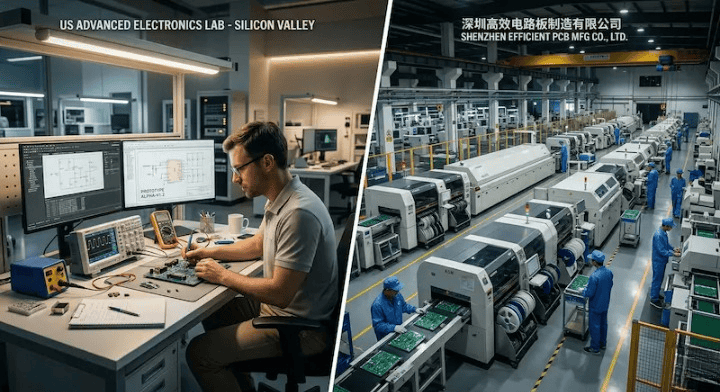
Quick Answer: Choosing between China vs USA PCB assembly comes down to balancing a 30-50% base cost advantage against trade tariffs and domestic security rules. Even with 2025 import tariffs of 25-35%, Chinese turnkey assembly often remains 15-25% cheaper for production runs over 100 units, while US domestic factories are the only legal option for ITAR-regulated or overnight defense projects.
Key takeaways:
- Chinese assembly base costs are typically 30-50% lower than US quotes.
- The 2025 Section 301 tariffs add 25-35% to the cost of imported finished PCBA.
- US factories deliver door-to-door in 5-10 days, while China air freight takes 12-18 days.
- English-only NDAs offer zero IP protection in China; you need a bilingual NNN agreement.
- How much cheaper is PCB assembly in China vs the USA?
- Why is China PCB assembly so much cheaper?
- Is Chinese PCB assembly quality as good as US?
- How do 2025 tariffs affect the China vs USA cost decision?
- What are the 5 situations where you must choose a US assembler?
- What are the 5 situations where China assembly still wins?
- How long does it actually take? China vs USA total lead time comparison
- How do I protect my IP when using a Chinese PCB factory?
- What’s the best hybrid strategy for 2025?
- FAQ
You are staring at two quotes for your new hardware run, wondering if the risk of China vs USA PCB assembly is worth the savings. The domestic shop wants $35 per board but promises it in 5 days, while the Shenzhen factory quoted $12 per board. But you worry about 2025 tariffs wiping out the savings, or facing a month of shipping delays. After processing over 2,400 turnkey orders last year, we see this exact dilemma daily. Here is the honest math on costs, shipping times, and legal protections to help you choose the right path.
How much cheaper is PCB assembly in China vs the USA?
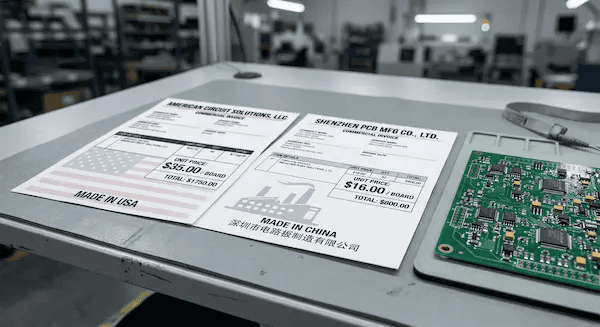
Chinese PCB assembly typically costs 30% to 50% less than US-based manufacturing before accounting for shipping and tariffs. For a standard 4-layer board with 150 components at a 500-unit volume, you might pay $35 per board in the US compared to just $16 per board in China.
But here’s what most guides won’t tell you…
The biggest cost gap isn’t just the per-board assembly fee. It hides in the setup charges. US factories often charge heavy NRE (Non-Recurring Engineering) and stencil fees just to start the machines. When calculating your true PCB Assembly Cost, you have to look at the whole invoice.
- Setup Fees: US shops charge $300-$800 for NRE; Chinese shops often charge $50-$150.
- Component Markup: Domestic suppliers mark up parts by 15-20%; overseas factories near the source mark up 5-8%.
- Bare Board Costs: Fabricating the raw PCB in the US costs roughly 3x more than in Asia.
| Feature | US Assembly | China Assembly | Winner |
|---|---|---|---|
| Setup/NRE Fees | $300 – $800 | $50 – $150 | China |
| Labor Cost per Hour | $25 – $40 | $4 – $8 | China |
| Component Costs | High (Imports + Markup) | Low (Local Sourcing) | China |
| Standard Lead Time | 5 – 10 Days | 12 – 18 Days (with Air) | US |
| IP Risk Profile | Low | Medium (Requires NDA) | US |
Why is China PCB assembly so much cheaper?
The PCB assembly cost difference stems from an integrated local supply chain where 80% of global electronic components are manufactured within a 100-mile radius of Shenzhen. This eliminates overseas component shipping costs and reduces raw material lead times by up to two weeks.
Here’s where it gets real…
It is not just about cheaper labor. The ecosystem builds efficiency. When a US factory needs a specific reel of capacitors, they wait for Digikey to ship it across the country. When a factory in Shenzhen needs that same reel, a courier drops it off on a scooter three hours later.
- Supply Chain Density: Fast access to passive components, custom enclosures, and raw FR4.
- Economy of Scale: Chinese SMT lines run 24/7 at massive volumes, lowering the machine-hour cost.
- Government Subsidies: Export tax rebates directly lower the final price offered to foreign buyers.
Is Chinese PCB assembly quality as good as US?
Chinese assembly quality matches US standards directly when the factory holds ISO 9001 and IPC-A-610 Class 2 or Class 3 certifications. The gap is no longer about geography, but about the specific quality control gates a facility enforces on the floor.
The real question is…
Do you know what happens after the boards leave the reflow oven? A cheap quote usually means someone skipped the testing phase. If a factory does not list their testing equipment, run away.
- We mandate 3D AOI (Automated Optical Inspection) on every single board.
- We use X-Ray inspection on every BGA joint before shipping.
- QueenEMS maintains a 99.7% first-pass yield rate by catching defects at the solder paste printing stage.
How do 2025 tariffs affect the China vs USA cost decision?
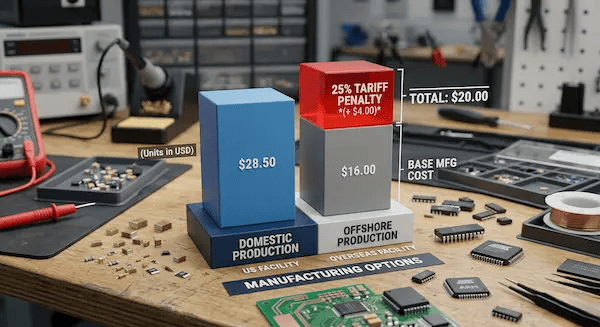
The 2025 Section 301 tariffs add a 25% to 35% tax on fully assembled PCBs imported from China into the US. This tax shrinks the historical 50% cost advantage down to a net savings of 15% to 25%, depending on the specific HTS code of your finished product.
So what does this actually mean for your budget?
You have to do the math on the landed cost, not just the quoted price. For complex multilayer boards, the base price in China is so low that even with a 35% penalty, it still beats domestic quotes. For very simple 2-layer boards in small volumes, the tariff might erase your savings entirely.
Table: 2025 Tariff Impact on a $10,000 PCB Assembly Order
| Metric | Scenario A (US Factory) | Scenario B (China Factory) |
|---|---|---|
| Base Manufacturing Quote | $14,500 | $10,000 |
| Shipping (Air Freight) | $100 (Local) | $800 |
| 2025 Tariff (Est. 25%) | $0 | $2,500 |
| Total Landed Cost | **$14,600** | $13,300 |
| Net Result | Faster delivery | Saves $1,300 (8.9% cheaper) |
What are the 5 situations where you must choose a US assembler?
You must use a US-based PCB assembler if your project involves ITAR compliance, Department of Defense contracts, requires extreme 24-hour physical turnarounds, demands in-person engineering collaboration, or uses highly restricted export-controlled components.
Want the honest answer?
We run a highly capable facility, but QueenEMS cannot process ITAR orders. If your hardware goes into a US military drone, the law strictly states your design data cannot leave US soil. Do not try to bend this rule.
- ITAR/DoD Contracts: Federal law requires domestic manufacturing and data storage.
- Overnight Prototyping: If you need a board spun and assembled in 24 hours, local is the only physical way.
- Secret IP R&D: When working on pre-patent tech where you need to stand next to the SMT machine.
- Heavy Government Grants: Some SBIR grants stipulate “Made in USA” requirements.
- Restricted Silicon: Certain high-end AI chips cannot legally be exported to China for assembly.
What are the 5 situations where China assembly still wins?
China assembly remains the superior choice for production volumes over 100 units, projects requiring full turnkey sourcing of hard-to-find Asian components, consumer electronics needing aggressive pricing, high-layer-count HDI boards, and scaling from prototype to mass production.
Now, here’s the part that surprises most customers…
When you scale up, the math shifts aggressively. Building 10 prototypes in Chicago makes sense. Building 5,000 IoT sensors there will bleed your startup dry. This is where full turnkey PCB assembly shines, as the factory handles everything from bare boards to plastics.
- Volume Production: Anything over 100-500 units hits massive economies of scale overseas.
- Turnkey Sourcing: Factories buy components direct from Asian manufacturers, skipping distributor markups.
- Complex HDI Boards: Up to 60-layer PCB fabrication capability exists in Shenzhen at a fraction of US prices.
- Labor-Heavy Assemblies: Projects requiring manual THT (Through-Hole) soldering or custom cable routing.
- Tight Hardware Budgets: When consumer retail pricing demands a strict $15 target BOM cost. (Check out our BOM Preparation Guide to optimize this).
How long does it actually take? China vs USA total lead time comparison
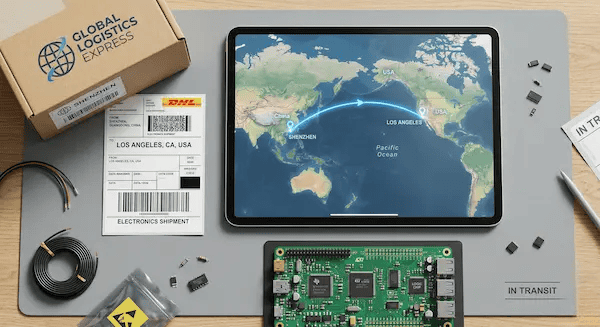
Total lead time for US assembly averages 5 to 10 days door-to-door, while Chinese assembly takes 12 to 18 days via air freight or up to 40 days via ocean freight. You must calculate production time plus customs clearance and physical transit to get the true schedule.
Here’s the thing…
Many buyers compare a US factory’s “5-day turn” quote directly against a Chinese factory’s “5-day turn” quote. They forget that the boards in China still have to cross an ocean.
- US Timeline: 5 days production + 2 days UPS Ground = 7 days to your desk.
- China Air Timeline: 5 days production + 2 days export customs + 3 days flight + 2 days import customs + 2 days local FedEx = 14 days to your desk.
- China Sea Timeline: 10 days production + 25 days on a boat + 5 days port clearance = 40 days.
How do I protect my IP when using a Chinese PCB factory?
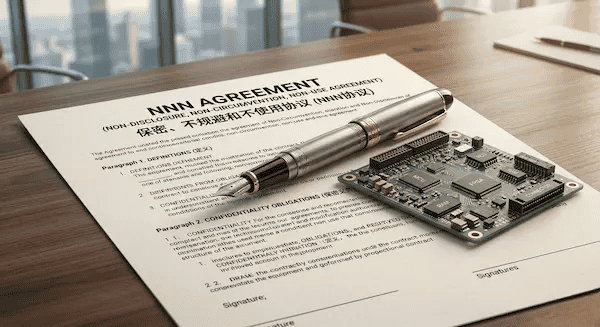
You protect your intellectual property in China by signing a bilingual NNN (Non-Disclosure, Non-Use, Non-Circumvention) agreement governed by Chinese commercial law, rather than a standard US-based NDA. An English-only NDA holds zero legal weight in a Chinese court.
Let’s face the facts…
We’ve had customers come to us after having their designs stolen by a previous supplier. The most common mistake: signing only an English-language NDA.
At QueenEMS, every customer gets a bilingual NDA enforceable under Chinese commercial law. We strictly isolate your Gerber files from our local component sourcing teams, meaning the people buying the parts never see the schematic.
We’ve processed 500+ orders under this system with zero IP disputes reported.
- Sign an NNN, not just an NDA.
- Ensure the contract names a specific Chinese city for legal jurisdiction.
- Only share exact files needed for quoting; withhold firmware code until final programming.
What’s the best hybrid strategy for 2025?
The optimal 2025 strategy is building your initial 5 to 10 prototypes domestically to squash bugs fast, then shifting the stabilized design to China for any run over 100 units. This hybrid approach gives you speed during R&D and margin during mass production.
It all comes down to this…
You do not have to pick just one region. Smart hardware teams evaluate Turnkey vs Consigned Assembly models and split their supply chain based on the product life cycle.
Table: The 2025 Scenario Decision Matrix
| Your Project Situation | Recommended Choice | Core Reason |
|---|---|---|
| V1 Prototype (Need to test ASAP) | US Local Factory | You save 10 days of shipping time to test your core concept. |
| Pilot Run (100 – 500 units) | China Turnkey | Break-even point hits; savings offset the shipping delays. |
| Mass Production (5000+ units) | China Turnkey | Massive cost reduction on components and labor scales beautifully. |
| ITAR or Defense Contract | US Local Factory | Legal requirement. Data cannot cross borders. |
| High Manual Labor (Through-hole) | China Assembly | Hourly labor rates of $5 vs $35 create huge margins. |
FAQ
Can a Chinese factory source exact US-brand components? Yes, but it depends on export restrictions. Factories can source authentic Texas Instruments or Analog Devices parts through authorized global distributors like Mouser or Digikey’s Asian branches. However, heavily restricted military-spec silicon cannot be exported to China. If you need standard components, let the factory handle the BOM. Upload your BOM for a free DFM check today.
Does the 2025 tariff apply to bare PCBs or only assembled boards? It applies to both, but often under different rates. Bare PCBs (unpopulated) have their own HTS codes, while fully assembled PCBA boards are classified differently. Generally, expect a 25% to 35% hit on fully assembled boards coming into US ports. Get a transparent quote within 24 hours to see your exact landed costs.
How do I know if my design is ITAR restricted? If your product is designed specifically for military, defense, or space applications, it likely falls under ITAR. If you are building a consumer smart home device, you are fine. If you hold a government contract, check the stipulations before sending any data overseas. Read our guide on preparing your PCB Assembly Quote Files to ensure you strip out unnecessary data before quoting.
If after reading this you decide your project is a fit for China vs USA PCB assembly—and you are ready to scale up—QueenEMS provides:
- Free DFM/DFA engineering review on every order
- Bilingual NNN agreements for total IP protection
- 100% 3D AOI + X-Ray testing
- Up to 60-layer PCB fabrication capability
Upload your Gerber files to https://www.queenems.com/turnkey-pcb-assembly/ to start your project, or visit QueenEMS to learn more.
Written by the QueenEMS Engineering Team